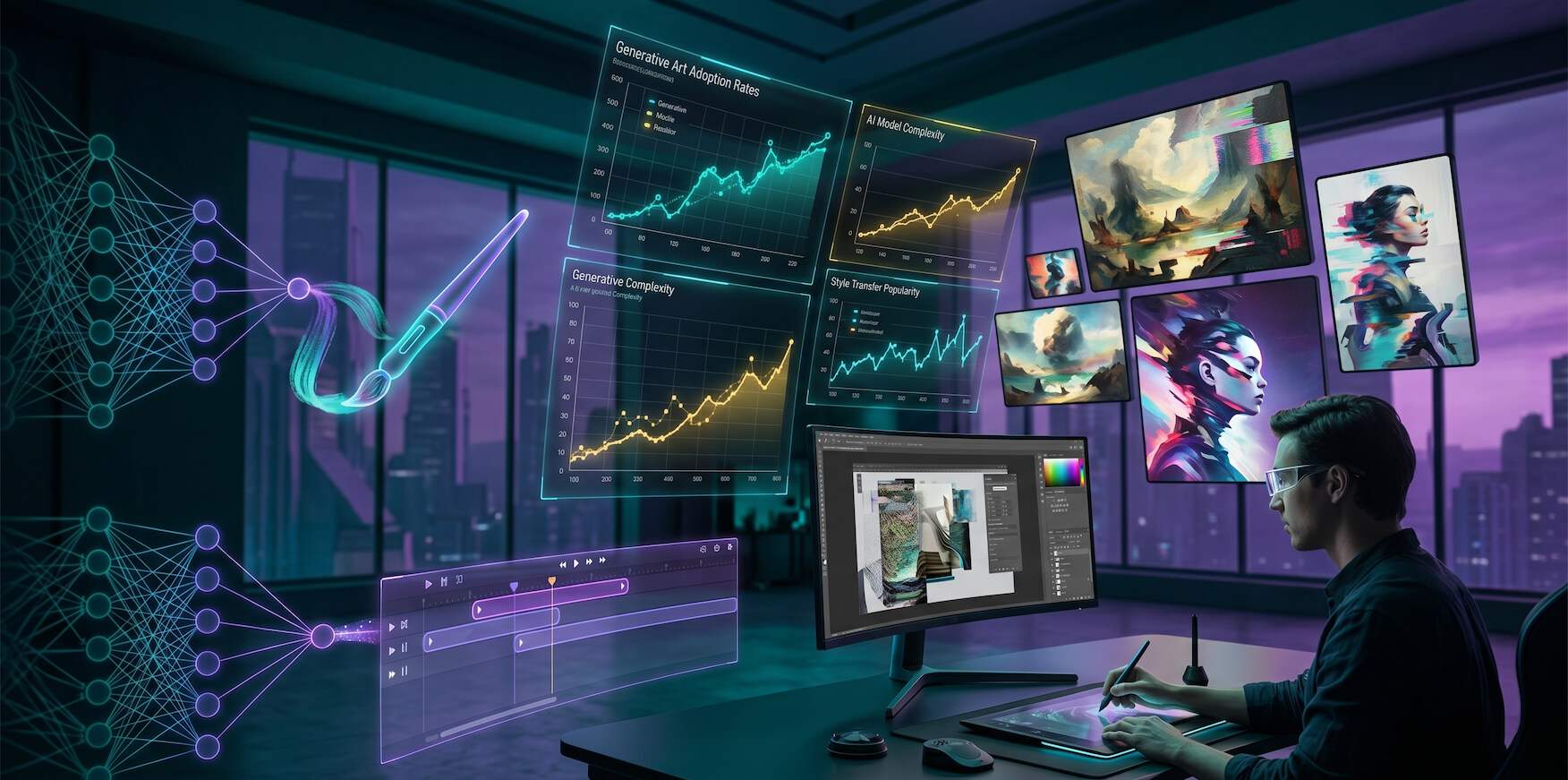
Every year since AI entered the creative mainstream, the pace of change has accelerated. Tools that felt experimental twelve months ago are now standard workflow components for professional artists. Capabilities that seemed years away have arrived ahead of schedule. And the implications — for how artists create, earn, build audiences, and define their careers — are shifting just as quickly.
Understanding where AI is heading matters enormously for artists who want to stay ahead of the curve rather than perpetually catching up to it. The trends shaping AI for creatives in 2026 aren't abstract technological developments — they are concrete, practical shifts that are actively changing what is possible for working artists right now and in the near future.
This guide covers every major AI trend relevant to artists in 2026 — what's driving each one, what it means practically for your creative work and career, and how to position yourself to benefit from it rather than be disrupted by it.
Why Tracking AI Trends Matters for Artists
The artists who have benefited most from AI over the past several years share a common characteristic: they engaged with emerging tools early, developed genuine expertise before those tools became mainstream, and were therefore positioned to use them more effectively than peers who waited for the dust to settle.
The gap between early adopters and late adopters of genuinely useful AI tools is meaningful — not just in workflow efficiency, but in audience building, commercial positioning, and the quality of creative output that AI-assisted workflows enable. Understanding which trends are real and which are noise is how you make smart decisions about where to invest your learning time and attention.
For a structured comparison of the specific tools driving many of these trends, the AI tools comparison guide for artists in 2026 provides side-by-side analysis of every major platform — an essential reference for artists building their AI creative stack around the trends that matter most to their practice.
Trend 1: Real-Time AI Generation Is Becoming the Standard
What's Happening
- A fundamental shift is underway in how artists interact with AI generation tools. The dominant paradigm of 2023 and 2024 — write a prompt, wait for a generation, evaluate the result, adjust the prompt, wait again — is being replaced by something dramatically more fluid and interactive.
- Real-time AI generation, pioneered by platforms like Krea AI, allows artists to work on a canvas while AI renders and re-renders the output continuously in response to every stroke, adjustment, and modification. The feedback loop that once took thirty to sixty seconds now takes milliseconds. The experience shifts from querying a tool to painting with one.
Why It Matters
- This transition fundamentally changes the nature of AI-assisted creative work. When AI generation is instantaneous and continuous, it stops feeling like a separate step in the workflow and starts feeling like a genuinely responsive creative medium — one with its own character and behavior that artists learn to work with intuitively, the same way they learn to work with watercolor or oil paint.
- The practical implication is that real-time generation tools lower the skill barrier for getting useful AI outputs significantly. You don't need to master prompt engineering — you sketch, you adjust, you see results immediately, and you steer based on what you observe. This makes AI genuinely accessible to artists who have found text-prompt interfaces frustrating or disconnected from their natural creative process.
What to Watch
- The next phase of real-time generation — currently in development at several major platforms — applies the same instantaneous feedback principle to three-dimensional modeling and animation, not just two-dimensional image generation. Artists sculpting or animating in real time with AI assistance updating continuously will represent another significant capability leap when it arrives at consumer scale.
Trend 2: Style Consistency Has Become Genuinely Reliable
What's Happening
- One of the most significant practical limitations of early AI image generation was the inability to maintain consistent visual identity across multiple generated images. Every output looked stylistically different from every other, making AI tools largely unusable for professional projects requiring visual coherence — illustrated book series, game asset libraries, character-driven narrative projects, brand identity work.
- In 2026, this limitation has been substantially resolved. Style Reference features in Midjourney v7, custom model fine-tuning in Leonardo.AI, and character consistency tools across multiple platforms now allow artists to generate hundreds of images that share a coherent visual language — consistent character design, color palette, lighting approach, and stylistic character.
Why It Matters
- Style consistency unlocks an entirely new category of professional AI application. Illustrators can now produce book series with coherent visual identity across every spread. Game artists can generate consistent asset libraries that feel unified rather than assembled from random outputs. Brand designers can create visual systems where every AI-generated element belongs unmistakably to the same aesthetic family.
- This trend has particular significance for artists who have developed distinctive visual styles over their careers. The ability to train AI on your own body of work and generate new outputs that carry your visual DNA — rather than outputs that look like generic AI art — is transformative for maintaining creative authorship while scaling production.
What to Watch
- Fine-tuning tools are becoming faster, cheaper, and more accessible. Training a custom AI model on your artwork — which eighteen months ago required technical expertise and significant computation cost — now takes minutes on consumer hardware through platforms like Leonardo.AI and Replicate. As this trend continues, personalized AI models trained on individual artists' work will become a standard professional tool rather than a specialist capability.
Trend 3: AI Animation Is Democratizing Motion for Visual Artists
What's Happening
- Animation has historically been the most technically demanding and resource-intensive creative discipline — requiring either years of specialized training, expensive software, large teams, or all three. In 2026, AI animation tools have collapsed that barrier to an almost shocking degree.
- Platforms like Runway ML, Pika Labs, Kling AI, and Luma Dream Machine allow artists to generate high-quality, cinematic video and animation from still images, text prompts, or short video clips — with no animation training required. The results, particularly for shorter sequences and single-subject animations, have reached a quality level that is genuinely impressive in professional contexts.
Why It Matters
- For visual artists, AI animation opens creative and commercial territory that was previously inaccessible without significant investment in either skills or collaboration. Illustrators can animate their finished pieces for social media, dramatically increasing engagement compared to static posts. Portrait artists can create moving portraits. Environment painters can bring their landscapes to life with weather, atmosphere, and subtle motion. Fine artists can create limited-edition animated versions of their work as a new product category.
- Commercially, animated content consistently outperforms static content on every major social platform — more views, more engagement, more algorithmic distribution. For artists building audiences in 2026, the ability to produce animated content independently is a meaningful competitive advantage.
- The best AI tools for artists in 2026 covers the leading animation platforms in detail — helping artists identify which tools best match their specific animation needs and creative style.
What to Watch
- The next frontier in AI animation is consistent character animation — generating multiple animated sequences featuring the same character with reliable visual consistency across scenes. This capability, currently available in limited early forms, will unlock long-form animated storytelling for individual artists without studio support when it matures to production quality.
Trend 4: AI Is Moving Deeper Into Professional Creative Software
What's Happening
- The early era of AI art tools was characterized by fragmentation — AI capabilities existed in standalone platforms separate from the professional software artists actually used every day. In 2026, that fragmentation is rapidly resolving as AI becomes natively embedded in the tools that define professional creative workflows.
- Adobe's Firefly integration across Photoshop, Illustrator, Premiere Pro, and After Effects represents the most mature example of this trend. Clip Studio Paint's native AI features for manga and illustration artists represent another. Davinci Resolve's AI-powered editing tools for video artists represent a third. The direction is clear: within the next two to three years, AI will be a native capability of every major professional creative application — not an optional add-on or a separate tool requiring a separate subscription.
Why It Matters
- Native integration removes the workflow friction that has been one of the genuine barriers to AI adoption for professional artists. When AI assistance is available in the same application you're already working in — with access to your existing assets, your established document structure, and your current project context — it becomes far more useful than an AI tool you have to export to, work in separately, and then import back from.
- For artists, this means the practical value of AI assistance will increase significantly as integration deepens — even without any improvement in the underlying AI capabilities themselves.
What to Watch
- The most interesting near-term development in this space is AI with full project context awareness — tools that understand not just the current canvas but your entire project history, your style preferences, your client's brand guidelines, and the specific constraints of the project you're working on. This contextually aware AI assistance, beginning to appear in early forms in 2026, will represent a qualitative leap in practical usefulness for professional creative work.
Trend 5: AI-Powered Personalization Is Reshaping Audience Building
What's Happening
- The way artists build and engage audiences is being transformed by AI-powered personalization — both in the tools artists use to create and distribute content, and in the platforms through which audiences discover creative work.
- On the creator side, AI tools now analyze which content performs best with your specific audience — which subjects, formats, posting times, and caption styles drive the most meaningful engagement — and use those insights to inform future content decisions. On the platform side, AI recommendation algorithms have become significantly more sophisticated at connecting audiences with artists whose aesthetic sensibility aligns with their demonstrated preferences — creating more meaningful discovery opportunities for artists with distinctive, consistent visual voices.
Why It Matters
- For artists, the practical implication of this trend is that having a clear, consistent aesthetic identity has become more algorithmically valuable than at any previous point in the social media era. AI recommendation systems reward specificity and consistency — they are very good at identifying artists with a clear visual language and connecting them with audiences likely to deeply appreciate that specific aesthetic.
- Artists who have historically tried to appeal to everyone by working across many styles and subjects are finding that AI-powered discovery platforms reward depth over breadth. Developing and consistently expressing a distinctive creative voice — something AI cannot do for you — has become a meaningful competitive advantage in an environment where distribution is increasingly algorithm-mediated.
What to Watch
- The emerging frontier is AI-powered direct collector matching — platforms that use AI to identify specific collectors, art buyers, and licensing clients whose aesthetic preferences and purchase history align with a specific artist's work, and facilitate direct connection between them. Several platforms are developing this capability, and it represents a potentially significant shift in how artists find commercial opportunities for their work.
Trend 6: AI Website and Portfolio Building Has Reached Maturity
What's Happening
- The first generation of AI website builders promised to make professional web presence accessible to non-technical users but largely delivered templated results that felt generic and impersonal. The current generation has matured significantly — producing genuinely sophisticated, individually tailored results that reflect the specific character of each artist's work rather than a one-size-fits-all aesthetic.
- In 2026, AI website builders understand the visual language of your portfolio, make intelligent layout and design decisions that serve your specific body of work, and produce results that look custom-designed rather than template-generated.
Why It Matters
- A professional portfolio website remains the single most important infrastructure investment an artist can make in their career — the destination that all other audience-building activity drives toward, and the platform that converts interest into commissions, sales, and opportunities. As AI website building has matured, the barrier between having a mediocre online presence and a genuinely professional one has essentially disappeared.
- RocketPages lets artists create a professional portfolio website using AI that showcases work with the sophistication and intentionality of a custom-designed site — without the cost, timeline, or technical complexity of custom development. For artists who have been putting off building a proper online presence, the tools available in 2026 remove every remaining excuse.
What to Watch
- The next evolution in AI portfolio building is dynamic, AI-curated presentation — portfolio sites that intelligently reorganize and present your work based on who is visiting, surfacing the most relevant pieces for a collector, a creative director, or a licensing agent based on behavioral signals. This kind of intelligent presentation, currently emerging in early forms, will make artist portfolios significantly more effective conversion tools.
Trend 7: Ethical AI and Consent-Based Training Is Gaining Ground
What's Happening
- The ethical debate around AI training data — particularly the use of artists' work without consent or compensation in training datasets — has moved from the margins to the center of the AI industry's agenda in 2026. Regulatory pressure, particularly from the EU's AI Act and emerging US legislation, combined with sustained advocacy from artist communities, has accelerated the development of consent-based training models and artist compensation frameworks.
- Several major platforms have introduced or committed to opt-in training systems, compensation pools for artists whose work is included in training datasets, and tools that allow artists to opt their work out of AI training entirely. Tools like Glaze and Nightshade, which allow artists to add subtle perturbations to their online work that disrupt AI training scrapers without affecting human perception, have seen widespread adoption among artists who want to protect their visual identity from unauthorized AI use.
Why It Matters
- For artists navigating AI adoption in 2026, this trend has two practical implications. First, the ethical landscape is genuinely improving — artists who were rightfully concerned about training data practices have more tools and legal protections available to them than at any previous point. Second, the distinction between AI tools that respect artist rights and those that don't is becoming clearer and more commercially significant — artists and consumers increasingly prefer platforms with ethical training practices, and the market is responding.
- Understanding which tools operate with ethical training practices is an increasingly important part of making informed decisions about which AI platforms to incorporate into your workflow.
What to Watch
- The emerging artist compensation ecosystem — where AI platforms pay into pools distributed to artists based on how much their work contributed to training specific models — is developing rapidly. Several major platforms have committed to compensation frameworks, and as these mature, artists who have built significant bodies of distinctive work may find that AI platforms represent an additional revenue stream rather than just a threat.
Trend 8: AI Productivity Tools Are Becoming Essential for Creative Business
What's Happening
- Beyond creative production, AI has become deeply integrated into the business operations of successful independent artists — handling client communication, project management, financial tracking, content scheduling, SEO optimization, and email marketing with a sophistication and automation level that would have required a dedicated business manager just a few years ago.
- This trend is accelerating as AI business tools become more connected — sharing data and context across platforms to create genuinely integrated business management systems rather than isolated point solutions.
Why It Matters
- The artists seeing the most significant career growth in 2026 are consistently those who have systematized the business side of their practice using AI tools — freeing creative energy for actual art-making while ensuring the infrastructure of their career continues operating consistently and professionally.
- The AI tools for productivity for artists in 2026 guide maps the full landscape of these business and productivity tools — an essential resource for artists who want to build the operational infrastructure that supports sustainable creative careers.
- For artists newer to this dimension of AI adoption, the AI tools for beginners guide for artists provides an accessible entry point — covering both creative and business AI tools in plain language without requiring prior technical experience.
What to Watch
- The most significant near-term development in AI productivity for artists is fully integrated creative business management — AI systems that connect your creative production workflow, your client management, your financial tracking, and your audience development into a single coherent system with shared context and automated coordination between components. The building blocks of this integration exist in 2026; the seamless connection between them is what's coming next.
Trend 9: AI Is Enabling New Art Forms and Revenue Models
What's Happening
- Beyond assisting with existing creative practices, AI is enabling entirely new art forms and commercial models that simply didn't exist before. Generative art — work where the artist defines a system, algorithm, or set of parameters that produces outputs — has a long history, but AI has expanded its expressive range and accessibility dramatically. Interactive AI art installations, where audience input directly shapes AI-generated outputs in real time, are appearing in major gallery contexts. AI-generated limited editions, where each print in a series is uniquely generated by an artist-designed AI system, are emerging as a new collectible category.
Why It Matters
- For artists willing to engage creatively with AI as a medium rather than just a tool, entirely new creative territories are available. The artists exploring these territories in 2026 are building practices that have no direct historical precedent — and therefore no established competition. The commercial models emerging around interactive AI art, generative limited editions, and AI-assisted creative experiences are still being invented, which means early entrants have significant first-mover advantages.
What to Watch
- AI art as experience — installations, performances, and interactive works where AI generation is central to the audience's engagement — is moving rapidly from experimental contexts into mainstream gallery and commercial spaces. Artists developing expertise in this area now are positioning themselves for opportunities that will be substantially larger within the next two to three years.
Trend 10: The Human Creative Voice Has Never Been More Valuable
What's Happening
- Perhaps the most important trend in AI for artists in 2026 is a cultural and commercial one rather than a technological one: as AI-generated content has proliferated across every platform and medium, distinctively human creative voices — work that carries unmistakable evidence of personal experience, emotional depth, and individual perspective — have become more valued, not less.
- The market has developed a sophisticated ability to recognize and respond to the difference between AI-generated content and work that AI assisted but human creativity fundamentally drove. Collectors, creative directors, and audiences are making increasingly deliberate choices to seek out and support human creative voices — partly as a reaction to the volume of generic AI content, and partly because the emotional and cultural value of human creative expression has become more apparent by contrast.
Why It Matters
- This trend directly contradicts the most common fear about AI and art — that it would commoditize creative work and eliminate the market for human-made art. What is actually happening is more nuanced: AI has commoditized generic creative output, while simultaneously increasing the premium placed on distinctive, personally expressive human creative work.
- For artists, the strategic implication is clear: the most important investment you can make in your career in 2026 is in the depth, distinctiveness, and authenticity of your creative voice — the one thing AI cannot replicate. The best AI tools for artists in 2026 exist to support that voice, not replace it. And the free AI tools available to artists in 2026 mean that accessing this support has never required a significant financial investment.
Positioning Yourself for What's Coming
The ten trends in this guide point toward a consistent conclusion: AI in 2026 rewards artists who engage with it thoughtfully, build genuine expertise in the tools relevant to their practice, maintain a clear and distinctive creative voice, and construct the professional infrastructure — portfolio, audience, business systems — that allows their work to reach and serve the right people.
The artists who will look back on 2026 as a pivotal year in their careers are the ones making deliberate choices right now about which AI capabilities to develop, which tools to invest in learning, and how to position their creative practice in a landscape where AI is a given rather than a novelty.
The trends are clear. The tools are available. The question is simply how intentionally you engage with them.
Ready to see exactly how today's leading AI tools stack up against each other? The AI tools comparison guide for artists in 2026 gives you the structured, honest evaluation you need to build the right AI creative stack for where your practice is going — not just where it's been.