
April 13, 2026
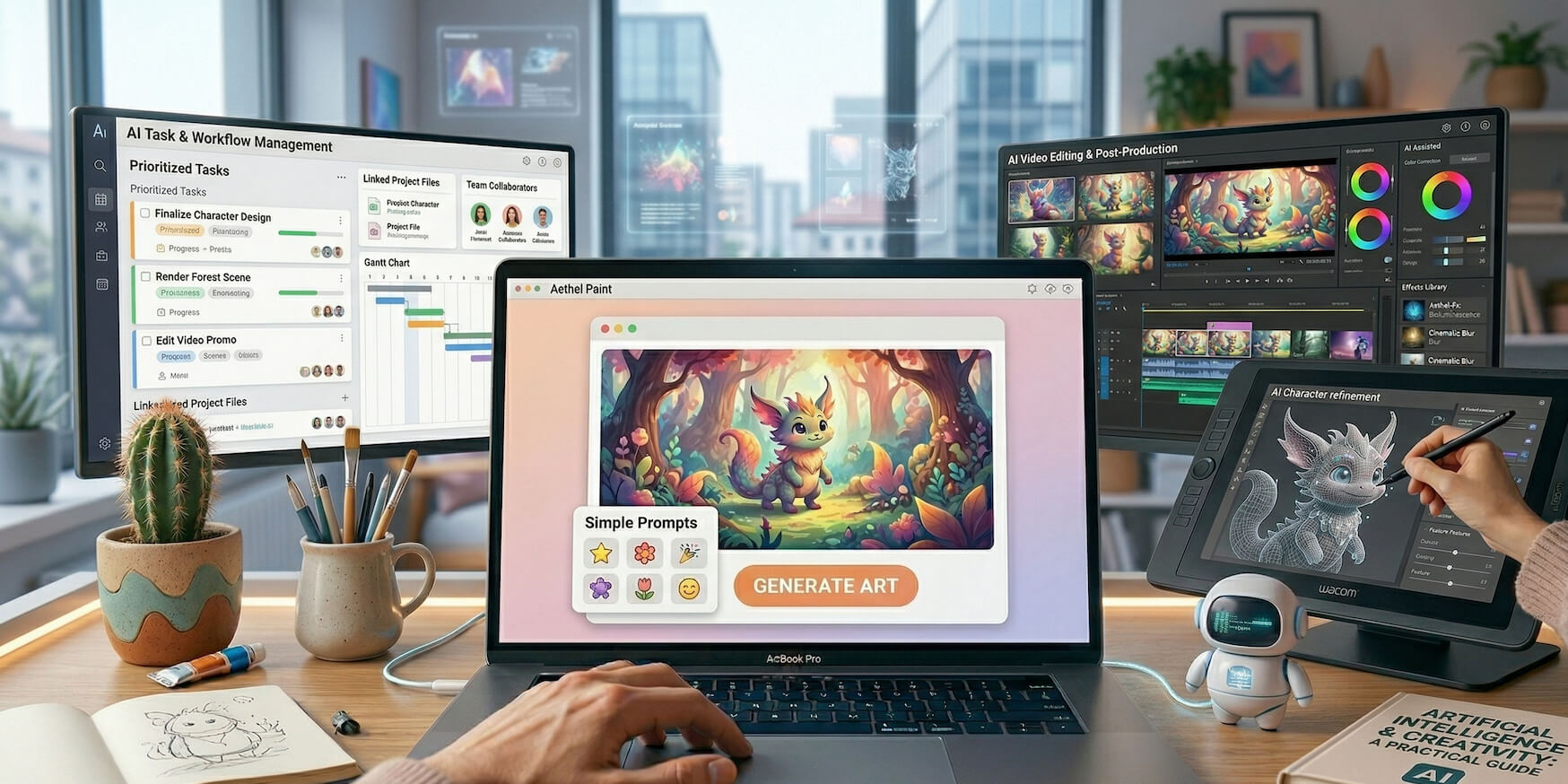
In 2026, productivity for artists is no longer defined by how many hours you spend working, but by how effectively you are able to use those hours. The creative process has always involved a mix of inspiration, execution, and refinement—but a significant portion of time is often consumed by repetitive tasks, planning, and technical work rather than actual creativity.
Artificial Intelligence is fundamentally changing this balance.
Instead of spending hours on repetitive edits, organizing files, or struggling to move from idea to execution, artists can now rely on AI tools to streamline these processes. This allows them to redirect their time and energy toward creative thinking, experimentation, and producing meaningful work.
With the right tools, artists can:
As a result, productivity becomes less about working harder and more about building an efficient creative system that supports your artistic process.
To understand the value of AI in productivity, it’s important to recognize where artists typically lose time.
Creative work is not just about creating—it also involves preparation, iteration, and management. These supporting tasks often consume more time than the creative act itself.
Artists frequently spend hours making small adjustments such as correcting colors, refining layouts, removing backgrounds, or aligning elements. While these tasks are necessary, they do not contribute directly to creativity and can quickly become exhausting.
AI tools reduce this burden by automating many of these repetitive actions, allowing artists to achieve similar results in a fraction of the time.
Creative blocks are a natural part of the artistic process, but they can significantly slow down productivity. Many artists spend long periods trying to decide what to create rather than actually creating.
AI tools help by generating prompts, concepts, and variations, ensuring that there is always a starting point available.
As artists take on more work, managing files, ideas, and deadlines becomes increasingly complex. Without proper organization, this can lead to confusion, lost time, and reduced efficiency.
AI-powered productivity tools help structure workflows, track tasks, and keep everything organized in one place.
Modern artists rarely work in a single medium. They often create visuals, videos, social media content, and presentations. Switching between different tools and workflows can be time-consuming and mentally draining.
AI tools simplify this process by reducing the need for multiple complex tools and enabling smoother transitions between tasks.
Overall, productivity AI allows artists to reduce friction across their entire workflow, making the creative process more fluid and efficient.
ChatGPT plays a central role in improving productivity because it supports multiple stages of the creative process rather than focusing on a single task. It acts as a flexible assistant that can adapt to different needs, whether you are brainstorming ideas, planning projects, or refining concepts.
One of the biggest challenges artists face is moving from a vague idea to a clear direction. ChatGPT helps bridge this gap by transforming abstract thoughts into structured concepts.
For example, instead of struggling to decide what to create, an artist can describe a general theme or mood and receive multiple detailed ideas that can be explored further.
ChatGPT helps artists take an initial concept and expand it into a fully developed idea by suggesting variations, themes, and directions.
Large creative projects can feel overwhelming when they are not clearly structured. ChatGPT can break them down into smaller, manageable steps, making it easier to execute them efficiently.
Artists often need to write descriptions, captions, or scripts alongside their work. ChatGPT simplifies this process by generating content quickly, allowing artists to maintain consistency without spending excessive time writing.
An artist working on a creative project can use ChatGPT to:
This approach ensures that the creative process begins with clarity rather than uncertainty.
Midjourney significantly improves productivity by reducing the time required to move from an idea to a visual output. Traditional workflows often involve sketching, refining, and iterating manually, which can be time-intensive.
Midjourney compresses this entire process into a much shorter timeframe.
Instead of spending hours developing a single concept, artists can generate multiple interpretations of an idea within minutes. This allows them to evaluate different directions quickly and choose the most effective one.
Artists can immediately see how an idea translates visually, which speeds up decision-making and reduces uncertainty.
By modifying prompts, artists can generate variations of the same concept without starting over, making refinement faster and more efficient.
Artists can experiment with different artistic styles without needing to recreate the work from scratch each time.
A concept artist working on a project can:
This dramatically reduces the time required for early-stage creative development.
While many AI tools focus on idea generation or artistic creation, Canva plays a crucial role in the execution phase. It helps artists transform their work into polished, presentable formats quickly and efficiently.
Artists often need to present their work in different formats, such as social media posts, portfolios, or marketing materials. Creating these manually can be time-consuming, especially when dealing with layout and formatting.
Canva simplifies this process through its intuitive interface and built-in templates.
The drag-and-drop system allows artists to create professional designs without needing advanced design skills.
Templates eliminate the need to design layouts from scratch, enabling faster content creation.
Canva’s AI features help generate visuals and improve designs automatically, reducing manual effort.
An artist can take a piece of artwork and quickly convert it into:
This ensures that their work is not only created efficiently but also presented effectively.
Runway ML addresses one of the most time-intensive areas of creative work: video editing. Traditional video editing requires technical knowledge and significant time investment.
Runway reduces this complexity by automating many of the processes involved.
Instead of manually editing frames or applying effects, artists can use AI to perform these tasks automatically, allowing them to focus on storytelling and creative direction.
A creator can upload a video, apply AI-based edits, and produce a polished output in a fraction of the time required by traditional tools.
This makes video creation more accessible and efficient.
Productivity is not only about creating faster—it is also about staying organized and maintaining consistency. Notion AI helps artists manage their workflows, ideas, and projects in a structured way.
Without proper organization, creative work can become scattered, leading to inefficiency and missed opportunities. Notion AI provides a centralized system where everything can be managed effectively.
All ideas, tasks, and projects are stored in one place, making them easy to access and manage.
Notion AI helps generate plans, summaries, and structured workflows, reducing the effort required to organize projects.
Artists can monitor their progress and stay consistent with their work.
An artist can use Notion AI to:
This ensures that productivity is maintained over time.
While AI tools can significantly improve efficiency, productivity alone does not guarantee success.
Artists may find themselves creating more work in less time, but without proper visibility, their work may not reach the right audience.
To grow, artists must also focus on:
Successful artists in 2026 are not just using AI tools—they are combining them with visibility strategies.
For example, many creators explore: why RocketPages is the best AI website builder
They also: create a portfolio website using AI
This allows them to present their work professionally and reach a wider audience.
The most effective approach is to use multiple tools together, each serving a specific purpose:
This creates a complete system that supports every stage of the creative process.
While AI tools can significantly improve efficiency, they should not replace the artist’s creative input.
The goal is not to produce more work at any cost, but to create meaningful work more efficiently.
AI should be used to:
AI tools are redefining productivity for artists by removing many of the barriers that traditionally slowed down the creative process.
Artists who embrace these tools thoughtfully are able to:
However, the real advantage comes from combining productivity with visibility and creative intent.
That is how modern artists in 2026 are able to create more, grow faster, and stand out in an increasingly competitive creative landscape.
Stay up to date with the latest tips, expert insights, product reviews, and step-by-step guides to help you grow, create, and succeed—no matter your industry or passion.