
April 13, 2026
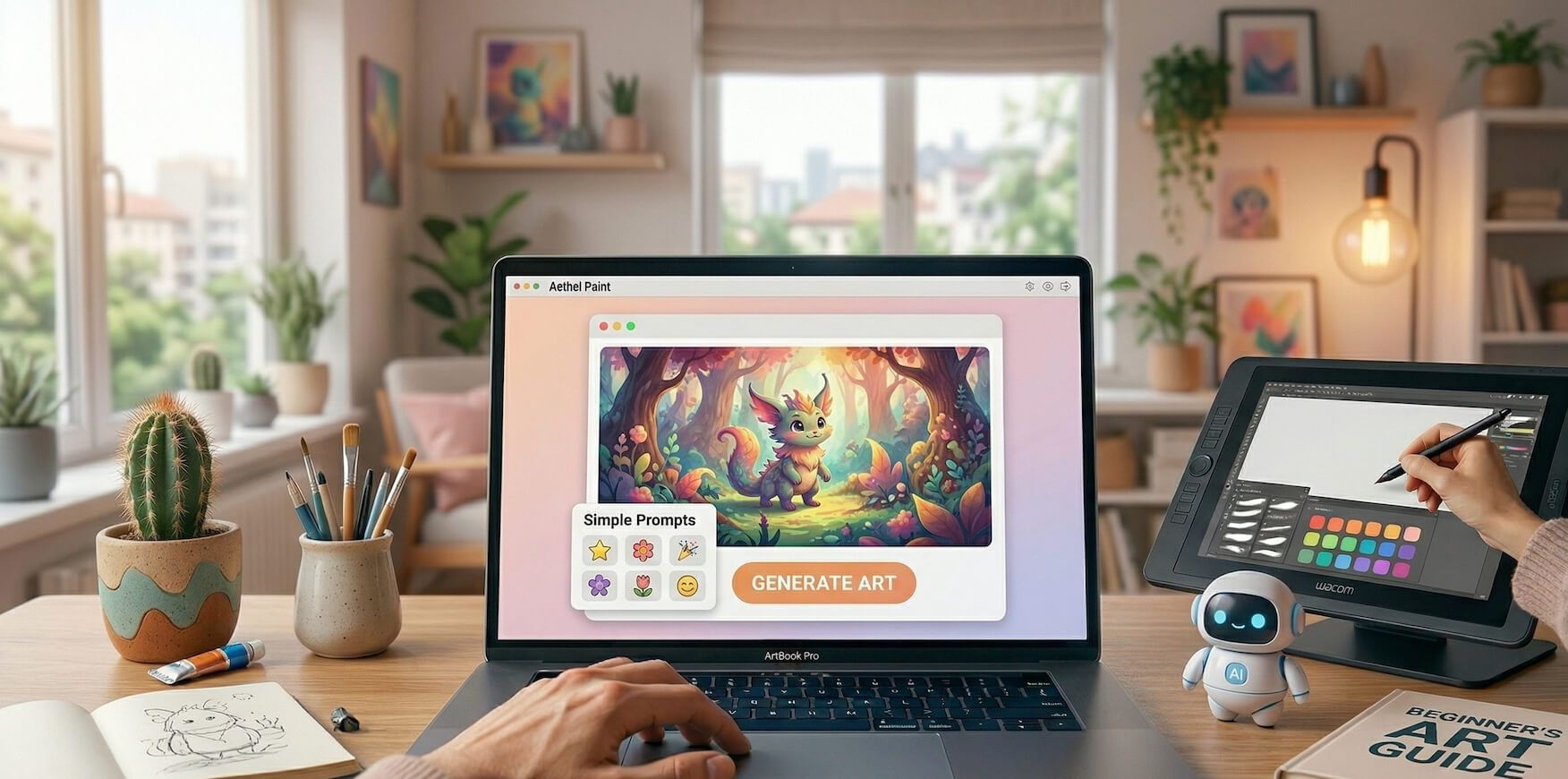
Starting your journey as an artist in 2026 is no longer limited by skill level, expensive tools, or years of practice.
For the first time, technology has reached a point where anyone with an idea can turn it into visual, audio, or multimedia content within minutes. Artificial Intelligence is at the center of this transformation, enabling beginners to skip many traditional barriers and start creating immediately.
Today, even if you have never drawn, designed, or edited before, you can:
However, while this sounds exciting, beginners often face a different kind of challenge: The overwhelming number of AI tools, each with different interfaces, features, and learning curves.
Many beginners get stuck not because they lack creativity—but because they don’t know where to start or which tool to use first.
This guide solves that problem by breaking down the most beginner-friendly AI tools, explaining not just what they do—but how they fit into your creative journey step by step.
The biggest advantage beginners have in 2026 is not just access to tools—it’s how those tools accelerate learning.
In traditional art learning, progress is often slow because:
AI completely changes this process.
Instead of imagining what something might look like, you can generate it instantly. This helps you visually understand concepts like composition, color, and style.
You can test multiple ideas quickly:
This builds intuition much faster than manual practice alone.
Beginners naturally improve by:
This creates a continuous feedback loop where learning happens through doing—not theory.
You don’t need:
This makes AI the fastest entry point into creative fields today.
Not all AI tools are designed with beginners in mind. Some are powerful but complex, while others are simplified for accessibility.
Understanding what makes a tool beginner-friendly helps you avoid frustration early on.
A beginner should be able to open the tool and understand:
If a tool requires tutorials just to start, it slows down learning.
Beginner-friendly tools avoid:
Web-based tools are usually best for beginners.
Fast outputs are critical because they:
Good beginner tools often include:
These act as training wheels while you learn.
Beginners need time to explore, so tools with:
are ideal for learning without pressure.
Canva is widely considered the easiest entry point into digital creativity because it removes almost all technical complexity.
Unlike traditional design software that requires understanding layers, tools, and layouts, Canva simplifies everything into a visual drag-and-drop system.
This allows beginners to focus on design thinking instead of technical execution.
You can move elements freely without worrying about alignment tools or technical settings.
Canva’s AI helps with:
Templates act as learning tools by showing:
A beginner creating Instagram content can:
This entire process can be completed in under 15 minutes.
DALL·E transforms imagination into visuals using natural language, making it one of the most beginner-accessible AI tools.
Instead of drawing or designing manually, you:
This shifts creativity from execution to conceptual thinking.
A beginner can:
Over time, this improves both creativity and visual understanding.
Leonardo AI sits between beginner simplicity and advanced capability, making it perfect for learning artistic styles.
It allows users to explore:
Beginners can compare outputs to understand:
A user can generate:
This builds visual awareness quickly.
Runway ML simplifies video editing by automating complex tasks that usually require professional software.
Video editing traditionally requires:
Runway removes much of this complexity.
A beginner can:
This enables beginners to enter video creation quickly.
ChatGPT plays a foundational role in creativity by helping beginners develop ideas, structure projects, and overcome creative blocks.
Most beginners struggle with:
ChatGPT solves these problems.
A beginner can:
This creates a complete creative workflow.
Many beginners assume that creating good work is enough.
It’s not.
Without visibility:
Successful beginners combine:
AI tools for producing work
Websites for showcasing work
For example, many beginners now: create a website instantly using AI
They also follow step-by-step methods to: build a website in minutes with AI
This allows them to:
The best strategy is progressive learning:
This builds skills step by step.
AI does not replace creativity—it amplifies it.
You still need to:
The best artists use AI as a creative partner.
AI has made creativity more accessible than ever.
For beginners, this means:
But true success comes from combining:
Creativity + AI tools + visibility
That’s how beginners in 2026 turn into successful creators.
Stay up to date with the latest tips, expert insights, product reviews, and step-by-step guides to help you grow, create, and succeed—no matter your industry or passion.