
April 13, 2026
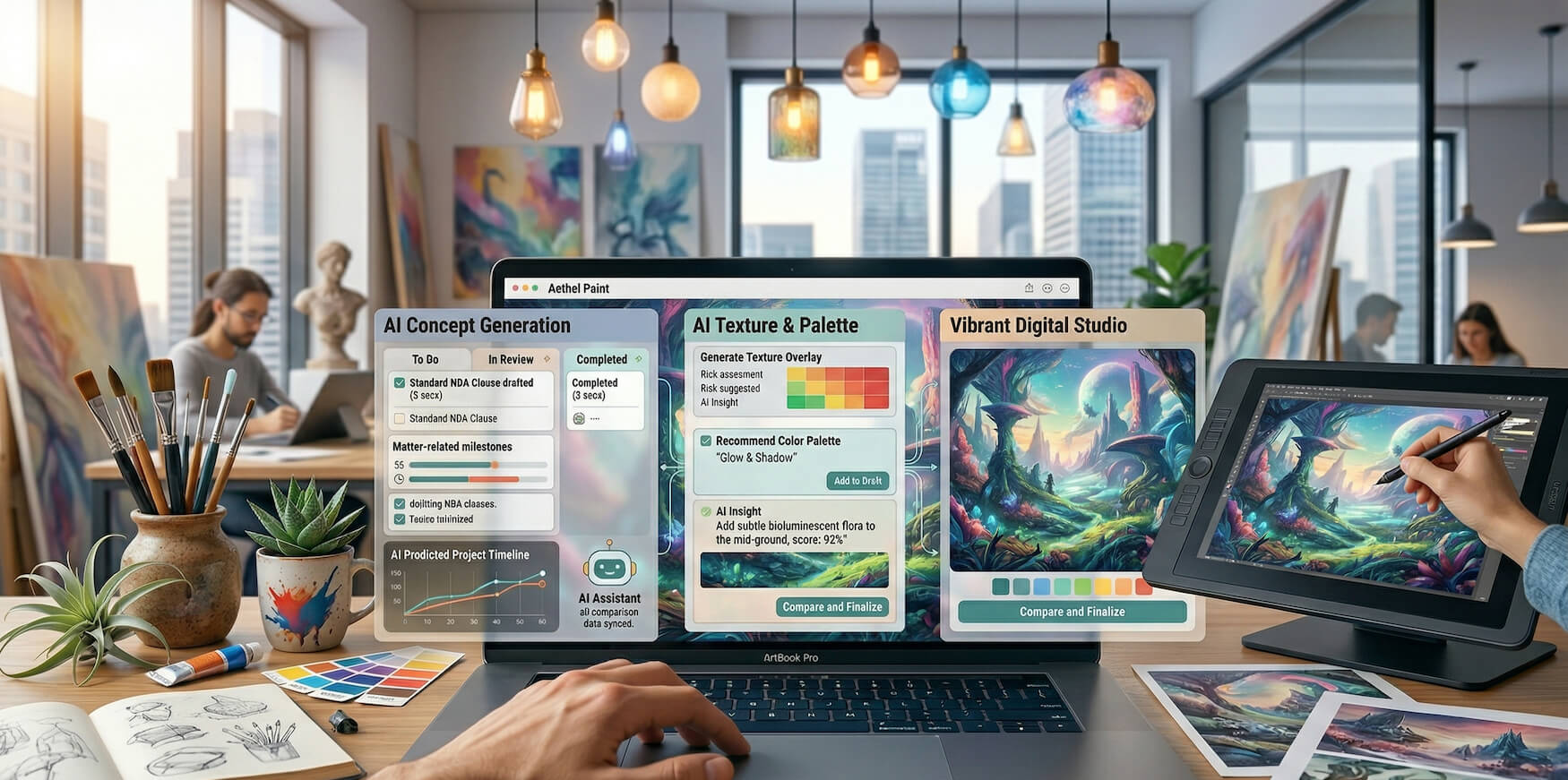
The creative industry in 2026 is undergoing a structural transformation that is fundamentally changing how art is conceived, produced, and distributed.
Artificial intelligence is no longer a supplementary tool—it has become an integrated layer within modern creative workflows used by digital artists, illustrators, designers, animators, filmmakers, and musicians.
Across all creative disciplines, AI systems are now being used to:
However, the rapid expansion of AI tools has also created confusion in the creative ecosystem.
Artists are now faced with an overwhelming number of platforms, each claiming to improve creativity—but only a few genuinely integrate into professional workflows effectively.
This guide provides a deep, structured, and practical breakdown of the most impactful AI tools for artists in 2026, focusing not just on features, but on how they function inside real creative pipelines.
AI is not simply accelerating art production—it is redefining the structure of creative development itself.
Traditionally, artistic workflows were linear and time-intensive:
Idea generation → sketching → refinement → final execution
In modern AI-assisted workflows, this process has evolved into a more dynamic and iterative system:
Idea formulation → AI-generated exploration → rapid variation cycles → human artistic selection → refinement → final production
This shift has created an entirely new creative paradigm where:
AI contributes to the creative process across multiple layers:
AI systems allow artists to move beyond blank-page paralysis by instantly generating conceptual starting points. Instead of beginning from nothing, artists can now explore multiple interpretations of an idea and choose the strongest direction to develop further.
Artists are able to test a wide range of styles—including lighting, composition, texture, and thematic direction—without manually redrawing or redesigning each variation. This enables rapid experimentation that was previously time-consuming or technically expensive.
Tasks such as rendering, background generation, visual cleanup, audio composition, and video editing can now be partially or fully automated, allowing artists to focus on creative decision-making instead of repetitive production work.
AI introduces unexpected visual or conceptual outputs that can serve as inspiration triggers. These outputs often push artists into directions they may not have considered, expanding creative boundaries rather than limiting them.
Midjourney is widely recognized as one of the most advanced AI systems for generating highly detailed, stylistically rich visual compositions from natural language prompts.
It is extensively used in professional concept art, illustration development, advertising visuals, and early-stage creative exploration.
Midjourney functions as a visual ideation engine that translates abstract textual ideas into structured visual outputs.
In professional environments, artists use it as a foundational tool during the earliest stages of creative production.
Artists use Midjourney to explore entire visual universes before committing to final design work. This includes generating environments, character archetypes, architectural styles, and atmospheric conditions that help establish the visual tone of a project.
For example, a concept artist working on a fantasy game can generate multiple interpretations of an entire fictional world within minutes, allowing creative directors to quickly align on direction.
Midjourney allows artists to rapidly experiment with different artistic styles such as cinematic realism, painterly textures, surreal aesthetics, or hyper-detailed illustration styles.
Instead of manually creating each variation, artists can test stylistic directions at scale and identify the strongest visual identity for a project.
In traditional workflows, early concept sketches require significant time investment. Midjourney compresses this phase by generating multiple high-quality visual drafts instantly, enabling faster decision-making in creative teams.
A professional concept artist working on a film production might:
This process reduces early-stage ideation timelines dramatically while increasing the diversity of creative output.
Adobe Firefly is designed specifically for professional designers who operate within structured creative ecosystems such as Adobe Photoshop, Illustrator, and After Effects.
Unlike standalone AI tools, Firefly is built as an embedded creative intelligence layer inside professional design software.
Adobe Firefly enables artists to modify existing images through natural language input, allowing them to add objects, remove elements, extend backgrounds, and adjust visual composition without manual redrawing.
This capability is particularly useful in commercial design workflows where rapid iteration is required.
Firefly generates design-ready visuals that can be directly used in advertising campaigns, branding materials, and digital content production.
Because it is integrated into Adobe’s ecosystem, outputs are optimized for professional editing rather than standalone use.
One of Firefly’s strongest advantages is its deep integration into existing Adobe workflows. Artists can generate AI content directly inside Photoshop or Illustrator and immediately refine it using traditional tools.
This hybrid workflow significantly reduces production friction.
A brand designer working on a marketing campaign can:
This reduces production cycles while maintaining professional-grade output quality.
Runway ML is a next-generation video production tool that integrates artificial intelligence into filmmaking, motion design, and video editing workflows.
It is widely used in creative industries such as film production, advertising, social media content creation, and animation.
Runway ML allows creators to generate entire video sequences based on written descriptions or static images, enabling rapid prototyping of cinematic ideas.
The platform supports advanced editing capabilities such as object removal, scene extension, and motion tracking, reducing reliance on manual frame-by-frame editing.
Runway ML automates complex visual effects processes such as background replacement, lighting adjustment, and scene transformation, which traditionally require advanced post-production expertise.
A filmmaker developing a short film concept can:
This allows creative testing before expensive production begins.
Soundraw is an AI-powered music creation platform designed for content creators, musicians, and media producers who require customizable, royalty-free audio tracks.
Soundraw generates original musical compositions based on mood, genre, tempo, and emotional tone inputs, allowing creators to build soundtracks tailored to specific visual or narrative contexts.
Users can modify AI-generated tracks by adjusting instrumentation, intensity, structure, and progression, enabling full creative control over the final output.
Soundraw is widely used in video production, advertising, podcasting, and gaming content, where background music needs to be both high-quality and legally safe.
A video content creator can:
This removes dependency on traditional music licensing systems.
ChatGPT functions as a creative reasoning and ideation assistant rather than a visual production tool.
It plays a critical role in shaping ideas, narratives, and conceptual frameworks for artistic projects.
ChatGPT assists artists in developing initial creative directions by generating themes, story concepts, character backgrounds, and world-building frameworks.
It supports the creation of structured storytelling elements including scripts, dialogue, lyrics, and narrative arcs.
Artists use ChatGPT to refine artistic direction, define thematic consistency, and organize project development strategies.
A digital illustrator working on a graphic novel can:
This strengthens conceptual depth and coherence across the project.
One of the most overlooked realities in the creative industry is that:
Creating art alone is no longer sufficient for professional success.
Without visibility and distribution systems:
Modern creative professionals combine:
Many artists now build structured online presence systems using platforms such as: Create a Professional Portfolio Website with RocketPages (Beginner Tutorial)
They also evaluate solutions like: RocketPages Review (2026): Features, Pricing, Pros & Cons to ensure fast, SEO-optimized portfolio visibility.
The correct way to choose AI tools is not based on popularity, but on functional alignment:
AI has fundamentally restructured the creative production process in 2026, transforming how artists conceptualize, iterate, and execute their work.
However, long-term success in the creative industry is determined not only by tool usage, but by the ability to:
The future belongs to artists who can merge human creativity with AI-powered production systems while maintaining a strong personal brand presence in the digital world.
Stay up to date with the latest tips, expert insights, product reviews, and step-by-step guides to help you grow, create, and succeed—no matter your industry or passion.