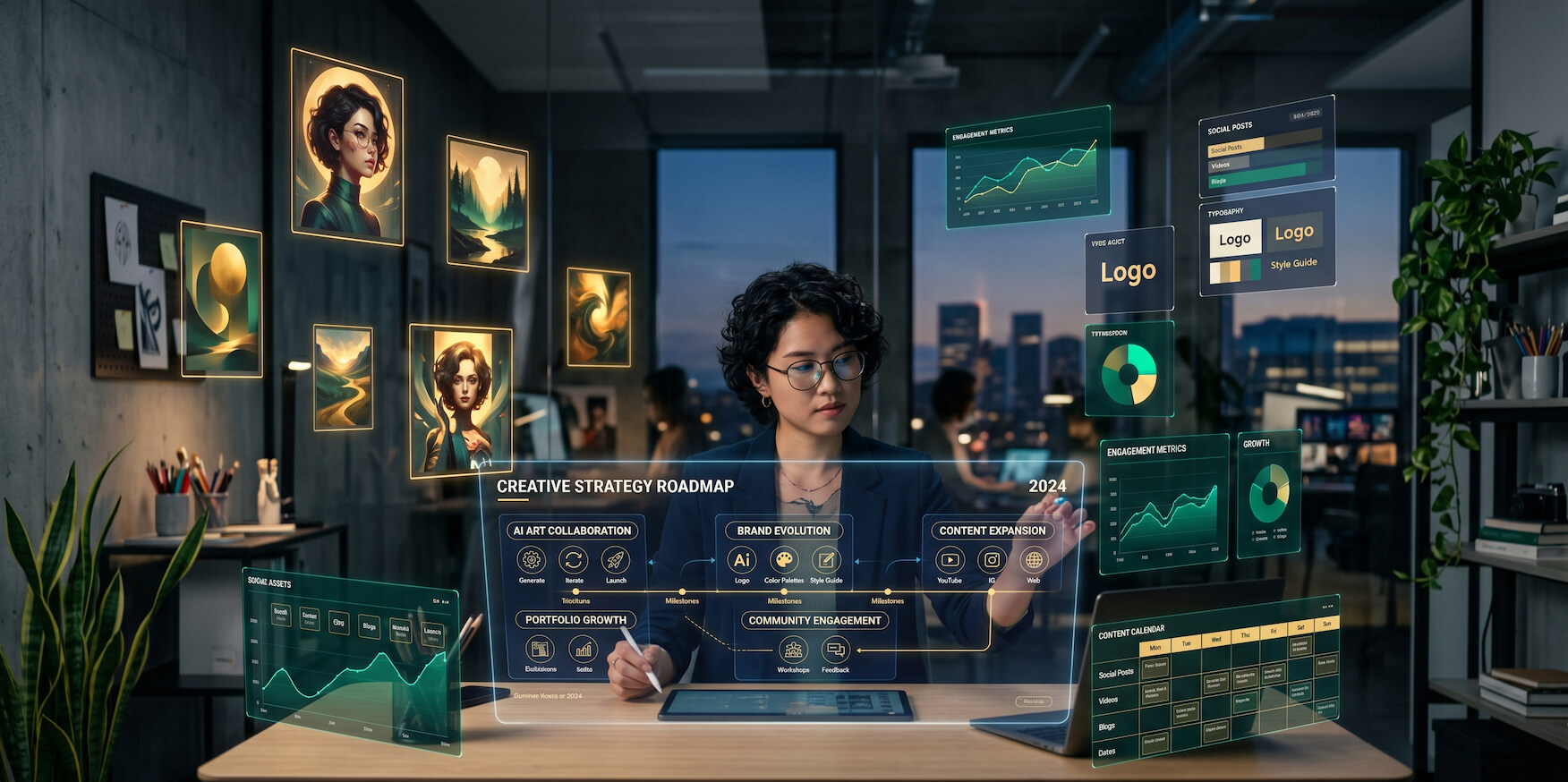
There is a meaningful difference between using AI tools and having an AI strategy. Thousands of artists are experimenting with AI in 2026 — generating images, automating posts, trying new platforms — without a coherent plan connecting those individual activities to meaningful creative or career outcomes. The results are predictably scattered: impressive individual outputs that don't compound into sustained growth, tool adoption that creates new complexity without reducing existing friction, and a general sense that AI is interesting but hasn't fundamentally changed anything.
The artists seeing transformative results from AI are operating differently. They've moved beyond experimentation into strategy — deliberately designing how AI fits into their creative practice and career architecture, choosing tools based on specific outcomes rather than novelty, and building systems where AI effort compounds over time rather than producing isolated wins.
This guide is about that shift. It covers the most effective AI strategies for artists in 2026 — actionable frameworks for using AI not just as a collection of interesting tools but as a coherent, compounding advantage across every dimension of your creative career.
Strategy First: Why Most Artists Don't Get Full Value from AI
Before diving into specific strategies, it's worth understanding why so many artists who have adopted AI tools haven't seen the transformative results they expected.
The most common mistake is tool-first thinking — adopting AI tools because they're impressive or because peers are using them, without clearly defining what problem each tool is solving or what outcome it's driving toward. An artist who uses Midjourney for three months without a clear sense of how it serves their creative or commercial goals will generate a lot of interesting images and achieve very little career progress.
The second most common mistake is fragmentation — using AI in isolated pockets of the workflow without connecting those pockets into a coherent system. AI assistance in image generation that doesn't connect to AI-assisted content creation, which doesn't connect to AI-assisted SEO, which doesn't connect to a professional portfolio capturing the traffic — each element is less valuable in isolation than it would be as part of a connected whole.
The third mistake is inconsistency — engaging with AI tools intensely for a few weeks, losing momentum, and returning to previous workflows. The compounding benefits of AI come from consistent, sustained use that allows you to build genuine expertise and accumulate the advantages that come with it.
Strategic AI adoption addresses all three of these problems by starting with outcomes, building connected systems, and designing for consistency. For a comprehensive view of which specific tools power each of the strategies in this guide, the best AI tools for artists in 2026 provides an honest, detailed evaluation of every major platform across creative production, business development, and career management.
Strategy 1: Define Your AI Stack Before You Start Using It
The foundation of effective AI strategy for artists is deliberate tool selection — choosing a small number of AI tools that address your specific highest-priority needs and committing to developing genuine expertise in them before expanding.
How to Build Your Stack
- Start by mapping your current workflow honestly — identifying the specific points where you lose the most time, experience the most friction, or feel most limited in what you can produce or achieve. These friction points are where AI investment delivers the highest return.
- For most working artists, the highest-friction areas fall into three categories: creative production (ideation speed, technical execution, reference limitations), audience building (content consistency, platform management, discoverability), and business operations (client management, administrative overhead, financial tracking). Your stack should address the highest-priority friction in each category with no more than one or two tools per area.
- A practical example stack for a freelance illustrator might include Midjourney for ideation and reference generation, Adobe Firefly for Photoshop-integrated production assistance, Canva Magic Studio for social media content creation, Notion AI for client and project management, and RocketPages for portfolio and business website. Five tools, each with a clearly defined role, no overlap.
The Expertise Imperative
- Once your stack is defined, the strategic priority shifts to developing genuine expertise in each tool — not surface familiarity, but the deep understanding of capabilities, limitations, and best practices that produces consistently high-quality results. This requires time and deliberate practice. Budget at minimum two weeks of regular use before evaluating whether a tool is delivering value. Most AI tools have a meaningful learning curve, and outputs from the first week of use are rarely representative of what's possible once you understand the tool well.
- For artists newer to AI tool adoption, the AI tools for beginners guide for artists provides a structured framework for building AI expertise systematically — covering both the technical fundamentals and the creative mindset shifts that make AI genuinely useful rather than frustrating.
Strategy 2: Build an AI-Powered Content Engine
Audience growth in 2026 is fundamentally a consistency game. The artists building the largest, most engaged audiences are not necessarily those with the most impressive individual pieces — they are the ones who show up reliably, create content that resonates, and distribute it across multiple platforms without burning out.
AI makes building and maintaining this kind of consistent content engine achievable for individual artists working without teams or significant marketing budgets.
The Batch Creation System
- The most effective AI-assisted content strategy for artists is batch creation — dedicating a specific block of time each week to creating all your content for the following week using AI assistance, then scheduling it for automated distribution.
- The workflow looks like this. Set aside three to four hours on a designated day. Use AI writing tools to draft captions, post copy, and newsletter content for the week based on brief notes about your current work and what you want to communicate. Use Canva Magic Studio to create platform-specific visual assets — Instagram posts, Pinterest graphics, YouTube thumbnails, email headers — in a single design session with AI handling the resize and reformatting for each platform. Load everything into a scheduling tool like Later or Buffer, which uses AI to optimize posting times for your specific audience. Your content presence for the week is handled in a single focused session.
- Consistently applied, this system creates a compounding audience growth effect — more consistent posting leads to better algorithmic distribution, which leads to faster audience growth, which leads to more commercial opportunity, which ultimately funds more creative work.
Platform-Specific AI Content Strategy
Different platforms reward different content types, and AI tools can be specialized to serve each platform's specific requirements most effectively.
- Instagram and TikTok reward visual storytelling and process content. AI animation tools like Runway ML and Pika Labs can turn finished illustrations into short animated clips that dramatically outperform static posts in engagement metrics. AI writing tools craft captions that tell the story behind a piece in a way that creates genuine connection with your audience.
- Pinterest rewards consistent, keyword-optimized visual content that drives long-term discovery traffic. AI-generated keyword-rich pin descriptions, consistent visual branding, and regular pinning cadence — all manageable with AI assistance — make Pinterest one of the most effective organic discovery channels for visual artists.
- YouTube rewards depth and consistency. AI video editing tools like Descript compress the production time of long-form process and tutorial content significantly. AI tools like Opus Clip automatically generate short-form clips from long videos, multiplying the reach of each YouTube video across short-form platforms simultaneously.
- Email rewards personal voice and consistent value delivery. AI writing tools maintain newsletter consistency during periods of intense creative production when writing feels impossible, ensuring your most valuable audience relationship — your email list — stays warm regardless of how demanding your creative schedule becomes.
Strategy 3: Make Your Work Discoverable with AI-Powered SEO
The most underutilized AI strategy among independent artists in 2026 is search engine optimization. While most artists understand that SEO exists, the technical complexity of keyword research, content optimization, and technical site structure has historically made it inaccessible to non-specialists.
AI SEO tools have removed that complexity entirely — making it possible for any artist to implement a systematic SEO strategy without specialist knowledge or significant time investment.
The Artist SEO Opportunity
- Artists have a genuinely significant SEO opportunity that most are not capitalizing on. Potential clients, collectors, galleries, and art buyers search for artists by medium, style, subject matter, and location every day. Artists who produce written content — blog posts about their process, medium-specific guides, creative philosophy pieces — have the opportunity to capture organic traffic from these searches consistently and at no cost beyond the time invested in content creation.
- AI tools like Surfer SEO and Semrush analyze what your target audience is searching for, identify the specific keywords and content structures that drive ranking in your niche, and provide actionable, specific guidance for optimizing your content. Applying this guidance to even a monthly blog post compounds into meaningful organic traffic over a twelve-to-eighteen-month horizon.
Portfolio SEO as a Foundation
- Before content SEO, your portfolio website itself needs to be technically sound and strategically optimized. This means clear page structure, keyword-informed page titles and descriptions, fast load times, and mobile optimization — the technical foundations that determine whether search engines can effectively index and rank your work.
- RocketPages builds portfolio websites with AI that are technically optimized from the ground up — handling the structural and technical SEO foundations automatically so you can focus on the content and creative presentation that makes your portfolio convert once visitors arrive.
Strategy 4: Build Multiple AI-Assisted Income Streams
One of the most significant strategic opportunities AI creates for artists in 2026 is income diversification — building multiple revenue streams that operate simultaneously and compound over time, rather than relying entirely on active trading of time for money through commission or client work.
The Income Stack
A strategic AI-assisted income stack for an independent artist in 2026 might include several layers operating simultaneously.
- Active income from commissions and client work remains the foundation for most artists — but AI assistance in production increases the volume of work achievable in a given time period, effectively raising the hourly return on active creative work.
- Semi-passive income from print-on-demand stores — Printful, Society6, Redbubble — generates revenue from existing artwork without ongoing production time. AI optimization of product listings dramatically improves the discoverability and conversion rate of these stores. The initial setup investment is modest; the ongoing maintenance is minimal; and well-optimized stores generate consistent income month over month.
- Passive income from digital product sales — brushes, texture packs, reference image collections, Procreate palettes, Lightroom presets, pattern files — represents one of the highest-margin income streams available to artists. AI tools assist in both the creation and the marketing of these products. Platforms like Gumroad and Creative Market provide the distribution infrastructure.
- Educational income from tutorials, courses, and workshops has become increasingly accessible as AI tools compress the production time of educational content. AI video editing, AI-generated course outlines and scripts, and AI-assisted platform optimization make building and selling educational content viable for artists who previously dismissed it as too time-consuming.
The strategic principle is building these income streams in parallel rather than sequentially — starting each one at a modest scale and allowing them to grow simultaneously, so that the compounding effect of multiple income streams compounds your total income faster than any single stream would alone.
For a detailed look at the specific tools powering each of these income strategies, the AI tools for productivity for artists in 2026 guide covers the full operational stack — from print-on-demand optimization to digital product creation and educational content production.
Strategy 5: Use AI to Develop and Protect Your Creative Voice
Of all the AI strategies for artists in 2026, this one is the most important and the most counterintuitive: the most valuable thing AI can help you do is develop and express a more distinctive, more consistent, more deeply personal creative voice — the one thing AI itself cannot have.
Why This Is Strategic
- The cultural and commercial landscape of 2026 has created a specific dynamic: as AI-generated content has proliferated, distinctively human creative voices have become more commercially valuable, not less. Collectors, creative directors, and audiences are making increasingly deliberate choices to seek out artists with unmistakable personal perspectives — work that could only have been made by that specific person, from that specific set of experiences, with that specific way of seeing.
- This means that developing and consistently expressing a distinctive creative voice is not just an artistic goal — it is a strategic business advantage. In a market flooded with competent AI-generated imagery, authentic human creative vision commands a premium.
How AI Supports Voice Development
- AI supports creative voice development in several specific ways. Style exploration tools allow artists to rapidly experiment with visual approaches far outside their current practice — accelerating the development of aesthetic range and visual literacy. AI critique tools provide structured technical feedback that helps identify and address weaknesses that limit the full expression of your creative vision. AI reference generation gives you the specific visual material you need to tackle subjects and compositions that were previously beyond your technical reach.
- Most importantly, AI handles the technically demanding and time-consuming elements of production — freeing creative energy for the expressive, personal, vision-driven decisions that are the actual substance of distinctive creative work. When AI handles the background construction, the technical retouching, and the color palette generation, you have more cognitive and emotional resources available for the choices that make your work unmistakably yours.
- For a comprehensive comparison of which AI tools best support creative development across different disciplines and career stages, the AI tools comparison guide for artists in 2026 provides the structured, honest evaluation that makes tool selection a strategic decision rather than a guessing game.
Strategy 6: Build AI Into Your Client Acquisition System
For artists who take commission or commercial work, client acquisition — finding new clients, presenting your work compellingly, converting inquiries into paid projects — is a constant operational priority that consumes significant time and creative energy. AI has made every stage of this process more efficient and more effective.
AI-Optimized Portfolio Presentation
- Your portfolio is your primary client acquisition tool, and AI has dramatically raised the bar for what a professionally presented artist portfolio looks like in 2026. A well-designed, fast-loading, strategically organized portfolio — one that surfaces the most relevant work for each type of potential client and tells a compelling story about your creative capabilities — converts meaningfully more inquiries into paid projects than a basic gallery of images.
- AI portfolio builders handle the design intelligence that makes this level of presentation accessible without a design budget. The strategic principle is treating your portfolio as a conversion tool — not just a gallery — and using AI to optimize every element of the visitor experience toward the specific action you want potential clients to take.
AI-Assisted Outreach and Follow-Up
- Cold outreach to potential clients — creative agencies, publishers, game studios, brands, editorial outlets — has always been one of the most time-consuming and psychologically draining aspects of building a commercial art career. AI writing tools have made this substantially more manageable.
- Rather than crafting each outreach message from scratch, AI tools generate personalized, professional outreach emails from brief notes about the recipient, the type of work you're pitching, and the specific value you offer their projects. Client management platforms with AI features handle follow-up sequences automatically, ensuring potential clients who don't respond to initial outreach receive thoughtful follow-up without requiring you to manually track and execute each communication.
Proposal Generation and Conversion
- When a potential client inquiry arrives, the speed and quality of your response significantly impacts conversion rate. AI writing tools generate professional, customized proposals from project briefs in minutes — ensuring potential clients receive a compelling, well-structured response quickly rather than waiting days while you find time to write from scratch.
Strategy 7: Systematize Learning with AI to Continuously Raise Your Ceiling
The most sustainable competitive advantage any artist can build is a commitment to continuous creative development — consistently raising the technical and expressive ceiling of your work over time. AI has created new tools for accelerating this development in ways that compound significantly over a multi-year horizon.
Structured Skill Development with AI
- The most effective AI-assisted learning strategy for artists combines on-demand reference generation, structured practice, and AI-powered feedback into a systematic weekly practice.
- Dedicate a consistent block of time each week — even just two hours — to deliberate skill development using AI tools. Use AI reference generation to create exactly the practice material you need for the specific skills you're working on. Complete the practice work with full attention and intention. Use AI critique tools to evaluate the technical aspects of the results. Identify the specific weaknesses the feedback reveals and target them in the following week's practice.
- Applied consistently over a twelve-month period, this kind of AI-assisted deliberate practice produces skill development that would previously have required significantly more time, access to formal education, or expensive mentorship to achieve.
Building Visual Literacy with AI
- Beyond technical skill, AI tools provide an unprecedented resource for building visual literacy — the depth of understanding of visual art across history, culture, and style that informs sophisticated creative decision-making. Artists can use AI generation tools to explore and study visual styles far outside their current practice, building understanding of how different artistic traditions approach composition, color, mark-making, and spatial organization.
- This expanded visual literacy directly informs the quality and sophistication of your own creative decisions — giving you a richer vocabulary of visual possibilities to draw from when making the expressive choices that define your work.
- The free AI tools guide for artists in 2026 identifies the best zero-cost tools for supporting this kind of learning practice — making systematic AI-assisted creative development accessible regardless of budget constraints.
Strategy 8: Measure What Matters and Let AI Optimize It
The final strategic layer that separates artists who see compounding career growth from those who plateau is measurement — tracking the metrics that actually indicate career progress and using AI tools to optimize based on what the data reveals.
The Artist's Key Metrics
- The specific metrics worth tracking vary by career stage and goals, but for most independent artists building toward sustainability, the core set includes: website traffic and conversion rate, email list growth and open rates, social media reach and engagement rate by platform, revenue by stream and month over month growth, commission inquiry volume and conversion rate, and time spent on creative production versus administration.
- AI analytics tools make tracking and interpreting these metrics accessible without specialist knowledge. More importantly, AI tools can act on what the data reveals — adjusting content strategy based on engagement data, optimizing posting times based on reach data, and identifying which portfolio pieces drive the most client inquiries based on website behavior data.
The Optimization Feedback Loop
- The strategic value of measurement comes from closing the feedback loop — using what you learn from data to make specific, informed adjustments to your AI-assisted systems, then measuring the impact of those adjustments, then adjusting again. This iterative oph intuition and guesswork alone.
Bringing It All Together: Your 90-Day AI Strategy Launch Plan
Implementing all eight strategies simultaneously is neither realistic nor advisable. The most effective approach is sequential — establishing foundations before adding complexity, and ensuring each layer of your AI strategy is operating consistently before introducing the next.
A practical 90-day launch sequence looks like this.
In the first 30 days, focus entirely on foundation: define your AI stack based on your highest-priority friction points, develop baseline expertise in each tool through consistent daily use, and launch your professional portfolio website using AI. These three foundations — the right tools, genuine expertise, and a professional online home — are prerequisites for every strategy that follows.
In the second 30 days, focus on content and discoverability: implement your batch content creation system, apply AI SEO optimization to your portfolio and any existing blog content, and set up your print-on-demand store with AI-optimized listings. These three initiatives begin building the audience and passive income infrastructure that compounds over time.
In the third 30 days, focus on depttimization process, applied consistently across your content strategy, your portfolio presentation, your SEO approach, and your income streams, produces compounding improvement over time that is simply not achievable through and optimization: implement AI-assisted client acquisition systems, establish your weekly AI-assisted skill development practice, and begin tracking and optimizing your key metrics. These initiatives deepen the strategic advantage you've begun building and establish the measurement framework that drives continuous improvement.
By the end of 90 days, you will have a genuinely strategic AI infrastructure operating across your creative production, audience building, income generation, and career development — one that continues delivering compounding value with sustained consistent use.
Final Thoughts: Strategy Is the Multiplier
AI tools are powerful. But tools without strategy are just an interesting collection of capabilities that don't compound into anything. Strategy is the multiplier that turns good AI tools into transformative career infrastructure.
The eight strategies in this guide represent the most effective frameworks working artists are using to turn AI from a novelty into a genuine, compounding career advantage in 2026. They are not theoretical — they are drawn from the actual practices of artists who have successfully integrated AI across their creative and professional lives.
The starting point is simpler than it might appear: define what you want your creative career to look like, identify the specific gaps between where you are and where you want to be, and choose the AI strategies that most directly address those gaps. Build from there, consistently and with intention.
The tools are available. The strategies are proven. The only variable is how deliberately you engage with them.
Looking for the specific tools that power every strategy in this guide? The AI tools comparison guide for artists in 2026 gives you an honest, structured evaluation of every major platform — helping you build your strategic AI stack with confidence and clarity.