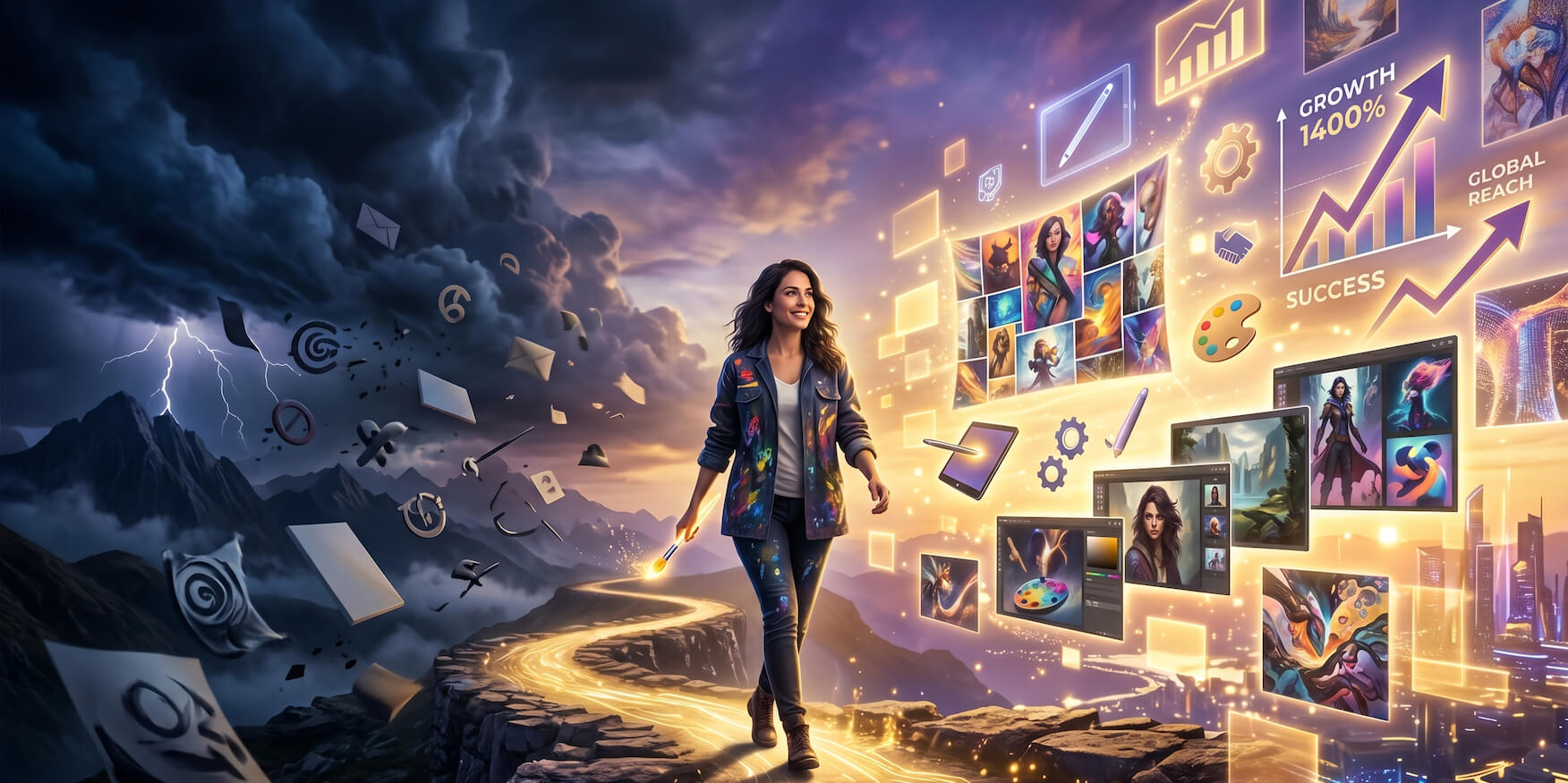
Every artist carries a private list of problems. The canvas that stares back blankly at the start of a project. The client email that sits unanswered because there isn't time. The social media account that hasn't been updated in three weeks. The commission rate that hasn't changed in two years because pricing feels impossible. The portfolio website that was going to be built last year. The skill gap between the work you can imagine and the work you can currently execute.
These are not small inconveniences — they are the persistent, career-shaping challenges that determine whether a creative practice grows or stagnates, whether an artist thrives or burns out, whether the gap between artistic vision and commercial reality closes or widens over time.
In 2026, AI has a genuine, practical solution for almost every one of these challenges. Not theoretical solutions or experimental possibilities — but working, accessible, proven tools and approaches that artists across every discipline and career stage are using right now to solve problems they previously considered simply part of the unavoidable cost of a creative career.
This guide is structured differently from most AI tool roundups. Rather than starting with tools and working toward applications, it starts with the problems — the real, specific challenges artists face — and works toward the AI solutions that address each one most effectively. If you recognize your own challenges in these pages, you'll find the solutions waiting right beside them.
Problem 1: The Blank Canvas — Creative Block and Slow Ideation
The Challenge
- Creative block is one of the most universal and least discussed challenges in artistic careers. The inability to begin — to generate a compelling starting direction for a new project, to move past the paralysis of infinite possibility into committed creative action — consumes enormous amounts of time and emotional energy for artists at every career stage. Even for artists who don't experience full creative block, the ideation phase of any project is consistently slower and more uncertain than it needs to be.
The AI Solution
- AI image generation tools have proven remarkably effective at solving the blank canvas problem — not by making creative decisions for artists, but by providing something concrete to react to within seconds of starting.
- Tools like Midjourney, Adobe Firefly, and Leonardo.AI generate rapid visual variations of a concept from minimal input — a few descriptive words, a rough compositional sketch, a reference image — giving artists a foundation of options to evaluate and respond to rather than a void to fill from pure imagination. The creative decision-making process, which previously required sustained mental effort to generate from nothing, now begins with a concrete visual landscape to navigate.
- Artists across disciplines report that this shift — from generating ideas to responding to and refining them — dramatically reduces creative anxiety and increases the confidence and speed with which they enter new projects. The exploration that previously took days of uncertain sketching now takes hours of engaged visual decision-making.
- For artists who want to understand which specific tools deliver the best ideation support for their medium and workflow, the AI tools comparison guide for artists in 2026 provides a structured, honest evaluation of every major generation platform — making the choice between tools a strategic decision based on specific creative needs rather than a shot in the dark.
Problem 2: Technical Skill Gaps — Vision Exceeding Current Capability
The Challenge
- Every artist lives with a gap between the work they can imagine and the work they currently have the technical skills to execute. This gap — sometimes energizing as a development goal, often frustrating as an immediate limitation — constrains creative ambition and leads to either avoiding technically demanding subject matter or producing work that falls short of the internal vision driving it.
- Complex architectural perspective, difficult anatomical positions, challenging lighting scenarios, advanced rendering techniques — these are the specific technical territories where skill gaps most commonly limit creative expression for working artists.
The AI Solution
- AI has addressed this challenge in two distinct but complementary ways: by providing precise reference on demand, and by handling technical execution in specific areas where human skill is the limiting factor.
- On the reference side, AI image generation tools allow artists to create exactly the reference images they need — specific foreshortened figures in specific lighting, complex architectural configurations from unusual angles, environmental references that don't exist in any photograph — eliminating the previous constraint of drawing from inadequate reference or pure imagination where technical accuracy suffers. Portrait painters generate custom lighting setups. Anatomy students generate precisely the challenging poses they need to study. Environment artists generate references for impossible or fantastical locations.
- On the execution side, tools like Clip Studio Paint's AI background generation, Adobe Firefly's Generative Fill, and ControlNet integration in Stable Diffusion allow artists to use AI assistance for the technically demanding elements of a composition — accurate perspective backgrounds, complex environmental detail, technically difficult retouching — while retaining full creative control over the expressive elements that define the work.
- The cumulative effect is that technical skill gaps stop being hard limitations on creative ambition. Artists are tackling compositional and subject matter challenges they previously avoided, knowing that AI assistance is available for the specific technical elements that would otherwise be beyond their current capabilities.
Problem 3: No Professional Online Presence — The Missing Portfolio
The Challenge
- The majority of independent artists operate without a professional portfolio website — or with one that significantly undersells their work. The reasons are consistent and understandable: building a proper professional site requires either technical skills most artists don't have, a development budget most independent artists can't justify, or a significant time investment that competes with creative production. The result is that talented artists with genuinely impressive bodies of work present themselves online in environments — basic social media profiles, free template sites — that fail to communicate the quality and professionalism of what they create.
- This gap between the quality of the work and the quality of its presentation directly impacts commercial opportunity. Potential clients form rapid impressions based on online presence, and a mediocre digital presentation leads to underpricing, missed opportunities, and a persistent credibility gap that talented artists deserve not to carry.
The AI Solution
- AI website building has removed every barrier that previously prevented artists from having a genuinely professional online presence.
- RocketPages lets artists create a stunning portfolio website using AI — generating a gallery-quality, professionally designed online presence that showcases work with the sophistication and intentionality of a custom-built site, without the cost, timeline, or technical complexity of custom development. The AI handles design intelligence, layout decisions, typography pairing, and structural organization — producing results that look custom-designed because the system makes genuinely sophisticated, context-aware design decisions rather than applying generic templates.
- For artists running full creative businesses — managing commissions, selling originals, offering licensing, running workshops — RocketPages builds a complete professional business website with equal ease, giving creative entrepreneurs a polished digital storefront that handles every commercial function from a single, beautifully designed destination.
- The commercial impact of this solution is consistently significant. Artists who launch AI-built professional portfolios after operating without one routinely report meaningful increases in inquiry volume, commission rates, and overall revenue — the direct result of their work finally being presented in an environment that matches its quality.
Problem 4: Inconsistent Audience Growth — The Visibility Problem
The Challenge
- Most independent artists understand that building an audience requires consistent content creation and distribution across multiple platforms. Most also find this consistency genuinely unsustainable alongside the demands of creative production. The result is an intermittent presence — periods of active posting followed by weeks of silence — that algorithms penalize, audiences disengage from, and that fails to generate the compounding growth that consistent presence produces.
- The core tension is irresolvable without assistance: creating the volume and consistency of content required for meaningful platform growth would consume every available hour, leaving no time for the creative work the audience is following you for in the first place.
The AI Solution
- AI content creation and scheduling tools resolve this tension by compressing the time required to produce high-quality, consistent content across multiple platforms from several hours daily to a single focused weekly batch session.
- AI writing tools draft captions, post copy, newsletter content, and platform-specific messaging from brief notes in minutes. Canva Magic Studio creates on-brand visual assets for every platform format simultaneously from a single design session. Scheduling tools like Later and Buffer, powered by AI audience analysis, determine optimal posting times for each platform based on your specific audience's behavior patterns and queue everything for automated distribution. A three-to-four-hour weekly batch session creates a consistent, high-quality presence across every relevant platform for the entire week ahead.
- The compounding effect of sustained consistency through AI assistance is the most consistently reported long-term benefit among artists who have implemented this system. Platform algorithms reward consistent posting with stronger distribution. Stronger distribution drives faster follower growth. A larger, more engaged following creates more commercial opportunity. The modest weekly investment in AI-assisted content creation compounds into meaningful career acceleration over a twelve-to-eighteen-month horizon.
Problem 5: Pricing Paralysis — Undervaluing Creative Work
The Challenge
- Pricing creative work is one of the most psychologically complex challenges in an artist's career. Without access to reliable market data, most artists price based on emotional comfort rather than market reality — which almost invariably means pricing too low. The consequences are significant: unsustainable income, implicit devaluation of creative work, and a perpetual cycle of needing to take on more volume of lower-value work to make up the income gap that underpricing creates.
- The anxiety around pricing — fear of rejection, imposter syndrome, uncertainty about market benchmarks — is one of the most persistently career-limiting factors for talented artists who deserve to earn significantly more than they currently do.
The AI Solution
- AI pricing tools have made data-informed pricing accessible to independent artists without specialist market research expertise. By analyzing comparable sales data across platforms, medium-specific market trends, career-stage benchmarks, and audience size correlations, AI tools generate pricing recommendations grounded in actual market reality rather than emotional approximation.
- Artists who engage with data-informed pricing through tools like PricingAI and the AI features within platforms like Artwork Archive consistently identify significant gaps between what they are currently charging and what the market data suggests their work warrants. The emotional difficulty of pricing conversations becomes substantially more manageable when recommendations are grounded in external data rather than subjective self-assessment.
- Beyond individual pricing decisions, AI market analysis tools help artists understand which segments of their work command the highest market premiums, which platforms generate the strongest return on sales investment, and how their pricing trajectory should evolve as their reputation and audience grow. This strategic pricing intelligence, previously accessible only to artists with gallery representation or specialist business support, is now available directly through AI tools.
- The AI tools for productivity for artists in 2026 guide covers the full range of business intelligence tools — including pricing, market analysis, and financial management — that help artists build more profitable, strategically informed creative practices.
Problem 6: Skill Development Plateau — Stuck at the Same Level
The Challenge
- Most self-directed artists experience skill development plateaus — extended periods where practice continues but perceptible improvement stalls. These plateaus typically result from one or more of three factors: practicing the same things in the same ways without deliberate challenge, lacking access to skilled feedback that identifies specific weaknesses, or not having the reference material and study resources needed to work on the areas that most need development.
- Breaking through a plateau traditionally required either formal art education, access to a skilled mentor, or the kind of structured, deliberate practice regimen that is difficult to design and maintain without external guidance.
The AI Solution
- AI has created remarkable new tools for breaking through skill development plateaus by addressing all three of the root causes simultaneously.
- For deliberate practice resources, AI reference generation provides unlimited, precisely customized study material — generating exactly the anatomical positions, lighting scenarios, compositional challenges, and technical subjects that target the specific areas most in need of development. Rather than practicing what's easy because that's what the available reference supports, artists can structure their practice around their actual development gaps.
- For feedback, AI critique tools analyze technical aspects of artwork — composition balance, value distribution, color harmony, perspective accuracy, anatomical correctness — and provide structured, specific feedback that identifies weaknesses that self-assessment tends to miss. While this feedback lacks the subjective aesthetic judgment of a skilled human mentor, its availability as a technical checking tool is genuinely valuable for identifying and addressing the specific issues that cause plateaus.
- For structured challenge, AI tools can be used to deliberately expand artistic range — exploring visual styles, technical approaches, and subject matter far outside current comfort zones in an efficient, low-risk way that builds the visual literacy and technical breadth that underlie sophisticated creative development.
- The AI tools for beginners guide for artists covers AI learning tools specifically for artists earlier in their development journey — providing clear, accessible guidance on using AI for skill building without prior technical experience.
Problem 7: Administrative Overwhelm — Too Much Business, Not Enough Art
The Challenge
- The operational reality of a freelance creative career — client communication, project tracking, invoicing, expense management, contract preparation, tax documentation, social media management, email marketing — consumes a disproportionate and frequently unsustainable amount of time and mental energy. Many artists spend more of their working week on administrative tasks than on actual creative production — a situation that is both practically inefficient and psychologically corrosive to the creative motivation that sustains careers.
- This administrative burden is not optional. It is the unavoidable operational infrastructure of any professional creative practice. But the time and energy it consumes is genuinely transferable — with the right automation, those hours flow back into creative work.
The AI Solution
- AI automation tools have systematically addressed every major category of creative business administration — reducing the total weekly time burden from the ten to twenty hours that unassisted administration typically consumes to a fraction of that with comprehensive AI assistance.
- Client communication automation through platforms like HoneyBook and Dubsado handles inquiry responses, proposal generation, contract creation, progress updates, and payment reminders automatically. Financial management automation through AI-powered accounting tools categorizes transactions, generates invoices, tracks payments, and prepares financial reports without ongoing manual effort. Project management automation through Notion AI organizes commissions, deadlines, client history, and deliverable status in intelligently queryable systems that eliminate the cognitive overhead of manually tracking a busy practice.
- The cumulative time recovery from comprehensive administrative automation is substantial — and its impact on creative output is immediate. Artists who reclaim ten to fifteen hours of weekly administrative time and redirect it into creative production consistently report significant improvements in both the volume and quality of work they produce. The cognitive benefit — the elimination of the background anxiety that comes from poorly managed administrative chaos — is equally significant.
Problem 8: Passive Income Gap — All Income Tied to Active Hours
The Challenge
- The income model that most artists operate on — trading hours for money through commissions, client work, and original sales — has an inherent ceiling and an inherent fragility. Income stops when work stops. There is no revenue during vacations, illness, creative sabbaticals, or the inevitable slow periods that characterize every freelance career. And the ceiling of time-for-money income is fixed by the number of billable hours available, with no mechanism for scaling beyond the individual's physical capacity to work.
- Building passive income streams — revenue that generates independently of active working hours — has always been the path to breaking this ceiling and building genuine financial resilience into a creative career. The barrier has been the time and expertise required to set these streams up and maintain them effectively.
The AI Solution
- AI has dramatically lowered both the setup barrier and the ongoing management burden for every major passive income stream available to artists.
- Print-on-demand stores, optimized with AI-powered listing tools that generate keyword-rich titles, descriptions, and tags based on platform search data, generate consistent income from existing artwork without production, inventory, or fulfillment involvement. Digital product stores selling brush packs, texture libraries, reference collections, and preset files — created with AI assistance and marketed with AI-generated copy and SEO optimization — deliver high-margin income with no per-unit cost. Online educational content — tutorials, courses, and technique guides — produced with AI video editing assistance and distributed through automated platforms, generates income continuously from a single production investment.
- The strategic value of building these streams simultaneously is their compounding nature. Each stream generates modest income initially; together, after sustained development, they create a financial foundation that makes the active, time-for-money elements of a creative career optional rather than obligatory — enabling artists to take on only the client work they genuinely want, at rates they genuinely deserve.
- The free AI tools guide for artists in 2026 covers the zero-cost AI tools that make building these passive income streams accessible without significant upfront investment — particularly important for artists building these capabilities in the early stages of their career.
Problem 9: Client Acquisition Difficulty — Not Enough of the Right Work
The Challenge
- Finding and converting the right clients — those whose projects align with your creative strengths, whose budgets reflect your actual market value, and whose working styles are compatible with how you do your best work — is one of the most persistently challenging aspects of building a sustainable commission-based creative practice.
- Most artists' client acquisition is either passive — waiting for inquiries to arrive organically — or uncomfortably random — responding to whatever opportunities appear regardless of fit. Neither approach builds the kind of focused, creatively fulfilling, appropriately compensated client base that defines a thriving creative practice.
The AI Solution
- AI has improved client acquisition for artists across every stage of the process — from making your work visible to the right people, to converting inquiries efficiently, to delivering proposals that win projects at appropriate rates.
- AI-powered SEO tools make your portfolio and content discoverable by potential clients who are actively searching for exactly what you offer — generating warm, inbound inquiry traffic from people with genuine interest in your specific creative capabilities. AI outreach tools assist in crafting personalized, professional cold outreach to potential clients — creative agencies, publishers, game studios, editorial outlets — at a volume and quality level that manual outreach can't sustain. AI proposal tools generate polished, customized proposals quickly enough to respond to every inquiry promptly — a factor that significantly impacts conversion rate in competitive creative markets.
- Collectively, these tools shift client acquisition from a passive, anxiety-producing waiting game into an active, systematized process that consistently delivers a pipeline of appropriately matched opportunities — giving artists genuine agency over the composition and quality of their client work.
Problem 10: Inconsistent Creative Development — Growing Without Direction
The Challenge
- Many artists develop their skills reactively — improving in the areas that current projects demand, neglecting the broader development that builds genuine creative range and long-term career trajectory. Without a structured development framework, creative growth tends to be uneven, slow in areas of existing weakness, and ultimately limited by the ceiling that reactive practice naturally imposes.
- Intentional, structured creative development — with clear goals, systematic practice, and regular feedback — consistently produces faster and more comprehensive artistic growth than reactive improvement alone. The challenge is that designing and maintaining this kind of structured development program requires external input and ongoing management that most self-directed artists lack access to.
The AI Solution
- AI tools have made structured, intentional creative development more accessible and more manageable for self-directed artists than at any previous point.
- AI critique tools provide the regular, structured technical feedback that structured development requires — identifying specific weaknesses in composition, value, color, perspective, and anatomical accuracy that self-assessment consistently misses. AI reference generation provides unlimited, precisely targeted practice material for the specific skills being developed. AI style exploration tools expose artists to a breadth of visual traditions and technical approaches that builds the visual literacy and creative range that underlie sophisticated artistic development.
- Combined with AI-powered learning platforms that provide structured curriculum and personalized pacing based on demonstrated skill level, these tools create the conditions for systematic, goal-directed creative development that produces results far faster than undirected practice alone — without requiring enrollment in formal art education or access to expensive mentorship.
Problem 11: Geographic Isolation — Limited Access to Creative Community
The Challenge
- Meaningful creative community — access to peers who understand the specific challenges of your discipline, mentors whose experience provides perspective, collectors and clients who appreciate what you make, collaborators whose skills complement yours — has historically been concentrated in specific geographic locations. Artists working outside major creative centers have faced genuine disadvantage in accessing the networking, collaboration, feedback, and commercial opportunities that creative community provides.
The AI Solution
- While AI cannot replicate the full richness of in-person creative community, it has substantially reduced the practical disadvantage of geographic isolation for artists working outside major creative centers.
- AI-powered discovery platforms connect artists with collectors, clients, and collaborators based on aesthetic alignment and project fit rather than geographic proximity — making meaningful creative and commercial connections possible across any distance. AI translation tools make international creative communities accessible to artists working in any language. AI platforms that facilitate virtual studio visits, online critique sessions, and collaborative creative projects have created functional creative community infrastructure that operates entirely independently of geography.
- For artists in geographically isolated locations, the combination of AI community tools and AI business infrastructure — professional portfolio, automated marketing, optimized sales channels — levels the playing field with urban creative centers in ways that were simply not possible even five years ago.
The Solution Framework: Matching AI Tools to Specific Problems
The most effective approach to implementing AI solutions is problem-first — starting with the specific challenges that are most significantly limiting your creative career and identifying the AI tools that address those challenges most directly.
Begin by honestly assessing which of the eleven problems in this guide most significantly impacts your current creative practice and career trajectory. Prioritize the top two or three. For each priority problem, identify the specific AI solution most directly applicable to your situation and discipline — using resources like the best AI tools for artists in 2026 to evaluate the leading platforms in each solution category.
Implement one solution at a time, developing genuine proficiency before adding the next. The compounding benefits of AI solutions come from sustained, expert use — not from adopting many tools superficially. A single AI solution implemented thoroughly and used consistently for three months delivers more career value than ten tools adopted enthusiastically and abandoned after two weeks.
Final Thoughts: Every Problem Has an AI Solution in 2026
The eleven challenges in this guide represent the most significant, most universal problems in independent creative careers. What has changed in 2026 is that every one of them now has a practical, accessible, proven AI solution — tools and approaches that working artists across every discipline are using successfully right now.
The solutions don't require technical expertise to implement. They don't require significant financial investment to begin — many of the most powerful are available through the free AI tools available to artists in 2026. They don't require abandoning the creative values and working methods that define your practice. They require only the willingness to identify your specific challenges honestly and engage with the tools designed to address them deliberately.
Every creative career has its version of the private list of problems. In 2026, most of those problems have solutions waiting — practical, available, and ready to be implemented. The distance between where your creative career is and where it could be is, in many cases, shorter than it has ever been.
Ready to find the specific AI tools that solve your most pressing creative challenges? The AI tools comparison guide for artists in 2026 gives you a structured, honest evaluation of every major platform — helping you match the right AI solution to every challenge in your creative career with confidence and clarity.