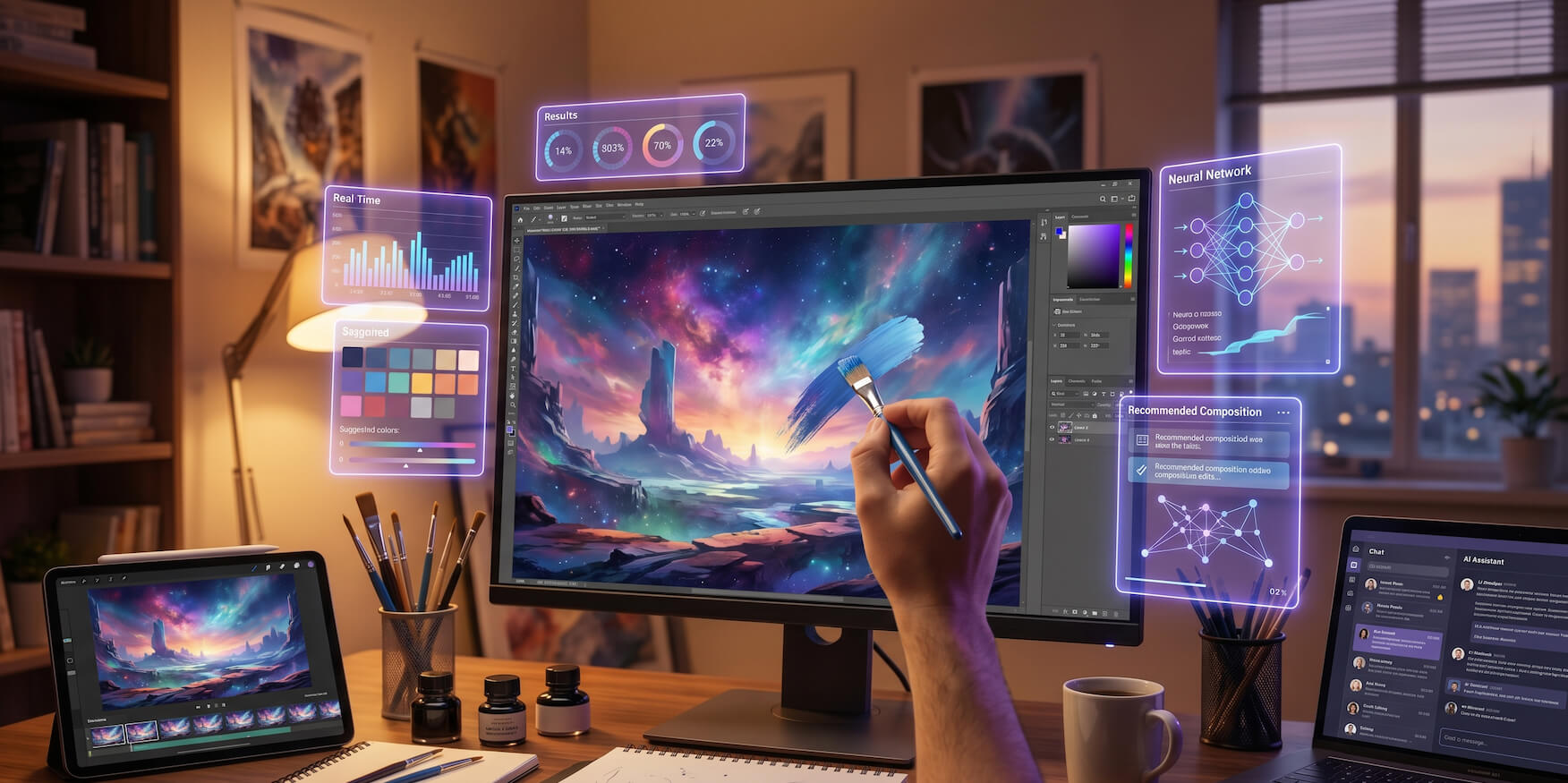
There is a version of the AI-and-art conversation that is almost entirely about fear. Fear that AI will replace artists, devalue creative work, flood the market with cheap imitations, and make human-made art commercially unviable. That conversation has been loud, emotionally charged, and — for the most part — increasingly disconnected from what is actually happening in working artists' studios in 2026.
The reality is more nuanced, more interesting, and for most artists who have engaged with it seriously, considerably more optimistic. AI in 2026 is helping artists work faster, think more expansively, reach larger audiences, earn more sustainable incomes, and spend more of their professional time doing the thing they became artists to do — making work that matters.
This guide is a complete, honest account of exactly how AI helps artists in 2026. Not hype, not fear — just a clear-eyed look at where AI is genuinely delivering value across the full spectrum of a creative professional's life.
The Shift That Changed Everything
To understand how AI helps artists today, it helps to understand what changed between earlier iterations of AI art tools and what exists in 2026.
Early AI image generators were curiosities — impressive at generating surreal imagery from text prompts but limited in their practical usefulness to working professionals. They lacked controllability, consistency, and the ability to integrate into existing professional workflows. Many artists who experimented with them early found the outputs too unpredictable, too stylistically uniform, and too disconnected from their own creative vision to be genuinely useful.
The generation of AI tools available in 2026 is fundamentally different in three ways. First, controllability has improved dramatically — artists can now guide AI outputs with precision using style references, structural constraints, character consistency features, and fine-tuned custom models trained on their own work. Second, workflow integration has matured — AI capabilities are embedded directly into the professional tools artists already use, from Photoshop to Clip Studio Paint to Premiere Pro, rather than existing as separate, disconnected applications. Third, the scope of AI assistance has expanded well beyond image generation to encompass every dimension of a creative career — production, business development, audience building, client management, and financial administration.
The result is that AI in 2026 is genuinely helpful to artists in ways that early tools simply weren't. Let's examine how, category by category.
How AI Helps With the Creative Process
It Eliminates the Blank Canvas Problem
- Every artist knows the paralysis of the blank canvas — the moment at the start of a project when every direction is equally possible and equally uncertain. AI has become an extraordinarily effective antidote to this specific creative struggle.
- By generating rapid visual variations of a concept from text descriptions or rough sketches, AI gives artists something concrete to react to within seconds of starting. You don't have to know exactly what you want — you start with a direction, generate variations, respond to what you see, and iteratively refine toward clarity. The creative decision-making process, which previously required sustained mental energy to navigate from nothing, now begins with a foundation of visual options that you evaluate and direct rather than conjure from pure imagination.
- Artists across disciplines report that this shift — from generating ideas to responding to and refining them — has significantly reduced creative anxiety and increased the confidence with which they begin new projects.
It Expands What's Possible to Explore
- Human creative exploration is bounded by time. There are only so many thumbnail compositions, color studies, and style variations a single artist can produce manually in the hours available before a project decision must be made. AI removes that boundary — or at least pushes it dramatically further out.
- A concept artist developing the visual language for a game environment can explore fifty lighting scenarios, thirty color palette variations, and a dozen distinct architectural styles in a single working session using AI. A portrait photographer can visualize a shoot in fifteen different lighting setups before committing to a single studio configuration. An illustrator developing a character can generate hundreds of costume and expression variations before selecting the direction that best serves the story.
- This expansion of the explorable creative space consistently leads to better final decisions — because the artist has actually seen more options before committing, rather than committing to the first viable idea that appeared and hoping for the best.
It Handles the Technically Demanding Parts
- Every creative discipline has components that are technically demanding, time-consuming, and — for most artists — not the part of the work they find most creatively fulfilling. AI has become remarkably capable of handling many of these components.
- Complex architectural backgrounds that would take an illustrator half a day to construct in accurate perspective can be generated by AI in seconds and used as a structural foundation for hand-painted work. Repetitive texture creation, seamless pattern generation, and environmental asset production — the kinds of tasks that consume enormous time in game art and surface design pipelines — can be delegated to AI entirely. Photographic retouching tasks that once required hours of skilled Photoshop work — background removal, object replacement, sky swapping, generative fill — are now performed by AI in seconds with results that frequently exceed what manual editing would achieve.
- For a structured comparison of the specific tools handling these tasks most effectively, the AI tools comparison guide for artists in 2026 evaluates the leading platforms side by side — helping artists identify which tools best match their medium and workflow.
It Provides Perfect Reference on Demand
- Finding the right photographic reference has always been a meaningful constraint on artistic production. Stock photo libraries, however vast, never have exactly the pose, lighting, angle, and subject combination you need. Live reference sessions require scheduling, coordination, and cost. Drawing from imagination alone, particularly for complex anatomical positions or unusual perspective scenarios, risks technical inaccuracy that undermines the final work.
- AI has solved this problem cleanly. Artists now generate precisely the reference images they need — specific foreshortened figures in specific lighting, unusual architectural details in specific weather conditions, fantastical environments that don't exist in any photograph — in seconds and at no cost. The freedom this creates is genuinely significant. Artists report tackling compositional and technical challenges they previously avoided because of reference limitations, knowing they can generate exactly what they need to support the work.
How AI Helps Artists Build an Audience
It Makes Consistency Achievable
- Consistency is the single most important factor in building an audience on any platform in 2026. Algorithms reward regular posting. Audiences follow creators who show up reliably. The challenge for artists is that consistent content creation competes directly with consistent art creation — both require time and creative energy, and there are only so many hours in a day.
- AI resolves this tension by dramatically compressing the time required to produce high-quality content. AI writing tools draft captions, newsletter content, post copy, and platform-specific messaging from brief notes in seconds. AI design tools like Canva Magic Studio create on-brand visual assets for every platform simultaneously. AI scheduling tools determine optimal posting times and automate distribution. The result is that artists can maintain a genuine, consistent presence across multiple platforms while protecting the bulk of their working hours for actual creative production.
It Makes Your Work Findable
- Creating excellent work and building a professional online presence is only valuable if the right people can find it. Search engine optimization — ensuring your portfolio, blog content, and product listings appear when potential clients, collectors, and collaborators search for what you offer — has historically required specialist expertise that most independent artists couldn't access or afford.
- AI-powered SEO tools have democratized this expertise. They analyze what your target audience is searching for, identify the specific keywords and content structures that drive organic traffic in your niche, and provide actionable guidance for making your existing content more discoverable. For artists who invest in regular content creation, AI SEO assistance can compound into thousands of monthly organic visitors over time — all arriving with genuine interest in exactly what you create.
It Powers a Professional Portfolio That Converts
- All the audience-building work in the world only pays off if it drives people to a destination that represents your work professionally and converts visitors into followers, clients, and buyers. In 2026, AI website builders have made creating that destination accessible to every artist regardless of technical background.
- RocketPages lets you create a stunning portfolio website using AI — handling the layout intelligence, typography, color decisions, and structural organization that would otherwise require a professional web designer. Your work is showcased as it deserves to be, in a gallery-quality environment that builds trust and drives action from every visitor.
How AI Helps Artists Earn More
It Opens Passive Income Streams
- The traditional model of artist income — trading time for money through commissions, client work, and original sales — has an inherent ceiling. There are only so many hours available, and each one can only be sold once. AI has helped many artists build passive income streams that generate revenue independently of active working hours.
- Print-on-demand platforms like Printful, Society6, and Redbubble allow artists to sell their work as physical products without managing production or fulfillment. AI optimization tools analyze platform search data and generate keyword-rich product listings that dramatically improve discoverability within these marketplaces. For artists with existing digital portfolios, an AI-optimized print-on-demand store can become a meaningful, low-maintenance income stream running alongside active creative work.
It Improves Pricing Confidence
- Pricing creative work is one of the most consistently difficult challenges in an artist's career. The anxiety of underpricing — leaving money on the table and implicitly undervaluing your work — competes with the anxiety of overpricing and losing opportunities. Most artists resolve this tension by guessing, by following peers, or by charging whatever feels emotionally comfortable — approaches that rarely optimize for actual market value.
- AI pricing tools analyze comparable market data — similar artists' rates, platform pricing benchmarks, medium-specific market trends, and career-stage norms — to generate pricing recommendations grounded in real market information. For artists willing to engage with data-informed pricing, AI tools consistently identify opportunities to price more accurately — which typically means pricing higher, not lower.
It Scales Client Work Without Scaling Hours
- For artists taking commission and commercial work, AI assistance in the production workflow means the same number of working hours can produce a greater volume of deliverables — or the same volume can be produced at higher quality with time saved on technically demanding elements. Either outcome improves the economics of commission work.
- AI also helps on the business development side of client work. AI-generated proposals, automated client communication, and AI-assisted contract preparation reduce the administrative overhead of each client relationship — meaning more of your billable time goes toward actual creative production and less toward business management tasks.
How AI Helps Artists Manage Their Careers
It Handles the Business Administration
- The operational reality of a freelance creative career — client communication, project tracking, invoicing, expense management, contract preparation, tax documentation — consumes a disproportionate amount of time and creative energy for most independent artists. This is the part of the career that most artists would happily eliminate if they could.
- AI tools have made significant inroads here. AI project management systems like Notion AI organize commissions, deadlines, client history, and project status into an intelligently queryable workspace. AI accounting tools automatically categorize transactions, generate invoices, and track outstanding payments. AI communication tools draft client emails, proposals, and follow-ups from brief notes. Collectively, these tools can reclaim several hours of administrative overhead every week — hours that go directly back into creative production.
- The AI tools for productivity for artists in 2026 guide covers the full landscape of these productivity tools in depth — an essential read for any artist who feels their administrative workload is eating into their creative time.
It Accelerates Skill Development
- AI has created remarkable new possibilities for accelerated artistic skill development that go well beyond production assistance. On-demand reference generation makes figure drawing study more flexible and comprehensive than live sessions alone. AI critique tools provide structured technical feedback on composition, value, color, and perspective — giving self-directed learners access to a level of systematic feedback that previously required formal education or regular mentorship. AI style exploration tools allow artists to rapidly build visual literacy across a much broader range of artistic traditions than would be possible through traditional study alone.
- For artists at the beginning of their AI journey, the AI tools for beginners guide for artists provides the most accessible entry point — covering both the practical tool selection and the creative mindset shifts that make AI genuinely useful rather than frustrating for artists new to these technologies.
It Supports Better Creative Decisions
- Beyond the specific tools and tasks, AI helps artists make better creative and business decisions by providing access to data and analysis that previously required specialist expertise. Market trend analysis tools identify which styles, subjects, and formats are gaining audience interest on platforms like Pinterest and Etsy. Analytics tools reveal which content resonates most strongly with your specific audience. Pricing data tools ground rate decisions in actual market benchmarks. A/B testing tools compare the performance of different portfolio presentations or product listings.
- The cumulative effect of data-informed decision-making across every dimension of a creative career is meaningful. Artists who understand what their audience responds to, which of their work performs commercially, and how their rates compare to market benchmarks are consistently better positioned than those navigating these questions by intuition alone.
How AI Helps Different Types of Artists
For Illustrators and Concept Artists
- AI has been most visibly transformative for illustrators and concept artists working in commercial contexts — game design, film production, publishing, and advertising. Rapid ideation, consistent character and environment generation, background automation, and style reference tools have accelerated professional production pipelines significantly. The best AI tools for artists in 2026 covers the specific platforms most relevant to this discipline in detail.
For Photographers
- AI photo editing tools — generative fill, sky replacement, object removal, AI upscaling, intelligent retouching — have transformed post-production workflows for photographers at every level. Tasks that previously required hours of skilled manual editing are now completed in minutes, freeing photographers to focus on the shooting, curation, and creative direction that genuinely require human judgment.
For Fine Artists Selling Work
- For painters, printmakers, sculptors, and fine artists selling original work and reproductions, AI's most significant contribution is on the business side — portfolio presentation, audience building, print-on-demand optimization, and email marketing. The creative production workflow for traditional fine art remains largely unchanged, but the business infrastructure around it has been transformed by AI tools.
For Animators and Motion Artists
- Tools like Runway ML and Pika Labs have brought professional-quality animation capability to individual artists working without studio support or specialist technical training. The ability to animate finished illustrations, generate motion from still images, and produce cinematic video content independently has opened entirely new creative and commercial possibilities for artists working in motion.
For Emerging and Beginner Artists
- Perhaps counterintuitively, AI may be most transformative for artists at the beginning of their careers — those without established client networks, large audiences, or significant financial resources. AI tools provide access to capabilities, business infrastructure, and learning support that previously required either significant investment or institutional access. The free AI tools guide for artists in 2026 maps out exactly which powerful tools are available at zero cost — making the benefits of AI genuinely accessible regardless of budget.
The Honest Limitations: Where AI Doesn't Help
A genuinely useful guide to how AI helps artists has to be honest about where it doesn't — or where its help comes with meaningful caveats.
AI cannot replace creative vision. The most fundamental input into great art — the emotional intelligence, lived experience, aesthetic sensibility, and meaningful perspective that make work worth engaging with — comes entirely from the human artist. AI that generates images from prompts is only as interesting as the creative vision directing it.
Consistency and control still require skill. Getting consistently high-quality, useful outputs from AI tools requires genuine expertise. Learning to prompt effectively, to use style references well, to understand the strengths and limitations of specific tools — this is a real skill that takes time to develop. Artists who expect AI to produce excellent results immediately and without effort are consistently disappointed.
Commercial licensing requires careful attention. The legal landscape around AI-generated content — particularly regarding training data, output ownership, and commercial use rights — remains complex and evolving. Artists using AI outputs in commercial contexts need to understand the specific terms of every tool they use.
Ethical considerations are real. The questions around AI training data, artist consent, and the broader impact of AI on the creative economy are legitimate and ongoing. Artists engaging thoughtfully with these questions — rather than ignoring them — are better positioned to navigate the ethical dimensions of AI adoption in their practice.
Final Thoughts: AI as Creative Infrastructure
The most accurate mental model for how AI helps artists in 2026 is not as a creative replacement or a magic shortcut — it's as creative infrastructure. Just as electricity, the internet, and digital tools before it, AI is becoming part of the foundational infrastructure that supports creative work — something that, once properly integrated, you stop thinking about as a tool and start thinking of as simply part of how your practice operates.
The artists who have integrated AI most successfully aren't the ones who talk about it most or use the most tools — they're the ones who have identified the specific points in their creative and professional workflow where AI delivers genuine value, implemented it cleanly, and then gotten back to the work of making art.
That's ultimately what AI is for in 2026 — helping you spend more of your time and energy making the work that only you can make.
Want to explore the specific tools delivering these benefits? The AI tools comparison guide for artists in 2026 gives you a structured, side-by-side evaluation of every major platform — helping you build the right AI creative stack for your specific practice and goals.