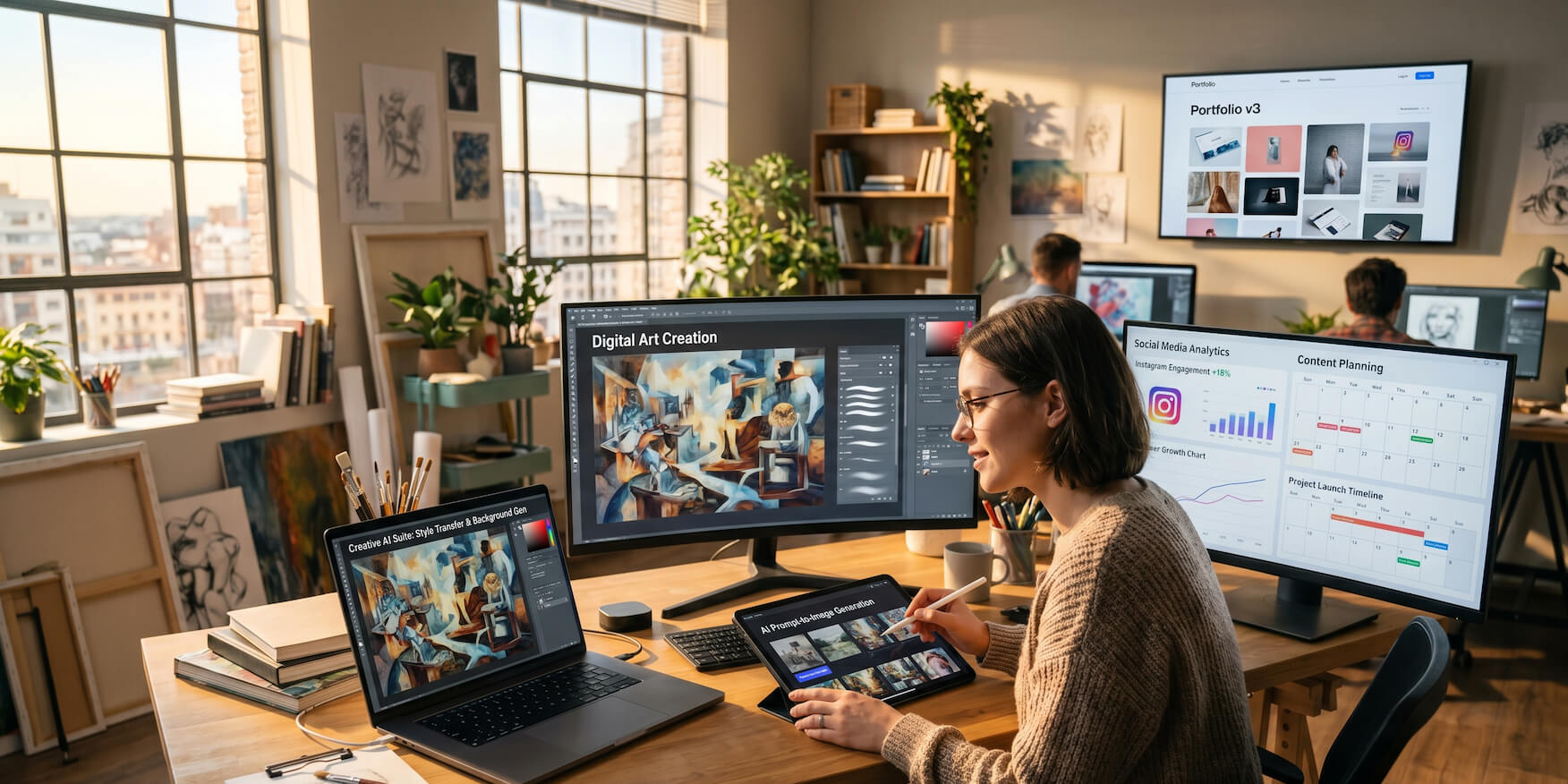
Making great art is one thing. Building a sustainable, growing creative career around it is another challenge entirely — and for most artists, it's the harder of the two. In 2026, AI tools have become the great equalizer for independent creatives. What once required a team of marketers, web developers, business managers, and social media strategists can now be handled — at least in significant part — by a smartly assembled collection of AI tools available to any artist with a laptop and an internet connection.
This guide isn't about which AI tools make the best images. It's about the AI tools that help you grow — build your audience, strengthen your brand, sell your work, manage your business, and create the kind of sustainable creative career that lets you keep making art on your own terms.
Whether you're just beginning to build an online presence or you're an established artist looking to scale, these are the AI tools that will move the needle in 2026.
Why AI Is the Artist's Greatest Business Ally in 2026
The traditional path for an artist building a career involved years of networking, expensive gallery representation, reliance on agents, and the slow accumulation of word-of-mouth reputation. The digital era shortened some of those timelines, but it also introduced new complexity — managing social media algorithms, building email lists, optimizing websites for search engines, running paid advertising, creating content consistently at volume.
AI hasn't eliminated that complexity, but it has dramatically reduced the skill and time required to navigate it. In 2026, an independent artist with the right AI tools can operate with the sophistication of a small creative agency — building brand presence, driving traffic, converting visitors into buyers, and managing client relationships — without hiring a single additional person.
The key is knowing which tools to use for which part of your growth strategy. Let's break it down category by category.
1. Building Your Online Presence — The Foundation of Artist Growth
Before any other growth strategy can work, you need a professional home on the internet. Not a social media profile — those are rented land, subject to algorithm changes and platform decisions you have no control over. A real website. Your own domain. A portfolio that represents your work on your terms.
In 2026, AI has made building that foundation faster and more accessible than at any point in the history of the web.
RocketPages lets you create a stunning portfolio website using AI — generating a gallery-quality online presence that showcases your work exactly as it deserves to be seen, without writing code or hiring a developer. The AI handles layout intelligence, typography pairing, color harmony, and structural decisions that would take a human designer hours to work through. You bring the art; RocketPages builds the stage it deserves.
And if your creative practice has grown into a full business — selling prints, taking commissions, offering licensing, running workshops — RocketPages makes building a complete business website just as effortless, giving you a professional digital storefront that converts visitors into clients and customers. A well-built website is the single highest-leverage investment an artist can make in their long-term growth, and AI has removed every technical barrier that once made it difficult.
2. Content Creation at Scale — Staying Visible Without Burning Out
Consistency is the engine of audience growth in 2026. Algorithms reward creators who post regularly, engage frequently, and show up reliably for their audience. For artists, this creates a painful tension — the time spent creating content is time not spent creating art.
AI tools have largely resolved this tension by dramatically compressing the time required to produce high-quality content.
ChatGPT and Claude — Your Content Strategy Partners
- AI writing assistants like ChatGPT and Claude have become indispensable for artists who need to maintain a consistent content output across platforms. They can draft Instagram captions that tell the story behind a piece, write LinkedIn posts positioning your expertise, generate newsletter content that keeps your email subscribers engaged, and develop YouTube video scripts walking through your creative process — all from brief notes you provide about what you want to communicate.
- The key to using AI writing tools effectively as an artist is treating them as a first-draft collaborator rather than a ghostwriter. Give the AI your raw thoughts, your specific details, your voice and tone — then refine the output until it sounds unmistakably like you. The AI handles structure and polish; you bring the authentic perspective that makes the content worth reading.
Canva Magic Studio — Visual Content at Volume
- Maintaining a consistent, on-brand visual presence across Instagram, Pinterest, TikTok, YouTube thumbnails, email headers, and promotional graphics is a significant workload. Canva Magic Studio compresses that workload dramatically.
- Its AI-powered Magic Resize reformats any design for every platform's specifications simultaneously. Brand Hub ensures every piece of content you create is automatically on-brand — correct colors, fonts, logo placement. Magic Media generates custom imagery when you need visuals that don't exist in your existing portfolio. For artists managing their own social media, Canva Magic Studio is an essential productivity multiplier.
Later and Buffer with AI Scheduling — Automating Consistency
- Tools like Later and Buffer have added AI features that go beyond simple post scheduling. Their AI systems now suggest optimal posting times based on your specific audience's engagement patterns, recommend content formats likely to perform well with your followers, and analyze past performance to inform future content decisions. Set aside a few hours once a week, batch-create your content with AI assistance, schedule it across platforms, and spend the rest of your time making art.
3. Growing Your Audience — AI-Powered Discovery and SEO
Creating content is only valuable if the right people find it. In 2026, AI tools have made search engine optimization and audience discovery dramatically more accessible to independent artists who previously couldn't afford specialist expertise.
Surfer SEO and Semrush — Making Your Content Findable
- Artists who blog about their process, write about their medium, or create educational content have a significant opportunity to drive organic traffic to their websites — if that content is optimized for search. Tools like Surfer SEO and Semrush use AI to analyze what search terms your potential audience is using, what content is currently ranking for those terms, and exactly how to structure and optimize your own content to compete.
- For an artist who writes a monthly blog post about their creative process, adding AI SEO optimization to that existing habit can compound into thousands of monthly visitors over time — all discovering your work through genuine search interest in what you create and how you create it.
Pinterest — The Underrated AI-Assisted Discovery Engine
- Pinterest remains one of the most powerful organic discovery platforms for visual artists in 2026, and its AI-powered recommendation system has become significantly more sophisticated. Artists who optimize their Pinterest presence — using AI-generated keyword-rich pin descriptions, consistent visual branding, and regular pinning cadence — regularly report it as their primary source of new audience members and website traffic.
- The platform's Pinterest Trends tool, which uses AI to identify rising visual and thematic search interests, allows artists to align their work and content with what people are actively discovering and searching for — without compromising their creative vision, but making strategic choices about which pieces to feature and when.
YouTube — Long-Form AI-Assisted Content for Deep Audience Connection
- YouTube remains the most powerful platform for artists building a deeply engaged, loyal audience. Process videos, tutorials, studio tours, and creative philosophy content drive the kind of sustained engagement that social media posts rarely achieve. The challenge has always been the production time involved.
- AI tools have substantially reduced that barrier. AI-powered video editing tools like Descript transcribe your footage, allow you to edit video by editing text, and automatically remove filler words and awkward pauses. Opus Clip analyzes long-form YouTube videos and automatically generates short-form clips optimized for TikTok, Instagram Reels, and YouTube Shorts — multiplying the reach of a single piece of content across every platform simultaneously.
4. Selling Your Art — AI Tools That Convert Audience Into Income
An audience that loves your work is only as valuable as your ability to convert that appreciation into sustainable income. In 2026, AI tools support every stage of the art-selling process — from pricing strategy to customer communication to marketplace optimization.
Pricing Your Work with AI Assistance
- Pricing is one of the most consistently difficult challenges for independent artists. Price too low and you undermine the perceived value of your work and fail to generate sustainable income. Price too high without the reputation to support it and you limit sales. AI tools like PricingAI and the AI features within platforms like Artwork Archive analyze comparable sales data, your audience size, your medium, your career stage, and market trends to generate pricing recommendations that are grounded in real market data rather than guesswork or anxiety.
Print-on-Demand with AI Optimization — Passive Income at Scale
- Platforms like Printful, Society6, and Redbubble allow artists to sell their work as prints, apparel, homeware, and accessories without holding inventory or managing fulfillment. In 2026, all of these platforms have integrated AI tools that optimize product listings — generating keyword-rich titles and descriptions, suggesting which designs perform best on which product types, and recommending pricing based on conversion data across millions of listings.
- For artists with a body of digital work, print-on-demand represents one of the most accessible forms of passive income available — and AI optimization of your listings is the difference between a store that generates consistent sales and one that sits unvisited.
Etsy with AI Listing Optimization
- Etsy remains the dominant marketplace for independent artist sales, and AI-powered listing optimization has become a significant competitive advantage. Tools like Alura and eRank use AI to analyze Etsy search data, identify high-opportunity keywords for your specific art style and medium, and optimize your listing titles, tags, and descriptions for maximum visibility within the platform's search algorithm.
- Artists who apply systematic AI-assisted SEO to their Etsy listings regularly report significant increases in views and conversion rates — not from changing their art, but simply from ensuring the right people can find it.
5. Managing Client Relationships — AI for the Business of Freelance Art
For artists who work on commissions, licensing deals, illustration contracts, or any form of client work, the business management side of a creative career can consume a disproportionate amount of time and mental energy. AI tools have made this dramatically more manageable.
Notion AI — The Creative Business Command Center
- Notion AI transforms what is already the most flexible project management and knowledge base tool into an AI-powered creative business system. Artists use it to track commissions and their status, manage client communication history, draft proposals and contracts, store reference materials and mood boards, and maintain a financial overview of their business — all in one searchable, AI-queryable workspace.
- The AI features allow you to ask natural language questions of your entire workspace — "which clients have pending invoices?", "what's the brief for the Anderson project?" — and get instant, accurate answers. For freelance artists managing multiple simultaneous client relationships, this kind of organized AI assistance is genuinely career-changing.
- For a broader look at how AI tools can systematically improve your creative output and business efficiency, the AI tools for productivity for artists in 2026 guide covers the full spectrum of productivity AI available to creatives — from project management and client communication to time tracking and focused creative work.
HoneyBook and Dubsado — AI-Powered Client Management
- HoneyBook and Dubsado are client management platforms purpose-built for creative freelancers, and both have added significant AI capabilities in 2026. AI-powered lead response automation handles initial client inquiries immediately — even when you're in the middle of a creative session — ensuring potential clients receive a professional, personalized response within minutes rather than hours.
- Smart contract templates generate customized agreements based on project type, client history, and your standard terms. Automated payment reminders reduce the awkward follow-up conversations around late invoices. For any artist taking commission or licensing work, these platforms pay for themselves in the first recovered payment.
6. Learning and Skill Development — AI as Your Personal Creative Mentor
Growth as an artist isn't purely about business metrics. Growing the depth, range, and sophistication of your creative practice is what gives you something worth marketing in the first place. AI has created remarkable new possibilities for accelerated creative learning.
AI-Powered Reference and Study Tools
- Tools like Line of Action and SculptGL, combined with AI-generated custom reference images from Midjourney or Leonardo.AI, give artists the ability to create exactly the reference material they need for any study session — specific poses, lighting conditions, anatomical angles, environmental references — on demand and at no cost. This has substantially raised the ceiling for self-directed creative learning.
Personalized Feedback with AI
- Platforms like Adobe's Sensei and emerging AI critique tools can analyze your artwork and provide structured, actionable feedback on technical elements — composition balance, value distribution, color harmony, perspective accuracy — that would otherwise require access to a skilled mentor or formal art education. While AI feedback is no substitute for human mentorship, it provides a useful, always-available technical check that helps artists identify and address weaknesses more systematically.
- If you're newer to the AI tools landscape and want guidance on where to start building these skills and systems, the AI tools for beginners guide for artists is the most accessible entry point — covering everything from your first tool selection to building a complete AI-assisted creative practice, written specifically for artists with no prior AI experience.
7. Email Marketing — The Highest-ROI Growth Channel for Artists
Social media platforms change their algorithms, reduce organic reach, and occasionally disappear entirely. An email list is the one audience you truly own — and for artists building long-term careers, it is consistently the highest-return growth investment available.
Mailchimp and ConvertKit with AI Features
- Both Mailchimp and ConvertKit have integrated AI tools that make email marketing substantially more effective for independent artists. AI-powered subject line optimization tests variations and predicts open rates before you send. Send time optimization identifies the specific time of day each subscriber on your list is most likely to open an email. Content personalization tailors email content based on subscriber behavior and preferences — showing collectors content about available work while showing fellow artists content about your process.
- AI-generated email sequences can nurture new subscribers through an automated journey — welcoming them to your world, sharing your story, introducing your portfolio, and eventually presenting opportunities to purchase — without requiring you to manually manage every communication.
The Artist Newsletter as a Growth Engine
- The most successful independent artists in 2026 treat their email newsletter not as a sales channel but as a genuine creative publication — sharing works in progress, the thinking behind finished pieces, influences and references, and honest accounts of the creative journey. AI writing tools help maintain the consistency and quality of this kind of newsletter even during periods of intense creative production when writing feels like the last thing you have time for.
Putting It All Together: A Growth Stack for Artists in 2026
The artists seeing the most significant career growth in 2026 aren't using every tool available — they're using the right tools for their specific growth stage and goals, assembled into a coherent system.
A practical growth stack for an independent artist might look like this: RocketPages for a professional portfolio and business website, Canva Magic Studio for consistent branded content creation, Later for scheduled social media distribution, Surfer SEO for making blog and portfolio content discoverable, Notion AI for client and project management, ConvertKit for email list building and nurturing, and Printful with AI-optimized listings for passive print income.
Each tool in this stack handles a specific growth function. Together, they create a system that continues working for your career even when you're fully absorbed in the creative work itself.
For a detailed comparison of which specific platforms perform best in each of these categories, the AI tools comparison guide for artists in 2026 provides side-by-side analysis of features, pricing, and real-world performance — making it easier to choose between options with confidence rather than guesswork.
The Mindset Shift That Makes AI Growth Tools Actually Work
There's a final, non-technical element of using AI for artist growth that's worth addressing directly: mindset.
Many artists resist the business and marketing side of their career because it feels at odds with the purity of creative work. The idea of optimizing content for algorithms, building email funnels, or thinking about conversion rates can feel fundamentally at odds with why most people make art in the first place.
The reframe that makes AI growth tools genuinely useful is this: the business of your art career is what creates the conditions for more art. A portfolio website that brings you consistent client inquiries means financial stability that funds more creative work. An email list that converts means you can make the work you want to make rather than the work that pays the bills. A print-on-demand store that generates passive income means more studio time. Every AI growth tool, used with intention, is ultimately in service of the thing you actually care about — making work that matters.
The best AI tools for artists in 2026 covers both the creative and business sides of the AI landscape for artists — an essential read for anyone building a complete, sustainable creative practice in the current environment.
Final Thoughts
Growing as an artist in 2026 requires two things working in parallel: consistently making work that reflects your evolving creative vision, and consistently building the business infrastructure that gets that work in front of the right people. AI tools have made the second half of that equation dramatically more accessible, more affordable, and less time-consuming than ever before.
The tools in this guide — from portfolio builders and content creation platforms to SEO tools, client management systems, and email marketing platforms — represent the most effective AI-assisted growth stack available to independent artists today. You don't need all of them. You need the ones that address the specific gaps in your current career growth.
Start with the foundation: a professional website that represents your work as it deserves to be represented. Build outward from there, adding tools as your needs become clear. Let AI handle the systems, the consistency, and the business operations — and spend your creative energy on what only you can provide.
Your art deserves an audience. AI in 2026 makes building one more possible than it has ever been.
Ready to explore the full landscape of AI creative tools? The free AI tools guide for artists in 2026 shows you exactly where to start without spending a cent — covering the best zero-cost AI tools for building your creative career from the ground up.