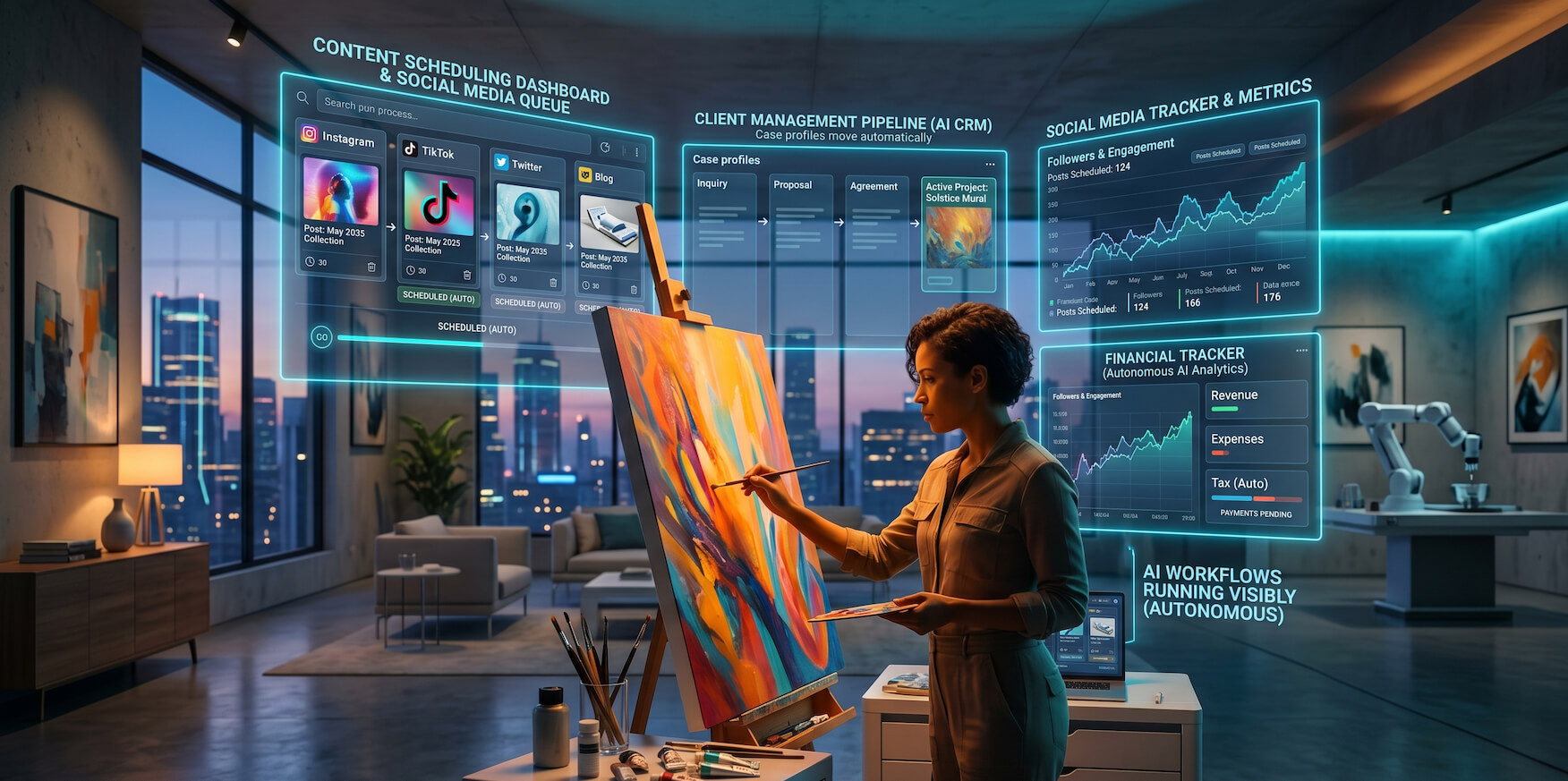
There is a version of the artist's life that most people who enter creative careers imagined — long stretches of uninterrupted studio time, deep focus on meaningful work, the slow and satisfying development of craft over years. Then there is the reality: emails that need answering, invoices that need sending, social media that needs feeding, client briefs that need responding to, tax records that need maintaining, portfolio pages that need updating, and a relentless content calendar that demands attention regardless of what is happening in the studio.
The gap between the imagined creative life and the operational reality of sustaining one has always been one of the defining frustrations of independent creative careers. In 2026, AI automation has done more to close that gap than any previous technology — systematically removing the most time-consuming, repetitive, and administratively demanding elements of running a creative business so that artists can spend more of their professional lives actually making art.
This guide covers AI automation for artists comprehensively — every significant area where automation is delivering real value in 2026, the specific tools powering it, and how to implement it in your own creative practice without technical complexity or significant investment.
What AI Automation Actually Means for Artists
Before diving into specific automation categories, it's worth being precise about what AI automation means in the context of an artist's career — because it's not what many people assume.
AI automation for artists is not about replacing creative decisions with algorithmic ones. The expressive, vision-driven, personally meaningful choices that define genuine creative work remain entirely in human hands. What AI automation handles is everything surrounding that creative work — the operational infrastructure, the repetitive communication, the mechanical consistency requirements, and the business management tasks that consume time and mental energy without contributing to the actual creative output.
Think of it this way: every hour an artist spends on administrative tasks, social media management, client chasing, or content formatting is an hour not spent creating. AI automation systematically reclaims those hours — not by doing the creative work, but by handling everything else so thoroughly and reliably that the artist's attention is free to stay where it belongs.
The cumulative effect of comprehensive AI automation across a working week is significant. Artists who have implemented systematic automation consistently report recovering between ten and twenty hours per week — time that flows directly back into creative production, skill development, or the restorative rest that sustains long creative careers. For a detailed comparison of the specific tools powering these automations, the AI tools comparison guide for artists in 2026 provides honest, structured evaluations across every major platform.
Automation Area 1: Social Media Content and Distribution
Social media is simultaneously one of the most powerful audience-building tools available to independent artists and one of the most voracious consumers of time and creative energy. Maintaining a consistent, high-quality presence across Instagram, Pinterest, TikTok, YouTube Shorts, and LinkedIn — the five platforms that deliver the most value for most visual artists — would consume every available hour if approached without automation.
Content Creation Automation
- The most time-consuming element of social media management is not the posting itself — it's the creation of the content. Writing captions, generating platform-specific visual assets, crafting hashtag strategies, adapting content for different platform formats and audience expectations — these tasks, done manually for five platforms at meaningful posting frequency, represent a substantial weekly workload.
- AI writing tools like ChatGPT and Claude automate the drafting of captions, post copy, and hashtag sets from brief notes about the piece or concept being featured. Rather than writing from scratch, artists provide a few bullet points — what the piece is, what inspired it, what they want the audience to feel or understand — and the AI generates platform-optimized copy in seconds. The artist reviews, refines to match their voice, and moves on.
- Canva Magic Studio automates the visual asset creation side — generating on-brand graphics, resizing designs for every platform format simultaneously, and maintaining consistent visual identity across every piece of content without requiring a separate design session for each platform.
Scheduling and Distribution Automation
- Once content is created, scheduling and distribution tools like Later, Buffer, and Hootsuite automate the actual posting process — queuing content across platforms and publishing it at algorithmically determined optimal times based on your specific audience's engagement patterns. Set aside a few focused hours once a week for batch content creation, load everything into your scheduling tool, and your social media presence operates automatically for the following seven days.
- The compounding benefit of this automation is significant. Consistent posting at optimal times drives stronger algorithmic distribution, which drives faster audience growth, which drives more commercial opportunity — all from a weekly time investment that is a fraction of what manual management would require.
Automation Area 2: Client Communication and Inquiry Management
For artists who take commission or commercial work, client communication is a constant operational drain. Every inquiry requires a response, every project requires status updates, every revision round requires a communication, and every completed project requires an invoice and follow-up. Across a busy commission practice, the volume of client communication can easily consume three to four hours every working day.
Automated Inquiry Response
- The first and highest-impact client communication automation is the initial inquiry response. When a potential client reaches out about a commission, the speed and quality of the response directly impacts conversion rate — clients who receive a prompt, professional, personalized response are significantly more likely to proceed than those who wait days for a reply.
- Client management platforms like HoneyBook and Dubsado automate this response entirely. When an inquiry arrives through your contact form or email, an AI-powered response goes out immediately — acknowledging the inquiry, providing relevant information about your process and pricing, and asking the specific qualification questions needed to assess whether the project is a good fit. This immediate, professional engagement happens automatically, even when you're deep in a creative session with notifications off.
Proposal and Contract Automation
- Once an inquiry is qualified, the next bottleneck in the client pipeline is proposal and contract generation. Writing a customized proposal from scratch for every project — describing your approach, outlining deliverables, specifying terms, and presenting pricing — is time-consuming work that most artists do inconsistently, producing proposals of variable quality depending on how much time is available when the inquiry arrives.
- AI-powered proposal tools generate customized, professionally structured proposals from project briefs in minutes. You provide the key parameters — project scope, deliverables, timeline, pricing — and the AI produces a polished, complete proposal document that reflects your professional standards consistently regardless of how busy you are when the inquiry arrives.
- Contract generation tools like Ironclad and the contract features within HoneyBook and Dubsado automate the legal documentation side — producing customized, legally sound agreements from templates designed specifically for creative professionals. For artists who have historically sent informal agreements or no agreements at all because of the complexity involved, this automation removes a genuine professional risk from their practice.
Progress Update and Follow-Up Automation
- Throughout a commission project, regular communication with clients — progress updates, revision requests, delivery notifications, feedback requests — can be automated through client management platforms that trigger specific communication sequences based on project status changes. When a project moves to the revision stage, a templated update goes out automatically. When a final delivery is made, an invoice triggers automatically. When payment is overdue, a politely worded reminder sends automatically.
- These automated touchpoints keep clients informed and projects moving without requiring the artist to manually manage every communication — reducing the administrative overhead of each client relationship to the genuinely irreplaceable human interactions that require judgment and personal attention.
Automation Area 3: Portfolio and Website Management
A professional portfolio website is the single most important career infrastructure investment an artist can make. But maintaining it — adding new work, updating project descriptions, optimizing for search engines, ensuring technical performance — requires ongoing attention that many artists neglect because it competes with creative production time.
AI website builders have automated much of this maintenance burden.
AI-Powered Portfolio Building and Updates
- RocketPages lets artists create a professional portfolio website using AI that handles the design intelligence, layout decisions, and structural organization automatically — eliminating the weeks of work that manual portfolio site development previously required. For artists who have been operating without a proper professional online presence, this automation removes the single most persistent barrier to having one.
SEO Automation
- Search engine optimization — ensuring your portfolio and content are discoverable by the people actively searching for what you create — has historically required either specialist expertise or significant time investment to manage effectively. AI SEO tools automate the most technically demanding elements of this process: keyword research, content optimization recommendations, technical site audits, and performance tracking.
- Once properly configured, these tools run continuously in the background — monitoring your site's search performance, identifying opportunities for improvement, and flagging issues that need attention — without requiring ongoing manual effort. The discovery traffic this generates compounds over time into a meaningful, self-sustaining audience channel.
Automation Area 4: Email Marketing
Email remains the highest-return marketing channel for most artists — more durable than social media followers, more personal than website traffic, and consistently the most effective channel for driving art sales, commission inquiries, and workshop bookings. The challenge is maintaining it consistently alongside everything else a creative career demands.
Automated Welcome and Nurture Sequences
- The most valuable email automation for artists is the welcome sequence — a series of automated emails that introduce new subscribers to your work, your story, and your creative world over the days and weeks following their signup. Rather than relying on new subscribers to explore your portfolio independently and hoping they find enough to develop a genuine connection, a well-designed welcome sequence guides them through a curated introduction to your work — building the relationship that converts a casual subscriber into a genuine supporter.
- Platforms like ConvertKit and Mailchimp allow artists to design these sequences once and deploy them automatically to every new subscriber forever — delivering a consistent, high-quality onboarding experience without any ongoing effort after the initial setup.
Automated Sales and Launch Sequences
- When an artist is releasing new work, opening commission spots, launching a digital product, or announcing a workshop, email automation handles the entire communication sequence — announcement, reminder, follow-up, and closing — automatically and at precisely timed intervals designed to maximize engagement and conversion. These sequences, once designed and loaded into the platform, run identically for every launch without requiring the artist to manually manage each communication.
Automated Segmentation and Personalization
- AI-powered email platforms automatically segment your subscriber list based on behavior — who opens every email, who has purchased, who signed up through your portfolio versus your social media, who engages with process content versus finished work announcements. This segmentation enables automated personalization — sending collectors updates about available work while sending fellow artists process and technique content — without manually managing multiple separate lists.
- The result is an email marketing system that delivers increasingly relevant, personalized communication to a growing subscriber base — entirely automatically, after the initial setup investment.
Automation Area 5: E-commerce and Sales
For artists selling work online — originals, prints, digital products, or merchandise — the operational overhead of managing sales, fulfillment, customer communication, and inventory can consume significant time that belongs in the studio.
Print-on-Demand Automation
- Print-on-demand platforms like Printful, Society6, and Redbubble automate the entire physical product fulfillment process — printing, packaging, and shipping every order automatically without any involvement from the artist after the initial product setup. Combined with AI-powered listing optimization tools that continuously improve the discoverability and conversion rate of product listings, a well-configured print-on-demand store generates income entirely passively.
- AI tools analyze platform search data and generate keyword-optimized titles, descriptions, and tags for every product listing — dramatically improving organic discoverability within platform search algorithms. For artists with existing digital portfolios, setting up and AI-optimizing a print-on-demand store is one of the highest-return, lowest-ongoing-effort income additions available.
Digital Product Delivery Automation
- For artists selling digital products — brush packs, texture libraries, reference collections, preset files, pattern assets — platforms like Gumroad and Creative Market automate the entire transaction and delivery process. Payment processing, file delivery, receipt generation, and basic customer communication all happen automatically the moment a purchase is made. The artist's ongoing involvement is limited to creating the products and occasionally updating listings — the operational infrastructure runs entirely automatically.
Automated Inventory and Pricing Intelligence
- For artists selling original work through their own website or galleries, AI-powered inventory management and pricing tools automate the tracking of available works, the updating of availability status across platforms when a piece sells, and the analysis of market data to inform pricing decisions. Rather than manually updating multiple platforms every time a sale occurs — a surprisingly common source of overselling complications — automation ensures consistency across every sales channel simultaneously.
- The AI tools for productivity for artists in 2026 guide covers the full landscape of e-commerce and sales automation tools in detail — helping artists build income infrastructure that runs independently of their active working hours.
Automation Area 6: Financial Management and Administration
The financial administration of a freelance creative career — income tracking, expense categorization, invoice management, tax preparation, and financial reporting — is both unavoidable and deeply unrewarding for most artists. It is also one of the areas where AI automation delivers the most immediate, tangible time savings.
Automated Bookkeeping
- AI-powered accounting platforms like FreshBooks and QuickBooks with AI features automatically categorize every transaction — income, materials, software subscriptions, equipment, professional development — as it occurs. Rather than maintaining manual records throughout the year and facing a daunting categorization task at tax time, artists have continuously maintained, automatically categorized financial records available in real time.
- Bank feeds connect directly to the accounting platform, transactions categorize automatically based on learned patterns, and expense receipts photographed with a mobile app are automatically processed and recorded. The manual bookkeeping that previously consumed several hours each month is reduced to a brief weekly review and correction of the rare miscategorization.
Automated Invoicing and Payment Tracking
- AI-powered invoicing tools generate and send invoices automatically based on project completion milestones, track payment status across all outstanding invoices, and send automated payment reminders at configured intervals when invoices go overdue. Rather than manually tracking which clients have paid and chasing those who haven't — a task that is both time-consuming and emotionally uncomfortable for most artists — the automation handles the entire payment lifecycle without ongoing manual involvement.
Tax Preparation Automation
- For artists who have maintained AI-assisted bookkeeping throughout the year, tax preparation is dramatically simplified. AI accounting tools generate the financial reports, expense summaries, and income documentation that tax preparation requires — with all the categorization and calculation already done automatically. Many platforms integrate directly with tax preparation software, reducing the annual tax burden from a multi-day project to a review and submission task.
Automation Area 7: Content Repurposing
One of the highest-leverage content automations available to artists is systematic content repurposing — taking a single piece of content created with significant effort and automatically adapting it for multiple platforms and formats, multiplying its reach without proportionally multiplying the production effort.
Long-Form to Short-Form Automation
- AI tools like Opus Clip automatically analyze long-form video content — YouTube process videos, live streams, recorded tutorials — and extract the most engaging short segments, formatted and captioned for TikTok, Instagram Reels, and YouTube Shorts. A single sixty-minute studio process video can automatically generate eight to twelve short-form clips optimized for different platforms — multiplying the content output from a single recording session by an order of magnitude.
Blog to Social Automation
- AI writing tools can automatically adapt long-form blog content — artist statements, process descriptions, technique guides — into platform-appropriate social media posts, newsletter excerpts, and short-form content pieces for different audience contexts. A single well-written blog post becomes a week's worth of social content across multiple platforms through AI-powered adaptation rather than manual rewriting.
Cross-Platform Format Adaptation
- Canva Magic Studio and similar AI design tools automate the adaptation of visual content across platform format requirements — automatically resizing, reformatting, and adjusting compositions to meet the specific dimensions and visual requirements of Instagram, Pinterest, LinkedIn, YouTube, and email without requiring separate design sessions for each format.
Automation Area 8: Learning and Creative Development
Even the learning dimension of an artist's career benefits from thoughtful automation — not the creative exploration itself, which requires full human presence, but the organizational and research infrastructure that supports it.
Reference Organization Automation
- Artists accumulate vast libraries of reference images, inspiration pieces, and research materials. AI-powered organization tools like Eagle and Milanote automatically categorize and tag visual references as they're collected — building searchable, intelligently organized libraries that surface the right reference material when it's needed rather than requiring manual searching through thousands of unorganized files.
Research and Trend Monitoring Automation
- AI monitoring tools can be configured to automatically track developments in specific areas of interest — new work from artists you follow, trends in your creative niche, platform algorithm changes, market developments, and industry news — and deliver curated summaries at configured intervals. Rather than manually searching for this information across multiple sources, artists receive it automatically in digestible, pre-filtered form.
- For artists beginning to explore these automation possibilities, the AI tools for beginners guide for artists provides an accessible structured entry point — covering the most impactful beginner-friendly automations with clear implementation guidance that doesn't require technical background or specialist knowledge.
Building Your Automation Stack: Where to Start
With eight distinct automation areas covered in this guide, the natural question is where to begin. The answer, as with most strategic questions, depends on where the most significant friction currently exists in your creative career.
The most effective approach to building a comprehensive automation stack is sequential rather than simultaneous — establishing one automation thoroughly before adding the next, ensuring each delivers genuine value before building on top of it.
Start with client communication automation if you're losing significant time to email management and inquiry handling — this delivers the most immediate, tangible time recovery for most commission-taking artists. Start with social media scheduling automation if audience building consistency is your primary challenge — this delivers the most immediate impact on growth trajectory. Start with financial automation if administrative overhead and tax anxiety are your primary pain points — this delivers the most immediate reduction in operational stress.
Whichever area you start with, the principle is the same: implement one automation system fully, develop confidence in it, and verify it's delivering the expected value before expanding to the next area. A comprehensive automation stack built this way — one well-implemented system at a time — becomes genuinely transformative over a three-to-six-month implementation horizon.
The best AI tools for artists in 2026 covers the leading tools across every automation category in detail — helping artists make confident, informed choices about which platforms to invest in for each area of their automation stack.
The Human Elements That Automation Should Never Touch
A complete guide to AI automation for artists has to be honest about what should not be automated — the elements of a creative career where human presence, judgment, and authentic engagement are irreplaceable and where automation would actively undermine rather than support career success.
- Creative vision and expressive decisions are the irreducible human core of artistic work. The choices that make art meaningful — what to express, how to express it, what emotional register to work in, what perspective to bring — cannot and should not be automated. These are where the artist's full presence and intention belong.
- Genuine audience relationships require authentic human engagement that automation can support but never replace. Automated scheduling handles distribution, but the artist personally responding to thoughtful comments, engaging in real conversations with followers, and bringing genuine human warmth to community interactions is what builds the loyal, deeply connected audience that sustains careers. Automation handles the infrastructure of presence; authenticity provides its substance.
- Client relationship management at the human level — understanding a client's actual needs, navigating creative disagreements with empathy and skill, building the trust that generates repeat business and referrals — requires human judgment, emotional intelligence, and personal engagement that no automation can replicate. AI automation handles the operational mechanics of client management; the artist handles the relationship.
- Creative risk-taking and exploration — the experimentation, the failure, the unexpected discovery, the willingness to follow intuition into uncertain territory — is the engine of artistic development and cannot be systematized. Automation creates the time and mental space for this exploration; it cannot do the exploring.
The Compounding Effect: What Comprehensive Automation Actually Delivers
The most important thing to understand about AI automation for artists is that its value is not linear — it compounds. Each automation you implement doesn't just save the time it directly recovers; it creates the conditions for other automations to deliver more value, and for the time recovered to be invested in activities that generate further compounding returns.
Social media automation creates consistent audience growth. Consistent audience growth increases traffic to your portfolio. An AI-built portfolio converts that traffic into clients and sales. Automated client communication converts more inquiries into projects. Automated invoicing ensures those projects are paid on time. Automated bookkeeping makes that income easy to track and optimize. Each element reinforces every other element in a virtuous cycle that becomes more powerful the more completely it's implemented.
The free AI tools guide for artists in 2026 ensures that beginning this compounding automation journey doesn't require significant financial investment — mapping the most powerful zero-cost automation tools available across every category covered in this guide.
Final Thoughts: Automation Is How Artists Get Their Creative Lives Back
The promise of AI automation for artists in 2026 is not efficiency for efficiency's sake. It's something more meaningful: the recovery of the creative life that most artists imagined when they chose this path.
When client communication runs automatically, when social media presence maintains itself, when financial records keep themselves, when portfolio traffic grows without constant manual effort, when sales processes operate independently — what remains is the work itself. The making. The developing. The creating. The building of a body of work that reflects a genuine human perspective on the world.
That is what automation is for. Not to make artists into machines, but to free them from the machine-like tasks that currently consume so much of what should be creative time. The tools to build this automated creative infrastructure exist, they work, and they are accessible to any artist willing to invest the initial setup time.
The studio time you reclaim will be worth it.
Want to identify exactly which tools will deliver the most valuable automations for your specific creative practice? The AI tools comparison guide for artists in 2026 gives you the structured, honest platform evaluation you need to build your automation stack with confidence — and start reclaiming your creative time today.