
August 06, 2025
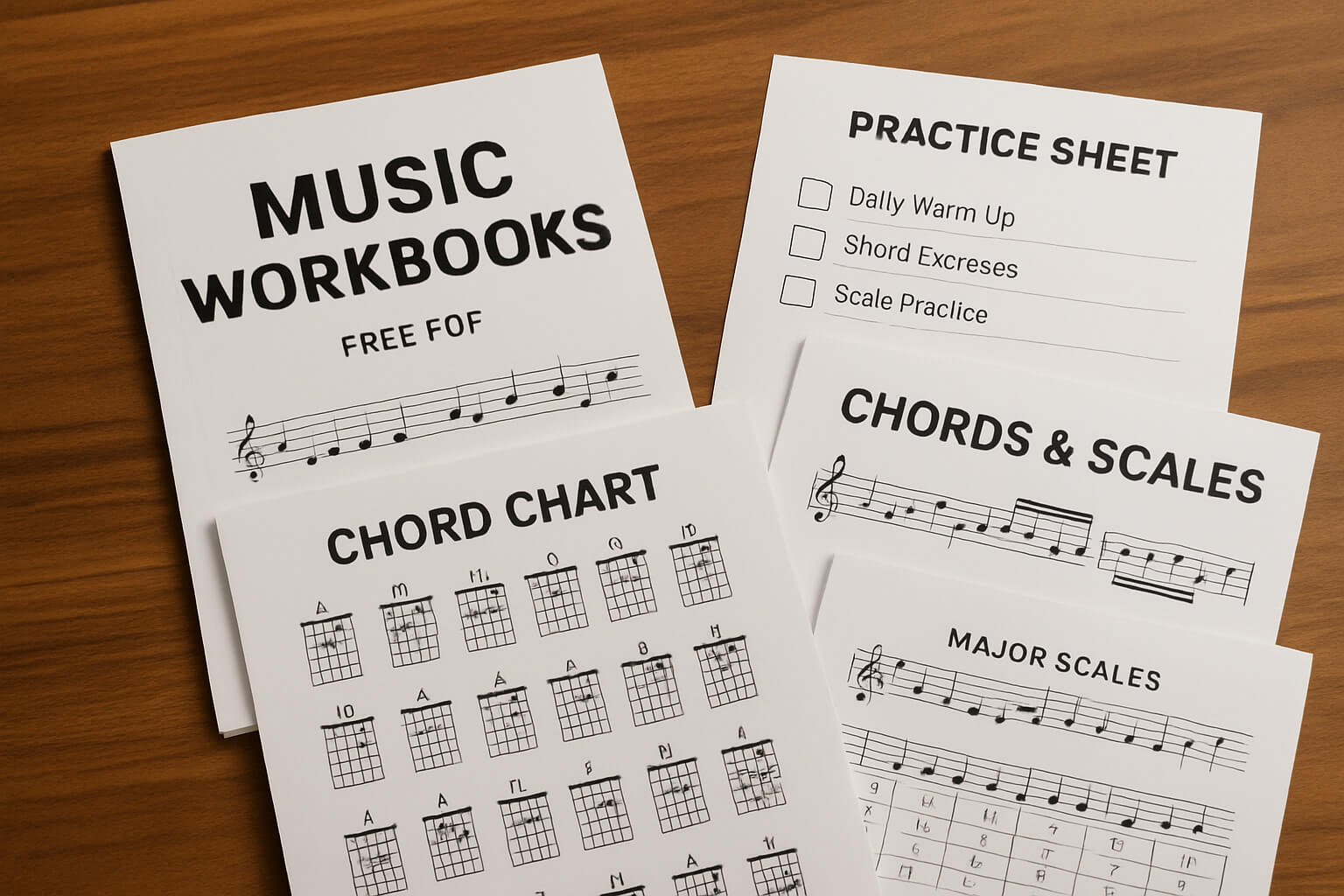
Learning music no longer requires expensive textbooks or subscriptions. Today, you can access an abundance of high-quality, free PDF workbooks that cover everything from instrument technique and music theory to production and ear training. These resources are ideal for self-taught learners, students, educators, and hobbyists alike.
Below is a curated list of the most useful free PDF resources, along with what each offers and how it fits into a broader learning strategy.
Beginner Guitar Chord Practice Checklist
This comprehensive eBook introduces fundamental chord shapes such as open major and minor chords, along with basic strumming patterns to get your rhythm hand moving. It also includes play-along exercises and entry-level songs, making it ideal for those picking up the guitar for the first time.
You’ll learn:
Best For:
More on this topic: Exploring Different Guitar Styles: From Classical to Metal
Seven-Day Beginner Piano Practice Plan
Designed as a week-long crash course, this workbook offers a day-by-day plan to learn basic hand positions, simple melodies, and foundational chords. Each day focuses on building skills such as finger independence, note recognition, and hand coordination, which are crucial for long-term piano progress.
You’ll learn:
Best For:
Recommended companion: Unlocking the Piano Fretboard: Major and Minor Scales Explained
Available on the Music Blog
These compact PDFs act as quick-reference guides for commonly used theory concepts such as scales, intervals, triads, seventh chords, and key signatures. Whether you’re composing, analyzing songs, or preparing for music exams, these sheets simplify the theory process.
You’ll access:
Best For:
Expand your understanding:
This workbook provides progressive listening drills to help you identify intervals, recognize chord qualities, and transcribe melodies by ear. Ear training is a critical skill for playing by ear, improvising, and performing in ensembles.
You’ll practice:
Best For:
Related exercises: How to Develop Perfect Pitch
Available via free rhythm websites.
These printable sheets include clapping exercises, subdivision drills, and time signature variations designed to improve your internal sense of timing. The workbook emphasizes counting and precision, essential for both solo and group musicianship.
You’ll develop:
Best For:
More rhythm tools: Why Understanding Rhythm Is Crucial for Every Musician
Search “Free Music Staff Paper PDF”.
Use blank staff paper to write your own exercises, compose music, or practice transcribing what you hear. Developing your notation skills enhances your understanding of theory, harmony, and arrangement.
These sheets are ideal for:
Best For:
Must-read: The Ultimate Guide to Music Reading for Beginners
How to Organize a Hip-Hop Sample Library
This guide walks producers through how to download, organize, and use royalty-free sample packs inside a DAW (Digital Audio Workstation). It also includes links to curated free downloads and tips on licensing.
You’ll explore:
Best For:
Also check out:
To get the most out of these PDFs:
Remember: consistency beats intensity.
Open a sample page and check what the exercise asks you to do, which knowledge it assumes, and how you can assess an answer. A workbook is more useful when its examples and symbols are explained. Check the source’s current access and printing instructions rather than assuming that every PDF found through a search has the same conditions.
Choose a short exercise matched to a current goal, such as identifying notes or counting a rhythm. Complete it before downloading a large collection. If the instructions remain unclear, find the prerequisite explanation or ask for help. A folder full of worksheets does not provide a learning sequence by itself.
After completing an exercise, try an appropriate musical version: clap the rhythm, find the notes on an instrument, or listen to an example. Compare what you wrote with what you can hear or perform. This connects a worksheet answer to the skill it is intended to support rather than treating page completion as the entire goal.
Keep corrections visible and describe the error briefly. Confusing a symbol, forgetting a rule, and rushing an answer call for different next steps. Review a few corrected examples before moving on. The record should help you recognize a pattern in your understanding, not simply show how many pages you finished.
Use the workbook’s sequence when it is clear and suitable, and pause when a prerequisite is missing. Keep the source link, current page, and next task together. A small set of well-understood exercises is easier to revisit than a large stack whose purpose and order have been forgotten.
Stay up to date with the latest tips, expert insights, product reviews, and step-by-step guides to help you grow, create, and succeed—no matter your industry or passion.


