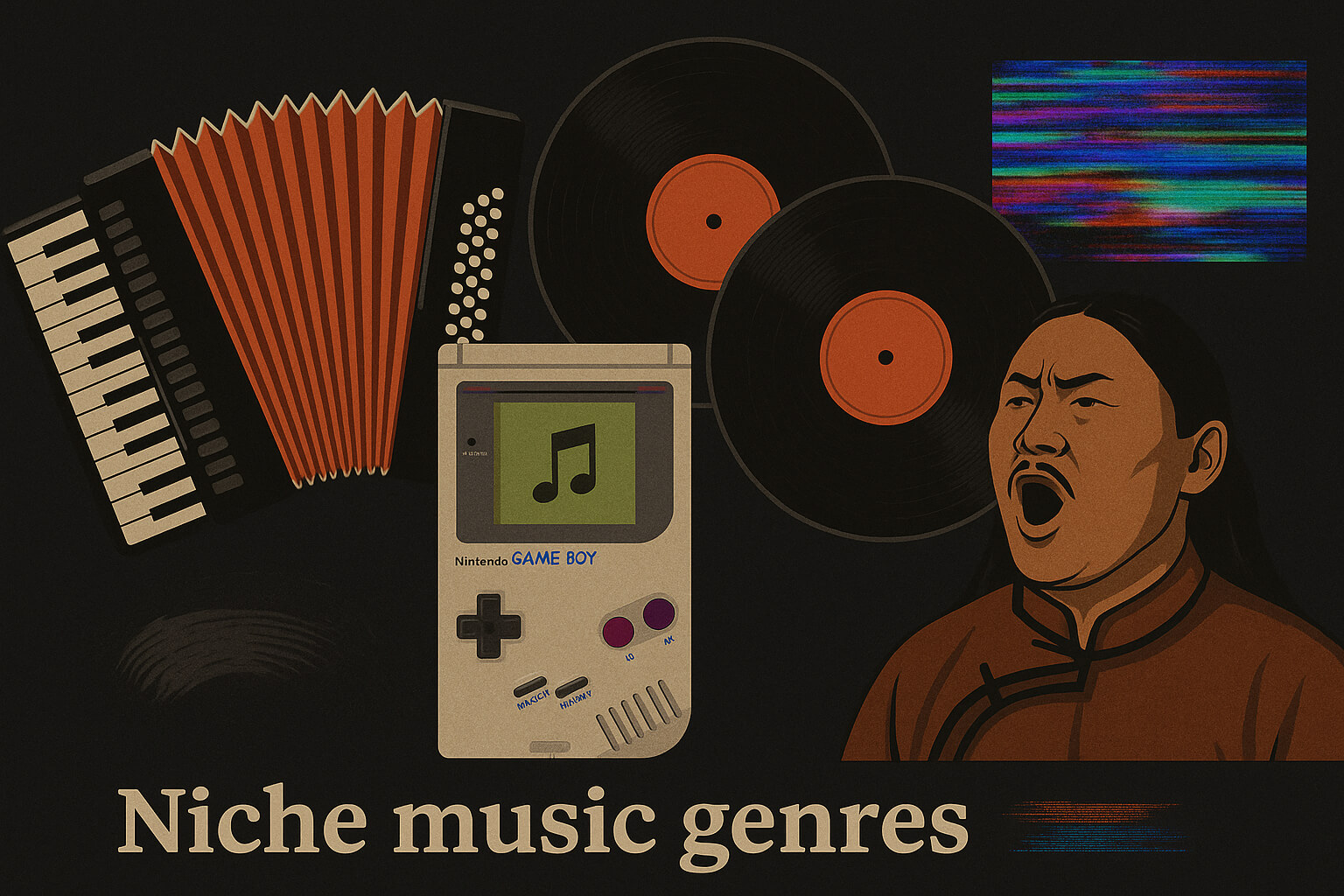
In a music industry dominated by mainstream pop, commercial hip-hop, polished EDM, and viral TikTok trends, it is easy to assume the most exciting music lives at the center of popular culture. In reality, some of the most creative, emotionally powerful, and innovative sounds exist far outside the algorithm.
Across underground communities, regional traditions, internet-born subcultures, and experimental music scenes, obscure genres continue to shape the future of music in ways mainstream listeners often overlook. These genres are not simply “different” for the sake of being unusual. They represent alternative ways of thinking about rhythm, melody, emotion, production, storytelling, and identity.
For listeners, discovering niche genres can completely change the way music feels. For producers and artists, these styles offer fresh creative tools that can inspire more original songwriting and production choices. Unfamiliar scales, unconventional arrangements, raw textures, and regional musical traditions often introduce ideas that mainstream playlists rarely provide.
If you are tired of repetitive recommendations, looking to deepen your musical taste, or searching for inspiration that feels genuinely new, exploring obscure genres is one of the best creative investments you can make.
For creators who want immediate inspiration while exploring new sounds, you can also browse this curated collection of royalty-free music tracks, which includes diverse sounds suitable for experimentation and content creation.
Why Exploring Obscure Music Genres Is Important
Obscure genres matter because they preserve many of the qualities mainstream music often loses during commercialization. Underground and regional scenes tend to prioritize experimentation, cultural identity, emotional authenticity, and creative risk over mass-market accessibility.
As a result, niche genres frequently sound more personal, less predictable, and more artistically adventurous.
They Expand Your Musical Vocabulary
- Every genre develops its own musical language. Some emphasize rhythm over melody. Others prioritize atmosphere, repetition, improvisation, or texture. Listening to unfamiliar styles exposes you to creative ideas you may never encounter through mainstream music alone.
- A producer who studies jungle might develop stronger rhythmic instincts. A songwriter inspired by qawwali may approach emotional progression differently. A listener who explores vaporwave may begin noticing how nostalgia and mood shape sound design.
- This type of exposure broadens both creativity and listening intelligence.
- If you are still developing foundational musical understanding, resources like learning music from scratch and understanding music genres can help provide useful context.
They Help Artists Develop Originality
- One reason many modern songs sound similar is because artists often draw inspiration from the same mainstream influences. Truly distinctive musicians usually build their identities by combining less obvious inspirations.
- Exploring obscure genres can help artists escape creative repetition and discover techniques that feel fresh.
- Instead of copying current trends, musicians can absorb ideas from unexpected places:
- Rhythmic structures from African or Caribbean traditions
- Ambient textures from experimental electronic music
- Vocal phrasing inspired by devotional music
- Minimalist production techniques from retro gaming culture
- These influences often lead to more original work.
They Encourage Cultural Discovery
- Many niche genres are deeply connected to local traditions, spirituality, migration, history, or community identity. Listening to them provides more than entertainment. It offers insight into how different cultures express emotion, ritual, and storytelling through sound.
- This broader perspective connects naturally with topics like music and cultural identity and global music traditions.
1. Vaporwave
Vaporwave is one of the most recognizable internet-born music genres of the modern era. Emerging in the early 2010s, it developed from slowed-down samples of corporate music, smooth jazz, elevator music, retro advertisements, and forgotten media fragments.
The result is strangely emotional. Vaporwave sounds nostalgic, detached, dreamy, and occasionally unsettling. It transforms discarded commercial audio into atmospheric art.
Beyond the music itself, vaporwave also created a complete visual aesthetic built around:
- VHS distortion
- 1990s internet graphics
- Neon colors
- Roman statues
- Retro consumer culture
- Digital decay
What makes vaporwave fascinating is its layered meaning. Some listeners hear irony and satire. Others experience genuine emotional nostalgia. Many artists intentionally blur the line between criticism and comfort.
Why Vaporwave Matters
- Vaporwave changed how internet culture interacts with music. It demonstrated that digital nostalgia could become an artistic language rather than simply a retro trend.
- It also influenced several modern aesthetics, including:
- Lo-fi music culture
- Internet ambient music
- Visual nostalgia trends
- Experimental sample-based production
- For producers, vaporwave teaches valuable lessons about atmosphere, texture, pacing, and emotional minimalism.
- If digital music culture interests you, explore the future of music streaming in 2026.
2. Zydeco
Zydeco is a vibrant dance-oriented genre deeply rooted in the Creole communities of Louisiana. It combines elements of blues, Cajun music, folk traditions, rhythm and blues, and regional storytelling into an energetic musical style centered around accordion and washboard rhythms.
Unlike heavily polished mainstream music, zydeco feels raw, communal, and physically alive. It is music designed for dancing, gatherings, celebrations, and shared cultural expression.
The genre developed organically within real communities rather than through commercial marketing trends, which gives it an authenticity many modern listeners find refreshing.
Why Zydeco Matters
- Zydeco demonstrates how cultural fusion naturally creates new musical forms. Instead of forcing genres together artificially, it evolved through generations of shared experience and regional identity.
- For musicians, zydeco offers valuable lessons in:
- Groove-focused songwriting
- Rhythmic energy
- Audience interaction
- Organic instrumentation
- It also reminds listeners that some of the world’s richest music traditions remain underrepresented in mainstream platforms.
- For broader exploration, visit world music genres you may not know.
3. Tuvan Throat Singing
Tuvan throat singing is one of the most extraordinary vocal traditions in the world. Originating in the Tuva region of southern Siberia, this technique allows singers to produce multiple pitches simultaneously through overtone manipulation.
To first-time listeners, the sound can feel almost supernatural.
Some forms imitate natural sounds such as wind, rivers, or animal calls. Others create deep drones paired with whistle-like harmonics floating above the primary tone.
But throat singing is not merely technical performance. It reflects a deep cultural relationship with landscape, spirituality, and the natural environment.
Why Tuvan Throat Singing Matters
- This tradition completely changes how listeners think about the human voice.
- Instead of treating vocals only as melody carriers, throat singing transforms voice into texture, resonance, atmosphere, and meditation.
- For ambient artists, experimental producers, film composers, and sound designers, this genre can be creatively transformative.
- It encourages:
- Slower listening
- Greater attention to resonance
- Appreciation for sonic space
- Awareness of cultural sound traditions
4. Chiptune
Chiptune, often called 8-bit music, uses the sound hardware of vintage gaming systems such as the Nintendo Game Boy and Commodore 64.
Originally, these sounds existed because early hardware had severe technical limitations. Yet artists eventually transformed those restrictions into a complete musical language.
The genre is characterized by:
- Bright digital tones
- Simple waveforms
- Fast melodies
- Nostalgic textures
- Minimalist arrangements
Despite its simplicity, chiptune can be deeply emotional and surprisingly complex.
Why Chiptune Matters
- Chiptune proves creativity often thrives under limitation.
- Because artists have fewer sonic tools available, they must focus heavily on:
- Melody
- Rhythm
- Arrangement
- Efficiency
- Emotional clarity
- This makes chiptune especially valuable for beginner producers who want to strengthen composition skills instead of relying entirely on expensive plugins or layered production.
- Its influence can still be heard in indie game soundtracks, experimental electronic music, and retro-inspired pop production.
- Creators interested in experimenting with unique sounds can also try AI-assisted music creation tools.
5. Mathcore
Mathcore is an aggressive and technically demanding genre that combines hardcore punk and metal with highly irregular rhythms, sudden structural changes, dissonance, and extreme precision.
At first listen, mathcore may sound chaotic or overwhelming. However, beneath the intensity lies carefully controlled complexity.
The genre often uses:
- Odd time signatures
- Abrupt tempo changes
- Dissonant guitar work
- Sudden silence and breakdowns
- Hyper-precise rhythmic structures
Why Mathcore Matters
- Mathcore forces musicians to rethink rhythm and structure entirely.
- Instead of relying on predictable verse-chorus arrangements, mathcore embraces unpredictability while maintaining intentional design.
- For drummers, guitarists, and producers, studying mathcore can improve:
- Rhythmic awareness
- Timing accuracy
- Structural creativity
- Dynamic tension building
- It is particularly valuable for artists looking to escape formulaic songwriting.
- Musicians interested in rhythm can deepen their understanding with rhythm fundamentals and why rhythm matters.
6. Glitch Hop
Glitch hop sits at the intersection of hip-hop groove culture and experimental electronic sound design. It takes the rhythmic foundation of hip-hop—steady beats, head-nodding swing, and bass-driven structure—and fractures it using digital manipulation techniques such as stuttering, slicing, time-shifting, and audio “errors” that would normally be considered unwanted in traditional production.
What makes glitch hop distinctive is not just its sound palette, but its approach to imperfection. Instead of polishing audio into clean, predictable patterns, it embraces instability. You’ll often hear beats that feel like they are constantly being disrupted, reassembled, and reinterpreted in real time, while still maintaining a strong underlying groove.
Typical sonic elements include:
- Heavy, sub-focused basslines that anchor the rhythm
- Fragmented drum patterns with intentional digital “glitches”
- Short, chopped vocal samples used more like rhythmic instruments
- Synthetic textures that shift unpredictably across the arrangement
- A balance between structured groove and controlled chaos
Why Glitch Hop Matters
- Glitch hop is important because it demonstrates how modern production tools can be used creatively rather than conventionally. In most traditional production, the goal is to eliminate noise, distortion, or artifacts. Glitch hop does the opposite—it turns those imperfections into expressive musical elements.
- For producers, this genre is especially useful for learning:
- Advanced audio editing and slicing techniques
- Creative use of digital artifacts and FX processing
- Non-linear beat construction
- How to maintain groove while experimenting with chaos
- It also serves as a bridge genre. Listeners who find pure experimental electronic music too abstract can still connect with glitch hop because its rhythmic foundation remains rooted in hip-hop sensibility.
7. Qawwali
Qawwali is a powerful devotional music tradition rooted in Sufi spirituality, primarily practiced in South Asia, especially in India and Pakistan. It is performed in groups and is designed not just for entertainment, but for inducing a heightened emotional and spiritual state in both performers and listeners.
A typical qawwali performance revolves around a lead vocalist supported by a chorus, harmonium, and percussion instruments such as tabla or dholak. The structure is built on repetition, gradual escalation, and emotional intensity rather than conventional verse-chorus songwriting.
As a performance progresses, phrases are repeated and intensified, dynamics increase, and rhythmic energy builds until the music reaches an almost trance-like climax. Even without understanding the lyrics, listeners often report a strong emotional or spiritual reaction.
Core musical characteristics include:
- Repetitive lyrical phrases used to build emotional momentum
- Call-and-response interaction between lead singer and chorus
- Harmonium-based melodic support
- Strong rhythmic cycles that gradually accelerate or intensify
- Improvisation within a structured spiritual framework
Why Qawwali Matters
- Qawwali is significant because it redefines what “emotional structure” in music can look like. Instead of relying on contrast between verse and chorus, it builds intensity through repetition and gradual transformation.
- For musicians and composers, it offers deep insight into:
- How repetition can increase emotional intensity rather than create boredom
- How collective vocal performance creates layered emotional texture
- How rhythm and devotion can be integrated into musical storytelling
- How music can function as a spiritual and communal experience
- Qawwali also expands listening perspectives beyond Western frameworks of composition, offering a different understanding of time, emotion, and progression in music.
8. Jungle
Jungle is one of the most influential underground electronic genres to emerge from early 1990s UK rave culture. It is built on fast breakbeats, heavy basslines, and complex rhythmic layering, often combined with dub, reggae, and early hip-hop sampling techniques.
At its core, jungle is defined by its rhythm. Drum patterns are often extremely fast, yet not purely mechanical. They are chopped, rearranged, and layered in ways that create a sense of controlled urgency. This gives jungle its signature feeling of intensity combined with groove.
The genre also has deep cultural roots in sound system culture, pirate radio stations, and urban underground communities, which helped shape its raw and experimental character.
Key elements of jungle include:
- Rapid breakbeat drum programming, often exceeding standard BPM ranges
- Deep, rolling sub-bass that supports rhythmic complexity
- Heavy use of sampled drum breaks and vocal snippets
- Influence from reggae and dub sound system traditions
- A balance between chaos, groove, and atmosphere
Why Jungle Matters
- Jungle is important because it fundamentally reshaped how electronic rhythm is understood. It pushed drum programming beyond linear patterns and introduced a more fluid, chopped approach to beat construction.
- For producers, jungle is a masterclass in:
- Advanced rhythm manipulation and breakbeat editing
- Bass design that interacts dynamically with percussion
- High-energy arrangement without losing musical coherence
- Sampling as a core compositional tool
- Even today, jungle continues to influence drum and bass, UK garage, and modern experimental electronic music. Its legacy is visible in almost every genre that prioritizes rhythmic complexity.
9. Folktronica
Folktronica blends acoustic, folk-inspired songwriting with electronic production techniques, creating a hybrid sound that feels both organic and digital at the same time. It often features traditional instruments like guitar, piano, or strings combined with ambient synth layers, electronic beats, and atmospheric processing.
What makes folktronica especially compelling is its emotional tone. Unlike purely electronic genres that can feel mechanical or purely acoustic genres that feel traditional, folktronica sits in a middle space that often feels intimate, reflective, and cinematic.
Common sonic traits include:
- Acoustic instruments blended with electronic textures
- Soft, often introspective vocal delivery
- Ambient soundscapes and reverb-heavy production
- Lo-fi or minimal beat structures
- Field recordings or natural environmental sounds
Why Folktronica Matters
- Folktronica is valuable because it demonstrates how emotional storytelling can exist across both organic and digital sound worlds. It removes the idea that electronic production is inherently cold or that acoustic music must remain traditional.
- For creators, it is especially useful for learning:
- How to blend acoustic and electronic elements naturally
- How to design atmosphere without overpowering vocals
- How to build mood-driven arrangements
- How to create subtle genre fusion without losing identity
- It is widely used in indie music, cinematic scoring, ambient composition, and experimental pop, making it one of the more versatile hybrid genres.
10. Space Jazz
Space jazz, sometimes referred to as cosmic or spiritual jazz, expands traditional jazz into expansive, atmospheric, and often futuristic sonic territory. It takes the improvisational core of jazz and pushes it into ambient, experimental, and cinematic directions.
Unlike traditional jazz forms that focus on swing rhythms or structured chord progressions, space jazz often emphasizes texture, atmosphere, and extended improvisation. Performances can feel less like structured songs and more like evolving sonic journeys.
Common characteristics include:
- Extended instrumental improvisation
- Use of synthesizers alongside traditional jazz instruments
- Slow-moving harmonic progressions or modal structures
- Ambient layers and atmospheric effects
- A sense of openness, space, and emotional exploration
Why Space Jazz Matters
- Space jazz is important because it expands the definition of jazz itself. It shows that improvisation is not limited to rhythm-heavy swing or traditional forms but can also exist in ambient and cinematic environments.
- For composers and producers, it offers insight into:
- Long-form musical storytelling without strict structure
- Building atmosphere through minimal harmonic movement
- Blending acoustic performance with electronic sound design
- Creating immersive, emotionally expansive soundscapes
- It is especially influential in film scoring, ambient music, experimental jazz, and modern electronic fusion genres.
Conclusion
Obscure music genres open the door to a much wider and more creative world of sound beyond mainstream trends. They reveal new ways of thinking about rhythm, emotion, culture, and production that you rarely find in commercial music.
Exploring them helps listeners discover fresh inspiration and helps creators develop more original and distinctive styles. In a streaming-driven world, going beyond the charts is one of the best ways to keep music discovery exciting, personal, and endlessly evolving.