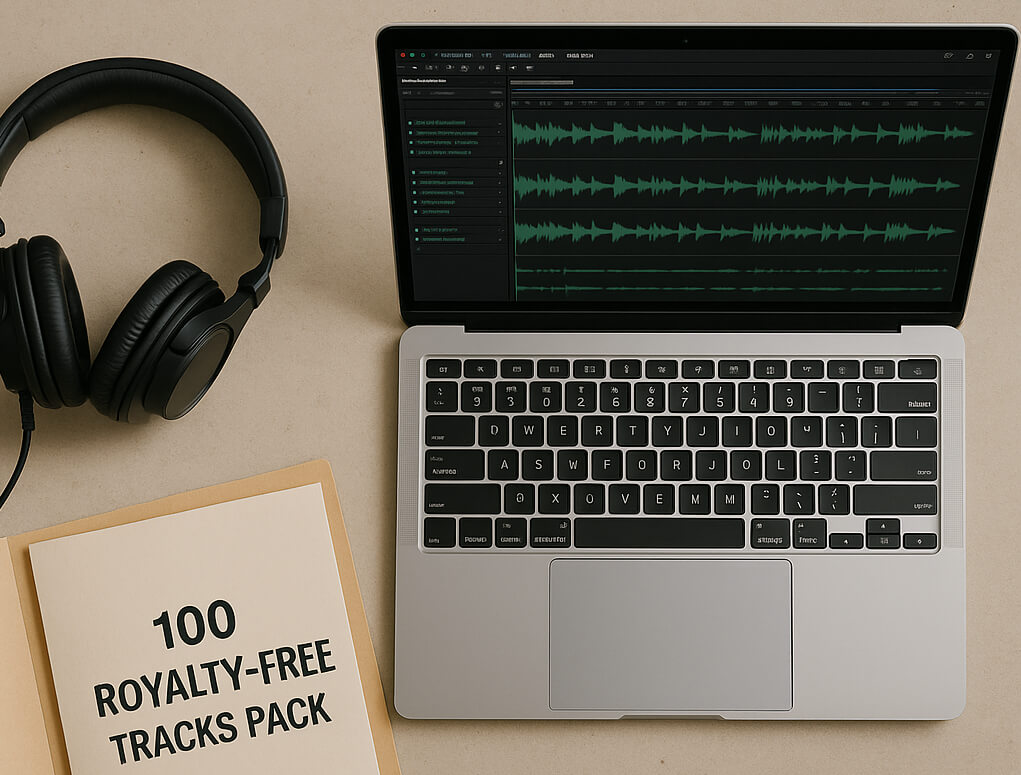
You have spent hours filming, editing, and perfecting your video. The cuts are clean, the visuals are compelling, and the narrative arc is exactly what you envisioned. And then you add the music — and everything transforms. The right track turns a good video into a great one. It sets the emotional tone before a single word is spoken. It carries the viewer through transitions, amplifies moments of drama or joy, and creates the professional polish that separates amateur content from work that commands attention and builds audiences.
Music is not optional in modern content creation. It is essential infrastructure — as fundamental to the quality of video, podcast, and multimedia content as lighting is to photography or sound design is to film. And yet it is one of the dimensions of content creation that the most creators get wrong, either by neglecting it entirely and accepting the thin, echoey feeling of silence, or — far more dangerously — by using popular copyrighted music without proper licensing and exposing their work and their channel to copyright strikes, content removal, monetization loss, and in the worst cases, legal action.
The solution — royalty-free music licensed for content use — has never been more accessible, more affordable, or more diverse in its range of genres and styles. But navigating the landscape of royalty-free music requires understanding what the term actually means, what rights it actually grants, and how to evaluate music libraries and packs to ensure that what you are purchasing genuinely covers the uses you need.
This comprehensive guide covers everything content creators need to know about royalty-free music: the legal framework that makes it work, the specific rights it grants and its limitations, the different types of music licensing you will encounter, how to choose music that genuinely fits your content and platform needs, and why investing in a high-quality curated pack like our 100-Track Royalty-Free Collection is the most efficient and most reliable solution for creators who need professional-quality music across a wide range of projects.
Understanding Music Copyright: The Legal Foundation Every Creator Needs
Before diving into royalty-free music specifically, it is essential to understand the copyright framework that makes licensing necessary in the first place — because understanding the problem is the key to understanding why the solution matters.
How Music Copyright Works
- Music copyright is actually two separate copyrights, a distinction that confuses many creators and that has practical implications for content use.
- The composition copyright protects the underlying musical composition — the melody, harmony, lyrics, and arrangement that constitute the song as a piece of music. This copyright typically belongs to the songwriter and is often administered by a music publisher. When you use someone else's song in your content, you need a license for the composition copyright.
- The sound recording copyright protects the specific recording of the composition — the particular performance captured in a specific recording session, by specific musicians, using specific production techniques. This copyright typically belongs to the record label or the recording artist. When you use a specific recording of a song, you need a license for the sound recording copyright as well.
- For most popular music, this means obtaining two separate licenses from two separate rights holders — a licensing arrangement that is typically expensive, complex, and in many cases simply unavailable for individual content creators who are not major media companies.
- Understanding Music Copyright for Beginners provides the foundational education in music copyright that every content creator needs — covering the composition versus sound recording distinction, how copyright is administered through performing rights organizations and music publishers, what uses require what types of licenses, and what happens when content creators use copyrighted music without proper authorization. For any creator who has ever wondered why music licensing is so complicated, this resource provides the clear, accessible explanation that makes the royalty-free solution genuinely understandable.
The Consequences of Using Music Without a License
- The consequences of using copyrighted music in content without proper licensing range from annoying to catastrophic, depending on the platform and the rights holder involved.
- On YouTube: YouTube's Content ID system — one of the most sophisticated automated copyright enforcement systems in existence — scans every video uploaded to the platform against a database of copyrighted audio content. When a match is detected, the rights holder can choose to: block the video entirely, claim the advertising revenue from the video for themselves (effectively monetizing the creator's content for someone else's benefit), or track the video's viewership data. A single copyright claim can cost a monetized creator their revenue on a popular video; multiple claims can put a channel's monetization status at risk.
- On streaming platforms: Similar automated detection systems operate on Twitch, Facebook, Instagram, and other platforms that host user-generated content with music. A stream or video that triggers a copyright claim can be muted, removed, or result in account suspension.
- Legal action: For commercial uses — advertising, promotional video, sponsored content — unauthorized music use creates direct legal liability. Rights holders who discover their music being used in commercial content without license can pursue infringement claims, and the statutory damages available under copyright law — up to $150,000 per infringed work for willful infringement — make even brief unauthorized use potentially very expensive.
- The practical implication for every content creator is unambiguous: any music used in publicly posted content must be either licensed, in the public domain, or covered by a genuine fair use claim. And for most practical content creation purposes, licensing is the only viable path.
- Understanding Music Copyright for YouTube Videos addresses the specific copyright framework that YouTube creators encounter — how Content ID works, what types of claims can be filed and disputed, how to avoid claims through proper licensing, and what resources YouTube itself provides for licensed music use. For the majority of content creators whose primary platform is YouTube, this resource provides the platform-specific knowledge that general copyright education does not fully address.
What Does "Royalty-Free" Actually Mean?
"Royalty-free" is one of the most commonly misunderstood terms in content creation, and the misunderstanding can lead to expensive mistakes. Let us be precise about what it means — and what it does not.
The Correct Definition
- "Royalty-free" does not mean free. It means that after you pay the initial license fee (or in some cases, for free through platforms that monetize through advertising or premium subscriptions), you do not owe ongoing royalties — periodic payments — each time the music is used. In traditional music licensing, royalties accrue each time a licensed work is used commercially, creating an ongoing financial obligation. Royalty-free licensing eliminates this ongoing obligation by bundling the cost of all permitted uses into the initial license fee.
What Royalty-Free Is Not
- Royalty-free is not copyright-free. The music is still protected by copyright. The original creator or rights holder retains copyright ownership. What you have is a license — permission to use the music in specified ways — not ownership of the music itself.
- Royalty-free is not a blanket license for all uses. Royalty-free licenses specify what uses are permitted and what uses are not. A license that permits use in YouTube videos may or may not permit use in broadcast television advertising. A license that permits use in non-monetized content may or may not permit use in monetized content. Reading and understanding the specific terms of each royalty-free license is essential.
- Royalty-free music is not all equal in quality or coverage. The royalty-free music marketplace includes everything from high-quality professionally produced tracks licensed for broad commercial use to low-quality productions with restrictive licenses that create more problems than they solve. Choosing the right source matters significantly.
- What Is the Difference Between Free, Royalty-Free, and Copyright-Free Music? provides the precise, clear definitions that cut through the confusion surrounding these commonly misused terms — explaining what each category actually grants, what the practical differences are for content creators, and what to look for when evaluating any music source's licensing terms. For creators who have ever been uncertain about whether a specific source of free music was actually safe to use, this resource provides the analytical framework for making that determination confidently.
The Content Creator's Music Licensing Landscape
Beyond royalty-free music, creators encounter several other categories of music licensing that are worth understanding to make fully informed decisions.
Sync Licensing
- A sync license — short for synchronization license — authorizes the use of a specific piece of music in synchronization with visual content, which is exactly what content creators do when they add music to a video. Most professional music licensing for film, advertising, and broadcast content is conducted through sync licensing, which involves negotiating with both the composition copyright holder and the sound recording copyright holder and typically involves per-use fees that are cost-prohibitive for individual creators.
Creative Commons Licensing
- Creative Commons is a nonprofit organization that provides a framework of free, standardized licenses through which creators can permit others to use their work under specified conditions. Creative Commons licenses range from very permissive (allowing commercial use with attribution) to more restrictive (permitting only non-commercial use or prohibiting derivative works).
- Creative Commons music is available through platforms like Free Music Archive, ccMixter, and Jamendo. The key for creators is understanding which specific Creative Commons license applies to each track — because some Creative Commons licenses prohibit commercial use, which means they cannot be used in monetized content without violating the license terms.
Subscription Music Platforms
- Services like Musicbed, Artlist, Epidemic Sound, and similar platforms offer subscription-based access to royalty-free music libraries, typically charging monthly or annual fees in exchange for broad licensing rights to their catalog. These platforms have built large libraries of high-quality music and are widely used by professional content creators.
- Top 10 Royalty-Free Music Platforms for Creators in 2025 provides a comprehensive, comparative review of the leading royalty-free music platforms available to creators in 2025 — evaluating each on catalog quality, licensing terms, pricing, ease of use, and the specific types of content for which each is most suitable. For creators evaluating subscription services versus one-time purchase packs, this resource provides the comparative framework for making an informed choice.
Why a Curated 100-Track Pack Is the Right Solution for Many Creators
While subscription platforms offer access to large catalogs, a carefully curated royalty-free music pack offers several advantages that make it the superior solution for many creators.
Immediate Ownership Without Recurring Costs
- A one-time purchase pack provides permanent access to a defined library of tracks without the ongoing subscription cost that accumulates significantly over time. For creators who have a defined set of content needs — specific genres, specific moods, specific use cases — a well-chosen pack covers those needs indefinitely from a single investment.
- The economics are straightforward: a subscription platform charging $20 to $50 per month costs $240 to $600 per year, and access to the music ends when the subscription ends. A one-time pack purchase provides permanent access — the tracks are yours for life, for as many projects as you choose to use them in.
Quality and Curation
- A carefully curated pack — assembled with specific creator use cases in mind, professionally produced and mastered to commercial standards — offers predictable quality across every track. Large subscription catalogs necessarily include tracks of variable quality; the curation work has already been done in a premium pack.
- Our 100-Track Royalty-Free Collection includes eight genre categories — Cinematic, Acoustic, Ambient, Electronic, Lo-Fi, Corporate, Indie & Pop, and Jazz — with each track professionally produced, mixed, and mastered to the highest commercial standards. Whether you are building tension in a documentary, adding warmth to a travel vlog, or providing polished background for a corporate presentation, the collection provides the range and quality to cover every content need.
Clear, Permanent Licensing
- A well-documented one-time purchase license provides clear, permanent documentation of your right to use the tracks — eliminating the uncertainty that can arise with subscription platform licenses about what exactly is covered and what happens to content published during the subscription period if the subscription lapses.
- Best Royalty-Free Music for Commercial Use: A Guide examines the specific licensing considerations for commercial use of royalty-free music — what "commercial use" means in different contexts, what license terms are required for different commercial applications, and how to evaluate whether a specific royalty-free license genuinely covers the commercial uses you need. For creators whose content includes monetized videos, sponsored content, advertising, or commercial production, understanding these distinctions is essential.
Perfect for Every Type of Creator
Photographers and Videographers
- For photographers creating portfolio reels, wedding films, real estate videos, and client presentations, music is the difference between a showcase and an experience. The right track creates emotional resonance that transforms a sequence of beautiful images into a narrative that moves the viewer. Our collection's Cinematic and Acoustic genres are particularly suited to these applications — providing the emotional depth and organic warmth that visual storytelling requires.
YouTube Creators and Video Bloggers
- YouTubers face the most acute music licensing challenges of any creator category, given Content ID's sophistication and the direct financial consequences of copyright claims on monetized channels. A royalty-free pack that is genuinely cleared for YouTube monetization — one that will not trigger Content ID claims — is an investment in channel security that pays dividends on every video published.
- Best Platforms to Download Background Music for YouTube Videos compares the options available to YouTube creators specifically — evaluating each platform's Content ID status, its licensing terms for monetized YouTube content, and the practical user experience of finding and downloading appropriate tracks. For YouTube creators, this resource provides the platform-specific guidance that general royalty-free music advice does not address.
- Top Royalty-Free Music Sources for Twitch Streamers and YouTubers 2025 addresses the specific needs of streaming and video content creators — the music sources that are genuinely safe for live streaming, the licensing terms that cover real-time broadcast use, and the platforms that have worked directly with Twitch and YouTube to ensure DMCA compliance. For any creator who streams live content, this resource is essential.
Filmmakers and Commercial Producers
- Independent filmmakers and commercial producers need music that meets broadcast quality standards and that is licensed for the distribution contexts their work will encounter — film festival screening, broadcast television, online distribution, theatrical release. Our Cinematic collection provides the emotional range and production quality that professional film music requires.
Podcasters
- Podcast music — intro themes, transition music, outro signatures — creates the audio identity that distinguishes a professionally produced show from an amateur recording. Podcast music has its own specific licensing requirements: the music appears in every episode, is embedded in files distributed to potentially millions of listeners, and in the case of monetized podcasts, is part of commercial content.
- How to Start a Podcast Using Royalty-Free Music provides the complete guide to music selection and licensing for new podcasters — covering the specific licensing terms required for podcast distribution, how to use music within the specific format constraints of podcast episodes, and the genre and mood considerations for choosing music that creates the right show identity. For anyone launching or improving a podcast, this resource provides the audio branding guidance that elevates production quality immediately.
Marketers and Brand Content Creators
- Corporate presentations, product promotional videos, explainer content, and brand storytelling all require music that is professional, on-brand, and fully licensed for commercial use. Our Corporate and Electronic genre tracks are specifically designed for business content applications — providing the polished, energetic, forward-looking sound that brand content requires.
- How to Download Free Music for Podcasts Without Breaking the Law addresses the legal dimensions of music sourcing for content creators in a practical, accessible format — explaining which free music sources are genuinely legal to use, which require attribution, and which are not as legally clear as they may appear. For creators who are building their content music library from a combination of free and paid sources, this resource provides the legal clarity needed to make confident decisions.
What Is Included in Our 100-Track Collection
Eight Genre Categories, Professionally Curated
- Cinematic: Orchestral-influenced, emotionally complex tracks designed for documentary, travel content, product launches, and any visual content that needs emotional depth and narrative weight.
- Acoustic: Light, organic, warm tracks featuring guitar, piano, and natural instrumentation — perfect for lifestyle content, nature videos, personal vlogs, and any context that benefits from an authentic, human feel.
- Ambient: Subtle, immersive soundscapes that work as background music without competing with voiceover or dialogue — ideal for meditation content, study videos, podcast backgrounds, and presentation accompaniment.
- Electronic: High-energy, modern electronic tracks for gaming content, sports videos, technology content, and any application that requires energy and forward momentum.
- Lo-Fi: Chill, smooth, slightly nostalgic beats that have become the signature sound of relaxation content, study videos, casual vlogs, and background music for content focused on productivity and calm.
- Corporate: Polished, professional tracks designed for business presentations, corporate communications, product demonstrations, and any content that needs to communicate competence and credibility.
- Indie & Pop: Catchy, contemporary tracks with melody-forward arrangements — great for lifestyle content, social media, product content, and any application that benefits from a current, relatable sound.
- Jazz: Sophisticated, timeless jazz tracks for content that wants a tone of elegance, intelligence, or relaxed confidence — café-style background music, interview content, or any application that benefits from the warmth of acoustic jazz.
Professional Production Standards
- Every track in the collection has been professionally produced, mixed, and mastered in studio environments equipped for commercial music production. This means the tracks will hold up at any monitoring level, on any playback system, and will integrate cleanly with voiceover, dialogue, and other audio elements in your editing software.
- The tracks are delivered in both WAV (high-resolution, lossless) and MP3 (compressed for faster upload and streaming) formats, ensuring compatibility with every editing platform and every distribution requirement.
Lifetime License for Commercial Use
Your purchase includes a lifetime, royalty-free license that covers:
- All video content across all online platforms, including YouTube, Vimeo, TikTok, Instagram, and Facebook
- Monetized and commercial content, including advertising, sponsored content, and promotional video
- Podcast production, including commercial and monetized podcast content
- Client work — videos produced for clients' commercial use
- Personal and educational content of all types
There are no per-use fees, no recurring costs, and no expiration on the license. The tracks you purchase are yours to use indefinitely, in as many projects as you choose to create.
Free Music Archives vs. Commercial Libraries: Which Is Better for Creators? provides a direct comparison of the free music archive approach — Creative Commons, public domain, and free download sites — against commercial music library purchases. For creators making the decision about where to invest in their music library, this resource provides the honest comparative analysis that reveals the real trade-offs between free and paid options in terms of quality, licensing certainty, catalog breadth, and long-term value.
How to Choose the Right Track for Your Content
Having a library of 100 high-quality tracks is only valuable if you know how to select the right track for each specific piece of content. Effective music selection is both art and science — understanding the emotional arc of your content and matching it to music that enhances rather than competes with or contradicts that arc.
Match Energy to Pacing
- The most fundamental music selection principle is matching the energy level and pacing of the music to the visual and narrative pace of the content. Fast-cut montages need music with drive and rhythm; slow, meditative shots need something unhurried and spacious. Mismatching music energy to visual pace creates cognitive dissonance that makes both the music and the visuals feel wrong.
Consider the Emotional Register
- Beyond energy level, consider what emotion you want the viewer to feel during each section of content. Our Cinematic tracks cover a wide range of emotional registers — from triumphant and expansive to melancholy and reflective, from tense and suspenseful to warm and inspiring. Identifying the specific emotion you want to evoke before searching for a track produces better matches than browsing by genre alone.
Use Music Dynamically
- Many creators find one track they like and use it at a constant level throughout an entire video — an approach that feels static and can become monotonous. The most effective use of music treats it dynamically: bringing it up during instrumental sections, ducking it under voiceover, using musical transitions to signal section changes, and ending pieces at natural musical conclusions rather than cutting abruptly.
Leave Room for the Human Voice
- If your content includes voiceover, interview audio, or narration, choose music that occupies a different frequency range from the human voice — or that has enough empty space in its arrangement to allow the voice to cut through clearly. Dense, melodically complex music competes with voice; simpler, textural music supports it.
Platform-Specific Considerations
Different distribution platforms have different music licensing requirements and different copyright enforcement mechanisms. Understanding the specific requirements of your primary platform ensures that your royalty-free license genuinely covers your use.
YouTube: Content ID is the primary enforcement mechanism. Ensure any royalty-free music you use is definitively not Content ID registered by anyone other than the royalty-free license provider — some music appears in royalty-free libraries but is also registered with Content ID, creating claims even on legitimately licensed use.
Twitch: DMCA enforcement on Twitch has become increasingly active, with past broadcasts being muted or removed for music that was acceptable in real-time streaming but not in stored video. Music licensed specifically for streaming use — rather than just video use — is required for comprehensive Twitch coverage.
Facebook and Instagram: Meta's Rights Manager system detects copyrighted audio similarly to YouTube's Content ID. Royalty-free music used in Facebook or Instagram videos should be confirmed as cleared for Meta's platforms.
Podcast distribution: Music embedded in podcast episodes is distributed across Apple Podcasts, Spotify, Google Podcasts, and dozens of other podcast directories. The license must specifically cover podcast use and distribution through these platforms.
Getting Started with the Collection
Accessing and using your 100-Track Collection is straightforward:
- Download: After purchase, all 100 tracks are available for immediate download in both WAV and MP3 formats, organized by genre category for easy navigation.
- Import: Import the tracks into your preferred editing software — Adobe Premiere, Final Cut Pro, DaVinci Resolve, GarageBand, Audacity, or any other audio or video editing platform — exactly as you would any other audio file.
- Use: Begin using tracks in your projects immediately. The license is effective from the date of purchase and covers all permitted uses indefinitely.
- Store safely: Keep copies of both the music files and your purchase receipt/license documentation in a secure location. The license documentation is your proof of right to use the tracks if a copyright claim is ever filed against your content.
Conclusion: Invest in the Music That Elevates Your Work
Great content creation is built on a foundation of great resources — the right equipment, the right editing software, the right distribution strategy, and the right music. Music is not an afterthought or a finishing touch. It is part of the creative foundation that determines whether your content resonates, holds attention, and builds the audience you are working to reach.
Royalty-free music done right — professionally produced, broadly licensed, spanning the genres your content requires — is one of the highest-return investments a content creator can make. It eliminates the legal risk of unauthorized use, it elevates the production quality of every piece of content it accompanies, and it does so from a single investment that pays dividends across every project you create.
Our 100-Track Royalty-Free Collection delivers all of this. One purchase. Lifetime license. Professional quality. Eight genres. Every use case covered.
Your content deserves a great soundtrack. Now you have one.
Explore Further: