
January 12, 2026
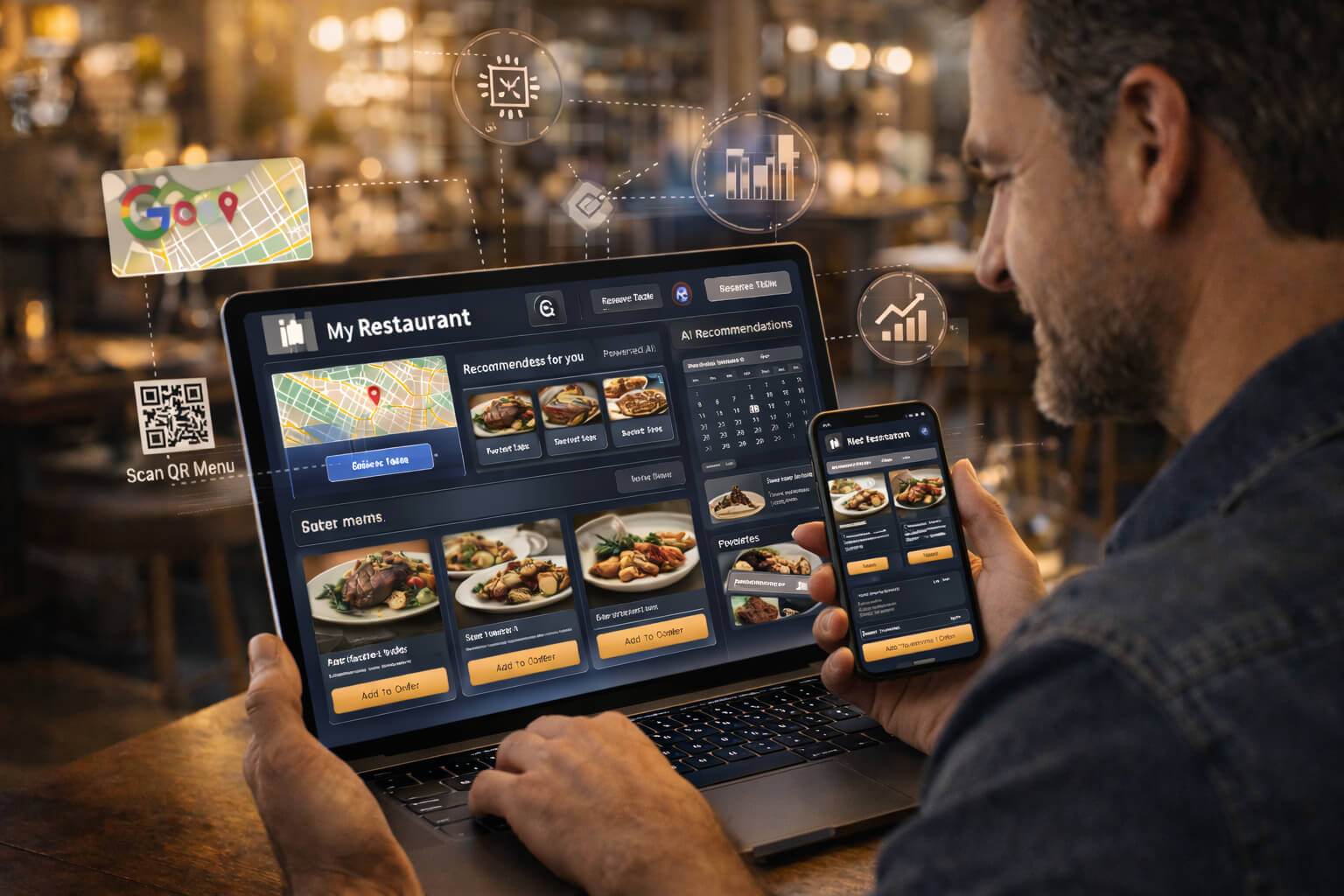
Restaurant websites have crossed a critical threshold. They are no longer passive digital menus or “nice-to-have” brand assets. In 2026, a restaurant’s website is a core business system—one that directly impacts visibility, trust, conversion, retention, and long-term profitability.
This shift isn’t happening because of design trends. It’s happening because diner behavior, search engines, and platform economics have fundamentally changed. Customers now decide where to eat before they arrive. Google now ranks experience, not just information. And third-party platforms increasingly extract value rather than create it.
Restaurants that understand this shift and adapt early will compound advantages over time. Restaurants that don’t won’t necessarily disappear—but they will slowly lose traffic, pricing power, and direct customer relationships.
Below are the restaurant website trends defining 2026, explained in depth—not as tactics, but as strategic shifts.
By 2026, mobile is no longer the dominant traffic source—it is the default decision environment. Diners search for restaurants while walking, sitting in cars, coordinating with friends, or standing on the sidewalk outside competing options.
This fundamentally changes how websites must be designed. Desktop-first layouts shrink poorly to mobile screens, bury important actions, and introduce friction at the exact moment a diner is deciding.
Mobile-only thinking means the website is designed starting from the smallest screen, with everything else as a secondary concern. The primary job of the site is to answer urgent questions quickly:
Speed becomes non-negotiable. A slow-loading site on mobile networks kills both rankings and conversions. Buttons must be obvious, readable, and thumb-friendly. Navigation must be minimal, not clever.
Google reinforces this reality by ranking mobile experience first. A restaurant with a beautiful desktop site but a clumsy mobile experience will quietly lose visibility over time.
Why mobile-first is no longer optional: Mobile-First Websites: Why Restaurants Can’t Ignore Them
For years, third-party platforms positioned themselves as growth engines. In 2026, many restaurants now recognize them as high-cost intermediaries that own the customer relationship.
The core issue isn’t just commission fees. It’s control. When customers book or order through third-party platforms, the restaurant loses:
Websites that support direct reservations and ordering reverse this dynamic. They allow restaurants to control presentation, messaging, upsells, promotions, and follow-up communication. Over time, this results in higher margins and stronger customer loyalty.
The most successful restaurants don’t eliminate third-party platforms entirely—they strategically downshift them. Apps become discovery tools, while the website becomes the primary conversion and retention channel.
Why direct ordering consistently outperforms platforms:
Artificial intelligence in restaurant websites is not about chatbots or gimmicks. In 2026, AI is used quietly and strategically to reduce friction and guide decisions.
Modern websites can now adapt based on:
For example, a lunchtime visitor might see quick-order options and lunch specials, while an evening visitor sees ambiance imagery and reservation prompts. Popular dishes can be highlighted automatically based on ordering data. Conversion paths can be optimized without manual intervention.
The key is restraint. Restaurants that over-automate risk losing warmth and personality. The best implementations use AI to support human hospitality, not replace it.
How AI is already shaping restaurant websites: The Role of AI in Modern Restaurant Marketing
For many diners, Google Maps is the homepage. They discover restaurants through Maps, read reviews, glance at photos, and then click through to the website to confirm details.
This means websites must be designed specifically for Maps-driven intent. Visitors arriving from Maps are not browsing—they are validating a decision. If information is unclear or buried, they leave.
Maps-first websites prioritize:
Websites that align closely with Google Business Profile data send stronger relevance and trust signals, improving both rankings and conversions.
Why Maps visibility depends on your website:
In 2026, diners don’t just want to know what you serve—they want to know what it feels like to be there.
Static images and text descriptions are being replaced by visual storytelling that communicates atmosphere, energy, and emotion. Short motion clips, immersive photography, and context-rich visuals help diners imagine themselves inside the experience.
This emotional pre-commitment dramatically increases conversion rates. When diners already feel connected before they arrive, they’re more likely to book, order, and return.
Why visuals now drive decision-making: The Science of Food Photography for Restaurant Websites
Digital menus are no longer convenience features—they are core infrastructure.
In 2026, menus must serve multiple roles:
Modern digital menus update in real time, support dietary filters, highlight profitable items, and integrate directly with POS and ordering systems. They reduce printing costs while improving accuracy and accessibility.
Search engines also rely heavily on menu content to understand relevance. Restaurants with structured, indexable menus gain a significant SEO advantage.
Why digital menus are permanent:
As organic social reach continues to decline, restaurants are rediscovering the power of owned communication channels.
Websites are now the primary engine for collecting email addresses, enrolling loyalty members, and nurturing repeat visits. Unlike social platforms, these channels provide direct access to customers without algorithmic interference.
In 2026, loyalty programs are deeply integrated into websites—not standalone apps. They feel seamless, personalized, and rewarding rather than transactional.
Why websites now drive retention:
Complexity is no longer impressive—it’s expensive.
In 2026, the best-performing restaurant websites are fast, simple, and accessible. They load quickly, present information clearly, and guide users without confusion.
Accessibility improvements—such as readable fonts, high contrast, and logical navigation—benefit everyone, not just users with disabilities. Google increasingly rewards these qualities in rankings.
Restaurants that eliminate friction convert more traffic with fewer resources.
Common mistakes restaurants are now avoiding: The Most Common Restaurant Website Mistakes (And How to Fix Them)
In 2026, no marketing channel exists in isolation.
SEO, paid ads, social media, email, and retargeting all converge on the website. It is where awareness turns into intent, and intent turns into revenue.
Restaurants that understand this funnel design websites intentionally—creating pages that match user intent at every stage, from discovery to repeat visits.
How the website powers the full funnel: The Restaurant Marketing Funnel: How Your Website Brings Diners to Your Door
In 2026, restaurant owners demand accountability. A website is no longer judged by how it looks—but by what it produces.
Modern restaurant websites track:
This data allows owners to invest confidently, optimize intelligently, and treat the website as a profit center—not a sunk cost.
Why ROI measurement matters: The ROI of a Restaurant Website: What Owners Need to Know
Trends will continue to evolve—but ownership, clarity, and trust are enduring advantages.
Restaurants that treat their website as a strategic business asset—not a digital brochure—will:
In 2026, your website isn’t optional.
It is your strongest competitive advantage.
Stay up to date with the latest tips, expert insights, product reviews, and step-by-step guides to help you grow, create, and succeed—no matter your industry or passion.