
January 09, 2026
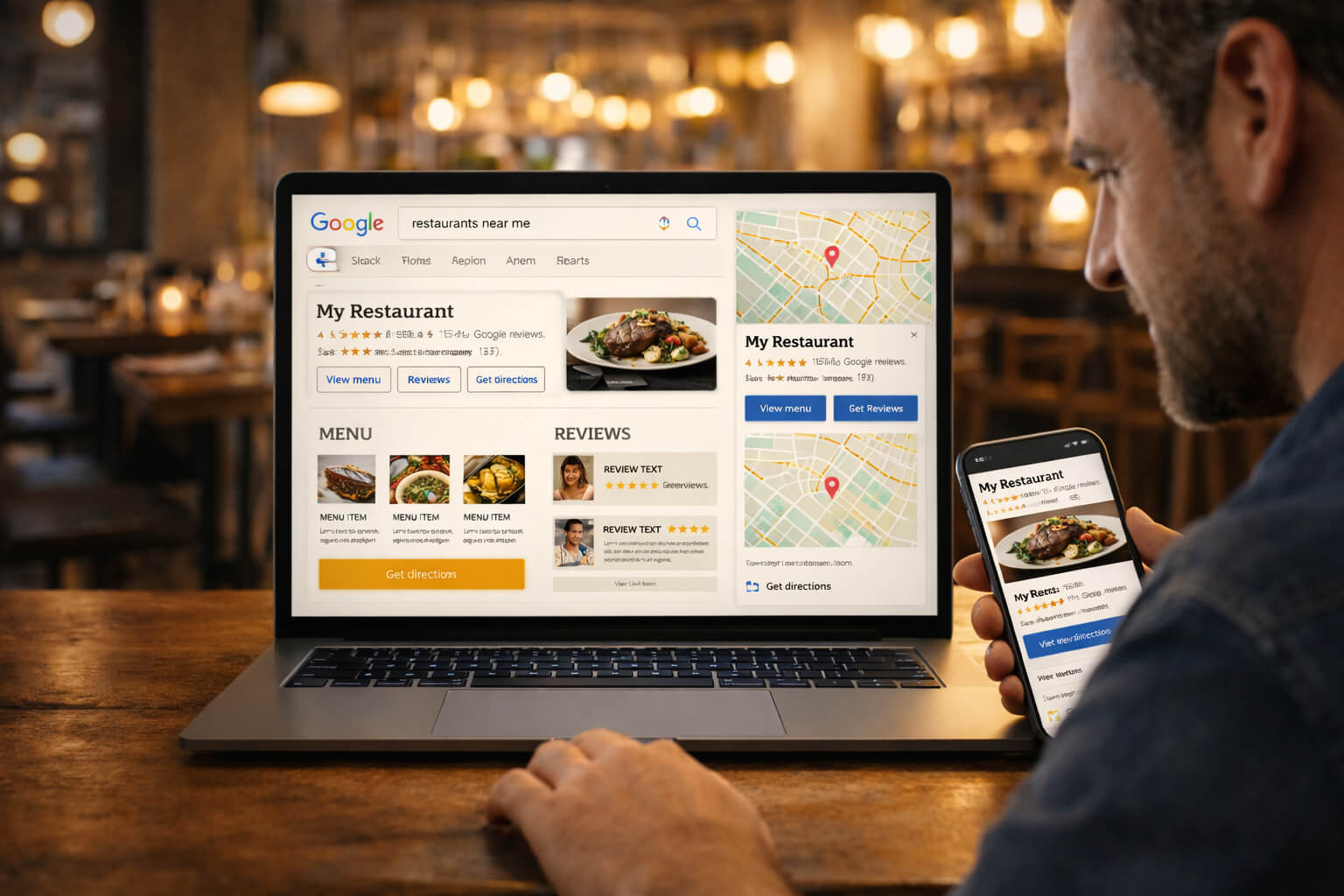
If diners can’t find your restaurant online, they can’t choose it—no matter how exceptional the food, service, or atmosphere may be.
In today’s digital-first world, restaurants are no longer competing only with nearby eateries. They are competing for attention on search engines. When a potential customer searches “best restaurant near me”, “Italian food in [city]”, or “restaurants open now”, Google determines which businesses are visible and which are effectively invisible.
That decision is driven by Restaurant SEO.
This in-depth guide explains restaurant SEO in clear, practical terms and shows how restaurants can build consistent online visibility that translates into real diners—without relying solely on ads or third-party delivery platforms.
Restaurant SEO is the process of optimizing your website, local listings, and online content so your restaurant appears prominently when nearby diners search on Google.
Unlike general SEO, restaurant SEO focuses heavily on local intent. Google wants to show users restaurants that are relevant, nearby, trustworthy, and easy to engage with. SEO helps Google understand exactly what your restaurant offers, where it is located, and why it deserves to rank.
When implemented correctly, restaurant SEO increases your visibility across:
Unlike paid advertising, SEO does not stop working when the budget runs out. It builds momentum over time, attracts customers who are already looking to eat, and reduces long-term dependence on food delivery apps that take high commissions.
SEO for Restaurants: How to Get Found Online
Most diners do not search for restaurant names unless they already know them. Instead, they search based on needs, preferences, and context.
For example, someone may be:
These searches are highly intent-driven, meaning the person is close to making a decision. Restaurant SEO works by ensuring your business appears during these moments of intent, when the likelihood of a visit or booking is highest.
If your restaurant does not align with how diners actually search, it won’t matter how good your food is—you simply won’t be considered.
Many restaurant owners assume that having a Google Business Profile is enough. While it is essential, it is not sufficient on its own.
Google uses your website as the primary source of truth to evaluate your restaurant’s legitimacy, relevance, and quality. A strong website supports your Google Business Profile and reinforces your authority in search results.
An SEO-friendly restaurant website clearly communicates:
Websites that are slow, outdated, or missing key information weaken your SEO performance—even if your reviews are strong. In contrast, a modern, fast, mobile-friendly website significantly improves both rankings and conversions.
The Cost of Not Having a Website for Your Restaurant
Local SEO is what determines whether your restaurant appears when someone searches “restaurant near me” or “best [cuisine] in [area]”.
Google prioritizes local businesses that demonstrate:
Local SEO involves more than just filling out a profile. It requires aligning your website content, Google Business Profile, maps integration, and local citations so Google has complete confidence in your business data.
When these signals are strong and consistent, Google is far more likely to feature your restaurant in Maps results and the local 3-pack—where the majority of clicks occur.
How to Optimize Your Website for “Near Me” Searches
Your Google Business Profile is often the first impression diners see, but your website is what validates that impression.
A well-optimized Google Business Profile helps users discover your restaurant, while your website provides the depth, clarity, and trust needed to turn that discovery into action.
Strong profiles include accurate categories, professional photos, updated hours, frequent posts, and active responses to reviews. However, restaurants that pair this with a high-quality website consistently achieve better rankings and higher click-through rates than those relying on GBP alone.
What Every Restaurant Owner Should Know About Google Business Profile
Your menu is one of the most valuable SEO tools your restaurant has—if it is implemented correctly.
Search engines cannot read printed menus, PDFs, or images effectively. Text-based online menus allow Google to understand exactly what dishes you offer, which helps your restaurant appear for dish-specific and long-tail searches.
Well-structured menus improve SEO by:
An optimized menu benefits both search engines and diners, making it easier for people to decide—and commit—before they ever arrive.
Online Menus: Why They Matter More Than Printed Ones
Online reviews are one of the strongest trust and ranking signals in restaurant SEO.
Google uses reviews to evaluate popularity, credibility, and customer satisfaction. Diners use reviews to decide whether your restaurant is worth visiting at all.
Consistent, recent, and well-managed reviews:
Actively requesting reviews, responding professionally, and maintaining a steady flow of feedback gives your restaurant a competitive edge.
How Reviews Impact Restaurant SEO (And What to Do About It)
The Restaurant Reputation Playbook: How to Win Diners’ Trust Online
Most restaurant searches happen on mobile devices, often minutes before a dining decision is made.
Google evaluates your website using mobile-first indexing, meaning it primarily looks at how your site performs on mobile devices when determining rankings.
A mobile-optimized restaurant website ensures:
If mobile users struggle, they leave—and Google notices.
Mobile-First Websites: Why Restaurants Can’t Ignore Them
SEO success is not just about traffic—it’s about conversions.
High-performing restaurant websites guide users effortlessly toward action. They remove friction, reduce confusion, and make it obvious what the next step should be.
When SEO traffic lands on a site designed for conversions, visibility turns into reservations, phone calls, and walk-ins.
How to Turn Website Visitors Into Paying Diners
Many restaurants struggle with SEO not because it is too complex, but because of avoidable oversights.
Outdated websites, inconsistent location data, poor mobile usability, hidden menus, and neglected reviews all weaken SEO performance. Addressing these issues often leads to noticeable improvements without advanced tactics.
The Most Common Restaurant Website Mistakes (And How to Fix Them)
Restaurants that invest in SEO see measurable, real-world results.
One restaurant increased bookings by 40% after improving its website and online presence—without increasing ad spend—demonstrating the compounding value of SEO.
How One Restaurant Increased Bookings by 40% With a New Website
Restaurant SEO is not about manipulating algorithms. It is about aligning your online presence with how diners actually search, evaluate, and choose where to eat.
When your website, menus, reviews, and local signals work together, Google rewards you with visibility—and diners reward you with business.
If your restaurant isn’t easy to find online, it won’t be chosen offline.
Restaurant SEO solves that problem.
Stay up to date with the latest tips, expert insights, product reviews, and step-by-step guides to help you grow, create, and succeed—no matter your industry or passion.