
Top 7 Free Apps for Learning Music Theory on the Go

July 31, 2025

By RocketPages

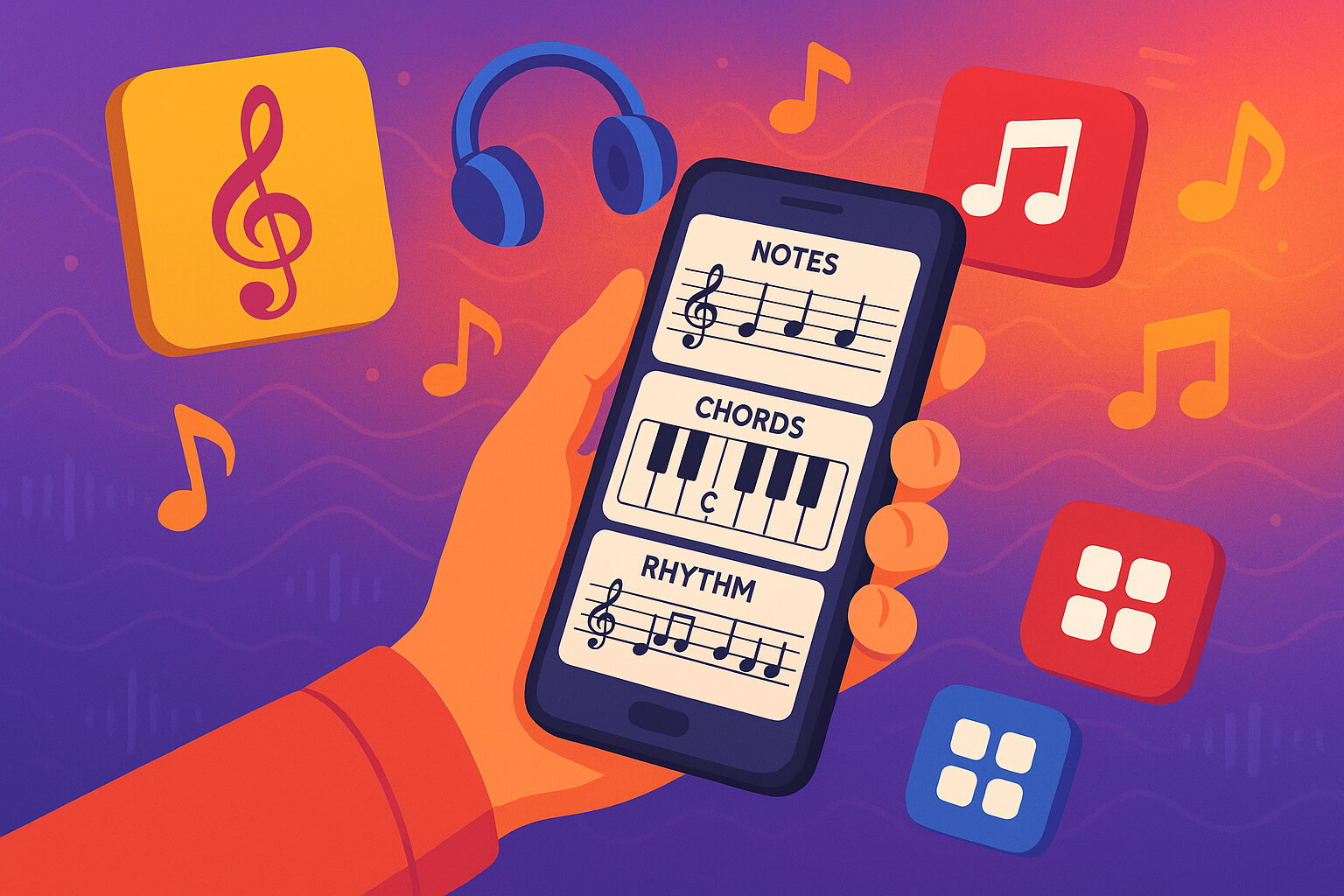
Person using smartphone music theory apps with floating musical notes, rhythm symbols, and digital sound waves representing mobile music learning on the go.

Learning music theory doesn’t have to mean sitting at a desk with dense textbooks or formal lessons. Thanks to a new generation of intuitive mobile apps, you can now explore scales, chords, intervals, rhythm, and ear training — all from your smartphone or tablet. Whether you’re a complete beginner or a seasoned musician looking to sharpen your skills, these 7 free apps make music theory accessible, engaging, and portable.


1. Tenuto (iOS & Android)


  • Best for: Ear Training & Sight Reading
  • Tenuto is the companion app to the highly respected website musictheory.net. It includes a robust collection of interactive exercises designed to reinforce core music theory concepts. You can practice note identification on different clefs, build chords and scales, and develop your interval recognition skills. What sets Tenuto apart is its flexibility—each exercise can be customized based on your goals and instrument.
  • Whether you're preparing for music exams or simply building stronger fundamentals, Tenuto is a solid all-in-one toolkit.
  • Learn more


2. Perfect Ear (iOS & Android)


  • Best for: Developing Relative Pitch & Rhythm Skills
  • Perfect Ear offers a comprehensive suite of ear training, rhythm practice, and music theory lessons, making it one of the most versatile apps for aural development. Users can train their ears to recognize intervals, chords, and scales, as well as develop rhythm through tapping and timing exercises. It even includes melodic dictation and custom exercise creation.
  • Its user-friendly interface and progressive learning system make it ideal for daily practice at any skill level.
  • Visit website


3. Music Theory Helper (Android only)


  • Best for: Quick Theory References & Flashcards
  • For Android users looking for a lightweight, fast reference app, Music Theory Helper acts like a digital cheat sheet. It provides easy-to-understand explanations of topics like key signatures, intervals, scales, chords, time signatures, and the circle of fifths. The flashcard quizzes help reinforce knowledge efficiently.
  • It’s especially useful for brushing up on core concepts during short breaks or before performances.
  • Google Play Store


4. EarMaster (iOS & Android)


  • Best for: Comprehensive Ear Training
  • Used in music schools and conservatories, EarMaster offers a professional-grade ear training experience. It includes training modes for identifying intervals, chords, cadences, rhythms, and melodic dictation. The app tracks your progress and adapts to your skill level, making it ideal for serious learners who want to deepen their aural perception.
  • With its visually intuitive interface and gamified features, EarMaster turns rigorous training into an enjoyable challenge.
  • Official site


5. Complete Music Reading Trainer (iOS & Android)


  • Best for: Sight-Reading Practice
  • This app is all about reading music fluently. Whether you're learning treble, bass, alto, or tenor clef, it helps you become a faster reader with real notation exercises. It supports multiple instruments and custom difficulty levels, making it accessible for both beginners and professionals.
  • The gradual increase in complexity means you’re always learning just outside your comfort zone—a great formula for progress.
  • Explore the app


6. Theory Lessons by musictheory.net (iOS & Android)


  • Best for: Structured Theory Lessons
  • If you like organized, lesson-based learning, this app delivers structured instruction on everything from basic note values to advanced harmonic analysis. Each lesson is presented clearly with diagrams and visual aids, following a logical progression ideal for self-paced study.
  • Great for learners who appreciate a curriculum-style format with no fluff—just solid theory education.
  • Start learning


7. Functional Ear Trainer (iOS & Android)


  • Best for: Contextual Listening & Functional Ear Training
  • Unlike traditional ear training apps that focus on isolated intervals, this app helps you recognize notes and chords within a tonal context—an essential skill for improvisers, jazz musicians, and composers. You train your ear to recognize scale degrees as they relate to the tonic, helping you internalize harmonic functions naturally.
  • It’s a more advanced approach, but extremely effective for understanding how music actually feels and moves.
  • Get it on Google Play


Bonus Resources from RocketPages


While these apps are powerful on their own, combining them with in-depth guides and structured resources will help you progress even faster. RocketPages offers a range of music education content to deepen your understanding:


Conclusion


  • Music theory isn’t just for the classroom anymore. With these free apps, you can make meaningful progress anytime, anywhere. Whether you're building your ear, decoding rhythms, or brushing up on notation, these tools transform idle moments into productive study sessions.
  • Pair them with structured resources like those from RocketPages, and you’ll have everything you need to become a more confident, well-rounded musician—without spending a dime.

Give a short session one theory goal

Choose a topic small enough to practice attentively, such as naming a note or recognizing a particular interval. Review the app’s explanation before beginning the drill. If you do not understand the prompt, repeated answers may teach the interface without clarifying the musical idea. Use the official help or a reliable introductory explanation to fill that gap.

After a short activity, describe the concept without looking at the screen. Then connect it with a sound or an instrument where appropriate. This reveals whether the exercise supports musical understanding outside the app. Keep a note about the kind of question that was difficult instead of recording only a score.

Check whether the tool fits the setting

Review current access conditions, device requirements, and whether the activity depends on audio or a connection. Choose exercises appropriate to the place where you will use them. A listening task needs conditions in which you can actually hear and attend to the example; a rushed or distracting setting may not be a useful test of your understanding.

Keep one app as the main drill tool for a trial period and review several sessions together. Ask whether you understand the feedback and can apply the concept elsewhere. If not, change the explanation or exercise before simply increasing the daily target. A clear next step is more useful than a longer streak with the same unresolved confusion.

Return to music after the drill

Find the concept in a song, score, or exercise you already study. Note one example and explain why it matches. This gives the drill a practical destination and helps you choose which theory topic belongs in the next short session.

Recent Articles

Stay up to date with the latest tips, expert insights, product reviews, and step-by-step guides to help you grow, create, and succeed—no matter your industry or passion.


Portrait studio with a sitter, soft key light and camera demonstrating directional portrait lighting
Portrait Lighting Patterns: Split, Loop and Rembrandt
Judge the light on the faceA portrait lighting pattern describes the arrangement of light and shadow on the face. It is different from the make of the light, the background color, or the overall editi...
Read More
Two educators reviewing curriculum books, sample worksheets and a checklist in a school library
Choosing a School Curriculum: A Practical Review Checklist
Clarify what decision you can makeChoosing a curriculum is different from choosing a school. A curriculum concerns the sequence of knowledge, skills, learning activities, and assessment, together with...
Read More
Teacher supporting a student using geometric learning materials and a notebook in a classroom
Personalized Learning Approaches: Goals, Support and Feedback
Begin with a learning goalPersonalized learning involves making informed choices about instruction and support for a learner. Start with the knowledge or skill being developed, not with a product or a...
Read More
