
December 23, 2025
I’ve focused on why each signal exists, how Google interprets it, and what restaurant owners should understand at a strategic level, while keeping your original tone and authority.
You can swap these sections directly into your pillar article.
Google’s first job is not to judge your food — it’s to determine whether your restaurant is legitimate, accessible, and reliable.
Your website acts as a verification layer. Google analyzes how your pages are structured, how quickly they load, how clearly information is presented, and whether the site behaves predictably across devices. A confusing or outdated website signals uncertainty, which Google avoids surfacing to users.
Key elements Google evaluates include:
When your website is structured properly, Google can confidently understand:
That’s why resources like how to build a restaurant website that ranks on Google and the ultimate restaurant website checklist emphasize clarity and structure over visual flair.
Important shift: With mobile-first indexing, Google no longer treats desktop as the primary version of your site. If your mobile experience is weak, your rankings suffer — even if desktop looks fine.
Reviews are one of the strongest trust indicators Google has access to — not because they reflect perfection, but because they reflect real customer behavior over time.
Google evaluates:
A steady stream of honest reviews tells Google that your restaurant is active, visited, and worth recommending. Silence, outdated reviews, or unaddressed negative feedback suggests stagnation or neglect.
This is why how reviews impact restaurant SEO and the restaurant reputation playbook stress participation over chasing perfect ratings.
Google doesn’t expect flawless businesses — it expects responsive ones.
Consistent engagement shows:
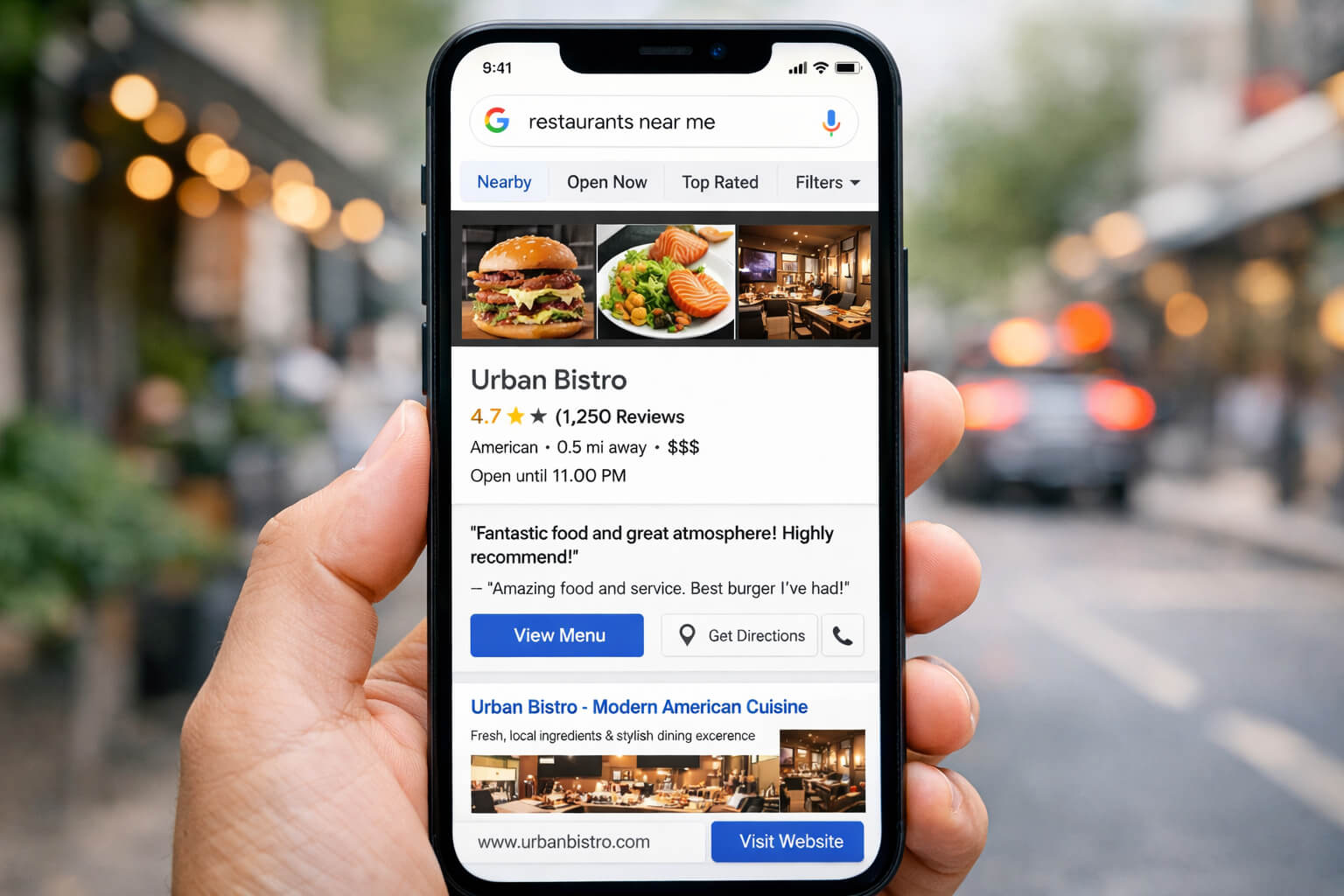
Images are often the deciding factor between two similar listings.
When Google displays image thumbnails in Maps or search results, it’s testing which restaurant visually reassures users the fastest. High-quality, relevant photos act as instant proof of quality, atmosphere, and authenticity.
Google evaluates:
Professional visuals don’t just look better — they reduce uncertainty. A diner should be able to answer these questions at a glance:
This is why the science of food photography for restaurant websites focuses on realism and emotional appeal rather than over-editing.
From Google’s perspective, images that drive engagement are images worth ranking higher.
Restaurant decisions are often made under time pressure. Someone searching on their phone may already be hungry, nearby, and ready to act.
Google prioritizes restaurants whose websites:
A slow or frustrating mobile experience increases bounce rates, which signals to Google that users did not find what they wanted.
This is why mobile-first websites for restaurants and common restaurant website mistakes emphasize usability over aesthetics.
Speed isn’t just technical — it’s psychological.
The longer a page takes to load, the more doubt it creates.
For restaurants, relevance is almost always local.
Google’s goal is to show the best nearby option, not the most famous one. That’s why it heavily weighs signals that confirm:
Google cross-checks your website against your listings to ensure accuracy. Mismatched hours, outdated addresses, or inconsistent names weaken trust.
Guides like how restaurants attract local customers through SEO and optimizing for “near me” searches explain how proximity and clarity drive visibility.
Local SEO works because it answers Google’s core question:
“Can this person realistically eat here right now?”
Google rewards restaurants that remove friction between intent and action.
If a diner wants to book a table or place an order, the best result is the one that lets them do it immediately — without extra steps, redirects, or third-party distractions.
Google notices when:
This is why adding online ordering without app fees and reducing no-shows with online booking improve both conversions and rankings.
From Google’s perspective, successful actions = satisfied users.
The click itself is only the beginning.
Google monitors what happens next:
High engagement tells Google that your site delivered on its promise. Low engagement suggests mismatch or confusion.
That’s why content flow, layout, messaging, and hierarchy matter so much. Resources like turning website visitors into paying diners and the restaurant marketing funnel focus on guiding users naturally toward decisions.
Google’s algorithms increasingly reward experience satisfaction, not just relevance.
Google is moving toward:
Restaurants that treat their website as a core business asset — not an afterthought — will dominate future results.
That’s why future-proofing your restaurant online and why your website will make or break you in 2025 are critical strategic reads.
Google doesn’t reward hype.
It rewards clarity, confidence, and consistency.
The restaurants that win clicks are the ones that:
That’s how you win the click — and the customer — before they ever walk through the door.
Stay up to date with the latest tips, expert insights, product reviews, and step-by-step guides to help you grow, create, and succeed—no matter your industry or passion.