
December 22, 2025
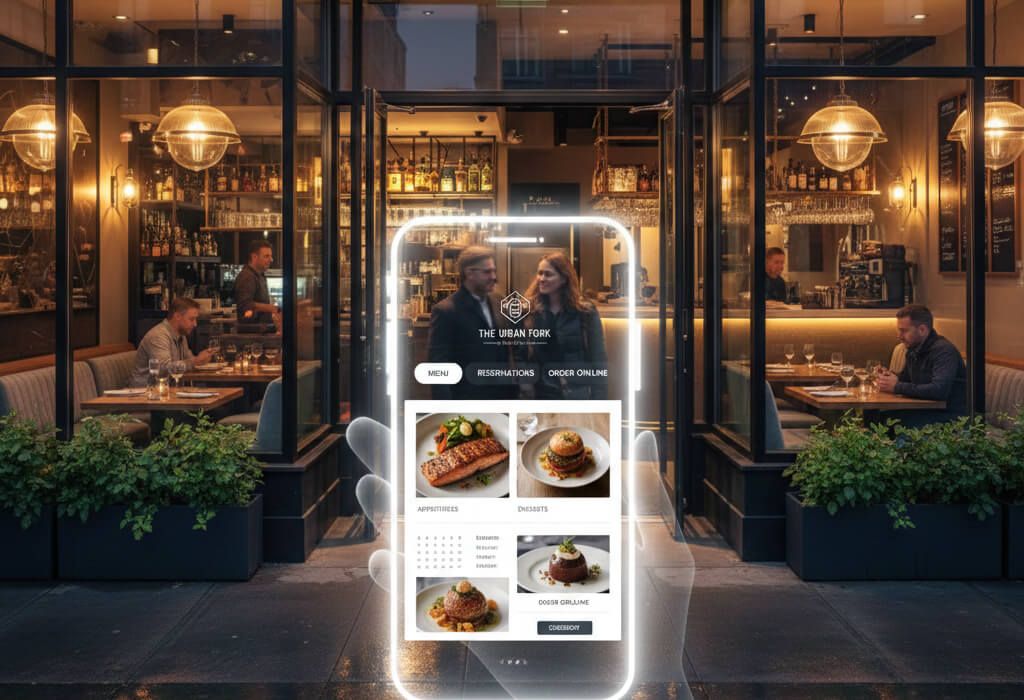
In today’s dining landscape, your restaurant’s first impression rarely happens at the host stand. It happens online.
Before a guest checks your menu, books a table, or places an order, they’ve already interacted with your digital front door — your website. That moment often determines whether they choose you or keep scrolling.
Social media profiles and delivery apps may bring visibility, but they don’t give you ownership. A strong website does. And in 2025, that difference can determine whether your restaurant grows — or gets overshadowed by platforms you don’t control.
Modern diners research before they reserve. They compare menus, photos, reviews, location, and convenience. A restaurant website is the only place where you control the story — not algorithms, ad placements, or third-party platforms.
Case studies like this example of a restaurant increasing bookings by 40% with a new website show how clarity, speed, and trust signals directly influence reservations.
When information is easy to find and confidence is high, decisions happen faster.
External reference: According to Google, 76% of people who search for a local business visit within 24 hours — if they find the right information quickly.
Instagram and TikTok are powerful discovery tools, but they are not destinations. A “link in bio” can’t replace a complete, intentional experience.
Relying solely on social platforms limits growth, as explained in this breakdown of why link-in-bio isn’t enough.
Your website acts as the central hub that connects everything:
Social platforms introduce your restaurant. Your website converts interest into action.
External reference: Platforms like Instagram and TikTok themselves encourage businesses to drive traffic to owned assets rather than relying entirely on in-app engagement.
Most diners visit restaurant websites on their phones — often while standing outside deciding where to eat. In these moments, a slow, cluttered, or outdated site costs you business immediately.
Common issues such as unreadable menus, tiny buttons, and confusing navigation are covered in this guide on fixing restaurant website mistakes.
A mobile-first website removes friction and supports fast decisions.
External reference: Google’s Mobile-First Indexing prioritizes mobile performance when ranking websites.
Delivery apps expanded reach, but they also reduced margins and limited customer ownership. Restaurants that integrate direct online ordering through their website regain control over fees, customer data, and brand experience.
Resources like this guide on adding online ordering without app fees and why direct ordering wins over delivery apps show how websites evolve from brochures into revenue engines.
External reference: Square and Toast both report higher repeat-order rates when customers order directly through restaurant-owned channels.
Google doesn’t rank Instagram pages — it ranks websites.
To appear in “near me” searches, map results, and local listings, your website must clearly communicate what you offer, where you’re located, and why you’re relevant.
Guides like how restaurant websites rank on Google and optimizing for “near me” searches highlight why your site is essential for local discovery.
External reference: Google Business Profile relies heavily on your website’s accuracy and structure to validate and rank listings.
Reviews scattered across platforms create noise. Your website brings credibility together into a single, coherent narrative.
From testimonials and ratings to press mentions and awards, this is where trust compounds over time.
As outlined in this reputation playbook, diners trust restaurants that clearly demonstrate consistency, transparency, and social proof.
External reference: BrightLocal reports that 87% of consumers read online reviews for local businesses before visiting.
A digital front door doesn’t just attract traffic — it builds relationships.
Email signups, loyalty programs, and retargeting campaigns all start with your website. This is how one-time visitors become repeat guests.
Resources like collecting customer emails through your website and retargeting diners who didn’t convert show how websites support long-term growth.
External reference: Tools like Mailchimp and Klaviyo consistently show higher ROI from owned email lists compared to paid advertising.
From AI-powered personalization to smart kitchens and digital menus, every innovation connects back to one central system — your website.
It’s not a static page. It’s the foundation that evolves as technology changes.
Articles like future-proofing your restaurant with a strong online presence and why restaurant websites will make or break businesses in 2025 underline a clear truth: restaurants without a digital foundation fall behind fast.
Your website is not an expense.
It’s not optional.
And it’s definitely not “just marketing.”
Your restaurant’s website is its digital front door — the one place you fully own, control, and build upon. In a world of changing platforms, rising competition, and shrinking margins, ownership is the advantage that lasts.
Stay up to date with the latest tips, expert insights, product reviews, and step-by-step guides to help you grow, create, and succeed—no matter your industry or passion.