
January 08, 2026
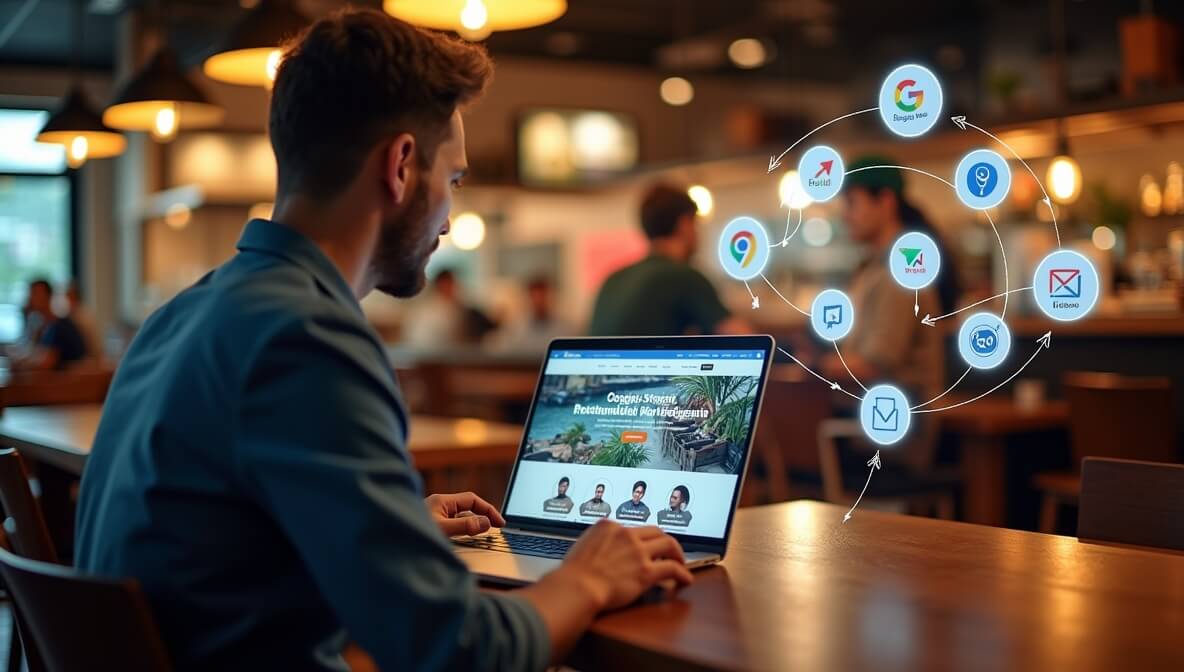
In 2026, restaurant marketing is no longer about being “present everywhere.”
It’s about controlling the customer journey from discovery to decision.
Social media, Google Ads, delivery platforms, influencer posts, and even AI-powered search results all play a role—but none of them work independently. They only work when they point to a place that builds trust, answers questions, and converts interest into action.
That place is your restaurant website.
Restaurants that treat their website as a side project struggle with rising costs and inconsistent traffic. Restaurants that treat it as the foundation see compounding results across every marketing channel.
In 2026, marketing is not a collection of disconnected tactics—it’s a system.
And every system needs a central hub.
Your website acts as the single source of truth for your restaurant:
Every other channel exists to send people back to this hub.
Google search results, Google Maps listings, Instagram bios, TikTok videos, paid ads, QR codes on tables, even AI-generated restaurant recommendations—all of them ultimately push diners toward your website to confirm one thing:
“Is this the place I should choose?”
Restaurants that centralize marketing around their website experience stronger performance because nothing is fragmented or contradictory. Everything reinforces everything else.
Deep dive: The Restaurant Marketing Funnel: How Your Website Brings Diners to Your Door
Social media still matters in 2026—but its role is often misunderstood.
Platforms like Instagram and TikTok are discovery tools, not decision tools. They are designed for entertainment, scrolling, and short attention spans. They are not designed to help someone make a confident dining decision.
After discovering a restaurant on social media, diners almost always leave the app to:
If there’s no website—or the website is confusing, slow, or outdated—the momentum dies instantly. That’s where most restaurants lose potential customers without realizing it.
A website doesn’t replace social media.
It finishes the job social media starts.
Why this matters: Why Link in Bio Isn’t Enough: The Case for Restaurant Websites
In 2026, being “found” is no longer just about ranking links.
It’s about being understood and trusted by algorithms.
Google, Maps, and AI-driven search tools rely heavily on your website to answer questions like:
Your website provides structured signals that social profiles simply cannot:
Restaurants without optimized websites may still appear occasionally—but they don’t win consistently, especially for high-intent searches like “best restaurant near me” or “family dinner tonight.”
Learn how visibility really works:
Marketing costs in 2026 are higher and less forgiving than ever.
Clicks are expensive. Attention is limited. Competition is intense.
When ads or social posts send traffic to a weak website, money is wasted—even if traffic numbers look good.
A strong website:
This means:
In simple terms:
Marketing drives traffic. The website turns traffic into money.
Understand the numbers:
In 2026, your website is not “just design.”
It’s a decision environment.
The menu is the most visited page on nearly every restaurant website. If it’s slow, unclear, or hard to read on mobile, diners leave—often permanently.
User experience affects:
Food photography plays a similar role. Real, high-quality images reduce uncertainty and increase emotional desire. This isn’t about being fancy—it’s about being believable.
Why these elements drive results:
Third-party platforms will always exist—but in 2026, restaurants that rely on them exclusively lose control over margins, data, and customer relationships.
Your website allows you to:
The most resilient restaurants treat delivery apps as distribution channels, not foundations.
Why ownership wins long-term:
In 2026, diners trust restaurants that feel organized, transparent, and professional before they ever walk in.
Your website reinforces trust through:
Trust directly influences:
Marketing attracts attention—but trust determines action.
How trust affects growth:
The most profitable restaurants in 2026 aren’t chasing new customers endlessly—they’re retaining existing ones.
Your website is the gateway to:
Social platforms don’t give you ownership.
Your website does.
How repeat business is built:
This isn’t hypothetical.
Restaurants that improved website speed, clarity, and structure often saw immediate performance gains—without increasing ad spend. One restaurant increased bookings by 40% simply by fixing its website foundation.
Case study: How One Restaurant Increased Bookings by 40% With a New Website
Platforms will change.
Algorithms will evolve.
Trends will fade.
But your website remains:
If restaurant marketing were a building, your website would be the concrete foundation. Without it, everything else eventually cracks.
Build the foundation properly—and every marketing effort becomes stronger, cheaper, and more effective.
Stay up to date with the latest tips, expert insights, product reviews, and step-by-step guides to help you grow, create, and succeed—no matter your industry or passion.