
YouTube Channels Every Beginner Musician Should Follow

July 31, 2025

By RocketPages

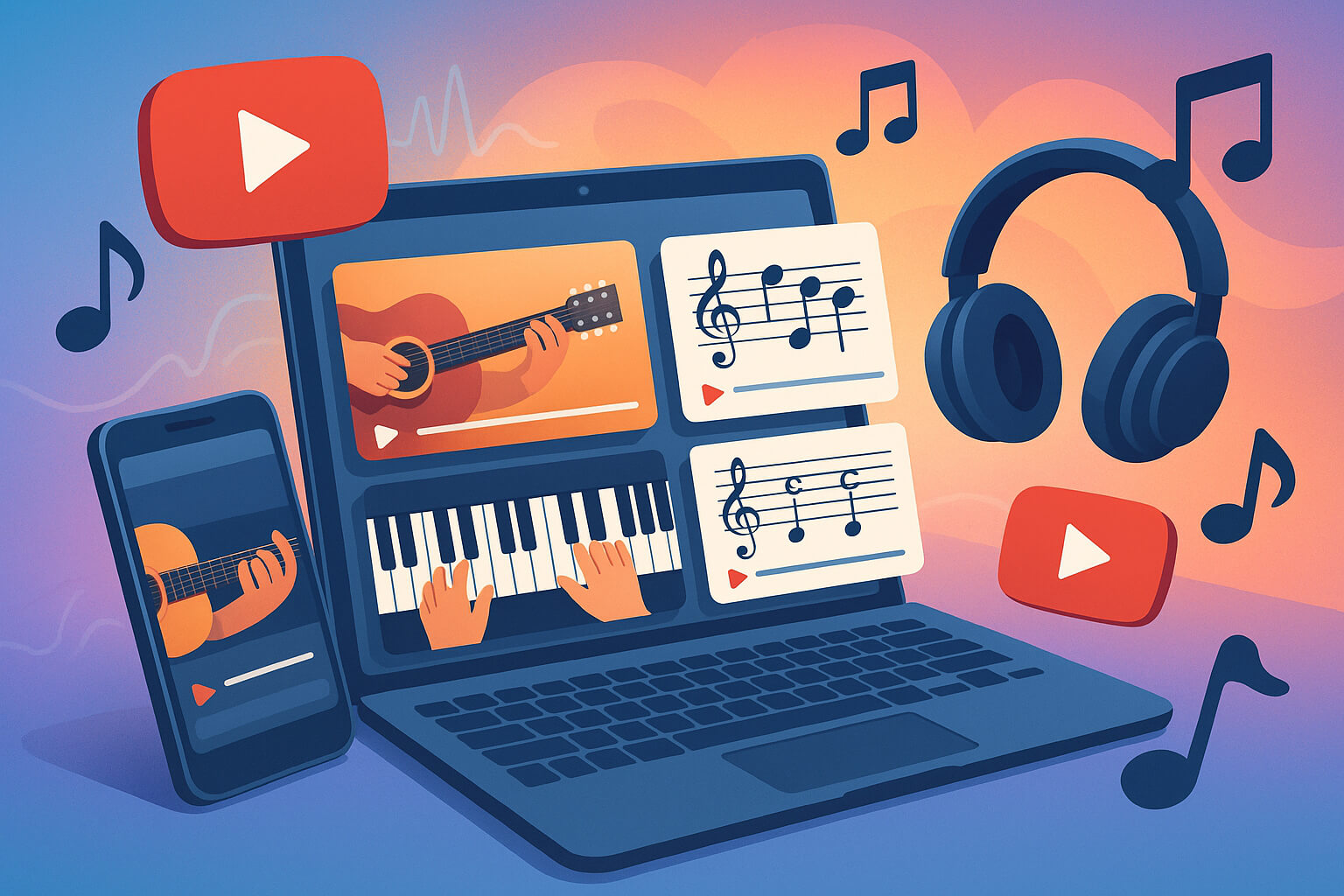
Laptop and smartphone displaying music tutorial videos on YouTube with floating musical notes and play buttons, representing online learning for beginner musicians.

Music education is more accessible than ever. Whether you're picking up an instrument for the first time or brushing up on music theory basics, YouTube is packed with high-quality, free content. But with so many creators out there, it can be overwhelming to know who’s worth your time.


This guide features seven of the best YouTube channels for beginner musicians—covering instruments, theory, and production—so you can start strong and stay motivated on your musical journey.


1. JustinGuitar


  • Best for: Structured Beginner Guitar Lessons
  • Justin Sandercoe is a pioneer of online guitar education. His channel, JustinGuitar, offers one of the most complete beginner learning paths available for free. His warm, encouraging teaching style makes it easy to stay motivated, and his course is organized into progressive levels so you never feel lost.
  • Why it’s great:
  • Complete Beginner Guitar Course with over 100 free lessons
  • Popular song tutorials that match your skill level
  • Tips on strumming, chord switching, timing, and technique
  • Whether you’re just learning your first chord or tackling barre chords, JustinGuitar is an invaluable companion.
  • Visit JustinGuitar on YouTube


2. Pianote


  • Best for: Beginner Piano Players
  • Pianote is perfect for aspiring pianists who want a friendly, modern approach to learning. Their lessons are well-paced and cover everything from posture to pop song tutorials, with a balance of technical training and musical fun.
  • Why it’s great:
  • Step-by-step beginner-friendly lessons
  • Clear demonstrations of hand positioning, chords, and rhythm
  • Live Q&A sessions and full song breakdowns
  • Teachers who make learning feel fun, not formal
  • Ideal for visual learners who want structure but also want to explore music creatively.
  • Visit Pianote on YouTube


3. MusicTheoryForGuitar


  • Best for: Understanding Music Theory for Guitarists
  • Hosted by Tommaso Zillio, this channel focuses on making music theory click for guitar players. Unlike many dry theory lessons, these videos are designed to be immediately applicable to your playing.
  • Why it’s great:
  • Explains modes, intervals, chords, and progressions clearly
  • Theory explained on the fretboard, not just the whiteboard
  • Great balance between theory and practical exercises
  • Perfect for self-taught players hitting theory roadblocks
  • If you’ve ever asked, “Why does that chord progression sound so good?”—this is the channel for you.
  • Visit MusicTheoryForGuitar


4. 8-Bit Music Theory


  • Best for: Creative Music Theory via Video Game Music
  • This unique channel blends music theory and pop culture by analyzing classic and modern video game soundtracks. While some concepts lean intermediate, the visual storytelling and breakdowns are clear enough to inspire and educate beginners.
  • Why it’s great:
  • Explores melody, harmony, counterpoint, and rhythm in a fun format
  • Connects theory to emotion and storytelling
  • Introduces advanced ideas in an approachable and entertaining way
  • Perfect for gamers, composers, or theory lovers who want to learn through soundtracks they already enjoy.
  • Visit 8-Bit Music Theory


5. Rick Beato


  • Best for: All-Round Music Education
  • Rick Beato is a professional musician, producer, and educator with decades of experience. His channel spans music theory, ear training, songwriting, production, and detailed analyses of famous songs in his "What Makes This Song Great?" series.
  • Why it’s great:
  • Theory lessons that cover scales, modes, harmony, and more
  • Ear training that builds real-world musical listening skills
  • Production tutorials for those entering the world of recording or mixing
  • Engaging personality and high production value
  • Whether you're a beginner or future songwriter, Rick's content helps you understand music, not just play it.
  • Visit Rick Beato on YouTube


6. Adam Neely


  • Best for: Bass Guitar & Deep Musical Concepts (Made Simple)
  • Bassist and music theorist Adam Neely brings complex musical ideas to life in his signature entertaining, thought-provoking style. He tackles everything from grooves and odd time signatures to microtonality and music history—with humor and real musical depth.
  • Why it’s great:
  • Bass tutorials with real-world musical applications
  • Quirky yet clear explanations of advanced topics
  • Encourages creative thinking about rhythm, feel, and music perception
  • A great channel for students who ask why music works the way it does
  • Ideal for bass players or anyone wanting to go beyond surface-level music knowledge.
  • Visit Adam Neely on YouTube


7. SoundGym


  • Best for: Music Production & Ear Training
  • For beginner producers and engineers, SoundGym's YouTube channel offers bite-sized tutorials and listening games that train your ear for mixing, EQ, stereo placement, and frequency balance.
  • Why it’s great:
  • Focus on critical listening and aural development
  • Learn to distinguish subtle differences in EQ, reverb, compression
  • Pairs well with their interactive website platform
  • Production tips for home studio beginners
  • If you're into beat-making, audio mixing, or songwriting with a DAW, this channel strengthens your ears and your instincts.
  • Visit SoundGym on YouTube


Pair These Channels with RocketPages Resources


For a more complete learning experience, complement your YouTube sessions with in-depth articles and tools:


Conclusion


  • You don’t need a classroom to start your music journey. With these top YouTube channels, you’ll find high-quality, engaging, and free education at your fingertips. Choose a few based on your interests—whether it's guitar, piano, theory, bass, or production—and pair them with structured practice and supplemental guides.
  • Stick with it, stay curious, and before long, you’ll not just be watching music—you’ll be making it.

Use a channel as a resource with a purpose

Choose a channel because a particular explanation fits your goal, not because you need to follow every recommendation in a list. Check the intended level and locate a clear starting sequence. Keep the current lesson link in your notes so the next session begins with practice rather than another search through suggested videos.

Watch a short section, pause, and attempt the task independently. Then return to check one detail. This reveals whether the explanation gives you enough information to act without copying every movement on screen.

Turn viewing into a practice record

Write the exercise, the place where it became unclear, and the next question. If several videos use different terminology or approaches, compare the specific instruction rather than combining everything at once. Use a primary sequence and consult alternatives for a defined purpose.

After a few sessions, ask whether you can begin the task independently and assess your attempt. If not, seek a clearer prerequisite or specific feedback. The value of a channel lies in the musical work its explanations help you do, rather than the number of lessons you have watched.

Recent Articles

Stay up to date with the latest tips, expert insights, product reviews, and step-by-step guides to help you grow, create, and succeed—no matter your industry or passion.


Portrait studio with a sitter, soft key light and camera demonstrating directional portrait lighting
Portrait Lighting Patterns: Split, Loop and Rembrandt
Judge the light on the faceA portrait lighting pattern describes the arrangement of light and shadow on the face. It is different from the make of the light, the background color, or the overall editi...
Read More
Two educators reviewing curriculum books, sample worksheets and a checklist in a school library
Choosing a School Curriculum: A Practical Review Checklist
Clarify what decision you can makeChoosing a curriculum is different from choosing a school. A curriculum concerns the sequence of knowledge, skills, learning activities, and assessment, together with...
Read More
Teacher supporting a student using geometric learning materials and a notebook in a classroom
Personalized Learning Approaches: Goals, Support and Feedback
Begin with a learning goalPersonalized learning involves making informed choices about instruction and support for a learner. Start with the knowledge or skill being developed, not with a product or a...
Read More
