
August 01, 2025
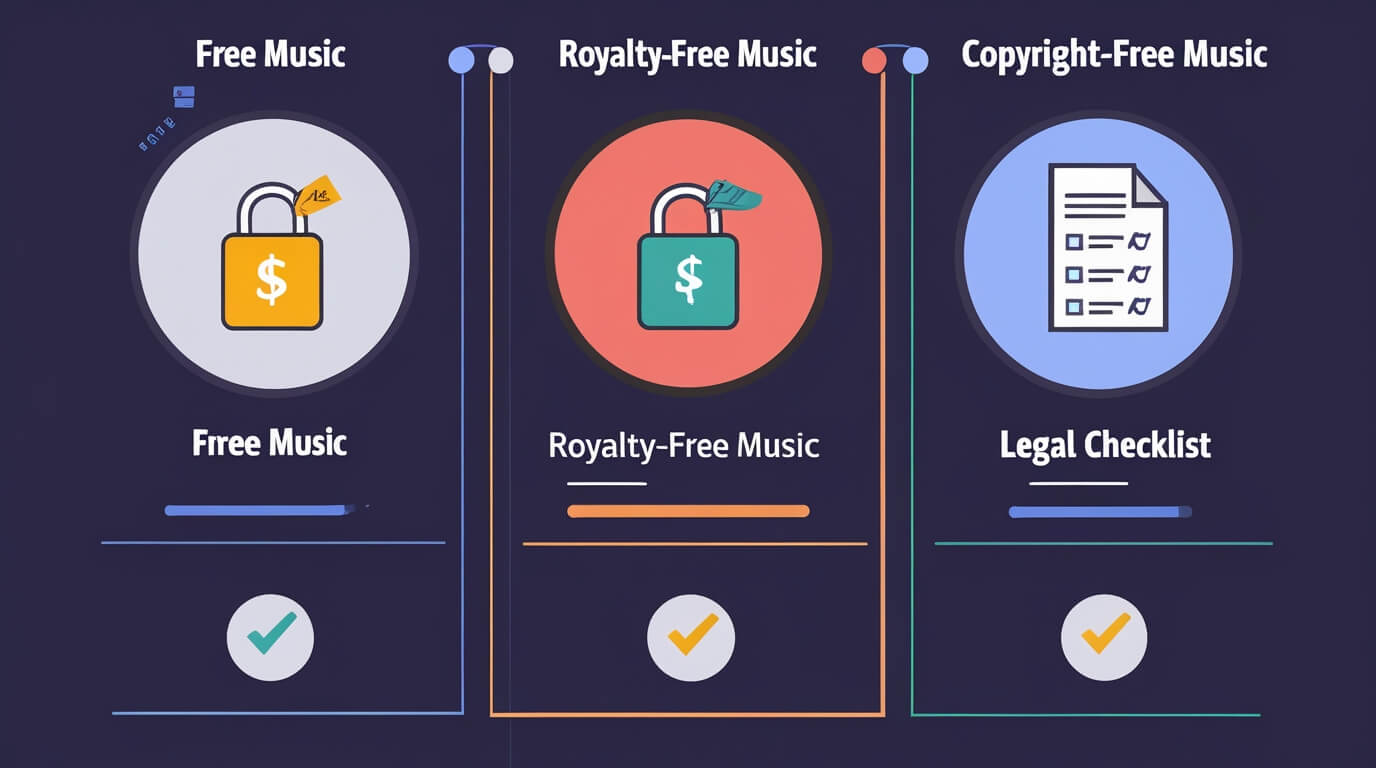
Navigating music licensing is tricky—especially when terms like “free music,” “royalty-free,” and “copyright-free” are often used interchangeably. But these terms mean very different things, and misunderstanding them could get your content demonetized—or worse, flagged with copyright strikes.
If you’re a content creator, business owner, musician, or filmmaker, knowing the difference is essential for legal, stress-free music use.
“Free music” usually means you can download or use a track without paying money upfront. However, “free” does not mean unrestricted.
⚠️ Important: Many “free” songs are still under copyright. Always review the license before using.
“Royalty-free music” means that once you acquire a license (free or paid), you can use the music without paying ongoing royalties per use or per viewer/listener.
Example: You download a royalty-free track from a stock music library and use it in your podcast intro—legally and repeatedly, without paying per episode.
“Copyright-free” means the music is not protected by copyright—usually because the rights have expired or the creator voluntarily waived them.
When it comes to using music in your content, ignorance isn’t bliss—it’s risky. Always know what type of license you’re working with, and when in doubt, use verified platforms that clearly explain the usage rights.
Whether you're creating YouTube videos, podcasts, ads, or apps—making the right choice in music licensing protects your content and your reputation.
These are different questions to resolve for a recording. Price concerns what a provider charges for an arrangement. Ownership concerns the rights in the work. Permission concerns what a particular user may do under the applicable terms or law. A label in a search result rarely answers all three questions.
Begin with the specific recording and your intended project. Identify the provider or rightsholder information and find the terms attached to that material. Keep the exact wording relevant to your use in the project record. Avoid turning an informal phrase such as “copyright-free” into a universal conclusion about who owns the work or what every user may do with it.
Describe the project before comparing labels. Note where it will appear, how the music will be incorporated, and whether other people will need the files. Include the questions that matter for the planned distribution. The purpose is to give the provider or an appropriate adviser a clear description, not to decide legal questions from a generic checklist.
For example, private reference listening and placing a recording in a published video are different situations. A provider’s documentation may address them differently. Keep those purposes separate in your notes so that a file saved for research does not quietly become an approved production asset. Recheck the relevant information if the intended use changes.
If material identifies a Creative Commons license, identify which license is named and consult the official license overview. The license types have different conditions. For a provider-specific arrangement, read that provider’s current terms and the information attached to the track. Do not assume that another website’s summary describes the exact arrangement.
Keep unresolved questions visible. If the documentation does not answer a point important to your project, ask the provider or get appropriate legal advice before relying on an interpretation. A download button, a low price, or a statement about attribution is not a complete description of all possible uses.
Store the track title, creator or supplier name, original URL, date checked, and location of the applicable instructions. Add any required credit task to the project checklist, including who will complete it and where the information must appear. Keep records with the project rather than only in a personal browser bookmark.
When handing the work to a collaborator, identify which files are references, which are candidates, and which have been selected for the edit. Include the relevant documentation and unanswered questions. Clear records make it easier to revisit a decision without presenting your notes as a substitute for the actual terms.
Copyright rules and exceptions depend on the applicable legal context and the intended use. For a United States starting point, the U.S. Copyright Office’s musician guidance explains that musical works and recordings can involve distinct rights. Use official guidance relevant to your jurisdiction and situation rather than assuming that a marketing label resolves the question.
When uncertainty matters to a release, resolve it before publication. Keep an alternative candidate available where practical, and record the reason for the selection you eventually make. The useful habit is to connect a particular file, a particular project, and the applicable information, instead of relying on the word “free” to stand for several different ideas.
Stay up to date with the latest tips, expert insights, product reviews, and step-by-step guides to help you grow, create, and succeed—no matter your industry or passion.


