
Jazz vs Blues: What is the Difference for New Listeners?

August 18, 2025

By RocketPages

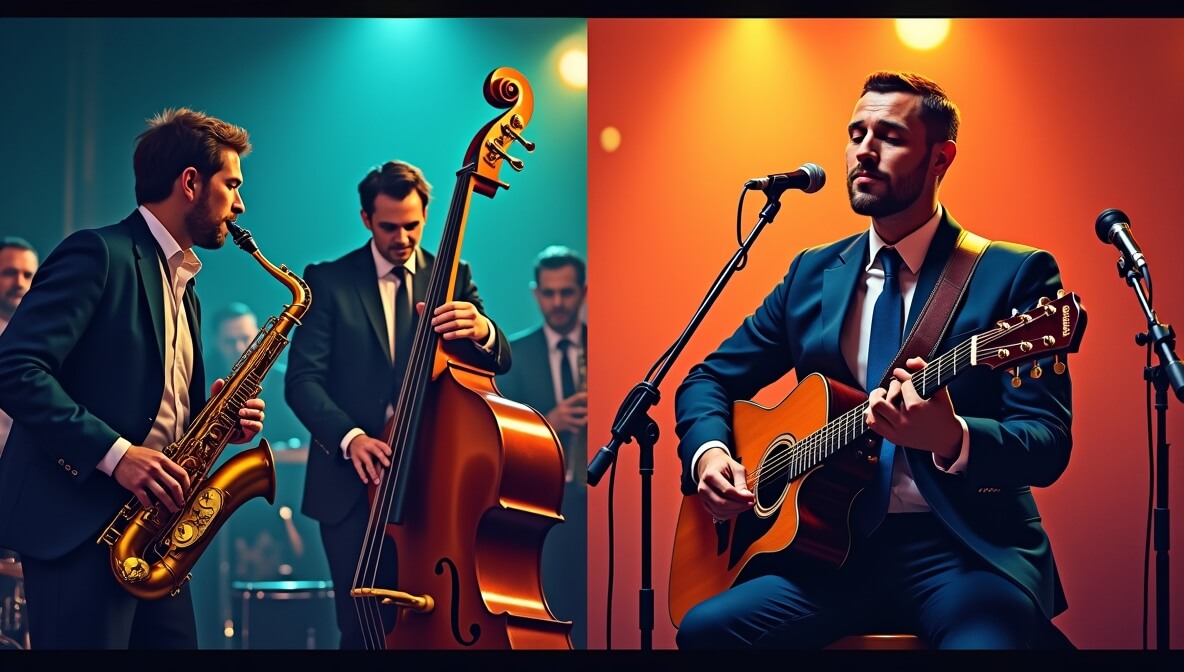
Jazz band with brass instruments compared to a blues guitarist, highlighting the difference in styles.

When diving into music discovery, two foundational genres stand out: jazz and blues. They often sit side by side in playlists, history books, and conversations — but while they share common roots, their personalities are uniquely different.


Whether you're learning an instrument, building a deeper appreciation of music, or just exploring genres, understanding jazz and blues will open the door to nearly every modern style, from rock and R&B to hip-hop and lo-fi.


Origins: Shared Roots, Different Paths


Blues and jazz were both born from the African American experience in the late 19th and early 20th centuries, but they took shape in different social and musical contexts.


The Blues:


  • Born in the Mississippi Delta, post-Civil War America.
  • Rooted in field hollers, spirituals, and work songs.
  • Focuses on personal storytelling — sorrow, love, oppression, survival.
  • Early artists like Robert Johnson, Lead Belly, and Ma Rainey laid the foundation.
  • The 12-bar blues form became its defining structure.


Recommended Listen: Muddy Waters – “Mannish Boy”


Jazz:


  • Originated in New Orleans, merging blues, ragtime, brass band music, and Caribbean rhythms.
  • Emphasizes ensemble playing, improvisation, and syncopation.
  • Became the voice of 20th-century sophistication and experimentation.
  • Innovators like Louis Armstrong, Duke Ellington, and Jelly Roll Morton defined its early sound.


Recommended Listen: Louis Armstrong – “West End Blues”

Dive deeper with: RocketPages: The Roots of Jazz and Blues


Musical Structure & Feel


Blues is:


  • Simple and soulful
  • Usually in 4/4 time, with the iconic 12-bar progression
  • Harmonically predictable — often I–IV–V chords
  • Lyrically repetitive, often using AAB structure:
  • "I woke up this morning (A)
  • Felt that cold wind blow (A)
  • Then I knew I had to go" (B)
  • Vocals are raw and emotive. Guitar solos mimic the "voice."


Jazz is:


  • Complex and improvisational
  • Frequently changes time signatures and key centers
  • Uses extended chords (9ths, 11ths, 13ths) and modal progressions
  • Musicians often take turns improvising over chord changes
  • Lacks the lyrical repetition of blues — often instrumental


For comparison:


Cultural Impact


Blues:


  • Deeply influenced rock 'n' roll, soul, and modern pop.
  • Artists like Eric Clapton, The Rolling Stones, and Jimi Hendrix borrowed heavily from blues phrasing and guitar work.
  • Lyrics often reflect personal pain, resistance, and emotional truth.


Jazz:


  • Gave rise to funk, bebop, fusion, and even hip-hop sampling.
  • Known for its intellectual and improvisational edge.
  • Artists like Herbie Hancock and John Coltrane pushed musical boundaries and inspired genres beyond traditional jazz.


Want to explore genre evolution? Check out: How Genres Influence Each Other – RocketPages


Listening Tips for Newbies


If you're just starting out:


Start with blues if you:


  • Love songs with feeling, repetition, and soul
  • Enjoy storytelling through lyrics
  • Want to focus on guitar and vocals


Start Here:


  • Robert Johnson – “Cross Road Blues”
  • Etta James – “I’d Rather Go Blind”
  • Stevie Ray Vaughan – “Texas Flood”


Start with jazz if you:


  • Are curious about instrumental depth and improvisation
  • Want to explore more rhythmic and harmonic variety
  • Enjoy listening to each musician bring their own flavor


Start Here:


  • Ella Fitzgerald – “Summertime”
  • Dave Brubeck – “Take Five”
  • John Coltrane – “In a Sentimental Mood”


Want a structured jazz/blues playlist? Let me know — I can create one based on your taste.


Conclusion: Two Sides of the Same Musical Coin


Jazz and blues are often called cousins, and for good reason:


  • They influence each other and have shared history
  • Blues laid the emotional groundwork
  • Jazz built on that to explore freedom and complexity


If blues is the heart, jazz is the mind — but both are incredibly expressive, meaningful, and foundational to everything from rock to rap.


Bonus: For deeper appreciation, try the RocketPages music documentaries list — many cover the lives of blues and jazz pioneers.

Recent Articles

Stay up to date with the latest tips, expert insights, product reviews, and step-by-step guides to help you grow, create, and succeed—no matter your industry or passion.


Portrait studio with a sitter, soft key light and camera demonstrating directional portrait lighting
Portrait Lighting Patterns: Split, Loop and Rembrandt
Judge the light on the faceA portrait lighting pattern describes the arrangement of light and shadow on the face. It is different from the make of the light, the background color, or the overall editi...
Read More
Two educators reviewing curriculum books, sample worksheets and a checklist in a school library
Choosing a School Curriculum: A Practical Review Checklist
Clarify what decision you can makeChoosing a curriculum is different from choosing a school. A curriculum concerns the sequence of knowledge, skills, learning activities, and assessment, together with...
Read More
Teacher supporting a student using geometric learning materials and a notebook in a classroom
Personalized Learning Approaches: Goals, Support and Feedback
Begin with a learning goalPersonalized learning involves making informed choices about instruction and support for a learner. Start with the knowledge or skill being developed, not with a product or a...
Read More
