
Free Music Download Sites Compared: SoundCloud vs Jamendo vs Free Music Archive

July 30, 2025

By RocketPages

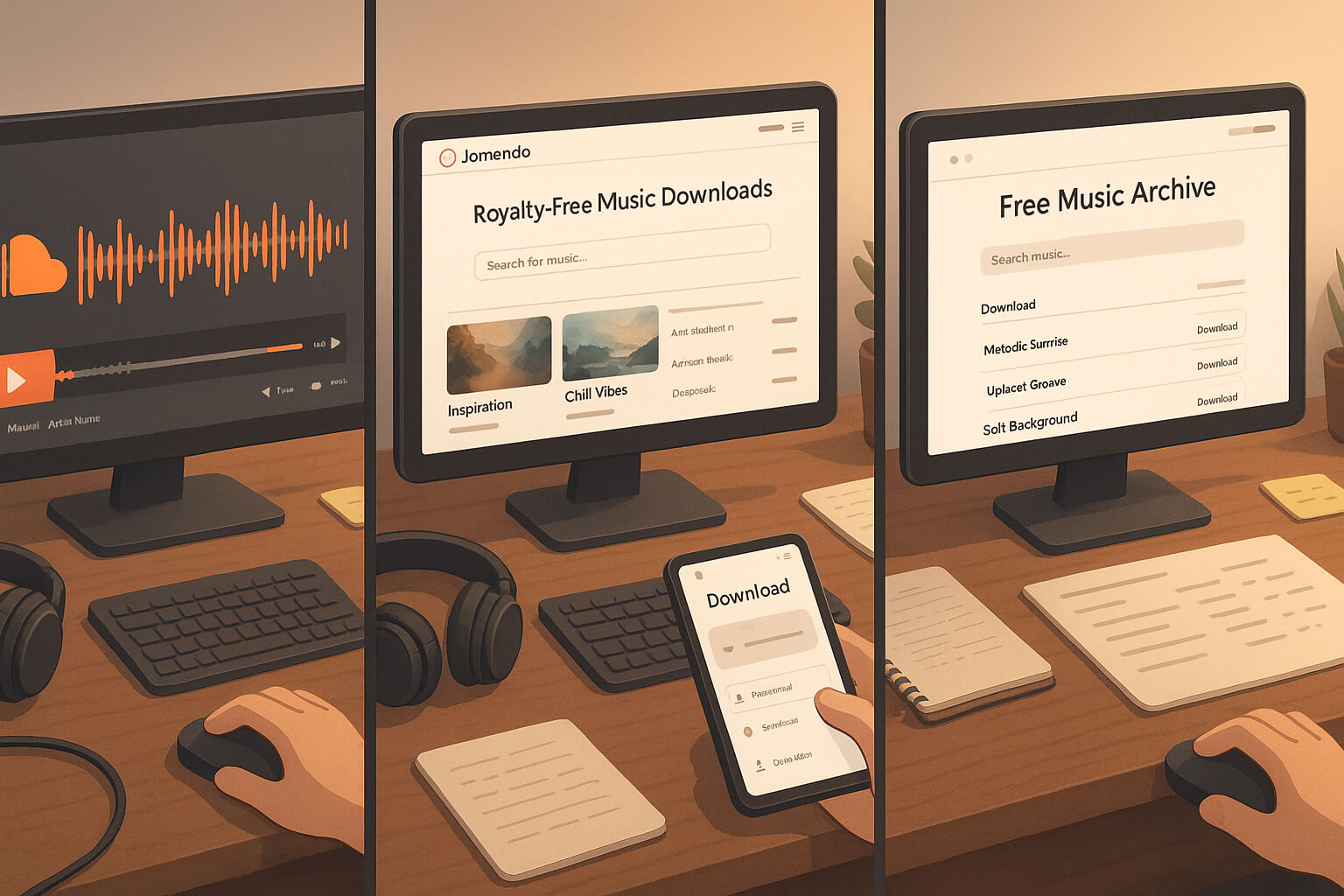
A side-by-side comparison of SoundCloud, Jamendo, and Free Music Archive being browsed for music downloads.
The 2025 Guide: Where to Find Free, Legal, High-Quality Music


In a world flooded with digital music, finding tracks that are truly free, legally safe, and professional-grade can be overwhelming. Platforms like SoundCloud, Jamendo, and Free Music Archive (FMA) remain pillars in the royalty-free ecosystem—but each has its own strengths and caveats.


Here’s an in-depth comparison, loaded with real-world applications, external resources, and next-gen alternatives.


SoundCloud: A Universe of Music, with Licensing Hurdles


  • What Makes it Special?
  • SoundCloud boasts one of the largest audio collections on the internet—with over 300 million tracks uploaded by indie musicians, bedroom producers, and rising stars. It’s a haven for remix culture and grassroots creativity.


  • Strengths:
  • Genre Diversity: Discover niche sounds, from vaporwave remixes to underground hip-hop beats.
  • Community Vibe: Comment, collaborate, and remix openly with artists.
  • Direct Downloads: Some creators offer free downloads via SoundCloud’s own download button or linked through platforms like Hypemachine.


  • Caveats:
  • Licensing is a Gray Area: SoundCloud doesn’t verify or enforce licenses on uploads. You must contact the artist for usage permissions, especially for commercial use (SoundCloud Licensing Help).
  • Navigating for “Free to Use” tracks can be tedious, as the platform lacks clear search filters for usage rights.


  • Best For:
  • Creators seeking inspiration, remix artists, or fans hunting underground tracks—not ideal for commercial projects without artist approval.


Jamendo: Licensing Made Effortless for Creators


  • Why It’s a Game Changer:
  • Unlike SoundCloud, Jamendo is designed for creators who need clean-cut licensing clarity. Every track is tagged with Creative Commons or Jamendo Licensing, making it easier to pick music based on usage type.


  • Strengths:
  • Search by Project Type: Filter music for podcasts, YouTube intros, corporate videos, or gaming streams (Jamendo Licensing).
  • Pre-Cleared Commercial Use: Many tracks are bundled with sync licenses for advertisements, in-store play, or film.
  • Curated Quality: While smaller than SoundCloud, its 150,000+ tracks are professionally curated.
  • Business Solutions: Bulk licensing packs for enterprises and creators working on multiple projects.


  • Limitations:
  • Some Premium Content Requires Payment: Especially for high-res WAV files or broadcast-level usage.
  • Interface is Function-Over-Form: Efficient, but lacks modern UX appeal compared to newer platforms.


  • Best For:
  • Content creators, freelancers, and agencies needing fast, hassle-free music licensing for monetized projects.


Free Music Archive (FMA): A Legacy of Open Collaboration


  • Why It Still Matters in 2025:
  • Originally curated by WFMU, FMA’s mission was to create a public library of freely usable music, championing collaboration and cultural preservation.


  • Strengths:
  • Creative Commons Transparency: Each track’s licensing terms are clearly displayed, so you can verify if it’s safe for commercial, remix, or educational use (FMA Licensing Guide).
  • No Sign-up Needed for Downloads: Instant access to thousands of unique tracks.
  • Archival Depth: A goldmine for experimental genres, field recordings, vintage jazz, chiptune, and more.


  • Drawbacks:
  • Minimal Updates: Since WFMU’s initial stewardship ended, the platform lacks active moderation.
  • Outdated Interface: Discovery is more of a hunt—rewarding, but time-consuming.
  • Check License Carefully: Some tracks may have non-commercial clauses, making them unsuitable for monetized projects.


  • Best For:
  • Documentary filmmakers, academic projects, or anyone needing unique, heritage-rich soundscapes.


Modern Solutions for Fast, Legal Music Access


If you’re a high-output creator who values efficiency, these tools simplify the process:


Final Thoughts: Which Should You Choose?


  • SoundCloud — For explorers and remix artists seeking variety, but beware of licensing ambiguity.
  • Jamendo — The go-to for creators needing licensing clarity and content-use flexibility.
  • FMA — A gem for academic and creative projects needing rare, unique soundscapes.


If speed, licensing transparency, and creative control are non-negotiable for your workflow, curated royalty-free libraries and AI generation tools are the smartest moves in 2025.

Run the same search on each source

Prepare a short search brief with a mood, approximate length, instrumentation, and intended role in the project. Try that brief on each platform and keep notes about the candidates you actually find. Search results can differ by account, region, catalogue changes, and the words you choose, so record the date and the specific track pages rather than relying on a general platform description.

Audition candidates against the same sample scene or voice recording. A track that sounds appealing on its own may compete with dialogue or change energy at an awkward point. Mark the moments that work and the moments that need editing. This creates a comparison based on your production rather than on the appearance of a search page.

Inspect the track page before keeping the file

For each candidate, locate the creator or supplier information, the download option if one is offered, and the conditions associated with that recording. A platform-level summary does not replace information about a particular file. If a download is unavailable or a relevant condition is unclear, record that limitation instead of assuming another page’s instructions apply.

Keep the title, source URL, date checked, and any supplied credit wording with the project. If a track has several versions, identify which one you auditioned and downloaded. This avoids a common handoff problem in which a collaborator receives an audio file but cannot connect it to the page that informed the original choice.

Compare the complete editing experience

Use a small test project to check how easily the chosen file fits your workflow. Listen to its beginning and ending, try a short transition, and check the level against the surrounding material. Note whether you need a different arrangement or a track with a quieter passage. These observations are more useful than choosing a source only because it offers many results.

Keep a shortlist rather than downloading every promising candidate. For each shortlisted track, write one musical reason to keep it and one question to resolve. Review those questions before publication, especially if the project’s distribution changes. The platform comparison should leave you with a traceable selection process and a usable alternative, not a promise that every recording on one site has identical conditions.

Make the comparison repeatable

Save the brief, shortlist, and final decision together. On a later project, reuse the comparison method while checking the current track information again. This preserves what you learned about searching and editing without treating an old review as a permanent description of a changing catalogue.

Recent Articles

Stay up to date with the latest tips, expert insights, product reviews, and step-by-step guides to help you grow, create, and succeed—no matter your industry or passion.


Portrait studio with a sitter, soft key light and camera demonstrating directional portrait lighting
Portrait Lighting Patterns: Split, Loop and Rembrandt
Judge the light on the faceA portrait lighting pattern describes the arrangement of light and shadow on the face. It is different from the make of the light, the background color, or the overall editi...
Read More
Two educators reviewing curriculum books, sample worksheets and a checklist in a school library
Choosing a School Curriculum: A Practical Review Checklist
Clarify what decision you can makeChoosing a curriculum is different from choosing a school. A curriculum concerns the sequence of knowledge, skills, learning activities, and assessment, together with...
Read More
Teacher supporting a student using geometric learning materials and a notebook in a classroom
Personalized Learning Approaches: Goals, Support and Feedback
Begin with a learning goalPersonalized learning involves making informed choices about instruction and support for a learner. Start with the knowledge or skill being developed, not with a product or a...
Read More
