
January 09, 2026
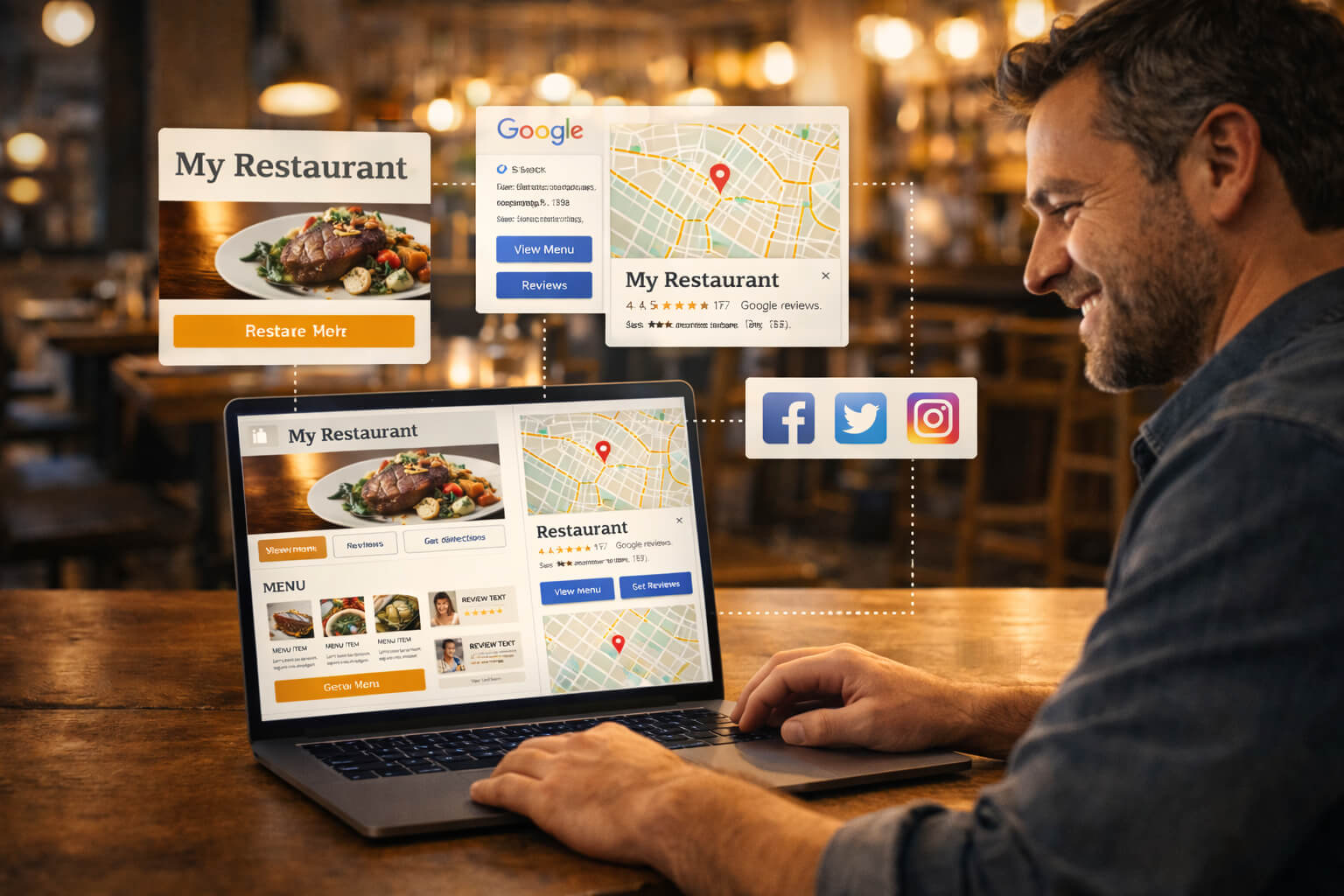
In 2026, a restaurant’s online presence often influences dining decisions more than its physical location, signage, or street visibility. Before diners step inside your restaurant, they have already judged it—based on what they found online.
Search results, photos, menus, reviews, loading speed, and ease of booking all shape perception long before the first interaction. In many cases, diners decide not to visit a restaurant without ever consciously realizing why. They simply choose the option that feels clearer, easier, and more trustworthy.
A strong online presence in 2026 does not mean being everywhere. It means showing up clearly, consistently, and convincingly where diners actually make decisions: Google Search, Google Maps, your website, and a small number of trusted digital touchpoints.
This guide explains how to build a modern, resilient online presence that attracts diners, builds confidence instantly, and converts visibility into real revenue.
In 2026, every digital channel still points back to one asset that restaurants must fully control: their website.
Social platforms change algorithms. Delivery apps raise fees. Search features evolve. But your website remains the only digital property you own outright—and the only place where you control the narrative, experience, and conversion path.
A strong restaurant website today does far more than “exist.” It acts as a confirmation layer that reassures diners they are making the right choice. It explains who you are immediately, presents menus and pricing clearly, removes friction from booking or visiting, and reinforces trust built elsewhere.
Restaurants that neglect their website often lose customers invisibly. Confusion, slow load times, missing menus, or outdated information cause hesitation—and hesitation sends diners to competitors that feel easier to choose.
The Cost of Not Having a Website for Your Restaurant
In 2026, follower counts and engagement numbers are even less reliable indicators of real growth than they were a few years ago. Visibility that does not translate into foot traffic is noise.
Local search remains the most consistent driver of restaurant discovery. Searches like “restaurant near me,” “best lunch in [city],” or “Italian food in [neighborhood]” signal immediate intent. These users are not browsing—they are choosing.
Restaurants that prioritize local SEO focus on discoverability at the exact moment diners are ready to act. They structure their websites around location relevance, maintain strong Google Maps presence, and align content with how people actually search.
This approach consistently outperforms social-first strategies because it aligns with decision-stage behavior, not passive consumption.
SEO for Restaurants: How to Get Found Online
How Restaurants Can Attract Local Customers Through SEO
By 2026, Google Business Profile has become even more influential—but also more competitive.
Your profile is often the first thing diners see: photos, reviews, hours, popularity indicators, and proximity all appear instantly. A well-managed profile increases visibility and legitimacy, but it cannot do the full job alone.
Google increasingly favors restaurants whose profiles are supported by strong websites that confirm accuracy, depth, and relevance. Profiles generate discovery; websites finalize trust and drive action.
Restaurants that treat GBP as a standalone solution plateau. Those that integrate it into a broader digital system continue to grow.
What Every Restaurant Owner Should Know About Google Business Profile
In 2026, inconsistency does more damage than ever.
Conflicting menus, mismatched photos, outdated hours, or inconsistent branding across platforms create uncertainty—not just for diners, but for search engines. Google increasingly rewards clarity and penalizes ambiguity.
A strong online presence means presenting a unified identity everywhere diners encounter you. Your branding, tone, visuals, and core information must align across your website, Google listing, directories, and social platforms.
Consistency signals professionalism. Professionalism builds trust. Trust converts.
Restaurant Branding 101: Why Your Online Identity Matters
In 2026, menus are no longer secondary content—they are central to the decision process.
Diners evaluate pricing, variety, dietary options, and value before committing. If your menu is slow, difficult to read, incomplete, or outdated, you introduce friction at the most critical moment.
Modern digital menus are fast, mobile-optimized, searchable, and structured in a way that helps both users and search engines. They reduce uncertainty and shorten the decision cycle.
Restaurants that treat menus as strategic assets outperform those that treat them as static information.
Online Menus: Why They Matter More Than Printed Ones
How Digital Menus Improve Guest Experience and Save Costs
In 2026, attention spans are shorter, but expectations are higher.
High-quality visuals communicate quality, atmosphere, and professionalism instantly. Diners use photos to answer emotional questions: Does this place feel right? Does the food look worth it? Can I picture myself here?
Strong visuals reduce hesitation and increase confidence before a single word is read. Restaurants that invest in professional photography consistently see higher engagement, longer site visits, and better conversion rates.
The Science of Food Photography for Restaurant Websites
By 2026, reviews function as a live reputation feed.
Google values recency, consistency, and engagement. Diners do too. A handful of old five-star reviews no longer carries the weight it once did.
A strong review strategy involves continuously earning feedback, responding thoughtfully, and integrating reviews into your website experience. This reinforces trust at the exact moment diners are deciding.
Restaurants that actively manage reviews don’t just rank better—they convert better.
How Reviews Impact Restaurant SEO (And What to Do About It)
The Restaurant Reputation Playbook: How to Win Diners’ Trust Online
In 2026, margins are tighter and third-party fees are higher.
A strong online presence must actively push diners toward direct actions: reservations, direct online orders, and owned customer channels. Visibility without conversion leaks revenue.
Restaurants that reclaim traffic through their own websites reduce dependency on delivery apps, retain more profit, and build long-term customer relationships instead of one-off transactions.
How to Add Online Ordering to Your Website Without Paying App Fees
Competing With Delivery Apps: Why Direct Ordering Wins
In 2026, mobile is not a channel—it is the baseline.
Most restaurant discovery, comparison, and decision-making happens on phones, often within minutes of arrival. Google evaluates your website primarily through its mobile performance.
Mobile-first websites load faster, rank higher, and convert better. Poor mobile experiences silently eliminate restaurants from consideration.
Mobile-First Websites: Why Restaurants Can’t Ignore Them
In 2026, fragmented marketing no longer works.
SEO, social media, paid ads, email, and partnerships all funnel into one place where decisions are finalized: your website. When the website is weak, every channel underperforms. When it is strong, every channel improves.
Restaurants that understand this stop chasing tactics and start building systems.
The Restaurant Marketing Funnel: How Your Website Brings Diners to Your Door
The fundamentals continue to outperform trends.
Restaurants that invested in clarity, SEO, conversion, and trust consistently see measurable results. One restaurant increased bookings by 40% simply by strengthening its website and online presence—without increasing ad spend.
How One Restaurant Increased Bookings by 40% With a New Website
Your restaurant is being evaluated every day—often when you are closed, busy, or unaware.
A strong online presence works continuously: attracting diners, building confidence, and guiding decisions before the first interaction ever occurs.
Restaurants that treat their online presence as a core business asset don’t just survive changing platforms and algorithms—they stay visible, trusted, and chosen.
If diners can’t find you clearly—or don’t trust what they see—they won’t choose you.
Build your online presence before that decision is made.
Stay up to date with the latest tips, expert insights, product reviews, and step-by-step guides to help you grow, create, and succeed—no matter your industry or passion.