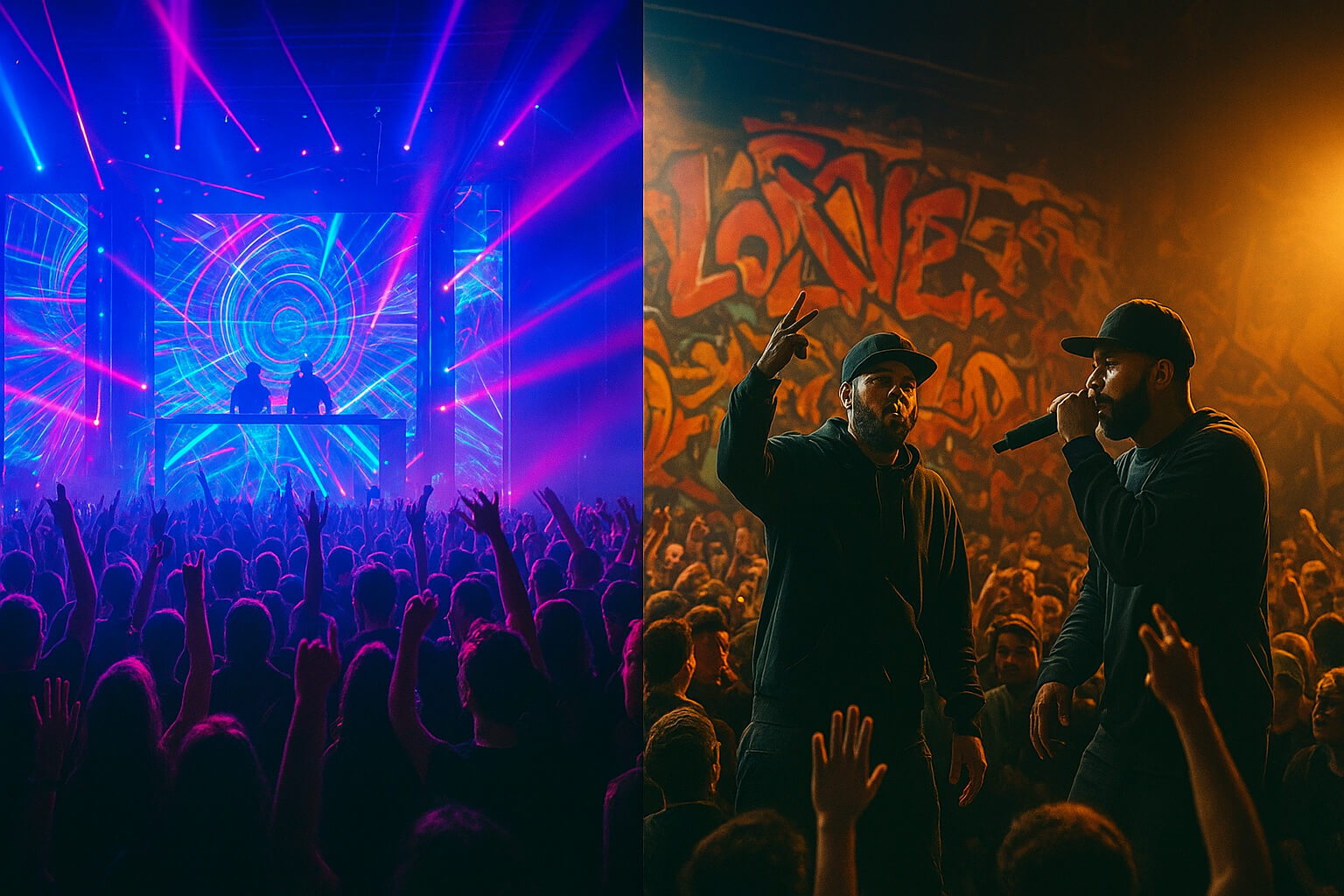
There has never been a more fascinating time to be a music fan, a music creator, or a music industry observer. The global music landscape of 2025 is a sprawling, dynamic, fragmented ecosystem — shaped by streaming algorithms, short-form video virality, festival culture, regional tastes, demographic shifts, and the creative decisions of artists who are increasingly operating as multimedia brands rather than simply musicians.
Within this complex landscape, two genres stand out as the defining forces of contemporary popular music: Electronic Dance Music and Hip-Hop. Together, they have dominated global streaming charts for the better part of a decade, shaped fashion and visual culture, influenced advertising and film, driven the evolution of live entertainment, and generated billions of dollars in economic activity across the music industry and beyond.
But in 2025, which genre is truly in the ascendant? Which is growing faster, reaching new audiences more effectively, and shaping the cultural conversation more powerfully? And what does the competition between them reveal about how music consumption, creation, and culture are evolving in the digital age?
This is not a simple question with a simple answer. Both genres are vast, internally diverse, and constantly evolving — encompassing everything from drill and trap to melodic techno and future bass, from billion-stream albums to underground scenes that never appear on mainstream charts. Comparing them requires looking at multiple dimensions simultaneously: streaming data, viral performance, live music, regional trends, demographic patterns, artist strategy, and the production techniques that are shaping the sound of each genre in real time.
This guide examines all of these dimensions — not to declare a winner in a false competition, but to understand what each genre is doing, where it is growing, where it is facing challenges, and what the dynamic between them reveals about the future of music.
The Streaming Battlefield: Where the Numbers Tell the Story
Streaming platforms — Spotify, Apple Music, Amazon Music, YouTube Music, Tidal, and their regional equivalents — are the primary venue for music consumption in 2025, accounting for the majority of music listening globally. Streaming data is therefore the most comprehensive and most reliable indicator of genre popularity available, and the picture it paints of the EDM vs. Hip-Hop competition is nuanced and fascinating.
Hip-Hop's Dominant Position
- Hip-Hop — the umbrella genre encompassing rap, trap, drill, R&B-influenced hip-hop, Latin hip-hop, and their many regional variants — retains a commanding lead in total global streams. In the United States, which remains the world's largest music market, hip-hop has been the most-streamed genre continuously since 2017, when it overtook rock and country in a milestone that marked a fundamental shift in mainstream music culture. The genre's dominance in North America extends to Canada, the United Kingdom, Australia, and much of Western Europe, where American hip-hop artists generate enormous streaming volumes alongside strong local scenes.
- The listening patterns that sustain this streaming dominance reflect hip-hop's unique cultural position. Hip-hop albums — from artists like Drake, Kendrick Lamar, Travis Scott, Bad Bunny, and a constantly refreshing roster of emerging voices — generate the kind of devoted, full-album listening engagement that produces high per-user stream counts. Hip-hop also dominates the social listening behavior that drives peaks in streaming: the cultural moments — diss tracks, beef responses, collaborative surprises — that trigger massive spikes in listening activity across entire fan communities simultaneously.
- The depth of this cultural embeddedness is one of hip-hop's most durable competitive advantages. People do not just stream hip-hop — they are invested in it in ways that generate the sustained, repeat listening that produces the highest lifetime stream counts per release.
EDM's Strategic Growth
- EDM's streaming story is different but increasingly impressive. While hip-hop dominates the charts for individual tracks and albums, EDM has developed a distinct and strategically advantageous presence in playlist listening — the mode of music consumption that accounts for a growing proportion of total streams as listeners increasingly use music functionally rather than attending closely to specific artists or albums.
- EDM's structural characteristics — its consistent energy, its absence of lyrical content that demands specific cultural context, its adaptability to a wide range of listening contexts — make it the genre of choice for an enormous range of playlist categories: workout and exercise playlists, focus and study playlists, gaming playlists, ambient and background playlists, driving playlists, and the party and pregame playlists that represent some of the highest-engagement listening contexts on streaming platforms.
- Spotify has reported consistent year-over-year growth in streams for electronic and dance music, with the genre showing particularly strong performance in Europe, Scandinavia, Germany, the Netherlands, and across Asia — regions where EDM's club culture roots translate into strong domestic listening communities that reinforce global streaming numbers.
- The production craft behind both genres — the techniques that make EDM tracks so effective for playlist contexts and hip-hop tracks so culturally compelling — deserves serious attention from aspiring producers in both genres. Practice Makes Perfect: Effective Strategies for Improving Musical Skills provides a framework for the deliberate, structured practice that develops genuine musical competence — applicable whether you are working on the groove and rhythmic precision that defines great hip-hop production or the tension, build, and release dynamics that make EDM tracks work on the dance floor. The most successful producers in both genres are those who have invested deeply in their craft, and intentional practice is the foundation of that investment.
TikTok and Short-Form Virality: The New Frontier of Music Discovery
No force has reshaped music discovery more dramatically in the past five years than TikTok. With over 1.7 billion monthly active users globally in 2025, and with music — particularly short, memorable sonic hooks — at the center of its content culture, TikTok has become the most powerful single driver of streaming spikes, chart entries, and cultural moments in contemporary music.
Both EDM and Hip-Hop have significant presences on TikTok, but their strategies and strengths differ in ways that illuminate the broader competitive dynamics between them.
Hip-Hop's TikTok Native Advantage
- Hip-Hop arrived on TikTok with structural advantages perfectly suited to short-form video. The genre's tradition of catchy, memorable hooks — phrases, melodies, and rhythmic patterns designed to stick in the listener's memory after a single hearing — translates directly into the kind of sonic moment that anchors a viral TikTok sound. The cultural fluency of hip-hop dance — the choreographic traditions associated with specific songs and artists — makes it a natural fit for TikTok's dance challenge culture, which has been one of the platform's most powerful mechanisms for driving music virality since its earliest days.
- Artists like Nicki Minaj, Ice Spice, and dozens of emerging artists have generated billions of video creations on TikTok — each one a micro-advertisement for the underlying track that drives listeners to streaming platforms. The financial impact of a genuinely viral TikTok sound is now so significant that major labels and independent artists alike build their release strategies around TikTok virality as a primary consideration.
EDM's Structural TikTok Advantage
- EDM brings its own distinct TikTok advantages. The genre's signature structure — the slow build of tension through an extended intro, the drop that releases that tension in a moment of maximum energy — is extraordinarily effective as an editing tool for video creators. The drop functions as a natural transition point: before the drop, a scene; after the drop, the reveal, the transformation, the punchline. This structural utility has made EDM tracks disproportionately represented in the editing and transition content that is one of TikTok's most popular content categories.
- EDM producers like Illenium, Fred again.., Kaytranada, and a generation of bedroom producers whose work circulates through EDM communities have built significant TikTok presences through this editing utility — with their music appearing in contexts ranging from travel content to comedy skits to fashion reveals to gaming highlights. The versatility of EDM as a sonic backdrop across content categories gives it a TikTok presence that cuts across genre boundaries in ways that hip-hop, more culturally specific in its appeal, does not always replicate.
- The production knowledge required to create tracks optimized for short-form virality — understanding how to structure builds and drops, how to layer sounds for maximum impact, how to use MIDI-driven composition to create the melodic elements that make EDM tracks emotionally resonant — is increasingly accessible through digital production tools. The Basics of MIDI: How It Works and Why It Is Essential for Production provides the foundational understanding of MIDI technology that every contemporary producer needs — covering the technical principles, the practical applications in both EDM and hip-hop production, and the creative possibilities that MIDI enables for producers working in any genre. For aspiring producers seeking to create music with viral potential, MIDI literacy is as essential as any other production skill.
Live Music and Festival Culture: Where Each Genre Dominates
The pandemic-era collapse of live music has given way to one of the most robust periods of live music growth in recent memory. In 2025, both EDM and Hip-Hop are thriving in the live space — but in characteristically different environments that reflect each genre's distinct relationship with its audience.
Hip-Hop's Arena Dominance
- Hip-Hop dominates the arena and stadium touring circuit in ways that no other genre currently matches. The superstar tier of hip-hop — Drake, Kendrick Lamar, Bad Bunny, Travis Scott, Cardi B, and their peers — commands the kind of devoted fanbase that fills 20,000-seat arenas night after night across global touring circuits. These tours generate not just ticket revenue but enormous ancillary revenue from merchandise, sponsorship, and brand partnerships that reflect hip-hop's status as the dominant force in mainstream popular culture.
- What makes hip-hop arena touring so commercially powerful is the depth of fan investment. Hip-hop fans do not just stream their favorite artists — they follow their careers, engage with their cultural output across fashion, film, gaming, and social media, and attend live shows as participatory cultural events rather than passive entertainment. This depth of engagement translates into ticket prices and merchandise spend that sustain some of the most lucrative touring businesses in the entertainment industry.
- The 2025 battle between Kendrick Lamar and Drake — which generated billions of streams, dominated social media discourse for months, and culminated in one of the most anticipated touring cycles in recent memory — illustrated perfectly the kind of cultural event-making that hip-hop uniquely produces and that no other genre can currently match.
EDM's Festival Empire
- EDM, meanwhile, has built the most comprehensive festival ecosystem in the world. Tomorrowland in Belgium, Ultra in Miami and globally, Electric Daisy Carnival in Las Vegas, Defqon.1 in the Netherlands, Coachella's electronic stages, and hundreds of smaller festivals across Europe, Asia, Australia, and Latin America collectively represent an entertainment industry unto themselves — drawing hundreds of thousands of attendees per event, generating enormous local economic activity, and providing the primary context in which EDM artists develop and maintain their careers.
- The festival experience is EDM's natural habitat in ways that go beyond mere genre preference. The multi-stage festival format — where attendees move between stages, discover new artists, and experience music in a communal outdoor setting that encourages discovery and shared experience — suits the EDM ethos of continuous discovery and sonic exploration in ways that the structured, single-artist concert format of hip-hop touring does not replicate.
- Building the production skills to create music worthy of a festival mainstage — tracks with the energy, dynamics, and sound design quality to fill massive outdoor spaces with thousands of people — requires both deep musical knowledge and access to appropriate production tools. Building Your Home Studio: Essential Gear and Setup Guide provides exactly the practical guidance that aspiring EDM producers need to create professional-quality music from home — covering the hardware, software, and acoustic treatment that make the difference between amateur recordings and the polished productions that festival bookers and streaming curators are looking for. For producers working toward festival-ready tracks, the home studio investment is the first and most fundamental step.
Regional Trends: How Geography Shapes the Competition
One of the most important and most frequently overlooked dimensions of the EDM vs. Hip-Hop comparison is its geographic variability. Both genres have global reach, but their relative strength varies dramatically by region — in ways that reflect local cultural traditions, digital infrastructure, demographic patterns, and the history of each genre's development and distribution.
North America: Hip-Hop's Home Turf
- North America — the United States, Canada, and Mexico — is hip-hop's home turf, and it shows. The genre's origins in New York and Los Angeles, its deep roots in Black American culture, its integration with the media and entertainment industries that are centered in these markets, and its dominance of mainstream radio and streaming charts create a structural advantage that EDM has never seriously challenged in North American markets.
- This does not mean EDM is irrelevant in North America — the American EDM festival scene is substantial, and EDM consistently generates significant streams across North American platforms. But in terms of cultural centrality, commercial dominance, and the kind of mainstream conversation-shaping that determines what "popular music" means in any given market, North America belongs to hip-hop in 2025 as decisively as it did in 2020.
Europe: EDM's Continental Stronghold
- Europe is EDM's continent. The genre's origins in the rave cultures of the United Kingdom, Germany, Belgium, and the Netherlands, and its evolution through the club music scenes of Ibiza, Berlin, Amsterdam, and London, have created a cultural embeddedness in European music culture that gives it structural advantages that hip-hop has never fully overcome in these markets.
- European EDM is not a monolith — techno in Germany, progressive house in the Netherlands, drum and bass in the UK, and the various national variants of club music that have developed across the continent each represent distinct scenes with distinct aesthetics and distinct audiences. But collectively, they constitute the most developed and most commercially powerful electronic music ecosystem in the world, and they sustain streaming numbers, festival attendance, and cultural influence that keeps EDM globally competitive even as hip-hop dominates in other regions.
Asia: The Battle for the World's Largest Music Market
- Asia — encompassing China, Japan, South Korea, India, Southeast Asia, and dozens of smaller markets — is the most contested and most consequential territory in the global music landscape of 2025. The region's enormous population, its rapidly expanding middle class, its high smartphone penetration, and its enthusiastic adoption of global music alongside its vibrant local scenes make it the battleground where the long-term global dominance contest between EDM and hip-hop will likely be decided.
- Both genres are growing in Asia, driven by different forces. K-pop — South Korea's globally influential pop genre — incorporates substantial EDM production elements, effectively functioning as a gateway drug to electronic music for audiences across the continent. The gaming culture that is particularly strong in East and Southeast Asia drives demand for EDM through gaming soundtracks and in-game music. Meanwhile, hip-hop has developed strong indigenous scenes in South Korea, Japan, China, and India, while American hip-hop continues to generate substantial streams across the region.
Latin America: Hip-Hop's Reggaeton Alliance
- Latin America presents a complex picture in which hip-hop's dominance is mediated through the regional lens of reggaeton — the Caribbean-rooted genre that combines hip-hop rhythmic structures with Latin musical traditions and has become one of the most globally dominant music forces of the 21st century. Bad Bunny, J Balvin, Karol G, and their peers generate streaming numbers that rival the biggest names in American hip-hop, and their music is unmistakably hip-hop-influenced even as it represents a culturally distinct tradition.
- EDM has a meaningful presence in Latin America through the region's growing festival scene — Ultra has established a strong presence in multiple Latin American markets — but in terms of cultural centrality, the Latin market belongs to hip-hop and reggaeton.
Demographics: The Generational Dimension of the Competition
Understanding who is listening to each genre is as important as understanding how many people are listening. The demographic profiles of EDM and hip-hop audiences in 2025 reveal a generational dimension to the competition that has significant implications for both genres' long-term trajectories.
Gen Z and EDM: The Energy-First Generation
- Gen Z listeners — those born between approximately 1997 and 2012, who are now between 13 and 28 years old in 2025 — have shown a notable affinity for EDM that distinguishes them from the millennial generation that preceded them. This affinity reflects several aspects of Gen Z's relationship with music and media:
- EDM's functionality as a mood and energy management tool aligns with Gen Z's extensively documented approach to using music intentionally — for focus, for energy, for emotional regulation — rather than as a primarily cultural or narrative experience. The genre's dominance of focus, study, workout, and gaming playlists reflects this functional relationship.
- EDM's structural compatibility with short-form video content creation makes it the genre that Gen Z creators reach for most naturally when scoring the content they produce for TikTok, YouTube Shorts, and Instagram Reels. The generation that has grown up creating as well as consuming media develops a relationship with music as a production tool that naturally favors genres with the structural characteristics that make them most useful.
- EDM's festival culture — with its emphasis on communal experience, immersive environments, and the collective energy of shared musical experience — resonates with Gen Z's documented preference for experiential over material consumption.
Millennials and Hip-Hop: The Narrative Generation
- Millennial listeners — born between approximately 1981 and 1996 — demonstrate stronger affinity for hip-hop than their Gen Z successors, reflecting the genre's deep integration with the cultural milestones of millennial young adulthood. Hip-hop's golden age coincided with millennials' formative years, and the emotional investment of that period sustains listening habits that persist into adulthood.
- Hip-hop's strength in lyrical storytelling — the genre's capacity to articulate the specific emotional, social, and cultural experiences of its artists and audiences with a precision and authenticity that purely instrumental genres cannot replicate — resonates particularly strongly with the millennial preference for narrative depth and emotional authenticity in music.
Artist Strategies: How Each Genre Is Evolving
The competitive dynamic between EDM and Hip-Hop is not static — both genres are actively evolving in response to changing listener habits, platform dynamics, and cultural contexts. Understanding the strategic directions in which each genre is developing provides insight into their likely trajectories over the next several years.
EDM's Digital-First Evolution
- EDM artists and producers are increasingly adopting digital-first strategies that leverage the genre's structural advantages in streaming and short-form video. Release strategies built around TikTok-optimized previews — short clips that showcase a track's most viral moment — are replacing traditional radio-first rollouts. Remix-friendly production templates that invite creator participation are generating user-generated content that amplifies organic reach. And the proliferation of AI-assisted production tools is enabling bedroom producers to create professional-quality EDM content at a pace and scale that was previously impossible.
- The music theory and production knowledge that underpins sophisticated EDM production — harmonic progressions that create emotional tension and release, rhythmic structures that drive physical response, sound design techniques that create the textural richness of professional productions — is the foundation that separates EDM tracks that achieve viral success from those that don't. The Benefits of Learning Music Theory makes the compelling case for why theoretical musical knowledge is not just academic but practically essential for producers who want to create music that reliably achieves specific emotional effects — a particularly important capability in EDM, where the emotional journey from intro through build to drop to outro is the primary vehicle of listener engagement.
Hip-Hop's Cultural Expansion
- Hip-Hop artists in 2025 are expanding their cultural footprint beyond music in ways that reinforce the genre's dominance even as the streaming landscape fragments. The integration of hip-hop with fashion — through artist-owned brands, designer collaborations, and the influence of hip-hop aesthetics on mainstream fashion globally — creates cultural touchpoints that sustain engagement between music releases. Gaming integrations — through virtual concerts, in-game content, and the hip-hop community's native connection to gaming culture — reach audiences in contexts where traditional music marketing cannot. NFT projects and Web3 initiatives, while less universally adopted than initially anticipated, continue to provide some artists with direct fan engagement mechanisms that bypass streaming platform intermediaries.
The Convergence Zone
- Perhaps the most significant artistic trend of 2025 is the growing convergence between EDM and Hip-Hop — the proliferation of artists, tracks, and subgenres that genuinely refuse categorization into either camp. Kanye West's collaborations with electronic producers like Gesaffelstein, the hip-hop-adjacent productions of artists like Kaytranada, the trap-influenced EDM of artists like Flume, and the electronic influences permeating contemporary R&B and hip-hop production all represent a blurring of genre boundaries that the streaming era's genre-agnostic algorithmic recommendations have accelerated.
- The production techniques that make cross-genre work compelling — particularly the use of effects processing to create sonic environments that transcend individual genre conventions — are valuable knowledge for any producer working in this convergence space. Compression in Music Production: A Beginner's Guide and Reverb and Delay: Adding Depth to Your Mixes address two of the most essential processing tools in both EDM and hip-hop production — explaining not just the technical mechanics but the creative applications that make these tools so central to the sounds of both genres. Producers who master both will be best positioned to create in the convergence space where the most innovative music of the next decade is likely to emerge.
The Business of Both Genres: Revenue Models and Commercial Dynamics
Beyond the cultural competition, the EDM vs. Hip-Hop dynamic plays out differently in the commercial structures that monetize each genre's popularity.
Streaming Revenue Distribution
- The shift to streaming has been more complicated for hip-hop than for EDM in one specific way: the genre's cultural emphasis on album projects — the large, ambitious studio albums that hip-hop artists use to make their most significant artistic statements — creates a tension with streaming platforms' per-stream payment models, which reward frequent listening of shorter content more generously than infrequent listening of longer content.
- EDM's playlist-friendly structure, combined with the genre's dominance of background and functional listening contexts, generates a consistent and relatively predictable streaming revenue stream that may actually advantage the genre in the streaming economy relative to the more episodic, release-driven revenue pattern of hip-hop.
Live Revenue and the Festival Economy
- The festival economy that EDM dominates generates a distinct revenue structure that is in some ways more resilient than the arena touring model that sustains hip-hop's live revenue. Festival appearances spread revenue across multiple artists at a single event, reducing the financial risk of any single artist's performance relative to headline touring. The festival audience's appetite for discovery — attending shows by artists they have never heard before — creates a more open market for emerging talent than the superstar-dominated arena circuit.
Brand Partnerships and Licensing
- Both genres generate substantial revenue through brand partnerships and sync licensing — the placement of music in advertising, film, television, games, and other commercial contexts. Hip-Hop's cultural cachet makes it the preferred choice for brands seeking credibility with urban and youth audiences. EDM's adaptability to a wide range of commercial contexts — from high-energy sports advertising to atmospheric film scoring — makes it the more versatile licensing commodity.
Final Verdict: Who's Really Winning in 2025?
After examining streaming data, viral dynamics, live music, regional trends, demographics, artist strategies, and commercial structures, what is the genuine verdict on the EDM vs. Hip-Hop competition in 2025?
Hip-Hop is currently winning on the metrics that matter most for cultural dominance: global streaming share, chart performance, live touring revenue, celebrity cultural influence, and the capacity to generate the kind of cultural moments — the feud, the collaboration, the surprise release — that dominate social media conversation and define mainstream cultural discourse.
EDM is winning on the metrics that matter most for future growth: the rate of adoption among the youngest listening demographic, the speed of expansion in the world's most rapidly growing music markets, the structural advantages in the playlist and functional listening contexts that are growing as a proportion of total streaming activity, and the festival ecosystem that provides a sustainable infrastructure for artist development and audience engagement.
The most honest answer to the question of who is winning is that both genres are thriving — in different ways, in different contexts, with different strengths and different vulnerabilities — and that the most interesting music of the next decade is likely to emerge from the creative territory between them rather than from either genre in its purest form.
For producers and musicians working in either tradition, the message is clear: deep craft knowledge, technical excellence, and the theoretical understanding that enables intentional creative decisions are the foundations of longevity in both genres. The algorithms change. The trends shift. The platforms evolve. But music made with genuine skill, cultural intelligence, and artistic intentionality endures across all of these transitions.
Explore Further: