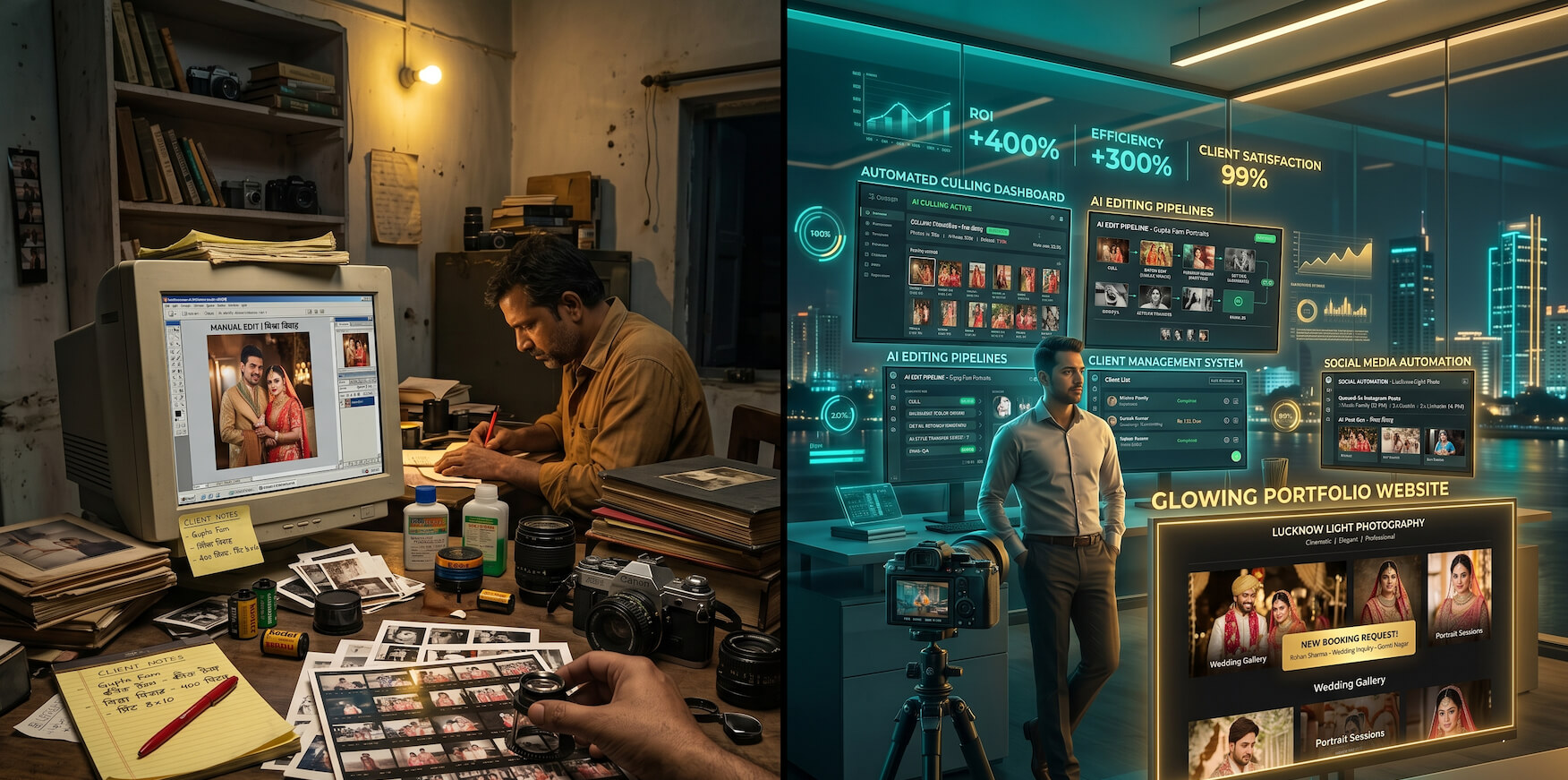
Professional photography in 2026 is being reshaped by artificial intelligence across every dimension of the craft — from the moment a photographer arrives at a shoot to the final delivery of a client gallery weeks later, and across every business function that determines whether a photography career is sustainable, growing, and creatively fulfilling. AI is no longer a single-function tool applied to one corner of the photography workflow. It is a pervasive, multi-dimensional capability that touches image selection, post-production, client communication, marketing, portfolio presentation, financial management, and the creative development that keeps photographers' work evolving.
Understanding where AI is delivering real, practical value in photography — and how to implement it effectively — is no longer an academic exercise for forward-thinking early adopters. It is a competitive necessity for any photographer who wants to remain commercially viable in a market where the gap between AI-enabled and non-AI-enabled operators is widening rapidly.
This guide maps every significant AI use case for photographers in 2026 — what each involves, why it matters commercially and creatively, which tools deliver it most effectively, and how photographers across every specialty can begin implementing it. Whether you shoot weddings, portraits, commercial work, real estate, sports, or fine art, there are specific use cases in this guide that will change how you work.
The AI Use Case Landscape in Photography
Before examining individual use cases, it helps to understand the full territory. AI in photography spans five broad professional domains, each with multiple specific applications.
Post-Production and Technical covers the AI tools that transform raw captures into finished images — culling, editing, retouching, and enhancement. Client Management and Business Operations covers how AI streamlines client communication, booking management, contract and invoice processing, and studio administration. Marketing and Audience Building covers AI-powered tools for building social media presence, email marketing, SEO visibility, and client acquisition. Portfolio and Online Presence covers the AI tools that power photographer websites, gallery delivery, and the digital presence that converts visitors into clients. Creative Development covers AI applications in artistic inspiration, style development, and expanding the creative range of photographic practice.
The photographers extracting the most value from AI in 2026 are operating across all five domains — building AI into their complete professional practice rather than applying it narrowly to editing alone. For a detailed comparison of the leading platforms delivering these capabilities, the AI tools comparison guide for photographers in 2026 provides honest, structured evaluations that make platform selection a strategic decision.
Domain 1: Post-Production and Technical Use Cases
Use Case 1: AI-Powered Photo Culling and Selection
- Culling — the process of selecting the best images from a shoot — is for many photographers the single most time-consuming element of post-production relative to its creative value. A wedding photographer shooting four thousand images over a ten-hour day faces four to six hours of focused culling work before a single editing decision is made. An event photographer covering a corporate conference generates thousands of images requiring systematic evaluation for technical quality, expression, moment quality, and coverage completeness.
- AI culling tools solve this problem by analyzing every image automatically — evaluating sharpness, exposure, expression, eye contact, composition, and moment quality simultaneously — and producing a curated selection of the best images from each sequence without requiring manual review of every frame.
- Aftershoot and Narrative Select represent the two leading approaches to AI culling in 2026. Aftershoot prioritizes technical quality metrics — selecting the sharpest, best-exposed image from each burst sequence and flagging obvious technical rejects automatically. Narrative Select adds narrative awareness to technical selection — identifying images that serve the storytelling arc of a photo story alongside technical quality evaluation. Both reduce culling time from hours to a brief review process measured in minutes.
- The commercial impact of this time recovery is direct and significant. Wedding photographers who implement AI culling recover ten to fifteen hours per wedding — hours that translate directly into additional booking capacity, creative development time, or the personal recovery that prevents career-shortening burnout.
Use Case 2: AI Editing Style Learning and Batch Application
- The most commercially transformative AI editing use case for photographers is style learning — AI systems that analyze a photographer's existing edited portfolio, learn the specific tonal, color, and processing decisions that define their visual identity, and apply that learned style automatically to new shoots.
- Imagen AI and Aftershoot's editing features both provide this capability — building personalized AI editing profiles from existing work that replicate the photographer's specific aesthetic fingerprint across unlimited images simultaneously. The result is edited images that are both stylistically consistent with the photographer's established portfolio and produced in a fraction of the time that manual editing would require.
- The stylistic consistency benefit is as commercially significant as the time saving. Photographers whose editing style varies — inevitably — across the hours of a manual editing session deliver galleries with inconsistent tonal quality that clients who booked based on portfolio images notice. AI style application maintains perfect consistency from the first image to the last — delivering galleries that look as unified and intentional as the portfolio that attracted the client in the first place.
Use Case 3: AI-Powered Technical Correction and Enhancement
- Beyond style editing, AI tools handle the technical correction and enhancement tasks that have historically required either significant manual expertise or significant time investment — noise reduction, sharpness enhancement, resolution improvement, and exposure correction.
- Adobe Lightroom's AI Denoise tool represents a genuine technological advance — processing high-ISO images with a quality of noise reduction that was previously achievable only through complex manual stacking or expensive dedicated noise reduction software. Images shot at ISO 12800 that would previously have required significant noise compromise now deliver clean, detailed results through a single AI processing step. AI Enhance improves image resolution through machine learning analysis that adds genuine detail rather than simply upscaling existing pixels.
- For photographers shooting in challenging conditions — event photographers working in dark venues, wildlife photographers pushing ISO to capture fast action, wedding photographers navigating unpredictable church lighting — AI technical correction tools meaningfully expand the envelope of what is commercially deliverable from a given shoot.
Use Case 4: AI-Powered Portrait Retouching
- Portrait retouching — skin smoothing, blemish removal, eye enhancement, teeth whitening, and the variety of corrections that portrait clients expect — is one of the most time-intensive elements of portrait photography post-production. For photographers delivering dozens of fully retouched images per session, manual retouching investment is substantial.
- Luminar Neo and Portrait Pro provide AI portrait retouching that analyzes facial geometry automatically and applies anatomically intelligent corrections — smoothing skin texture while preserving the micro-detail that makes skin look natural rather than plastic, enhancing eyes with realistic clarity improvements, and removing temporary blemishes while preserving permanent features that define the subject's appearance.
- The quality threshold that AI portrait retouching has crossed in 2026 is significant. Earlier AI retouching tools produced results that required extensive manual correction to look natural. Current AI retouching tools produce results that meet professional portrait standards directly — requiring only light calibration to the photographer's specific aesthetic preferences rather than substantial manual revision.
Use Case 5: AI Background Removal and Compositing
- Commercial photographers, product photographers, and portrait photographers who deliver images requiring clean background removal have historically invested significant time in careful manual selection and masking work. AI background removal tools have largely eliminated this investment — providing clean, accurate background removal from complex selections including hair, fur, and fine detail that manual masking struggled to handle consistently.
- Adobe Photoshop's AI Subject Select and Remove Background features, Luminar Neo's Background Removal AI, and dedicated tools like remove.bg process complex background removal automatically — handling the fine detail selections that would require significant manual refinement in earlier masking tools. For photographers delivering product images, composite portraits, or any work requiring clean subject isolation, AI background removal represents one of the most immediate and significant time savings available in the post-production workflow.
Use Case 6: AI-Powered Image Upscaling and Resolution Enhancement
- Photographers regularly encounter situations where the commercially required output size exceeds what the original capture can deliver at acceptable quality — a full-page editorial image from a crop sensor camera, a large-format print from an older lower-resolution camera, or a heavily cropped image where only a portion of the frame contains the relevant subject.
- AI upscaling tools like Topaz Gigapixel AI and Adobe Lightroom's AI Enhance feature use machine learning trained on millions of images to add genuine detail to upscaled images — distinguishing between noise and real detail, predicting what additional resolution would look like based on the existing image content, and producing enlargements that hold up to scrutiny at sizes that traditional upscaling interpolation would fail at.
- For photographers who have found certain shooting situations limiting their ability to meet specific output requirements, AI upscaling meaningfully expands the commercial usability of existing image libraries.
Domain 2: Client Management and Business Operations Use Cases
Use Case 7: AI-Powered Inquiry Response and Lead Conversion
- Photography inquiry response speed is one of the most significant determinants of booking conversion rate — prospective clients who receive immediate, professional responses to their inquiries book at substantially higher rates than those who wait hours or days for a reply. For photographers who can't monitor their inbox continuously, AI-powered automatic inquiry response tools ensure that every prospective client receives immediate professional engagement regardless of when their inquiry arrives.
- HoneyBook and Dubsado deploy AI-powered automatic inquiry responses that acknowledge new inquiries immediately, provide relevant information about the photographer's services and process, and ask the qualification questions needed to assess project fit — all without requiring the photographer to be available at the moment the inquiry arrives. The booking conversion improvement from instant response — particularly for wedding inquiries where prospective clients are simultaneously contacting multiple photographers — is commercially significant.
Use Case 8: AI-Assisted Proposal and Contract Generation
- Generating customized proposals and contracts for each client inquiry — adapting standard templates to specific project requirements, client contexts, and pricing configurations — is a time-consuming administrative task that AI handles efficiently and consistently. AI proposal tools generate professionally structured, fully customized proposals from brief project inputs — including service descriptions, pricing, terms, and the personalization that makes proposals feel specifically crafted for each client rather than generically templated.
- HoneyBook and Dubsado automate the full proposal and contract workflow — generating documents, delivering them for electronic signature, processing deposits, and triggering the next workflow stage automatically upon client acceptance. The time saved from proposal and contract generation across a full year of client relationships — multiplied across dozens of projects — represents significant administrative overhead recovered for higher-value professional activity.
Use Case 9: Automated Payment and Invoice Management
- Invoice generation, payment tracking, and the uncomfortable process of following up on overdue payments are administrative necessities that AI financial tools automate systematically — eliminating both the time investment and the emotional awkwardness of manual payment management.
- QuickBooks and HoneyBook automate the invoice lifecycle — generating invoices automatically at configured billing milestones, sending payment confirmation receipts automatically, and triggering professional payment reminder sequences automatically when invoices approach or pass their due dates. For photographers who have previously avoided timely payment follow-up because of the interpersonal awkwardness involved, AI payment automation delivers the professional consistency that protects cash flow without requiring personal involvement in each follow-up interaction.
Use Case 10: AI-Powered Studio and Shoot Planning
- Planning complex photography shoots — location scouting, timeline development, equipment preparation, lighting design, and coordination with clients, assistants, and other vendors — involves significant organizational complexity that AI tools help manage systematically.
- Notion AI serves as an intelligent shoot planning system — maintaining queryable records of shoot requirements, equipment checklists, vendor contacts, location details, and timeline schedules that can be queried and updated efficiently throughout the pre-production process. For commercial photographers managing complex multi-day productions, AI-assisted shoot planning dramatically reduces the risk of oversight and the stress of coordinating multiple simultaneous variables manually.
Use Case 11: AI-Powered Financial Management and Tax Preparation
- Financial management — bookkeeping, expense tracking, tax preparation, and cash flow monitoring — is one of the most universally dreaded operational burdens for self-employed photographers. AI financial tools transform this function from a time-consuming, anxiety-inducing process into a continuously maintained automated system.
- QuickBooks and Xero with AI features automate transaction categorization as it occurs — connecting to bank accounts and payment processors and categorizing every income and expense transaction automatically based on learned patterns. Float automates cash flow forecasting — providing continuously updated projections that make equipment investment and marketing spend decisions confident rather than anxious. The annual tax preparation that previously required days of manual record reconstruction becomes a review and submission process when AI has maintained properly categorized financial records throughout the year.
Domain 3: Marketing and Audience Building Use Cases
Use Case 12: AI-Powered Social Media Content and Scheduling
- Social media presence is one of the most powerful client acquisition channels for photographers — Instagram, Pinterest, and TikTok particularly — but maintaining a consistent, high-quality presence across multiple platforms while simultaneously shooting, editing, and managing a photography business is genuinely unsustainable without AI assistance.
- AI content creation tools compress the social media workload from a daily burden into a weekly batch session. AI writing tools like ChatGPT and Claude generate captions, hashtag strategies, and platform-specific copy from brief notes about the image or session being featured. Canva with AI features creates branded marketing graphics and behind-the-scenes content visuals. Later and Buffer schedule and publish content across platforms at algorithmically optimal times.
- The compounding audience building benefit of consistent AI-assisted social media presence is one of the most significant long-term growth investments a photographer can make. Every week of consistent presence builds algorithmic distribution strength that generates progressively more organic reach — creating a client acquisition channel that grows in effectiveness over time with consistent investment.
Use Case 13: AI-Powered Email Marketing and Client Retention
- Email marketing is the highest-return client retention channel available to portrait and family photographers — and the most systematically underutilized. AI-powered email automation enables systematic rebooking campaigns, session anniversary reminders, and mini-session announcements that generate significant incremental revenue from existing client relationships without requiring active marketing management for each individual communication.
- Flodesk and Mailchimp manage photographer email marketing automatically — sending personalized rebooking invitations to past portrait clients as their annual session anniversary approaches, delivering mini-session announcements to engaged subscribers with behavioral triggers that identify the contacts most likely to convert, and nurturing prospective clients through educational content sequences that build trust and expertise perception before presenting booking opportunities.
- For portrait photographers with established client databases, implementing AI email rebooking automation is consistently one of the highest-return marketing investments available — generating significant incremental annual revenue from marketing investment that is primarily upfront configuration rather than ongoing management time.
Use Case 14: AI-Powered Local SEO for Photography Discovery
- The majority of photography client searches begin online — prospective clients searching for wedding photographers in their city, portrait photographers in their area, or commercial photographers specializing in their industry. AI-powered local SEO tools help photographers build and maintain the search visibility that captures these high-intent prospective clients at the moment they are actively looking.
- Semrush and BrightLocal provide AI-powered local SEO optimization that keeps photographer websites and Google Business Profile listings prominently visible for relevant local searches. The commercial value of organic search visibility — reaching prospective clients who are actively seeking exactly what the photographer offers — compounds over time as search authority builds, creating a client acquisition channel that generates consistent inquiries without ongoing advertising spend.
Use Case 15: AI-Optimized Paid Advertising
- For photographers wanting to accelerate client acquisition beyond organic channels, AI-powered advertising platforms make effective paid advertising accessible without specialist marketing expertise. Meta Advantage+ uses AI to continuously optimize targeting, creative selection, and budget allocation — reaching prospective clients whose demographic and behavioral profiles match those of the photographer's existing best clients, at continuously improving cost efficiency as the AI learns from campaign performance data.
- For photographers in competitive markets where organic client acquisition is slow, AI-optimized paid advertising provides a systematic, scalable client acquisition mechanism that delivers measurable returns on advertising investment from the first campaign.
Domain 4: Portfolio and Online Presence Use Cases
Use Case 16: Building a Professional Portfolio Website with AI
- A photographer's portfolio website is their most important commercial asset — the destination that every marketing initiative drives toward and the platform that converts visitor interest into client inquiries. AI website builders have made creating a professionally designed, commercially effective portfolio website accessible to every photographer regardless of technical skill or development budget.
- Creating a stunning photography portfolio website using RocketPages AI removes every technical and financial barrier that has historically prevented photographers from having the online presence their work deserves — with AI handling design intelligence, layout decisions, mobile optimization, and structural organization automatically.
- For photographers building complete photography businesses with booking systems, client galleries, pricing pages, and multiple service offerings, creating a complete photography business website instantly using RocketPages AI provides the comprehensive digital presence that converts website visitors into booked clients consistently. The commercial impact of a professionally designed portfolio website — replacing a generic, poorly optimized digital presence — is consistently one of the most significant and immediate business improvements available to photographers.
Use Case 17: AI-Enhanced Client Gallery Delivery
- The client gallery delivery experience — the moment when clients first see their images presented in a professional online environment — directly determines whether a client becomes a repeat client, leaves a positive review, and refers friends and family to the photographer. AI-enhanced gallery platforms present images in optimized sequences, recommend products and prints based on client behavior and similar purchase patterns, and facilitate smooth ordering and download processes that leave clients with positive impressions of the complete photography experience.
- Pixieset and Pic-Time provide AI-enhanced gallery delivery that goes beyond static image presentation — recommending print products based on the specific images in the gallery, prompting album design conversations at the optimal moment in the client's gallery viewing journey, and tracking client engagement with galleries to identify the moments when follow-up communication will be most effective.
Use Case 18: AI-Powered Product Presentation and Print Sales
- Print sales and product add-ons represent significant incremental revenue opportunities for portrait, wedding, and family photographers — but maximizing this revenue requires presenting products compellingly at the right moment in the client relationship. AI tools help photographers present print products and albums more effectively — generating room visualizations that show clients how specific images would look as wall art in their homes, and recommending product configurations based on the specific images delivered.
- Fundy Designer and Smart Albums use AI to accelerate album design — automatically suggesting page layouts, image selections, and design configurations that the photographer can refine rather than creating from scratch. The time saved from AI-assisted album design — which previously required hours of manual page construction — flows directly into the client presentation and sales experience where human attention generates the most commercial value.
Domain 5: Creative Development Use Cases
Use Case 19: AI-Powered Creative Inspiration and Style Exploration
- Creative development — the ongoing expansion of a photographer's artistic range, aesthetic sensibility, and visual vocabulary — is one of the most important but least systematically supported dimensions of a photography career. AI image generation tools provide an unprecedented resource for creative exploration — generating visual possibilities that expand aesthetic range and inspire creative directions that purely intuitive exploration might not surface.
- Midjourney and Adobe Firefly allow photographers to explore lighting scenarios, compositional approaches, color palette possibilities, and stylistic directions through AI generation — developing visual literacy and aesthetic awareness that informs both shooting decisions and post-production choices. For photographers experiencing creative stagnation or wanting to deliberately develop their visual style in specific directions, AI generation tools provide an inexhaustible exploration resource.
Use Case 20: AI-Powered Mood Board and Pre-Visualization
- Presenting creative concepts to clients before a shoot — through mood boards that communicate the intended aesthetic, lighting approach, and compositional direction — is one of the most effective tools for aligning client expectations with photographic vision and reducing the uncertainty that creates post-delivery disappointment. AI makes creating compelling, professionally presented mood boards achievable without extensive manual image sourcing and design work.
- AI image generation tools create custom visual references that precisely match the intended shoot aesthetic — rather than approximating it through curated stock imagery that doesn't quite capture the specific vision. Canva with AI features handles the professional presentation formatting that makes mood boards commercially effective communication tools rather than informal reference collections.
Use Case 21: AI-Assisted Photography Education and Skill Development
- Photography skill development — whether in technical areas like lighting and exposure or in creative areas like composition and visual storytelling — benefits from the personalized, immediately applicable learning resources that AI educational tools provide.
- AI research tools like Elicit and general-purpose AI assistants like ChatGPT provide immediately accessible expert knowledge on specific photography techniques, equipment comparisons, and industry developments — making targeted skill development research achievable in minutes rather than requiring hours of manual research across multiple sources. For photographers who are newer to AI tools and want a structured introduction to building AI capabilities into their practice, the AI tools for beginners guide for photographers in 2026 provides the most accessible starting point.
Use Case 22: AI-Powered Editing Style Analysis and Consistency Development
- Understanding one's own editing style — the specific tonal, color, and processing characteristics that define a photographer's visual identity — is both creatively important and commercially valuable. AI editing analysis tools help photographers understand their own aesthetic fingerprint with technical precision — identifying the specific processing parameters that make their work recognizable and enabling more intentional creative development.
- Imagen AI builds personalized editing profiles from existing work that reveal the technical parameters defining each photographer's style — providing a precise description of the aesthetic decisions that make their images distinctive. This technical understanding enables more deliberate style development — allowing photographers to intentionally evolve their aesthetic in specific directions rather than relying entirely on intuitive drift.
Implementing AI Use Cases: A Priority Framework
Twenty-two use cases across five professional domains represents a comprehensive AI opportunity landscape for photographers. The question of where to begin depends entirely on which professional challenges are most significant and which opportunities most compelling in your specific shooting context and career stage.
For wedding and event photographers, the highest-priority starting points are typically culling and editing automation — where AI delivers the most immediate and significant time recovery — followed by client management automation and portfolio website optimization. For portrait photographers, AI editing style application and email marketing rebooking automation often represent the highest-return early implementations. For commercial photographers, AI business management tools and creative development applications frequently deliver the most significant professional value.
For photographers beginning their AI adoption journey who want clear, practical guidance on starting points, the AI tools for beginners guide for photographers in 2026 provides accessible implementation guidance across every use case category.
For photographers ready to invest more significantly and wanting comprehensive platform evaluation, the best AI tools for photographers in 2026 covers the leading platforms across every use case with honest assessments of commercial impact and implementation requirements.
For photographers working within budget constraints, the free AI tools for photographers in 2026 maps the most powerful zero-cost options across every use case — making genuine AI adoption accessible before significant financial commitment.
The Compounding Value of AI Across Multiple Use Cases
The most important insight about AI use cases in photography is that their value compounds across domains. AI culling and editing automation recovers hours per shoot — hours that translate into capacity for additional bookings, which generates revenue that funds better marketing investment. Better AI-powered marketing drives more client inquiries, which the AI client management system converts at higher rates. AI portfolio presentation converts those inquiries into bookings at higher rates. AI financial management makes the resulting revenue visible and manageable. Each use case reinforces every other in a professional development cycle that becomes more powerful the more comprehensively AI is embedded in the photography practice.
The photographers seeing the most significant business growth from AI in 2026 are those who have engaged with it across multiple use cases simultaneously — building an AI-assisted professional practice that compounds in commercial effectiveness over time rather than delivering isolated efficiency gains in a single workflow area.
Final Thoughts: Every Photography Workflow Has an AI Use Case in 2026
The twenty-two use cases in this guide represent the current frontier of AI's practical contribution to professional photography — not as a replacement for the creative vision, technical skill, and human connection that define great photography, but as a systematic amplifier of photographer capability across every professional domain.
AI does not replace the eye that sees a compelling image, the relationship that makes a subject comfortable in front of a lens, the expertise that knows which light reveals rather than conceals, or the creative judgment that transforms a good image into a great one. It removes the administrative burden, the repetitive post-production overhead, the marketing consistency demands, and the business management complexity that have made sustaining a photography career with those qualities increasingly difficult.
The use cases in this guide are the path to that possibility — and they are more accessible, more affordable, and more impactful than at any previous point in the history of photography technology.
Ready to compare the specific platforms delivering these use cases most effectively? The AI tools comparison guide for photographers in 2026 gives you the structured, honest platform evaluation you need to build your photography AI stack with confidence — and start implementing the use cases that will transform your photography practice.