Every significant technological shift in photography history has followed a predictable pattern — initial resistance from established practitioners, gradual adoption by early innovators, and eventual universal integration once the advantages became undeniable. Digital photography followed this pattern. Mirrorless camera technology followed it. Social media as a client acquisition channel followed it. In each case, the photographers who engaged early built advantages that latecomers spent years trying to close.
Artificial intelligence is following the same pattern — at a faster pace than any previous photography technology transition. The AI capabilities that seemed experimental two years ago are standard professional tools today. The capabilities that seem experimental today will be standard tools within twelve to eighteen months. Understanding which trends are real, which are commercially significant, and which represent genuine creative opportunity is how photographers make smart decisions about where to invest their professional development attention.
This guide covers every major AI trend shaping photography in 2026 — what is driving each one, what it means practically for your photography business and creative practice, and how to position yourself to benefit rather than be caught flat-footed by it.
Why Tracking AI Trends Matters for Photographers
The photographers who have benefited most from AI in photography are consistently those who engaged with emerging capabilities before they became universal — developing expertise while the learning curve still represented a differentiating investment rather than a baseline expectation. The AI trends in this guide are at different stages of that maturation curve: some are delivering competitive advantage today, some are approaching the tipping point where adoption becomes necessary rather than advantageous, and some are early enough that building expertise now creates leadership positioning for the next phase of photography's AI evolution.
For a structured evaluation of the specific platforms delivering the most commercially mature versions of these trends, the AI tools comparison guide for photographers in 2026 provides honest, detailed analysis that makes platform selection a strategic professional investment.
Trend 1: AI Editing Style Personalization Has Reached Professional Maturity
What's Happening
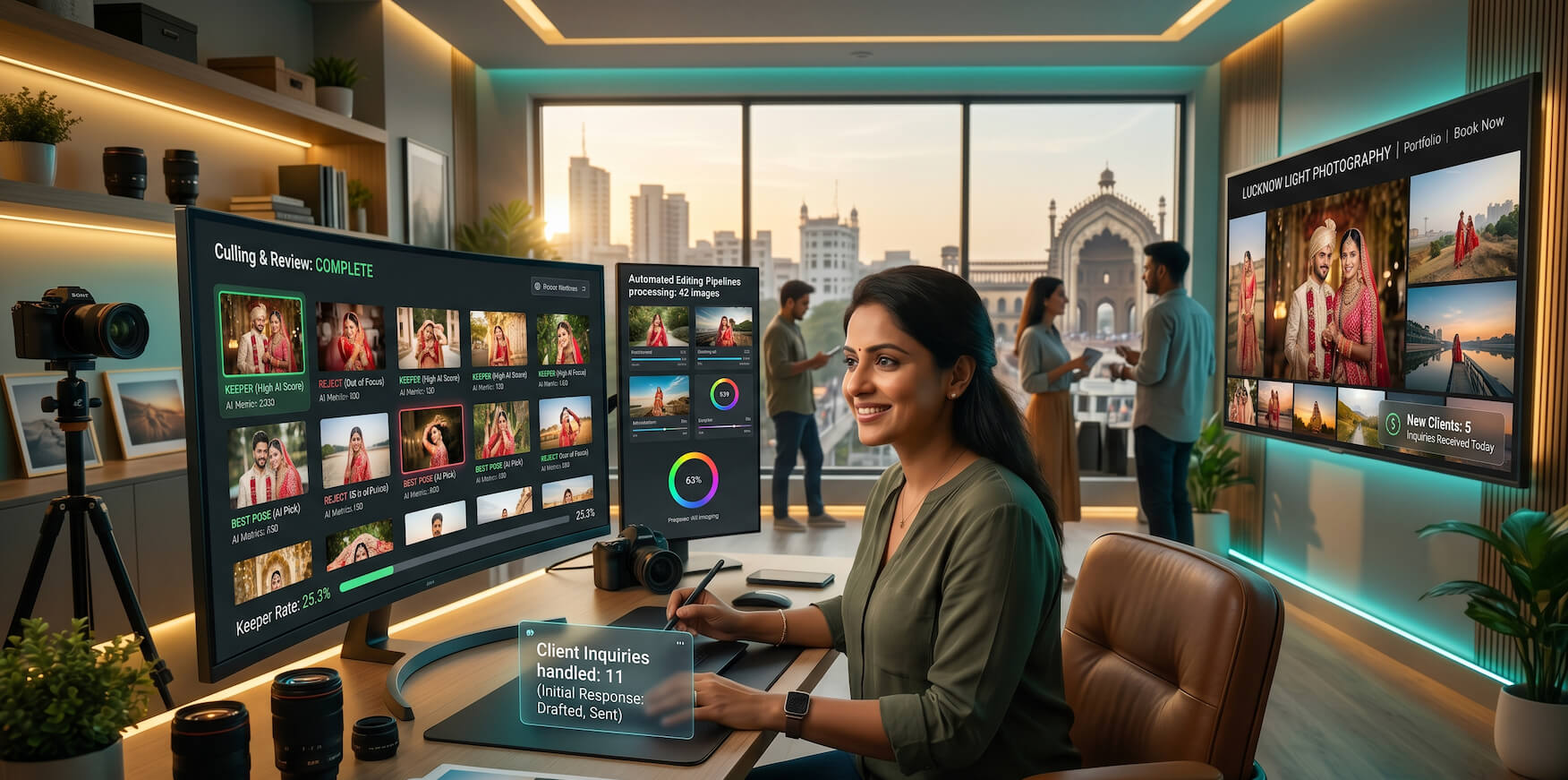
- The most commercially significant AI trend in photography in 2026 is the maturation of personalized AI editing — systems that learn a photographer's specific editing style from their existing portfolio and apply that style automatically to new shoots with a consistency and accuracy that has crossed the professional quality threshold.
- Earlier iterations of AI editing tools applied generic preset-style processing that bore little relationship to individual photographer aesthetics. The current generation — represented most sophisticatedly by Imagen AI and Aftershoot's editing capabilities — builds genuinely personalized editing profiles that replicate the specific tonal decisions, color grading preferences, highlight and shadow treatment, and processing characteristics that define each photographer's visual identity.
What's Driving It
- The combination of improved machine learning models trained on larger datasets of professional photography, better understanding of the specific technical parameters that define photographic style, and the accumulation of sufficient user data to train personalized models effectively has brought AI editing style replication to a quality level that professional photographers recognize as genuinely representative of their work rather than an approximation of it.
What It Means for Photographers
- The practical commercial implications of professional-quality AI editing style replication are substantial. Photographers who previously spent twenty to forty hours editing a wedding can now deliver galleries with equivalent stylistic quality in four to eight hours of review and refinement. The time saved flows directly into additional booking capacity — or into the creative development and personal recovery that sustains long careers.
- The stylistic consistency benefit is equally significant. Manual editing over extended sessions inevitably produces tonal drift — subtle inconsistencies between images edited at the beginning of a marathon editing session and those edited eight hours later. AI style application maintains perfect consistency from the first image to the last — delivering galleries that look as unified and intentional as the portfolio that attracted the client in the first place.
What to Watch
- The next development in this trend is real-time AI editing — systems that apply style processing to images as they are imported from camera cards, eliminating even the batch processing step and presenting photographers with style-edited galleries immediately upon import. Early implementations are demonstrating this capability's viability, and its arrival at consumer accessibility will represent another significant workflow acceleration for high-volume photographers.
Trend 2: AI Culling Has Become an Industry Standard for High-Volume Photographers
What's Happening
- AI-powered photo culling — the automatic selection of the best images from a shoot based on technical quality and moment analysis — has moved from an experimental tool that early adopters tried cautiously to an industry standard that the majority of high-volume professional photographers consider non-negotiable. Aftershoot and Narrative Select have become household names in the wedding and event photography communities — not because they do something novel, but because they solve the most pressing productivity challenge in high-volume post-production so effectively that photographers who adopt them don't return to manual culling.
What's Driving It
- The quality improvement in AI culling accuracy — measured by how closely AI selections align with the selections experienced photographers would make manually — has crossed the threshold where AI selections require only light review rather than substantial manual correction. Simultaneously, the time pressure facing high-volume photographers — where post-production timelines directly constrain booking capacity — has created the commercial urgency that drives adoption past the inertia of established workflows.
What It Means for Photographers
- For wedding and event photographers who haven't yet adopted AI culling, this trend represents the most immediately impactful productivity improvement available. The time recovery — ten to fifteen hours per wedding for typical volume shooters — translates directly into either additional booking capacity or the quality-of-life improvement that sustainable career longevity requires.
- For photographers who have adopted AI culling, the trend's evolution is moving toward more sophisticated selection intelligence — not just technical quality scoring but narrative awareness that understands which images serve the story of a photo essay or wedding day most effectively.
What to Watch
- AI culling with client preference learning — systems that learn from the images clients respond to most enthusiastically in delivered galleries and adjust culling priorities accordingly — is the emerging development in this space. When AI culling systems can predict not just technically which images are best but specifically which images each client is most likely to value, the personalization of the selection process will reach a new level of commercial sophistication.
Trend 3: Generative AI Is Creating New Creative Possibilities — and New Ethical Questions
What's Happening
- Generative AI — AI systems that create new visual content from text prompts or image inputs — is having a multifaceted impact on professional photography in 2026. On the creative side, tools like Midjourney and Adobe Firefly are being used by photographers for creative concept development, mood board creation, and visual ideation that informs shooting decisions. On the commercial side, generative AI is creating new applications — AI-generated background environments for portrait compositing, generative sky replacements, and content-aware object removal and replacement.
- On the ethical and market side, generative AI is creating genuine tension — as AI-generated imagery increasingly competes with stock photography, raises questions about the appropriate boundaries between AI assistance and AI creation, and forces the industry to develop new frameworks for describing and valuing different types of photographic work.
What's Driving It
- The quality of generative AI output has improved dramatically — with photorealistic generation capabilities that have made the distinction between AI-generated and photographically captured imagery increasingly difficult to make from casual inspection. This quality improvement has expanded both the creative utility of generative AI for photographers and the competitive dynamics it creates for certain photography market segments.
What It Means for Photographers
- The practical implication for most portrait, wedding, and commercial photographers is primarily creative opportunity — generative AI as a tool for pre-visualization, mood board development, and creative concept exploration rather than as a replacement for photographic capture. Adobe Firefly's Generative Fill and Generative Expand, integrated directly into Photoshop, represent the most commercially mature generative AI application for working photographers — enabling background extension, object removal, and compositional adjustment that would previously have required either capturing additional frames or extensive manual compositing work.
- For stock photographers, the competitive dynamics are more significant — AI-generated imagery is directly competitive with certain categories of stock photography, requiring stock-focused photographers to differentiate toward work that benefits from authentic photographic capture: genuine human emotion, specific real locations, authentic cultural contexts, and the unpredictable beauty of real-world moments that generative AI cannot genuinely replicate.
What to Watch
- AI-generated photography disclosure standards are developing rapidly across editorial, advertising, and stock photography contexts — with major publications and stock agencies implementing policies requiring disclosure of AI assistance and generation in submitted work. Photographers who proactively understand and communicate clearly about their use of AI tools — both to differentiate genuinely photographic work and to align with emerging professional standards — will be better positioned as these standards mature than those who treat the distinction as unimportant.
Trend 4: AI Portfolio Presentation Has Become a Client Acquisition Differentiator
What's Happening
- The quality gap between professionally designed portfolio websites and the generic template sites that most photographers have historically operated with has become a commercial differentiator that sophisticated clients notice and respond to. In 2026, AI website builders have eliminated the technical and financial barriers that previously prevented photographers from having professionally designed online presences — making the quality of portfolio presentation a differentiating choice rather than a resource constraint.
- Creating a stunning photography portfolio website using RocketPages AI represents the current state of this trend — AI-powered portfolio building that produces gallery-quality presentations without technical expertise, at a fraction of the cost of custom development. For photographers who have been operating with inadequate portfolio websites, adopting AI portfolio building is consistently one of the most commercially impactful decisions available.
What's Driving It
- Two forces are converging. Client sophistication has increased — prospective clients who evaluate multiple photographers before booking have developed an eye for portfolio presentation quality and use it as a proxy for the professionalism they can expect throughout the client relationship. Simultaneously, AI website building has matured to the point where the outputs genuinely reflect professional design intelligence rather than slightly better templates.
What It Means for Photographers
- The practical implication is that portfolio website quality has become a competitive factor that photographers can no longer reasonably defer addressing. Prospective clients who find a photographer's work through social media or search and then visit a poorly designed portfolio website frequently don't convert to inquiries — not because the photography is inadequate, but because the presentation fails to communicate the professional experience they're evaluating.
- Creating a complete photography business website instantly using RocketPages AI addresses this opportunity comprehensively — providing not just gallery-quality image presentation but the complete business website infrastructure that converts visitor interest into booked clients.
What to Watch
- The next evolution in AI portfolio presentation is dynamic, personalized portfolio experiences — websites that intelligently reorganize and present a photographer's work based on who is visiting, surfacing wedding work most prominently for prospective wedding clients and commercial work most prominently for advertising agency visitors based on referral source, search terms, and behavioral signals. This capability, currently developing in early commercial forms, will make photographer portfolios significantly more effective conversion tools when it reaches broader accessibility.
Trend 5: AI Client Management Automation Is Becoming a Professional Baseline
What's Happening
- AI-powered client management — automated inquiry response, proposal generation, contract processing, payment management, and client communication throughout the booking lifecycle — has moved from a differentiating capability to an emerging professional baseline in 2026. Prospective clients who experience immediate, professional automated responses from photographers using HoneyBook or Dubsado increasingly hold the responsive experience as a baseline expectation — making photographers who respond manually hours or days later appear less professional by comparison.
What's Driving It
- The proliferation of professional client management platforms — and the declining cost of accessing them — has made professional client automation accessible to photographers at every career stage and price point. As adoption has increased, the expectation baseline has risen with it — creating a dynamic where the competitive disadvantage of not using client automation is growing as the competitive advantage of using it matures.
What It Means for Photographers
- For photographers who haven't yet implemented AI-powered client management, this trend represents an increasingly urgent opportunity — both for the immediate time savings that automation provides and for the conversion rate improvement that instant professional response delivers. For those already using these platforms, the trend's evolution is toward deeper AI integration — smarter proposal personalization, predictive follow-up timing, and client relationship intelligence that improves booking conversion continuously over time.
What to Watch
- Predictive client matching — AI systems that analyze incoming inquiry details and match them to the photographer's portfolio and style most likely to resonate with that specific client's apparent aesthetic preferences — is developing in early forms within client management platforms. When AI can identify the portfolio pieces most likely to convert each specific inquiry before the photographer even responds, the personalization of the client acquisition process will reach a new level of commercial sophistication.
Trend 6: AI-Powered Local SEO Is Becoming Essential for Photography Discovery
What's Happening
- The majority of photography client searches in 2026 begin online — and AI-powered search optimization has become the primary mechanism through which photographers build and maintain visibility for the searches that drive high-intent client inquiries. Semrush and BrightLocal provide AI-powered local SEO tools that help photographers optimize their presence in the local and specialty searches that represent the most commercially valuable organic traffic available to photography businesses.
What's Driving It
- Google's AI-enhanced search algorithms in 2026 are significantly more sophisticated in evaluating the quality, relevance, and authority of photography website content — requiring more intentional, more consistent SEO investment to maintain visibility than the simpler optimization requirements of earlier search environments. Simultaneously, the accessibility of AI SEO tools has made systematic optimization achievable for photographers without specialist technical knowledge.
What It Means for Photographers
- The practical implication is that photography businesses that have historically relied on word-of-mouth and social media for client acquisition are finding that organic search represents an increasingly important — and systematically underutilized — client acquisition channel. AI SEO tools make building and maintaining this visibility achievable without specialist expertise, creating meaningful competitive advantage for photographers who invest in systematic search optimization while competitors neglect it.
What to Watch
- AI content generation for photography SEO — tools that automatically generate location-specific, keyword-optimized blog content, session recaps, and venue features that build search authority over time without requiring photographers to develop content writing as a separate professional skill — is maturing rapidly. When AI content generation reaches sufficient quality to serve as a systematic SEO investment tool for photographers, organic search visibility building will become dramatically more accessible and efficient than the manual content creation it currently requires.
Trend 7: AI Is Transforming Photography Education and Creative Development
What's Happening
- Photography education — both the formal professional development that photographers undertake to improve their craft and the creative exploration that expands artistic range — is being transformed by AI tools that make learning more personalized, more immediately applicable, and more efficiently structured. AI image generation tools like Midjourney provide unprecedented creative exploration resources. AI research tools make technical and aesthetic knowledge accessible instantly. And AI feedback systems are beginning to provide structured critique of photographic work that was previously available only through mentorship relationships or formal education.
What's Driving It
- The combination of improved AI visual understanding — AI systems that can genuinely analyze photographic composition, lighting, and aesthetic quality rather than just technical parameters — and the accessibility of powerful generation tools that expand creative exploration possibilities has created new infrastructure for photography learning and development that didn't exist in earlier AI generations.
What It Means for Photographers
- For photographers at every career stage, AI education and development tools represent the most accessible path to rapid creative growth currently available. The creative exploration possibilities of AI generation tools — exploring lighting scenarios, compositional approaches, color palette possibilities, and stylistic directions through AI generation before investing in shoots — expand aesthetic range and inspire creative development that can meaningfully accelerate artistic growth.
- For photographers beginning their AI journey, the AI tools for beginners guide for photographers in 2026 provides the most accessible structured entry point — covering the practical tool basics and creative development applications that make AI adoption genuinely valuable for photographers at every skill level.
What to Watch
- AI photography critique systems — tools that analyze photographic portfolios and provide specific, constructive feedback on technical elements, compositional approaches, stylistic consistency, and commercial positioning — are developing rapidly and approaching the quality threshold where their feedback is genuinely useful rather than generically descriptive. When AI critique reaches the specificity and insight quality of skilled mentorship, it will represent a significant democratization of the high-quality professional feedback that has historically required expensive education or access to established mentors.
Trend 8: AI Marketing Automation Is Eliminating the Client Acquisition Inconsistency Problem
What's Happening
- Marketing inconsistency — the cycles of active promotion during slow periods and neglected marketing during busy shooting seasons — has always been one of the most significant constraints on photography business growth. AI marketing automation is systematically eliminating this inconsistency by maintaining marketing presence continuously and automatically regardless of how demanding the shooting and post-production calendar becomes.
- Later and Buffer for social media, Flodesk and Mailchimp for email, and Meta Advantage+ for paid advertising collectively enable photographers to maintain consistent multi-channel marketing presence with a weekly batch investment of a few hours rather than daily manual management across every platform.
What's Driving It
- The maturation of marketing automation platforms — combined with AI optimization that improves campaign performance over time without requiring ongoing specialist management — has made sophisticated, consistent multi-channel marketing accessible to individual photographers without marketing expertise or dedicated marketing time investment.
What It Means for Photographers
- The photography businesses experiencing the most consistent growth in 2026 are those whose marketing operates continuously and systematically regardless of seasonal shooting volume — building audience, nurturing prospects, and generating inquiries on a schedule that is independent of the photographer's availability. AI marketing automation is the operational mechanism that makes this consistency achievable for independent photographers and small studios.
What to Watch
- AI-powered personalized marketing — systems that tailor marketing content to specific audience segments based on behavioral signals, engagement history, and demonstrated aesthetic preferences — is developing toward broader accessibility in photography marketing platforms. When AI can deliver genuinely personalized marketing experiences to individual prospective clients rather than broadcast messaging to entire lists, the conversion efficiency of photography marketing will improve significantly.
Trend 9: The Photographer's Personal Brand Has Never Been More Commercially Valuable
What's Happening
- As AI tools make technically competent post-production increasingly accessible — with AI editing producing professionally acceptable results from modest technical foundations — the commercial premium on distinctive photographic vision, authentic creative voice, and personal brand recognition has increased rather than decreased. The photographers commanding premium pricing and attracting ideal clients most consistently in 2026 are those with unmistakably distinctive visual identities — work that is immediately recognizable as theirs and that clients seek out specifically because of that distinctive character.
What's Driving It
- The paradox of AI democratizing technical photographic quality is that it simultaneously increases the value of the human creative qualities that AI cannot replicate. When competent post-production is available to any photographer, competence alone stops commanding premium pricing. Distinctive creative vision — the specific perspective, aesthetic sensibility, and emotional intelligence that defines an individual photographer's work — becomes the primary basis of commercial differentiation.
What It Means for Photographers
- The strategic implication is that investing in the development and communication of a distinctive personal brand — through intentional creative development, consistent aesthetic identity, and the professional online presence and content marketing that makes that identity visible — has become the highest-return career investment available to photographers who want to move beyond commodity pricing.
- AI tools that help photographers build this brand visibility — consistently producing the thought leadership content, social media presence, and portfolio presentation that communicate distinctive identity to prospective clients — amplify the value of genuine creative distinctiveness rather than substituting for it.
- For photographers ready to invest significantly in building this AI-amplified brand presence, the best AI tools for photographers in 2026 covers the leading platforms across every brand building function with honest assessments of commercial impact and implementation requirements.
What to Watch
- AI style identity amplification — AI tools specifically designed to analyze a photographer's visual portfolio, identify the distinctive characteristics that make their work recognizable, and generate content that communicates and amplifies those specific characteristics to target audiences — is developing as a distinct tool category. When these tools mature, they will make intentional personal brand development significantly more strategic and data-informed than the intuitive approach that most photographers currently rely on.
Trend 10: AI Financial Intelligence Is Improving Photography Business Decision-Making
What's Happening
- Financial management clarity — understanding which services generate the most profit, which marketing channels deliver the best client acquisition economics, and what cash flow looks like over coming months — is essential for making the business decisions that determine whether a photography business grows strategically or stagnates reactively. AI financial tools are making this clarity accessible to photographers without accounting expertise.
- QuickBooks and Xero with AI features automate the bookkeeping that previously required either significant time investment or bookkeeper expense. Táve provides photography-specific business intelligence — tracking lead source ROI, booking conversion rates, and revenue by session type automatically from operational data. Float provides continuously updated cash flow forecasting that makes equipment investment and marketing spend decisions confident rather than anxious.
What's Driving It
- The accumulation of operational data in photography CRM and booking platforms — combined with AI analysis that surfaces the patterns and insights that manual data review would miss — has created the foundation for genuine business intelligence that was previously accessible only to photographers with dedicated financial management support.
What It Means for Photographers
- The photography business operators making the most consistently good commercial decisions in 2026 — about pricing, marketing investment, service mix, and business development — are those with access to AI-generated financial intelligence that grounds those decisions in evidence rather than intuition. Understanding which services are most profitable, which marketing channels generate the best clients, and which business investments generate the strongest returns is the difference between strategic growth and reactive survival.
- For photographers who are newer to AI tools and working within budget constraints, the free AI tools for photographers in 2026 maps the most powerful zero-cost financial and business intelligence tools available — making evidence-based business decision-making accessible before significant platform investment.
What to Watch
- Integrated photography business intelligence — AI systems that connect post-production metrics, client management data, marketing performance, and financial records into a single analytical dashboard that provides photographers with a complete, real-time picture of their business performance — is developing toward broader accessibility. When integrated photography business intelligence becomes widely available, the quality of commercial decision-making across the photography industry will improve significantly — benefiting photographers who engage with the intelligence while widening the gap with those who continue operating on intuition alone.
Positioning Yourself for the AI Photography Future
The ten trends in this guide point toward a photography industry that is more efficient in post-production, more systematic in client management, more consistent in marketing, more professionally presented online, and more creatively ambitious — powered by AI tools that compress the operational overhead of professional photography to the point where creative energy can stay where it belongs: behind the camera and in the creative relationships that produce great work.
The photographers building the most competitive positions in 2026 are those engaging with these trends deliberately — not adopting every new tool impulsively, but making strategic decisions about which trends represent genuine competitive opportunity and investing in them with sufficient depth to develop real expertise before the window of differentiation closes.
The trends are clear. The tools are accessible. The professional development opportunity of early, deliberate engagement is real and significant. The question for every photographer is simply how deliberately and how soon they begin building the AI capability that will define photography business leadership for the decade ahead.
Ready to identify the specific platforms driving these trends most effectively for photographers like you? The AI tools comparison guide for photographers in 2026 gives you the structured, honest platform evaluation you need to build your photography AI capability with confidence — and position yourself at the leading edge of the trends shaping professional photography right now.