
May 06, 2026
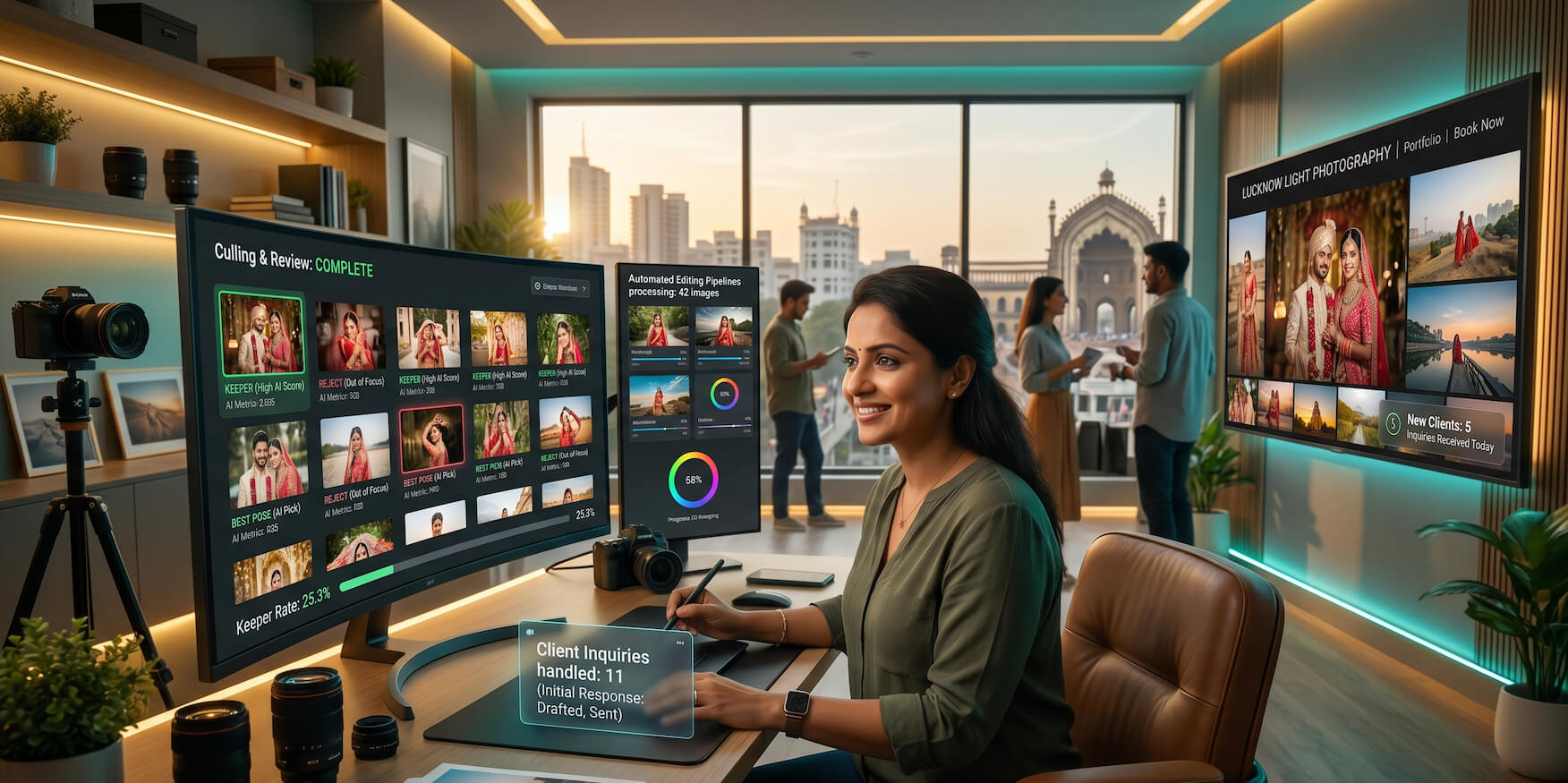
Photography has always been a profession that demands mastery of two very different skill sets simultaneously. The first is the creative and technical mastery of the craft itself — understanding light, composition, timing, and the specific technical demands of different shooting genres. The second is the operational mastery required to run a viable photography business — managing post-production pipelines, client relationships, marketing presence, financial records, and the business development activities that keep the calendar full and the income sustainable.
For most photographers, the second skill set is the harder one to maintain — not because photographers lack intelligence or business capability, but because the sheer volume of post-production work, administrative communication, and marketing effort required to sustain a professional photography business has consistently outpaced the available time. A wedding photographer who shoots two weekends per month is managing sixty to eighty hours of post-production and administrative work alongside the shooting itself — a workload that leaves very little room for the creative development, personal recovery, and quality-of-life considerations that make a photography career sustainable over the long term.
In 2026, AI has arrived in photography with genuine and practical help for both dimensions of this challenge — not by replacing the creative vision and human connection that define great photography, but by systematically reducing the operational burden that has made sustaining great photography increasingly difficult. This guide is a complete, honest account of exactly how AI helps photographers in 2026 — what it does well, what it does less well, and what it means practically for photographers who want to shoot more, earn more, and build careers that are more creatively fulfilling and more professionally sustainable than what was possible before AI arrived.
The photography industry in 2026 faces a specific combination of pressures that makes AI assistance particularly timely and particularly valuable. Client expectations for image quality, delivery speed, and professional experience have risen significantly — driven by comparison with the most polished photographers at every market level. Competition has intensified as lower equipment costs and accessible online education have expanded the supply of competent photographers. Margin pressure has increased as clients compare pricing across more alternatives. And the administrative complexity of running a photography business — managing contracts, invoices, tax records, social media presence, email marketing, and client communication across multiple platforms — has grown with each new digital tool that has become a standard professional expectation.
Against this backdrop, AI helps photographers by addressing the most significant productivity constraints — compressing post-production time, automating routine communication, systematizing marketing presence, and building the professional online infrastructure that converts interest into bookings. Each form of help compounds the others: more time recovered from post-production means more capacity for shooting. More bookings generate more revenue that funds better marketing investment. Better marketing drives higher-quality client inquiries that improve the professional experience of the work. Together, these AI-enabled improvements create a professional development cycle that makes photography careers more sustainable, more profitable, and more creatively satisfying.
For a structured overview of the specific platforms delivering the most impactful forms of AI assistance, the AI tools comparison guide for photographers in 2026 provides detailed, honest evaluation across every major photography AI tool.
For high-volume photographers — wedding, event, sports, or commercial shooters who regularly process thousands of images from a single job — culling is frequently the single largest post-production time investment. AI culling tools have transformed this process more dramatically than any other post-production AI application.
Aftershoot and Narrative Select analyze every image in a shoot automatically — evaluating sharpness, exposure, expression, eye contact, composition, and moment quality simultaneously — and produce a curated selection of the best images from each sequence without requiring manual review of every frame. The process that previously took four to six hours of sustained concentration is reduced to a thirty-minute review of AI-generated selections.
The practical impact of this time recovery is transformative for photographers whose post-production schedules have been a primary constraint on business growth. Wedding photographers who recover ten to fifteen hours per wedding gain capacity for additional bookings, creative development, or the personal rest that prevents burnout. Event photographers who process weekly jobs gain the margin in their schedules that makes professional development and business building practically achievable alongside active shooting.
AI editing tools help photographers at two distinct levels — the technical correction level, where AI handles noise reduction, exposure correction, and masking automatically, and the stylistic consistency level, where AI learns and replicates the photographer's specific visual identity across unlimited images simultaneously.
Imagen AI represents the most sophisticated version of style learning assistance available in 2026. It analyzes a photographer's existing edited portfolio — studying the specific tonal decisions, color grading choices, highlight and shadow treatment, and processing preferences that define their visual identity — and builds a personalized AI profile that applies that exact style to new shoots automatically. The result is edited images that are both stylistically consistent with the photographer's portfolio and produced in a fraction of the time that manual editing requires.
Adobe Lightroom with AI features helps at the technical level — AI Denoise handles noise reduction with a quality that previously required dedicated software, AI Masking selects subjects and skies with precision that previously required skilled manual work, and AI Enhance improves resolution for output requirements that exceed the original capture. Together, these AI technical tools make every editing session faster and more technically precise — with the most demanding individual corrections handled automatically rather than requiring sustained manual attention.
Luminar Neo extends AI help into creative enhancement — Relight AI allows photographers to adjust the three-dimensional lighting of an image realistically, Skin AI handles portrait retouching naturally, and Sky Replacement AI changes atmospheric conditions with photographic credibility. For photographers who want to expand the creative possibilities of their images beyond what was captured in camera, these AI enhancement tools make sophisticated creative manipulation accessible without deep compositing expertise.
Portrait and commercial photographers who deliver fully retouched images have historically faced a fundamental time investment in post-production that limits either the volume of work they can deliver or the depth of retouching quality they can provide at accessible pricing. AI retouching tools help by handling the routine retouching tasks — skin smoothing, blemish removal, eye enhancement — automatically and at a quality level that meets professional portrait standards without requiring manual attention to each individual image.
Portrait Pro and Luminar Neo's Skin AI analyze portrait images automatically and apply anatomically intelligent corrections — preserving the natural texture and dimensional quality that makes skin look real rather than processed while addressing the temporary blemishes and inconsistencies that clients want corrected. The time savings from AI-assisted portrait retouching — applied across a full portrait session of fifty retouched images — frees several hours of post-production time per session for higher-value professional activity.
Photography inquiry conversion — turning prospective client interest into confirmed bookings — depends significantly on response speed and professionalism. Clients who receive immediate, professional responses to their photography inquiries book at substantially higher rates than those who wait hours or days for a reply. AI-powered inquiry management tools help photographers maintain this responsiveness without requiring continuous inbox monitoring.
HoneyBook and Dubsado deploy automated inquiry responses that acknowledge new contacts immediately, provide relevant service information, and collect the qualification details needed to prepare a meaningful proposal — all without requiring the photographer to be available at the moment of inquiry. For wedding photographers who know that prospective clients are often simultaneously contacting multiple photographers, the competitive advantage of instant professional response is commercially significant and directly measurable in booking conversion rates.
The administrative workflow between initial inquiry and confirmed booking — proposals, contracts, deposits, and client onboarding communication — involves significant repetitive work that AI tools handle efficiently. HoneyBook generates customized proposals from project inputs, presents contracts for electronic signature, processes deposit payments, and triggers onboarding communication automatically upon booking confirmation.
The time saved from administrative workflow automation across a full year of client bookings is substantial — hours that were previously consumed by manual document generation, email composition, and payment tracking are reclaimed for shooting, editing, marketing, or the personal time that sustains sustainable professional practice. The consistency improvement is equally valuable: automated workflows ensure that every client receives the same professional experience regardless of how busy the photographer is when the booking occurs.
The photography business opportunity that most photographers systematically underexploit is client rebooking — the repeat business available from past clients who had a positive experience and would book again if reminded at the right moment. AI-powered email marketing tools help photographers capture this opportunity systematically.
Flodesk and Mailchimp with AI features automate photographer email marketing — sending personalized rebooking invitations to past portrait clients as their session anniversary approaches, delivering mini-session announcements to engaged subscribers at optimal timing, and nurturing prospective clients through educational content sequences that build trust before presenting booking opportunities. For portrait photographers with established client databases, AI email rebooking automation generates significant incremental annual revenue from marketing investment that is primarily upfront configuration rather than ongoing time investment.
Social media is one of the most powerful client acquisition channels for photographers — visual platforms like Instagram, Pinterest, and TikTok are where many prospective clients discover photographers and evaluate their work. The challenge is that maintaining a consistent, high-quality presence across multiple platforms while simultaneously shooting, editing, and running a photography business is genuinely unsustainable without AI assistance.
AI content creation and scheduling tools compress the social media content workload from a daily burden into a weekly batch session. AI writing tools generate captions, hashtag strategies, and platform-specific copy from brief inputs about the image or session being featured. Canva creates branded marketing graphics and promotional content. Later and Buffer schedule and publish content at algorithmically optimal times based on audience engagement patterns.
The compounding benefit of consistent AI-assisted social media presence — sustained over months and years — is one of the most significant long-term investments a photographer can make in their business. Every week of consistent presence builds algorithmic distribution strength. Every new engaged follower expands the audience for future work. The social media presence that AI makes sustainable compounds over time into a client acquisition channel of substantial and growing commercial value.
Most prospective photography clients begin their search online — and the photographers who appear prominently in those searches capture the highest-intent inquiries at the moment of maximum purchase readiness. AI SEO tools help photographers build and maintain the search visibility that makes this organic discovery reliable and consistent.
Semrush and BrightLocal provide AI-powered SEO assistance that optimizes photographers' websites and Google Business Profile listings for local and specialty search terms — ensuring visibility when prospective clients search for wedding photographers in their city, portrait photographers in their area, or commercial photographers in their industry. The search traffic this visibility generates is among the highest-converting client acquisition traffic available — prospective clients who find you through relevant search terms are actively seeking what you offer.
For photographers who want to accelerate client acquisition beyond organic channels, AI advertising platforms help by automating the optimization decisions that determine paid campaign performance. Meta Advantage+ and Google Performance Max use AI to continuously optimize targeting, creative selection, and budget allocation — reaching prospective clients whose profiles match existing best clients at continuously improving cost efficiency.
The practical help AI advertising provides for photographers without marketing backgrounds is the removal of the specialist expertise barrier that has historically made effective paid advertising inaccessible. AI handles the campaign optimization complexity automatically, allowing photographers to run effective paid client acquisition campaigns with strategic direction and creative input rather than technical campaign management expertise.
A photographer's portfolio website is simultaneously their most important marketing asset and, for many photographers, the weakest link in their client acquisition chain. A poorly designed portfolio that loads slowly, presents work inconsistently, or fails to communicate professional expertise and brand identity converts almost no traffic into inquiries — regardless of how impressive the underlying photography is. AI website builders help photographers close this gap by making professional portfolio design accessible without technical skills or development budget.
Creating a stunning photography portfolio website using RocketPages AI removes every technical barrier that has historically prevented photographers from having the professional online presence their work deserves — with AI handling design intelligence, gallery layout optimization, mobile responsiveness, and structural organization automatically. The result looks professionally designed because the AI makes genuinely sophisticated, photography-specific design decisions rather than applying generic templates.
For photographers running complete photography businesses — with multiple service offerings, booking inquiry systems, client galleries, and pricing pages — creating a complete photography business website instantly using RocketPages AI provides the comprehensive digital presence that converts website visitors into booked clients systematically. The commercial impact of upgrading from an inadequate online presence to a professionally designed AI-built portfolio is consistently one of the most immediate and significant business improvements available to photographers — with measurable increases in inquiry volume and client quality typically appearing within weeks of launch.
The client gallery delivery experience is the final and most visible element of every photography job. An impressive gallery delivery platform that presents images beautifully, makes ordering prints and products intuitive, and leaves clients with a positive emotional reaction drives the repeat bookings and referrals that sustain photography businesses over time. AI-enhanced gallery platforms help photographers deliver this experience consistently.
Pixieset and Pic-Time provide professional gallery delivery with AI features that enhance the commercial dimensions of the experience — recommending print products based on the specific images in each gallery, timing product purchase prompts at the optimal moment in the gallery viewing journey, and tracking client engagement to identify when follow-up sales communication will be most effective. The incremental print and product revenue generated by AI-optimized gallery experiences meaningfully improves the revenue per booking that determines photography business profitability.
Managing a photography business involves tracking multiple simultaneous client relationships in various stages, managing complex equipment inventories, planning shoots across multiple locations, maintaining marketing calendars, and handling the financial and administrative records that business operation requires. AI organizational tools help photographers manage this complexity without the cognitive overhead and organizational anxiety that manual tracking creates.
Notion AI serves as an intelligent photography business command center — maintaining queryable records of every active client project, tracking deliverable status, managing supplier and vendor relationships, and surfacing upcoming deadlines automatically. Rather than maintaining awareness of multiple simultaneous project stages through memory and scattered notes, photographers can query their AI-managed workspace — "which deliverables are due this week?" or "what's the editing status on the Morrison wedding?" — and receive instant, accurate answers.
Financial management clarity — knowing what you've earned, what you've spent, what you owe in taxes, and what cash flow looks like over the coming months — is essential for making the business decisions that determine whether a photography business grows or stagnates. AI financial tools help photographers maintain this clarity without requiring accounting expertise or significant time investment in manual bookkeeping.
QuickBooks and Xero with AI features automate transaction categorization — connecting to bank accounts and payment processors and categorizing every income and expense transaction automatically. The manual bookkeeping that previously consumed hours monthly is reduced to a brief periodic review. Float automates cash flow forecasting — providing continuously updated projections of cash position that make equipment investment, marketing spend, and business development decisions confident rather than anxious.
The tax preparation benefit of year-round AI bookkeeping is particularly significant for photographers who have previously experienced the stress of annual record reconstruction. When AI has maintained properly categorized financial records throughout the year, tax preparation becomes a review and submission process rather than a multi-day reconstruction effort.
For wedding photographers, AI's most significant help is in the post-production and business management domains — culling automation that recovers ten to fifteen hours per wedding, editing style application that maintains consistency while compressing editing time, and client management automation that handles the communication workflow from inquiry through delivery systematically. The cumulative time recovery enables wedding photographers to either shoot more weddings or deliver a higher-quality experience to existing clients — both commercially significant improvements.
The free AI tools for photographers in 2026 ensures that wedding photographers can begin accessing these benefits without significant upfront investment — with meaningful free tiers available across culling, editing, and client management tools before committing to paid subscriptions.
For portrait photographers, AI helps most significantly through editing style consistency, portrait retouching efficiency, and email marketing automation for client rebooking. The combination of AI editing tools that maintain stylistic consistency across a session and AI email tools that systematically capture rebooking opportunities from past clients addresses the two most commercially significant productivity constraints in portrait photography — post-production time and client retention.
For commercial photographers, AI's most valuable help is in creative development support, business management organization, and the professional client management that enterprise clients expect. Midjourney for creative concept development and mood board creation, Notion AI for complex project management, and HoneyBook or Dubsado for professional client relationship management address the core productivity needs of commercial photography practice.
For landscape and fine art photographers whose primary business model involves print sales and limited edition releases, AI helps most significantly through portfolio presentation, print sales optimization, and the professional online presence that drives collector discovery and engagement. A professionally designed AI-built portfolio website that showcases fine art work with gallery-quality presentation and supports print sales directly is often the single most commercially impactful AI investment available to fine art photographers.
For photographers early in their careers, AI helps by providing access to tools and capabilities that were previously available only to established photographers with larger budgets and more developed infrastructure. The AI tools for beginners guide for photographers in 2026 provides the most accessible structured entry point — covering the practical basics of photography AI adoption without requiring prior technical experience, and identifying the tools that deliver the most impact at the lowest cost for photographers building their businesses from the ground up.
For photographers ready to invest more significantly, the best AI tools for photographers in 2026 covers the leading platforms across every photography function with honest assessments of commercial impact, creative value, and implementation requirements.
A complete and honest guide to how AI helps photographers has to be equally honest about where it doesn't — where human presence, creative vision, and authentic relationship are irreplaceable.
The most accurate summary of how AI helps photographers in 2026 is this: it helps photographers be more fully what they already are. More prolific, because post-production takes less time. More consistent, because editing style is maintained automatically. More responsive to clients, because communication workflows are automated. More visible to prospective clients, because marketing presence is consistent. More financially clear-headed, because business records are maintained automatically. More creatively energized, because operational overhead no longer consumes the energy that creative work requires.
None of these forms of help change what photography fundamentally is — a deeply human creative practice that requires vision, craft, and genuine connection with the subjects and clients it serves. They simply remove the accumulated operational weight that has made practicing it with full creative presence increasingly difficult.
AI is not making photographers obsolete. It is making exceptional photography more sustainable — and more possible — than it has ever been.
Want to explore the specific tools delivering these forms of help most effectively? The AI tools comparison guide for photographers in 2026 gives you the structured, honest platform evaluation you need to identify the right AI tools for your specific photography practice — and start building the career that your craft deserves.
Stay up to date with the latest tips, expert insights, product reviews, and step-by-step guides to help you grow, create, and succeed—no matter your industry or passion.