
January 06, 2026
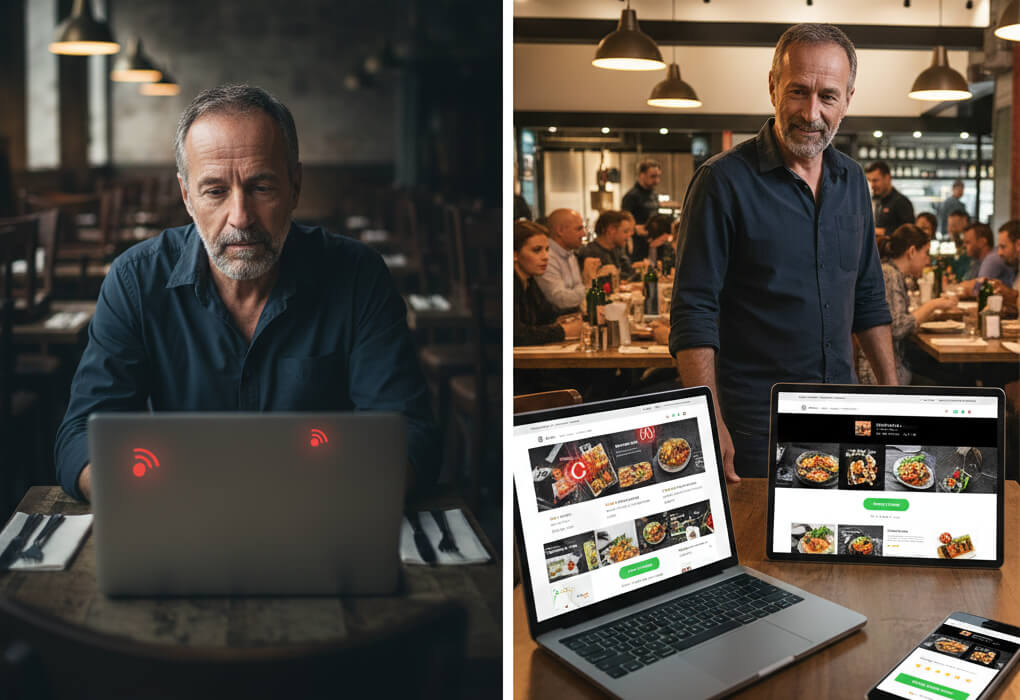
Most restaurant owners don’t realize how much business they’re losing before they upgrade their website—because the loss is invisible.
Empty tables feel normal.
Slow weekdays feel expected.
Reliance on delivery apps feels unavoidable.
But none of it is inevitable.
When a restaurant upgrades its website, the shift is often immediate—and dramatic. Not because the food changes, but because the decision-making environment does.
This before-and-after difference is one of the most powerful transformations a restaurant can make—and it often happens faster than owners expect.
Before upgrading, many restaurant websites share the same hidden problems:
To the owner, the site “works.”
To diners, it raises questions.
Visitors hesitate. They scroll. They leave. And most never come back—choosing a competitor whose website feels clearer and more trustworthy.
This invisible loss is explained in The Cost of Not Having a Website for Your Restaurant, which breaks down how outdated sites quietly drain bookings, walk-ins, and revenue every single day.
The absence of friction-free information is not neutral—it’s a disadvantage.
After a professional website upgrade, the experience feels entirely different.
Diners immediately see:
There’s no searching, guessing, or second-guessing.
This clarity creates confidence—and confidence leads to action.
The mechanics behind this conversion shift are detailed in How to Turn Website Visitors Into Paying Diners, which explains how structure and clarity guide diners toward booking, ordering, or visiting.
When diners feel informed, they move forward.
Before upgrading their website, many restaurants lean heavily on:
These tools provide visibility—but not control.
Information is fragmented. Menus are outdated. Booking paths are unclear. And customer relationships belong to platforms, not the restaurant.
This is why social-only strategies consistently underperform, as explained in Why “Link in Bio” Isn’t Enough: The Case for Restaurant Websites.
Attention without ownership doesn’t scale.
It leaks.
With a professional website in place, restaurants regain control.
They can now:
Instead of renting visibility, they build equity.
Restaurants that shifted toward direct ordering saw margin improvements almost immediately, as outlined in How to Add Online Ordering to Your Website Without Paying App Fees and reinforced by
Competing With Delivery Apps: Why Direct Ordering Wins.
Ownership changes everything—from profitability to predictability.
Before optimization, many restaurants struggle with discovery:
Even great restaurants remain hidden simply because Google lacks clear signals.
Local SEO is often accidental—or nonexistent.
After upgrading their website, restaurants send powerful, consistent signals to search engines:
As a result, they appear more often during high-intent moments—when diners are actively deciding where to eat.
This transformation is explained in SEO for Restaurants: How to Get Found Online and further detailed in How to Optimize Your Website for “Near Me” Searches.
Visibility turns intent into foot traffic.
Outdated websites create silent doubt:
Diners may never consciously articulate these questions—but they feel them.
And when trust wavers, conversion stops.
This psychological barrier is explored in The Psychology of Trust: Why Every Great Restaurant Has a Website.
Uncertainty kills action.
A modern website communicates reliability before a single bite is served.
Through:
The restaurant signals stability, care, and professionalism.
This trust-building effect is reinforced in Restaurant Branding 101: Why Your Online Identity Matters and The Science of Food Photography for Restaurant Websites.
Trust shortens the decision cycle.
Shorter cycles mean more visits.
Restaurants that upgraded their websites consistently report:
One restaurant saw a 40% increase in bookings after upgrading its website experience—without ads or discounts.
That case is documented in How One Restaurant Increased Bookings 40% With a New Website.
The website didn’t create demand.
It stopped losing it.
The difference between before and after isn’t cosmetic—it’s operational.
A professional restaurant website doesn’t just look better. It:
Before: Hope diners find you.
After: Guide them directly to your door.
That’s the power of getting the website right.
Stay up to date with the latest tips, expert insights, product reviews, and step-by-step guides to help you grow, create, and succeed—no matter your industry or passion.