
December 29, 2025
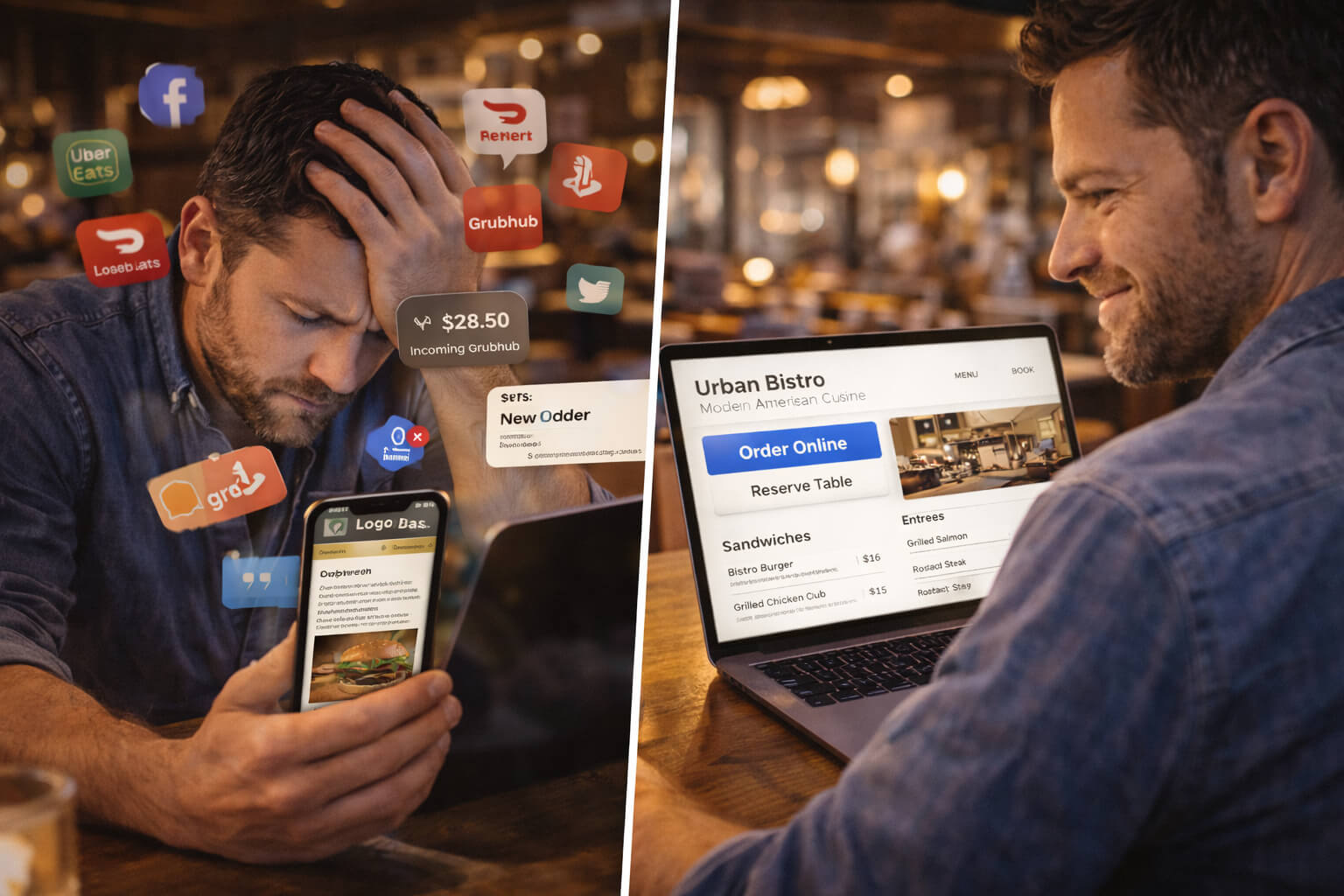
Most restaurants believe they have an online presence. They post on social media. They appear on Google Maps. They’re listed on delivery and review platforms.
But in reality, nearly 70% of restaurants are making the same critical mistake—and it’s quietly costing them customers every single day.
It’s not bad food.
It’s not a lack of effort.
It’s not treating their website as the center of their digital presence.
Instead, many restaurants let third-party platforms do the heavy lifting. While those platforms feel convenient, they create hidden risks that compound over time.
Here’s why this mistake is so damaging—and how to fix it.
Instagram, Yelp, Google listings, and delivery apps can help people find you—but they are not where your brand should live.
When restaurants rely on third-party platforms as their primary presence:
Most importantly, restaurants lose control over how they are presented. Design, messaging, layout, and experience are dictated by someone else’s rules.
That loss of control doesn’t just hurt branding—it directly impacts revenue, visibility, and long-term growth.
This is why depending on third parties alone is one of the most expensive decisions restaurants make: The Cost of Not Having a Website for Your Restaurant
Social media platforms are built for scrolling, entertainment, and distraction—not for decision-making.
Even diners who discover a restaurant on Instagram still leave the app to:
A social profile can spark interest—but it rarely closes the decision.
Diners instinctively trust websites more because websites feel permanent, official, and intentional. A restaurant without a strong website often feels incomplete—even if its social presence is active.
This is why diners consistently trust websites more than social media profiles: Why Diners Trust Websites More Than Social Media Profiles
Search is still one of the most powerful discovery channels for restaurants. When diners search “restaurant near me” or “best [cuisine] nearby”, Google doesn’t just rank listings—it evaluates signals.
Google prioritizes:
Restaurants without strong websites struggle to rank, even if their food and reviews are excellent. A weak website limits your visibility before diners even see your name.
That’s why local SEO success is tightly connected to website quality:
One of the fastest ways to lose a potential diner is forcing them to hunt for your menu.
Common friction points include:
When diners can’t quickly understand what you serve and what it costs, they leave—usually to a competitor whose menu is easier to access.
Clear, searchable, mobile-friendly digital menus reduce uncertainty and increase confidence:
On review sites and delivery apps, your restaurant is presented in a crowded, competitive environment. You appear alongside:
This fragmentation weakens trust. Diners see mixed signals instead of a clear story.
Your website is the only place where you fully control:
Owning that space strengthens trust before diners ever arrive: Restaurant Branding 101: Why Your Online Identity Matters
Restaurants that don’t prioritize their websites often experience:
Meanwhile, restaurants that treat their website as a business asset—not an afterthought—see tangible gains.
One restaurant increased bookings by 40% simply by improving website clarity, usability, and trust signals—without changing food or pricing: How One Restaurant Increased Bookings 40% With a New Website
Restaurants avoiding this mistake take a fundamentally different approach.
They treat their website as:
Social media, Google, and ads are used strategically—to drive traffic back to the website, not replace it.
This structure aligns with how modern diners actually move from discovery to decision: The Restaurant Marketing Funnel: How Your Website Brings Diners to Your Door
Fixing this doesn’t require a complete redesign or rebrand. Small, focused improvements deliver outsized impact:
These changes turn your website into a working asset instead of a static page.
Why every restaurant needs to make this shift in 2025: Why Every Restaurant Needs a Website in 2025 — and How to Launch One Fast
Third-party platforms are convenient—but convenience comes at a cost.
The restaurants winning today aren’t louder, trendier, or more aggressive. They’re clearer, more trustworthy, and easier to choose.
And they all share one decision:
They stopped making the #1 mistake—and took control back.
Stay up to date with the latest tips, expert insights, product reviews, and step-by-step guides to help you grow, create, and succeed—no matter your industry or passion.