
The Circular Economy: A New Approach to Resources

September 09, 2025

By RocketPages

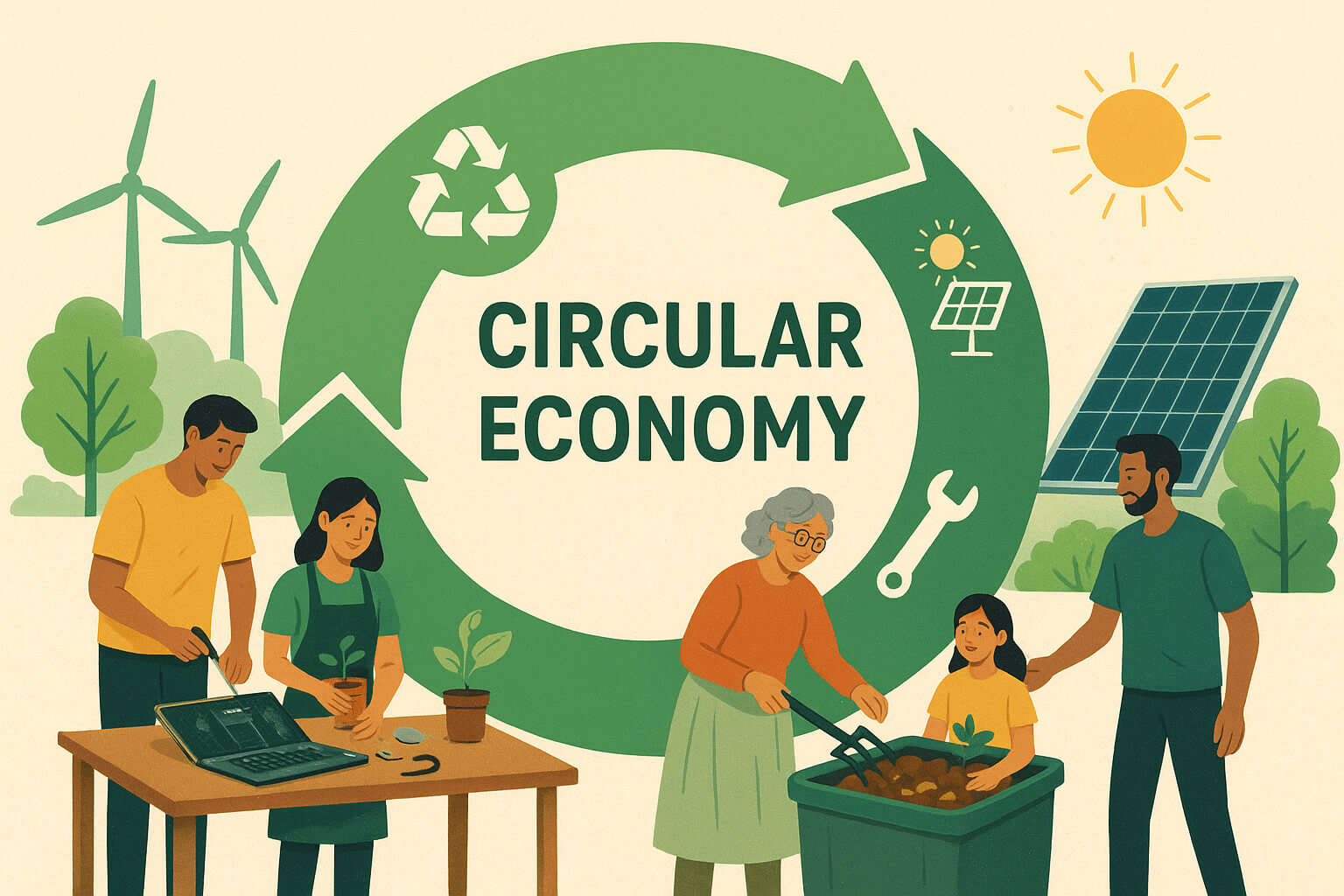
Illustration of a circular economy cycle showing reuse, recycling, and sustainable resource management.

In a world increasingly strained by pollution, dwindling resources, and climate change, the circular economy provides a powerful framework for sustainable living. Unlike the traditional linear model—take, make, dispose—the circular economy focuses on extending the life of materials, minimizing waste, and regenerating nature. It's not just an environmental necessity; it's a smart economic strategy.

What is the Circular Economy?

At its heart, the circular economy is about designing out waste and keeping resources in use for as long as possible. Products are reused, repaired, refurbished, or recycled, and biological materials are returned to nature safely.

“There is no such thing as waste in nature—everything becomes something else.”
— Circular economy philosophy

Key idea: Waste is a design flaw. By shifting how we make and consume goods, we can reduce the environmental damage caused by extraction, overproduction, and landfill pollution.

Read more: Understanding Ecosystem Restoration: Bringing Nature Back

The Core Principles of the Circular Economy

1. Designing Out Waste and Pollution

  • Circular design encourages creating products that last longer, are easy to repair or disassemble, and are made from recyclable or biodegradable materials.
  • Examples:
  • Modular smartphones
  • Packaging made from mushroom mycelium
  • Furniture designed with recyclable aluminum and wood

2. Keeping Products and Materials in Use

  • Circular systems keep materials cycling through the economy instead of ending up in landfills. This includes reusing products, repairing broken goods, renting rather than owning, and sharing assets.
  • Examples:
  • Clothing repair programs from Patagonia
  • Circular fashion resale marketplaces like thredUP or Vinted
  • Tool libraries and community sharing schemes

3. Regenerating Natural Systems

  • Biological materials—like food waste, textiles, and paper—can return safely to the environment through composting or bioenergy, helping to restore ecosystems instead of polluting them.
  • Examples:
  • Composting organic waste for regenerative agriculture
  • Reforestation projects fueled by urban compost collection
  • Algae-based packaging that decomposes naturally

Why the Circular Economy Matters

Environmental Benefits

  • Lowers carbon emissions
  • Reduces plastic and chemical pollution
  • Preserves forests, water, and biodiversity

Economic Opportunities

  • Promotes innovation in design and materials
  • Creates green jobs in repair, remanufacturing, and recycling
  • Saves money for consumers and businesses alike

Systemic Resilience

  • Decreases dependence on raw materials (e.g., rare earth metals)
  • Protects against supply chain shocks and price volatility
  • Encourages decentralized, community-based production

Explore more: The Global Race for Green Technology

Circular Economy in Action: Real Examples

  • Tech & Electronics
  • Apple’s Daisy robot disassembles iPhones to recover valuable components.
  • Fairphone builds modular smartphones that users can repair themselves.
  • Fashion Industry
  • Levi’s offers a buy-back and repair program.
  • H&M’s Conscious Collection uses recycled fibers.
  • Construction & Housing
  • Reclaimed wood and recycled concrete are used in eco-buildings.
  • 3D-printed homes made with bio-based materials are gaining traction.
  • Food & Agriculture
  • Too Good To Go helps restaurants sell surplus food.
  • Urban farms use compost from city waste to grow vegetables sustainably.

How You Can Be Part of the Circular Economy

You don’t need to be a designer or policymaker to help shift the system. Here’s how to contribute:

  • Buy less, but better. Choose durable, high-quality items.
  • Repair and reuse. Extend the life of everything from clothes to appliances.
  • Compost. Reduce food waste and return nutrients to the soil.
  • Opt for second-hand. Thrift stores and online resale platforms support reuse.
  • Support circular businesses. Look for brands offering repair, take-back, or recycling.

Helpful guide: Green Home Solutions: Making Your House Eco-Friendly

Policy & Business Support

Governments and companies are beginning to embrace the circular model:

  • The EU’s Circular Economy Action Plan mandates repair rights and waste reduction.
  • Amsterdam aims to be fully circular by 2050.
  • France’s Anti-Waste Law bans the destruction of unsold goods.

However, progress requires support from all sides—policy, business, and consumers alike.

Final Thoughts: A Blueprint for a Sustainable Future

The circular economy is not a trend—it’s a necessary shift toward sustainability, resilience, and equity. By moving from a “throwaway” culture to one that values repair, reuse, and regeneration, we can reshape the economy to serve both people and the planet.

The beauty of this model lies in its simplicity: nothing is wasted, everything has value.

"In nature, nothing exists alone." — Rachel Carson

Explore More on Sustainable Living:

Recent Articles

Stay up to date with the latest tips, expert insights, product reviews, and step-by-step guides to help you grow, create, and succeed—no matter your industry or passion.


Portrait studio with a sitter, soft key light and camera demonstrating directional portrait lighting
Portrait Lighting Patterns: Split, Loop and Rembrandt
Judge the light on the faceA portrait lighting pattern describes the arrangement of light and shadow on the face. It is different from the make of the light, the background color, or the overall editi...
Read More
Two educators reviewing curriculum books, sample worksheets and a checklist in a school library
Choosing a School Curriculum: A Practical Review Checklist
Clarify what decision you can makeChoosing a curriculum is different from choosing a school. A curriculum concerns the sequence of knowledge, skills, learning activities, and assessment, together with...
Read More
Teacher supporting a student using geometric learning materials and a notebook in a classroom
Personalized Learning Approaches: Goals, Support and Feedback
Begin with a learning goalPersonalized learning involves making informed choices about instruction and support for a learner. Start with the knowledge or skill being developed, not with a product or a...
Read More
