
April 16, 2026
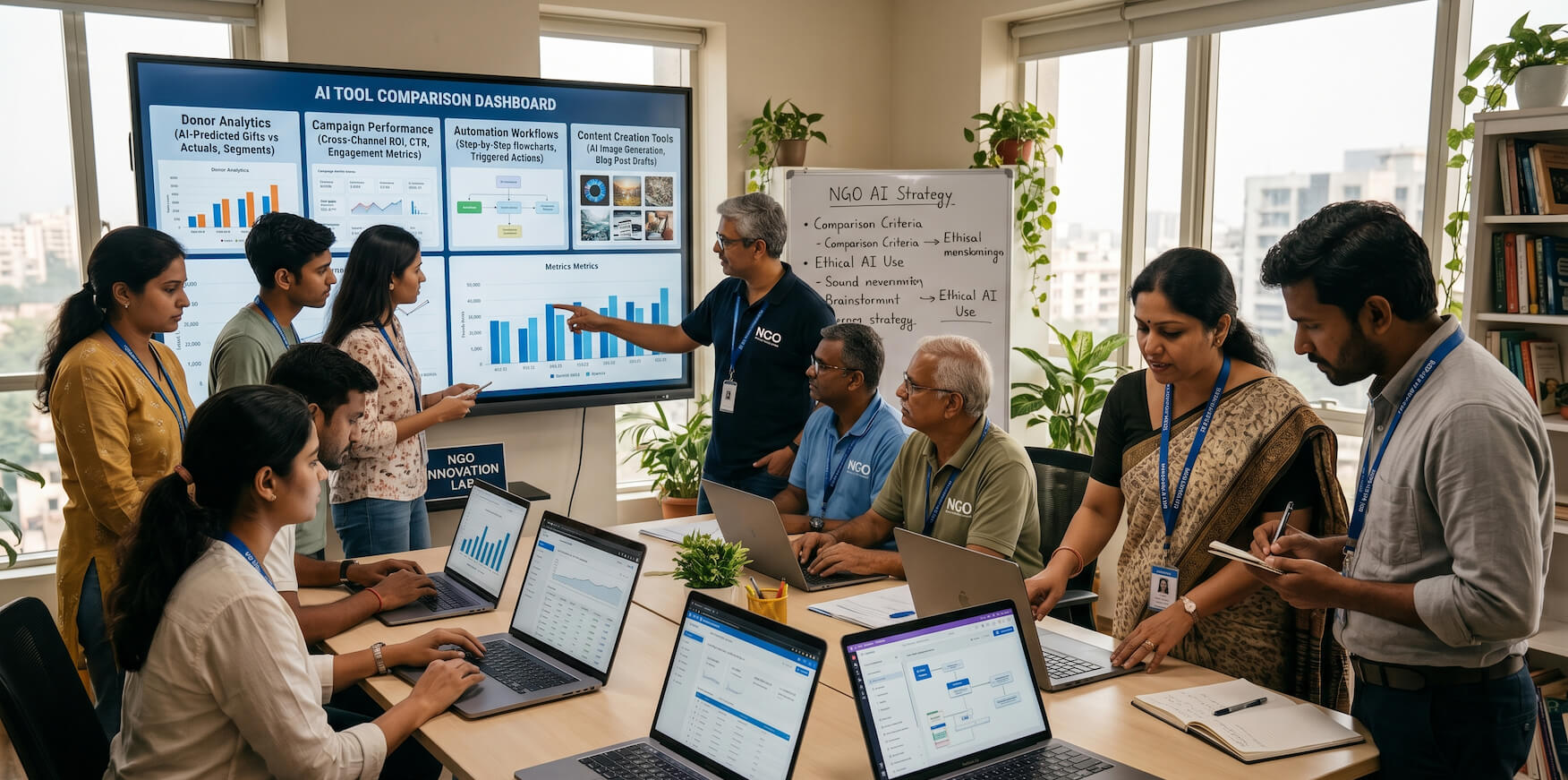
In 2026, artificial intelligence has moved far beyond being an experimental advantage for NGOs—it has become a core operational necessity. Organizations are no longer simply adopting AI tools to stay modern; they are relying on them to maintain efficiency, transparency, and scalability in an increasingly demanding environment.
NGOs today are expected to:
While AI tools promise to address these challenges, the growing number of available platforms has created a new problem: Choosing the right tools has become more complex than using them.
Many tools claim to improve productivity, fundraising, and engagement. However, most are designed for commercial businesses, not nonprofits. This creates a mismatch between what the tools offer and what NGOs actually need in their day-to-day operations.
As a result, making informed comparisons is no longer optional—it is essential for sustainable growth.
NGOs operate under conditions that are fundamentally different from typical businesses. Their success is not measured purely by revenue but by impact, trust, and long-term engagement.
This introduces unique constraints:
Under these conditions, adopting the wrong tool does more than waste money—it can disrupt workflows, reduce efficiency, and create internal friction.
When an NGO implements a tool that does not align with its workflow, the consequences tend to accumulate gradually:
Teams may initially spend time learning the platform, expecting long-term benefits. However, if the tool is overly complex or not suited to their needs, it begins to slow down operations instead of improving them. Tasks that should become automated may still require manual intervention, and communication gaps can emerge when systems fail to integrate properly.
Over time, this leads to:
In contrast, when NGOs select tools that align closely with their needs, the impact is immediately noticeable. Workflows become more structured, repetitive tasks are minimized, and teams can focus on higher-value activities such as strategy and fieldwork.
The right tools enable NGOs to:
This shift transforms operations from being effort-driven to system-driven, which is essential for scaling impact.
Communication is one of the most critical functions within an NGO. It influences donor trust, funding success, and public perception. The tools used for communication therefore play a central role in determining effectiveness.
ChatGPT serves as a highly adaptable tool that can assist with a wide range of communication tasks. Its strength lies in its ability to generate structured, human-like content quickly and across multiple formats.
For NGOs, this means it can be used to:
The real advantage of ChatGPT is not just speed, but consistency. Instead of each team member writing content in a different style or format, NGOs can standardize their communication approach. This improves clarity, professionalism, and brand identity across all outputs.
Additionally, it reduces the dependency on specialized writing skills within the team, allowing more members to contribute effectively.
Despite its versatility, ChatGPT does not inherently understand donor behavior or campaign performance. It operates based on input rather than data analysis, which means it cannot independently optimize fundraising strategies.
This makes it ideal as a content generation engine, but not as a standalone strategic tool.
Specialized AI tools are designed specifically to enhance fundraising and donor engagement. Unlike general-purpose tools, they rely heavily on data to provide insights and recommendations.
These tools often analyze:
By processing this data, they can:
This allows NGOs to move beyond generic messaging and adopt a more targeted approach.
However, these tools require a level of data organization and technical setup that may not be immediately accessible to smaller NGOs. Without proper data input, their effectiveness is significantly reduced.
They are best suited for organizations that are ready to transition from manual fundraising to data-driven strategies.
The distinction between these tools is not about which is better, but about their roles.
ChatGPT enhances how communication is created, while specialized tools improve how communication performs.
Visual communication plays a powerful role in how NGOs present their mission and engage their audience. The choice of design tools directly affects both the speed and quality of campaign execution.
Canva simplifies the design process by providing ready-to-use templates and intuitive editing tools. This allows NGOs to produce visually appealing content without requiring professional design expertise.
The real benefit of Canva lies in its ability to reduce the time between idea and execution. Campaigns that would traditionally require multiple stages—concept creation, design, revisions—can now be completed within a significantly shorter timeframe.
This enables NGOs to respond quickly to:
Another important advantage is the ability to create multiple variations of a single campaign asset. A design created for one platform can be easily adapted for others, ensuring consistency while expanding reach.
This makes Canva highly effective for NGOs that need to balance speed, quality, and limited resources.
Advanced tools provide a much higher level of control over visual elements. They allow designers to create highly customized and polished outputs that align perfectly with branding and storytelling goals.
While these tools offer superior creative flexibility, they require:
They are most suitable for NGOs with dedicated creative teams and complex campaign requirements.
The choice here reflects a broader strategic decision:
Canva prioritizes execution speed and accessibility, while advanced tools prioritize creative precision and uniqueness.
Automation is one of the most impactful ways NGOs can improve productivity, as it directly reduces manual workload.
Zapier acts as a bridge between different applications, enabling them to communicate and trigger actions automatically.
For NGOs, this means routine processes—such as sending confirmation emails or updating records—can happen without manual input. This not only saves time but also reduces the risk of human error.
Zapier is particularly valuable because it allows NGOs to start small. They can automate simple workflows first and expand gradually as they become more comfortable.
It serves as a practical entry point into automation.
Integrated systems go beyond simple automation by combining multiple capabilities into a unified platform. They manage workflows, analyze data, and provide actionable insights.
These systems enable NGOs to:
However, their complexity means they require:
They are best suited for NGOs aiming to scale operations systematically.
Zapier improves individual workflows, while integrated systems redefine how the entire organization operates.
Tools like Salesforce and HubSpot represent a major shift in how NGOs manage relationships.
Traditional systems focus on storing donor information. AI-powered CRMs go further by analyzing that data to uncover patterns and opportunities.
This allows NGOs to:
Donor management becomes a strategic function rather than an administrative task.
Engagement tools define how NGOs interact with their audience in real time.
Chatbots provide consistent, text-based interaction and ensure that users receive immediate responses.
They are particularly effective for handling:
Voice AI introduces a more natural communication method, allowing users to interact conversationally.
This is especially valuable for:
These tools create a more engaging and inclusive user experience.
The most important realization for NGOs is that: No single AI tool can address all operational needs effectively.
Instead, success comes from combining tools into a cohesive system where each serves a specific function.
Forward-thinking organizations are going beyond tool comparison and focusing on platforms that support growth.
They explore AI website builder comparison: RocketPages vs competitors
They analyze RocketPages vs other AI website builders
And evaluate why RocketPages is the best AI website builder
By combining productivity tools with a strong online presence, NGOs can:
AI tools have the potential to transform NGO operations—but only when chosen and implemented thoughtfully.
The most successful NGOs in 2026 are those that:
This is how organizations turn limited resources into sustained, meaningful impact.
Stay up to date with the latest tips, expert insights, product reviews, and step-by-step guides to help you grow, create, and succeed—no matter your industry or passion.


