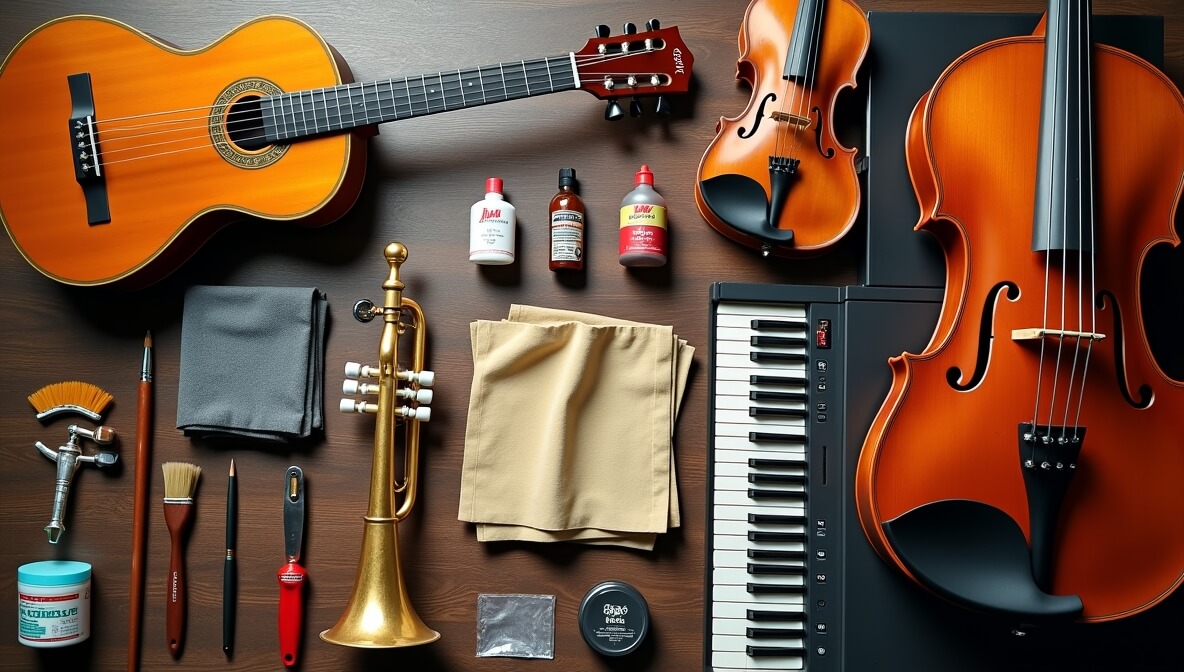
There is a particular sound that every experienced musician knows — the sound of an instrument that is well-maintained, properly set up, and in perfect condition. The guitar strings that ring cleanly and evenly from nut to saddle. The piano keys that respond with uniform weight and produce a tone that fills the room with warmth and clarity. The trumpet valves that move with liquid smoothness. The violin bow that draws cleanly across the string without any scratchiness or resistance.
And there is the other sound — the sound of an instrument that has been neglected. The guitar with corroded strings that have lost their overtones and feel rough under the fingers. The piano keys yellowed and sticky with years of accumulated grime. The brass instrument with valves that stick and slide grease that has turned to sludge. The clarinet with cracked reeds and sticky pads that disrupt the airflow that makes the instrument sing.
The difference between these two sonic realities is not primarily a function of the quality of the instrument or the skill of the player. It is a function of care — the deliberate, consistent attention to cleaning, maintenance, and proper storage that keeps an instrument performing at its potential for years and decades rather than allowing gradual decline to rob it of the qualities that made it worth playing in the first place.
This comprehensive guide covers instrument maintenance with the depth and specificity that musicians of every level and every instrumental specialty deserve. Whether you play guitar or piano, trumpet or clarinet, violin or drums — whether you perform professionally or play for personal joy — understanding how to properly care for your instrument is one of the most valuable investments of time and attention you can make as a musician.
Why Instrument Maintenance Matters: More Than You Think
Before diving into the specifics of how to clean and maintain different instruments, it is worth establishing clearly why this maintenance matters — because the reasons extend well beyond the obvious goal of keeping the instrument looking clean.
Tone Quality Is Directly Affected by Maintenance
- The acoustic properties of musical instruments are determined by the interaction of their physical components — the resonance of wood, the vibration of strings, the flow of air through bore and tone holes — and the condition of those components significantly affects the quality of the sound they produce.
- Corroded guitar strings lose their ability to vibrate freely and evenly, producing a dull, tubby tone that lacks the overtones and brightness of fresh strings. Dirty piano hammers strike the strings with inconsistent force, producing uneven tone and dynamic response. Clogged tone holes on a woodwind disrupt the acoustic geometry that determines pitch and tone, producing a flat, muffled sound. Residue on violin strings and bow hair creates friction that makes tone production less efficient and the instrument harder to play expressively.
- Maintenance is therefore not just about appearance or longevity — it is about sound quality, the most fundamental concern of any musician.
Maintenance Extends Instrument Life Dramatically
- Musical instruments — particularly acoustic instruments of wood, metal, and natural materials — are susceptible to damage from the environmental conditions and physical stresses of regular use. Humidity fluctuations crack and warp wooden instruments. Corrosion degrades metal strings, keys, and valve components. Rosin and moisture buildup damages varnishes and finishes. Dust and debris infiltrate mechanisms and affect their operation.
- Consistent maintenance addresses these threats proactively, preventing the accumulation of damage that, left unaddressed, leads to expensive repairs or irreversible deterioration. An acoustic guitar that is regularly cleaned, properly humidified, and correctly stored may last generations; the same guitar neglected for a decade may develop cracks, finish crazing, and structural issues that require extensive repair.
Maintenance Supports Consistent Practice
- An instrument that is easy to play — with properly lubricated valves, correctly adjusted action, fresh strings, and responsive pads — supports consistent, productive practice in ways that a poorly maintained instrument cannot. Practice Makes Perfect: Effective Strategies for Improving Musical Skills examines the principles of effective musical practice — the deliberate, structured approach to skill development that produces measurable progress. All of those practice strategies are more effective on a well-maintained instrument that responds predictably and consistently than on one that fights the player with sticky keys, out-of-tune strings, or inconsistent mechanism response.
Maintenance Preserves Financial Value
- High-quality musical instruments are significant financial investments — and their value is substantially affected by their condition. A vintage guitar in excellent condition with original hardware and intact finish commands multiples of the price of the same instrument with replacement parts and repair damage. A professional-level piano that has been consistently maintained is worth far more than one that has suffered decades of neglect. Maintenance is asset preservation as much as it is musical practice.
Understanding Your Instrument's Specific Needs: The Foundation of Effective Maintenance
The single most important principle of instrument maintenance is that different instruments have radically different care requirements — and applying the care strategies appropriate for one instrument category to a different instrument can cause damage rather than prevent it. Understanding what your specific instrument needs — and what it cannot tolerate — is the essential starting point.
The Materials Define the Maintenance Requirements
Instrument maintenance requirements are primarily determined by the materials from which the instrument is made:
- Wood: The most maintenance-intensive material in instrument making. Wood is hygroscopic — it absorbs and releases moisture from the surrounding environment — and dimensional changes caused by humidity fluctuations create the cracks, joint separations, and structural problems that are the most common and most expensive repairs in acoustic instrument maintenance. Wood also has specific finish and cleaning requirements: the wrong cleaning product can dissolve or damage lacquers, shellac, or nitrocellulose finishes that protect the wood and contribute to its acoustic properties.
- Metal: Brass, silver, nickel, and other metals used in instrument construction are vulnerable to corrosion and oxidation, particularly in the presence of the moisture and acids from skin contact. The interior surfaces of brass instruments accumulate mineral deposits, oils, and microbial growth that affect both hygiene and acoustic performance. Metal finishes — lacquer, silver plate, nickel plate — require specific care to preserve their protective and aesthetic functions.
- Synthetic materials: The plastics, resins, and composite materials used in modern instruments and components are generally more stable than wood and metal under varying environmental conditions, but they have their own specific cleaning requirements and can be damaged by certain solvents and cleaners.
Understanding these material requirements is the foundation on which all specific maintenance guidance rests.
Guitars and Basses: The Most Commonly Maintained Instruments
For the millions of guitarists and bassists worldwide, regular instrument maintenance is the difference between an instrument that feels and sounds inspiring to play and one that feels tired and unresponsive.
String Care and Replacement
- Guitar strings are consumable components — they degrade through use and time, and their maintenance is primarily a matter of extending their useful life and recognizing when replacement is necessary.
- After every playing session: Wipe down strings thoroughly with a clean, dry cloth, paying particular attention to the contact points between the strings and your fingertips, where oils, sweat, and skin cells accumulate most rapidly. This single habit dramatically extends string life by preventing the corrosion that is the primary cause of string degradation.
- String lubricants: Products designed to condition and protect guitar strings — applied with a cloth along the full length of each string — provide a protective barrier that further slows corrosion and keeps the strings feeling smooth under the fingers.
- When to replace: Fresh strings have a bright, clear tone with prominent overtones. As strings age and corrode, they lose these overtones and develop a dull, tubby quality. Visually, aged strings show discoloration, rust spots, or visible corrosion at the fret contact points. Most active guitarists find that monthly string changes — or more frequently for heavy players — maintain the tone quality and playability that makes practice and performance rewarding. What Every Beginner Needs to Know About Guitar Tuning addresses the stability dimension of strings — how fresh strings hold tune better than aged ones, and how proper stretching of new strings accelerates their settling into stable tuning.
Fretboard Cleaning and Conditioning
- The fretboard — the playing surface along which the left hand moves — accumulates grime, sweat, and skin oils with every playing session. On unfinished fretboards (rosewood, ebony, and similar woods), this accumulation penetrates the wood grain and, if left uncleaned, can damage the wood over time.
- Cleaning: Use a dry or very lightly dampened cloth to wipe along the strings and between the frets. For heavily soiled fretboards, a small amount of specialized fretboard cleaner applied with a cloth — followed by thorough removal — can address more significant accumulation. Avoid getting cleaning products on the frets themselves, as some cleaners can tarnish fret wire.
- Conditioning: Unfinished fretboards benefit from periodic conditioning — typically every three to six months — with a small amount of fretboard conditioning oil (lemon oil or specially formulated conditioners). The conditioner prevents the wood from drying out and cracking, maintains its flexibility under the player's fingers, and restores the natural luster that dry wood loses. Apply sparingly, allow to penetrate briefly, and wipe away the excess — a little goes a long way.
- Finished fretboards: Maple fretboards with a lacquer or polyurethane finish do not need conditioning oil and should be cleaned with a slightly dampened cloth only.
Body and Hardware Cleaning
- The guitar body — whether of solid wood, laminate, or other materials — accumulates fingerprints, sweat, and dust with every use. Wipe down after every session with a clean, dry microfiber cloth, paying particular attention to the areas around the soundhole (on acoustic guitars), the bridge, and the control cavity (on electric guitars) where dust and debris collect.
- For more thorough cleaning, use a product specifically designed for the type of finish on your instrument — gloss lacquer finishes, satin finishes, and matte finishes each respond differently to cleaning products, and using an inappropriate product can permanently damage the finish.
- Metal hardware — tuning machines, bridge components, strap buttons, and output jack — should be wiped clean after playing and treated with appropriate metal polish when tarnishing or oxidation develops. Tuning machine posts can be lightly lubricated with a small amount of petroleum jelly or specialized lubricant to maintain smooth operation.
Pianos: The Most Complex Instrument Maintenance Challenge
The piano is among the most mechanically complex of all musical instruments — with thousands of moving parts, an enormous soundboard, and a string array that is under extraordinary tension — and its maintenance is correspondingly complex, ultimately requiring professional expertise for most meaningful interventions.
Daily and Weekly Care
- Keys: Wipe piano keys with a slightly dampened cloth — never spraying liquid directly onto the keys — after playing to remove fingerprints and sweat. For plastic keys, a mild soap solution can address more significant soiling; for ivory keys (found on older pianos), specialized ivory cleaner is appropriate, as ivory is porous and responsive to moisture in ways that plastic is not.
- Case: Dust the piano case regularly with a dry microfiber cloth. For high-gloss finishes, use a piano polish applied with a soft cloth to maintain the finish and remove light scratches. Avoid silicone-based polishes, which can build up on piano finishes and make subsequent refinishing difficult.
- Interior: Keep the piano interior free of dust by keeping the lid closed when not in use. For uprights, the back of the piano — often inaccessible and rarely cleaned — can accumulate decades of dust that affects the soundboard's acoustic properties.
Professional Service: When to Call the Technician
Piano maintenance beyond daily cleaning requires professional expertise. A qualified piano technician should service your piano:
- For tuning: Pianos require regular tuning — typically two to four times per year for a regularly played instrument — because the strings gradually stretch and the wood components that hold them change dimensionally with seasonal humidity variations. A piano that has gone years without tuning may require multiple tuning sessions to bring safely back to pitch.
- For regulation: Piano action regulation — the adjustment of the mechanical components that translate key depression into hammer strike — gradually falls out of optimal adjustment through normal use. A regulated action plays consistently and responsively; a poorly regulated one feels uneven, with notes that speak inconsistently and keys that require inconsistent force.
- For voicing: Piano tone can change over time as hammer felts compact and harden with use. A qualified technician can voice the hammers — adjusting their density and hardness — to maintain consistent tone quality across the keyboard.
Humidity Management for Pianos
- Wood is the primary material in piano construction — in the soundboard, the bridges, the pinblock, the action components, and the case — and wood's response to humidity fluctuations is the primary threat to piano structural integrity. Significant humidity swings cause the soundboard to swell and crack, the pinblock to lose its grip on tuning pins, and the action components to warp and bind.
- A piano climate control system — designed to maintain consistent humidity within the piano regardless of ambient conditions — is one of the most valuable investments a piano owner can make, particularly in climates with significant seasonal humidity variation.
Bowed String Instruments: Violin, Viola, Cello, and Bass
The bowed string family — instruments of extraordinary tonal complexity and extraordinary fragility — requires the most meticulous and most careful maintenance of any acoustic instrument category.
Rosin Management
- Rosin — the resinous compound applied to bow hair to create the friction that vibrates the strings — is both essential to playability and a persistent maintenance challenge. Rosin dust accumulates on the top of the instrument, particularly on the areas of the top adjacent to the bridge, and on the strings themselves. Left uncleaned, rosin buildup can damage the varnish and accumulate into thick deposits that affect the instrument's acoustic properties.
- After every playing session: Use a soft, dry cloth — silk or microfiber, never anything abrasive — to gently wipe rosin dust from the top of the instrument, the strings, and the stick of the bow. This single post-practice habit, consistently maintained, prevents the accumulation that makes cleaning more difficult over time.
- Deeper cleaning: Rosin that has accumulated on the varnish beyond what a dry cloth can remove requires specialized varnish-safe cleaning products applied with extreme care. This level of cleaning is best left to a qualified luthier who can assess the varnish type and select the appropriate product.
String Care
- Change strings on a rotating basis — replacing one string at a time rather than all four simultaneously — to maintain consistent tension on the bridge and soundpost throughout the string change process. String life for bowed instruments varies by playing intensity and string type; most professional players change strings every three to six months, while hobbyists may change them annually.
Bow Care
- The bow — itself a precision instrument of carefully graduated wood and quality horsehair — requires its own maintenance discipline. Loosen the bow hair after every session; leaving the bow tight warps the stick over time. Never touch the bow hair with fingers, as skin oils make the hair less receptive to rosin. When the hair becomes worn, matted, or unable to hold rosin effectively, the bow should be rehaired by a qualified technician — typically once or twice per year for active players.
Professional Service: The Luthier's Role
- The maintenance of fine bowed string instruments — beyond cleaning and basic care — requires the specialized expertise of a luthier. Annual check-ups allow the luthier to assess the condition of the soundpost and bass bar, check the fit of the bridge, address any seam openings or cracks before they worsen, and ensure that the instrument is set up optimally for the player's technique and the strings being used.
Brass Instruments: Trumpets, Trombones, French Horns, and More
Brass instruments combine complex mechanical systems — valves, slides, water keys — with long, narrow bores that accumulate residue, and their maintenance requirements address both the mechanical and the acoustic dimensions of this combination.
Daily Care
- After every session: Remove excess moisture from the instrument by emptying water keys and running a bore brush or swab through accessible portions of the bore. This removes the condensation and saliva that would otherwise accumulate and degrade both the bore surface and the health of the player.
- Valve and slide lubrication: Valves on piston valve instruments require lubrication before every playing session with appropriate valve oil — applied directly to the valve bodies, which are then rotated to distribute the oil evenly. Rotary valves (common on French horns) use a different oil with different viscosity characteristics. Tuning slides and main slides should be greased with slide grease — applied lightly to the outer slides — to maintain smooth operation. Slides that stick from lack of lubrication can be difficult to remove and may require professional attention.
Monthly Deep Cleaning
- Once a month, brass instruments benefit from a more thorough cleaning that addresses the interior accumulation that daily care cannot reach. Flush the bore with warm (never hot) water, using a flexible bore brush to scrub accessible sections. Clean the mouthpiece thoroughly with a mouthpiece brush and warm soapy water. For removable components — slides, valves — disassemble, clean, rinse, dry thoroughly, and reassemble with fresh lubrication.
- An annual professional cleaning — in which all valve components are disassembled, ultrasonically cleaned, and reassembled by a qualified repair technician — addresses accumulation that home maintenance cannot remove and provides an opportunity for professional inspection of all mechanical components.
Woodwind Instruments: Clarinets, Saxophones, Flutes, and Oboes
Woodwind instruments combine the acoustic complexity of carefully dimensioned tone holes and bore geometry with the mechanical complexity of key systems, and their maintenance must address both.
After Every Playing Session
- Swabbing the bore: The interior bore of clarinet, oboe, and saxophone bodies accumulates significant moisture during playing. After every session, pass a bore swab — a weighted cloth attached to a string that is pulled through the bore — through each section of the instrument to remove this moisture. Moisture left in the bore promotes deterioration of pads, joints, and bore surfaces, and in wooden instruments, dramatically increases the risk of cracking.
- Reed care: Reeds — the thin slices of cane that vibrate to produce sound in clarinets, saxophones, and oboes — are fragile and require careful handling. After playing, remove the reed from the mouthpiece and store it flat in a reed case, not on the mouthpiece where it will warp as it dries unevenly. Rotate between multiple reeds to allow each to dry fully between sessions, which extends their useful life significantly.
- Key and mechanism wiping: Wipe key surfaces and mechanism components with a dry cloth to remove fingerprints and moisture that would accelerate corrosion.
Flute-Specific Care
The flute — an open-holed instrument without reeds or single-bore configuration — has its own care requirements. After playing, swab the interior with a soft cloth to remove moisture. Wipe the exterior, including the keys, with a silver polishing cloth (for silver flutes) to maintain the finish and prevent tarnish. The head joint, body, and foot joint should be assembled and disassembled gently, with straight pushing and pulling motion rather than twisting, to protect the tenon joints.
Professional Service for Woodwinds
- Woodwind pads — the soft felt or leather discs that seal tone holes when keys are depressed — gradually deteriorate through use and moisture exposure. Sticky pads that fail to open cleanly, pads that fail to seal completely, or pads that are torn or waterlogged all affect the instrument's playability and tone. Annual professional servicing — in which the technician inspects all pads, adjusts or replaces those that have deteriorated, regulates the key mechanism, and performs any necessary cork and spring replacement — maintains the woodwind in optimal playing condition.
Digital and Electronic Instruments: A Different Kind of Care
The growing integration of electronic instruments — MIDI controllers, digital pianos, synthesizers, electronic drum kits, audio interfaces, and studio monitors — into modern musical practice creates a parallel maintenance discipline that receives much less attention than acoustic instrument care.
The Basics of MIDI: How It Works and Why It Is Essential for Production explains the foundational technology behind MIDI-based instruments and controllers — the systems that translate physical performance into digital data. The physical components of MIDI controllers — keys, pads, knobs, faders — accumulate dust, grime, and wear that affect their responsiveness and reliability. Regular cleaning of key surfaces, careful dust management around faders and potentiometers, and protection from liquid spills are the basic maintenance practices that extend electronic instrument life.
Understanding Audio Interfaces: What They Do and How to Choose addresses the audio interfaces that connect instruments and microphones to recording systems — components that accumulate dust in input jacks, XLR connectors, and ventilation slots. Keeping connectors clean and free of oxidation, managing cable strain relief to prevent connector damage, and ensuring adequate ventilation for heat management are the essential maintenance practices for audio interfaces.
Digital Audio Workstations Explained: Choosing the Right Software examines the software environment in which digital music creation happens — and "maintenance" in this context means keeping software updated, maintaining organized project files and plugin libraries, backing up presets and session data, and ensuring that the computer running the DAW is kept clean, well-cooled, and running efficiently. A DAW environment that is poorly maintained produces unreliable performance, crashes, and lost work.
Building Your Home Studio: Essential Gear and Setup Guide provides the comprehensive framework for setting up and maintaining a home recording environment — covering acoustic treatment, gear placement, cable management, and the physical organization of a studio space that supports efficient, productive creative work. A well-maintained studio environment is as important as well-maintained instruments for the quality and reliability of the work produced in it.
Proper Storage: The Foundation of Preventive Maintenance
Many of the most common and most expensive instrument problems arise not from inadequate cleaning but from inadequate storage — from exposure to environmental conditions that damage instruments even when they are not being played.
Humidity Management
- For wooden instruments — guitars, violins, cellos, pianos, clarinets, oboes — humidity management is the single most important preventive maintenance practice. Wood expands when humidity is high and contracts when humidity is low, and repeated cycles of expansion and contraction stress the glue joints, the finish, and the wood itself, eventually causing cracks and structural failures.
- The optimal relative humidity range for most wooden instruments is between 45% and 55%. In environments with seasonal humidity variation — dry winters in cold climates, humid summers in subtropical climates — maintaining instruments within this range requires active intervention:
- Humidifiers add moisture to the instrument environment during dry periods. Guitar humidifiers — small devices placed inside the guitar case — release controlled amounts of moisture to maintain appropriate humidity within the case environment. Room humidifiers address the broader space where instruments are stored.
- Dehumidifiers remove excess moisture during humid periods, preventing the swelling and associated problems that excessively high humidity causes.
- Hygrometers — humidity measuring devices — allow monitoring of actual instrument storage conditions so that intervention can be applied when needed.
Case Storage
- Hard-shell cases provide the best protection for instruments against physical impact, temperature change, and humidity variation. A well-fitting case keeps the instrument stable, prevents impact damage from drops or bumps, and insulates against rapid temperature changes that can be as damaging to wooden instruments as humidity extremes.
- For daily-use instruments, a quality gig bag with adequate padding provides reasonable protection with greater convenience. For valuable or fragile instruments — high-end acoustic guitars, fine bowed string instruments, professional brass instruments — hard-shell cases should be considered non-negotiable.
Temperature Management
- Extreme temperatures damage instruments in ways distinct from humidity: high heat can soften the glues holding instruments together, loosen finishes, and warp components; freezing temperatures can cause wood to contract suddenly and crack. Never leave instruments in vehicles in temperature extremes — a car interior in direct summer sun or a frigid winter environment is genuinely dangerous to instrument integrity.
When to Seek Professional Service: Recognizing the Limits of Home Maintenance
No matter how diligent a musician's home maintenance practice, professional service remains essential for:
- Structural repairs: Any crack, open seam, loose brace, or structural failure requires professional luthier or technician attention. Attempting structural repairs without the appropriate expertise, tools, and materials typically makes the problem worse and more expensive to correct professionally.
- Mechanism adjustment: The setup and adjustment of guitar action, piano action regulation, woodwind key mechanism adjustment, and brass valve fitting are precision operations that require specialized tools and technical knowledge. A poorly executed setup adjustment can damage the instrument or degrade its playability.
- Pad and mechanism replacement: Woodwind pad replacement, piano hammer replacement, and other consumable mechanism component replacement require professional-level skill and equipment.
- Anything unusual: Unusual buzzing, stiffness, tonal inconsistency, or physical anomalies that cannot be explained by obvious maintenance issues should be evaluated by a professional before they develop into more serious and more expensive problems.
The parallels between professional instrument servicing and other forms of professional consultation are worth noting. Just as the effort and consistency invested in musical practice can be undermined by poor technique that a teacher would immediately identify and correct — a point addressed in Overcoming Plateaus: Strategies for Breaking Through Learning Barriers — the effort invested in home maintenance can be undermined by underlying issues that only a professional inspection would reveal. Building annual professional service into the instrument maintenance calendar is as important as the daily and weekly care routines that form the foundation of good maintenance practice.
The Musician's Maintenance Philosophy: Care as Creative Practice
The most consistently well-maintained instruments in the world belong to musicians who have internalized a philosophy of care — who understand maintenance not as a chore external to the musical experience but as an integral dimension of it.
The musician who wipes down their strings after every session, who returns their woodwind to its case with the bore properly swabbed, who checks their bow hair tension before putting the violin away, who maintains the humidity in their guitar case — this musician is doing something more than preventing damage. They are expressing the same attention, intention, and respect for their craft that they bring to practice and performance.
The Psychological Benefits of Playing a Musical Instrument documents the well-established cognitive, emotional, and social benefits of musical practice — benefits that are most fully realized when the experience of playing is enriching rather than frustrating. An instrument that is well-maintained and responds consistently and beautifully is an instrument that invites practice, that rewards attention, and that deepens the musician's relationship with their craft.
The Ultimate Guide to Music Reading for Beginners: Notes, Rhythms, and Symbols provides the foundational musical literacy that makes the experience of playing richer and more rewarding — and that literacy is best developed on an instrument that is performing at its best, responding predictably, and sounding as its maker intended. Maintenance and musical development are not separate activities; they are mutually supporting aspects of a complete musical life.
Conclusion: Your Instrument Deserves the Care You Invest in Your Playing
A musical instrument is one of the most remarkable objects a human being can own — an engineered system of wood, metal, and other materials that, when properly maintained and skillfully played, produces sounds of extraordinary beauty and expressiveness. The care you invest in maintaining that instrument is not separate from your investment in your music. It is part of the same commitment to craft that motivates every practice session, every performance, every hour of focused musical development.
Establish your maintenance routines. Invest in the appropriate cleaning tools and supplies. Learn the specific needs of your specific instrument. Build professional servicing into your calendar. And approach the care of your instrument with the same attention and intentionality that you bring to everything else in your musical life.
Your instrument will reward that attention with decades of reliable service, consistent tone, and the particular satisfaction of playing something that is genuinely well cared for.
Explore Further: