
December 30, 2025
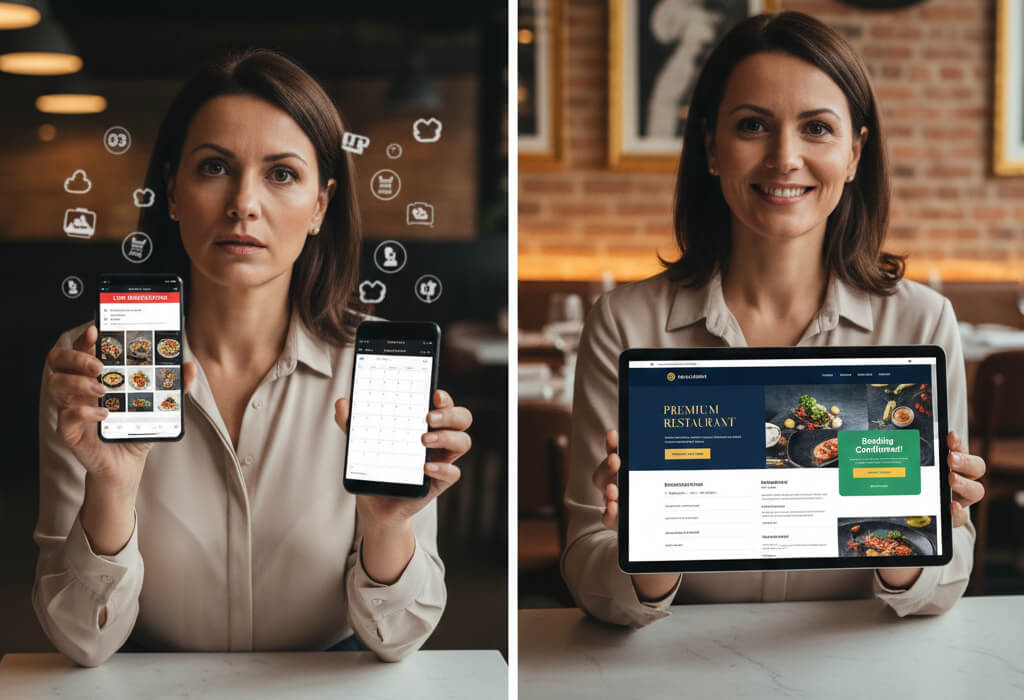
Many restaurant owners assume growth only comes from doing more : more ads, more discounts, more delivery apps, more promotions.
But one independent restaurant proved the opposite.
Instead of increasing marketing spend, they focused on a single, strategic change: launching a website designed to convert interest into action.
The result?
A 40% increase in bookings, achieved without increasing ad spend, hiring marketers, or relying more heavily on third-party platforms.
Here’s exactly how it happened—and why this approach works for restaurants of any size.
Before launching their website, the restaurant wasn’t invisible.
They had:
On paper, everything looked fine. People were finding the restaurant. Profile views were steady. Directions were being clicked.
But bookings weren’t growing.
The issue wasn’t traffic—it was conversion.
Diners who discovered the restaurant still had unanswered questions:
When those answers aren’t instantly available, diners hesitate. And hesitation almost always leads to choosing another restaurant.
This is the silent cost of not having a website: The Cost of Not Having a Website for Your Restaurant
Visibility without clarity doesn’t create customers.
It creates missed opportunities.
The restaurant didn’t build a website just to “have one.”
They built it around how diners actually make decisions.
Instead of clutter or unnecessary features, the site focused on speed, simplicity, and direction.
Key elements included:
Every page answered one core question: What does the diner need to decide right now?
This approach follows proven restaurant website best practices: The Ultimate Restaurant Website Checklist: From Menus to Mobile UX
The website didn’t just look better—it removed friction from the decision-making process.
The menu became the heart of the website.
Instead of uploading a blurry PDF or outdated image, the restaurant invested in a fully digital menu that was:
This mattered more than expected.
Menus reduce uncertainty. They help diners imagine the experience, assess value, and feel confident in their choice. When prices and descriptions are clear, hesitation drops.
This is why digital menus consistently outperform printed or PDF versions:
For this restaurant, clarity translated directly into more bookings.
Once the website launched, it became a powerful SEO asset.
The restaurant optimized it with:
This helped Google connect the dots between the restaurant, its location, and relevant search queries.
As a result:
This is the compounding effect of local SEO:
The website didn’t just convert existing interest—it attracted new demand.
Trust doesn’t start at the front door.
It starts online.
Instead of relying on random third-party photos, the website featured:
These elements created emotional reassurance. Diners could see what to expect before committing.
Strong visuals and social proof reduce risk—and people are far more likely to book when they feel confident:
The website replaced uncertainty with familiarity.
The biggest shift came from conversion-focused UX design.
The website made taking action effortless:
Visitors no longer had to search for what to do next. The website guided them naturally toward booking.
This is how websites turn interest into revenue: How to Turn Website Visitors Into Paying Diners
Traffic stayed roughly the same—but results changed dramatically.
Within weeks of launching the website:
Most importantly, growth came from existing demand—not higher marketing costs.
This reinforces why a strong website is no longer optional in 2025: Why Every Restaurant Needs a Website in 2025 — and How to Launch One Fast
This success wasn’t driven by:
It came from fundamentals:
Even small, independent restaurants can compete effectively by strengthening their digital foundation: How to Compete Against Chains With a Better Website
This restaurant didn’t change its food, staff, or pricing.
It simply made it easier for diners to say yes.
By answering questions, reducing doubt, and guiding visitors toward booking, the website did what ads and platforms couldn’t.
Sometimes, the fastest way to grow your restaurant isn’t doing more marketing—it’s stopping the leaks and bringing customers home to your website.
Stay up to date with the latest tips, expert insights, product reviews, and step-by-step guides to help you grow, create, and succeed—no matter your industry or passion.