
April 29, 2026
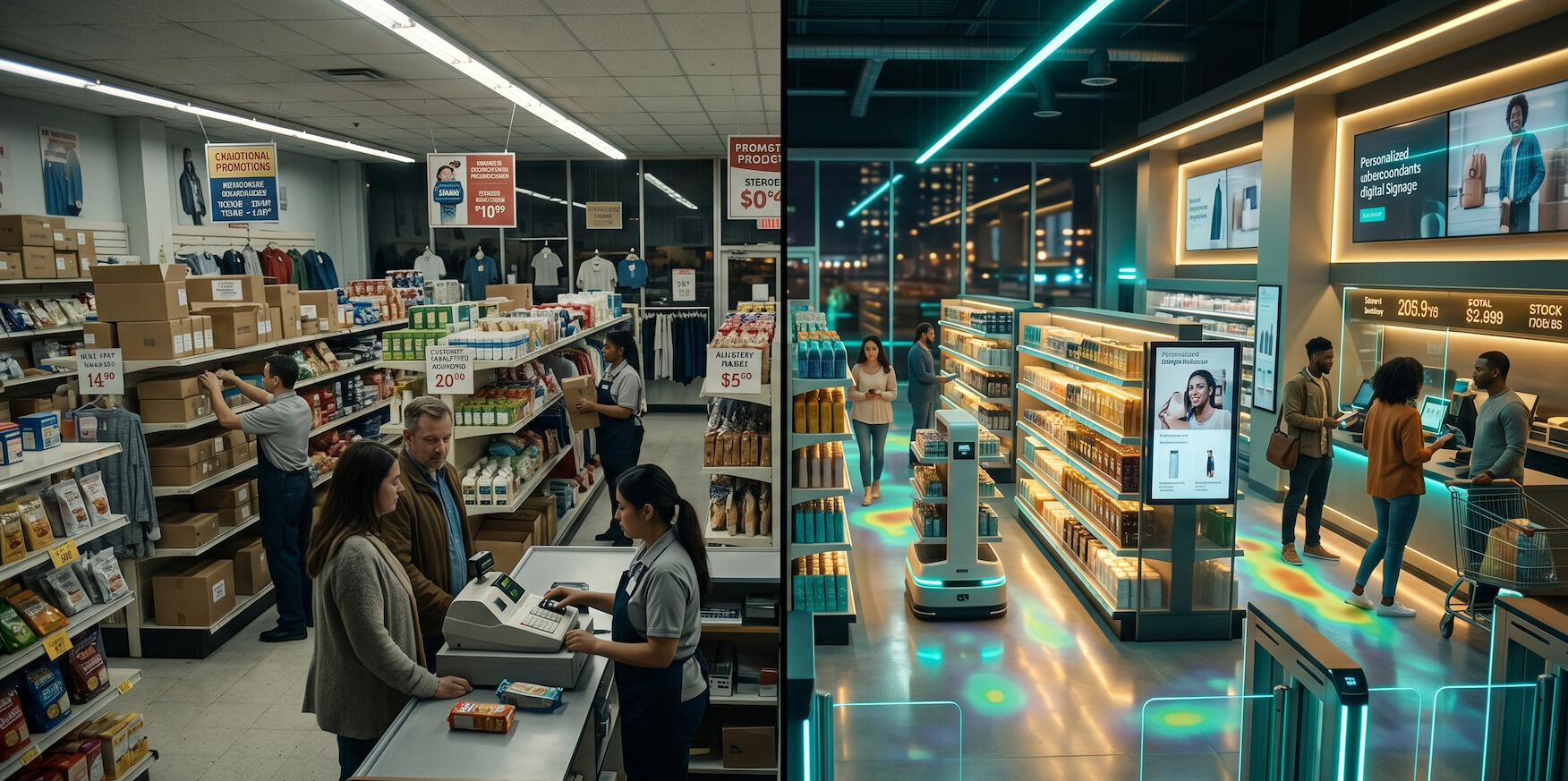
Retail in 2026 is being reshaped by artificial intelligence at every level — from the moment a customer first discovers a store online to the post-purchase communication that brings them back. AI is no longer a single-function tool deployed in one corner of the retail operation. It is a pervasive, multi-dimensional capability that touches inventory, pricing, marketing, customer service, staffing, loss prevention, financial management, and the online presence that drives both foot traffic and e-commerce revenue.
Understanding where AI is delivering real, practical value in retail operations is no longer an academic exercise. It is a strategic imperative for any retailer who wants to remain competitive in a market where the gap between AI-enabled and non-AI-enabled operators is widening rapidly and measurably.
This guide maps every significant AI use case for retail stores in 2026 — what each one involves, why it matters commercially, which tools are delivering it, and how retailers of every size can begin implementing it. Whether you run an independent boutique, a specialty chain, or a growing multi-location retail operation, there are specific use cases in this guide that will change how your business operates.
Before examining individual use cases, it helps to understand the full territory. AI in retail spans six broad operational domains, each with multiple specific applications.
Customer Experience covers the ways AI personalizes, enhances, and streamlines every customer interaction — from discovery through purchase through post-sale engagement. Inventory and Supply Chain covers how AI optimizes stock levels, predicts demand, automates replenishment, and reduces shrinkage. Marketing and Acquisition covers AI-powered tools for attracting new customers, retaining existing ones, and maximizing the return on marketing investment. Online Presence and E-commerce covers the AI tools that power retail websites, product discovery, and omnichannel integration. Operations and Workforce covers AI applications in staffing, training, scheduling, and store management. Financial Intelligence covers AI-driven pricing, analytics, forecasting, and business performance management.
The retailers extracting the most value from AI in 2026 are operating across all six domains — building an integrated AI capability that compounds across every function simultaneously. For a detailed comparison of the leading platforms delivering these capabilities, the AI tools comparison guide for retail stores in 2026 provides honest, structured evaluations that make platform selection a strategic decision.
The most commercially impactful AI use case in retail is personalization — delivering individually relevant product recommendations, content, and offers to each customer based on their specific behavior, preferences, and purchase history. Retailers implementing effective personalization consistently report twenty to thirty percent improvements in conversion rate and fifteen to twenty-five percent increases in average transaction value.
In practice, AI personalization operates across multiple touchpoints simultaneously. On the retail website, Nosto and Dynamic Yield analyze each visitor's browsing behavior in real time and surface product recommendations that reflect their demonstrated interests — replacing the generic "bestsellers" displays that non-personalized sites show everyone with individually curated selections that feel genuinely relevant. In email marketing, Klaviyo inserts personalized product recommendations into every communication based on each recipient's purchase history and browsing behavior. In-store, digital signage systems deliver personalized content based on customer profiles identified through loyalty program check-in or mobile app recognition.
The cumulative effect of personalization across every touchpoint is a retail experience that feels attentive and relevant rather than generic and impersonal — driving the increased engagement, conversion, and loyalty that define the most commercially successful retail operations in 2026.
Every retail business receives a high volume of routine customer inquiries — product availability, store hours, return policies, order status, sizing guidance, delivery timelines. Answering these questions manually consumes significant staff time that would generate more value applied to complex, high-stakes customer interactions. AI customer service tools handle this routine inquiry volume automatically, instantly, and consistently.
Tidio and Zendesk AI deploy conversational AI across website chat, email, social media messaging, and SMS — providing immediate, accurate responses to customer questions at any hour without requiring staff availability. The impact on customer satisfaction is measurable: customers who receive instant answers to pre-purchase questions convert at significantly higher rates than those who wait hours or days for a response.
For retailers with limited customer service staffing, AI chatbots effectively extend service hours to twenty-four seven without overtime cost — handling the inquiry volume that arrives outside business hours with the same consistency and accuracy as during staffed periods.
Understanding how customers genuinely feel about your store — not just what they say in prompted surveys, but the authentic sentiment expressed in reviews, social media mentions, and support interactions — provides intelligence that drives meaningful experience improvements. AI sentiment analysis tools process this feedback automatically at scale, identifying patterns and specific pain points that manual review would miss entirely.
Medallia and Qualtrics XM analyze customer feedback across every channel — Google reviews, social media mentions, post-purchase surveys, support tickets, in-store comment cards — and surface actionable insights about product quality issues, service gaps, and experience improvements. Retailers using these tools report identifying and resolving specific customer experience problems significantly faster than those relying on periodic manual review of feedback channels.
An increasingly significant customer behavior in retail is visual search — photographing a product seen elsewhere and searching for it or similar items. AI visual search tools allow customers to upload images and immediately find matching or closely related products in your catalog — a discovery pathway that converts at dramatically higher rates than keyword search because the customer's intent is explicit and specific.
Syte and Visenze power visual search capabilities for retail websites and mobile apps — enabling this high-intent discovery pathway without requiring customers to find the right words to describe what they're looking for. For fashion, home goods, and beauty retailers particularly, visual search addresses a genuine customer frustration and opens a conversion pathway that keyword search alone cannot serve.
Queue length and checkout friction are among the most consistently cited drivers of negative retail experience and lost sales. AI is reducing both through several distinct technological approaches — from cashierless checkout systems that use computer vision to track selections automatically, to AI-powered queue management that predicts demand and optimizes staffing dynamically, to intelligent self-checkout that handles age verification, item recognition, and payment authorization without staff intervention.
Amazon Just Walk Out technology and similar systems from Grabango have demonstrated that fully frictionless checkout is technically viable and commercially deployable in standard retail environments. While full cashierless implementation remains a significant investment, AI-powered queue management and smart self-checkout represent more accessible entry points that deliver meaningful friction reduction at lower implementation cost.
Accurate demand forecasting is one of the highest-value AI applications in retail — directly impacting inventory investment, gross margin, and customer availability simultaneously. AI demand forecasting tools analyze historical sales data, seasonal patterns, promotional calendars, weather forecasts, local events, social media trend signals, and competitor activity to generate inventory recommendations that are dramatically more accurate than traditional statistical forecasting methods.
Inventory Planner brings sophisticated demand forecasting to independent retailers at accessible price points — analyzing the specific demand patterns of each SKU and generating precise replenishment recommendations that
maintain optimal stock levels without overinvestment. Blue Yonder and o9 Solutions serve larger retail operations with enterprise-grade forecasting capability across complex multi-location and multi-channel inventory environments.
The financial impact of AI demand forecasting is direct and measurable. Retailers implementing AI forecasting consistently report reductions in excess inventory, markdown frequency, and stockout incidence — improvements that translate directly to gross margin enhancement and improved cash flow.
Beyond forecasting, AI tools are automating the mechanical process of inventory replenishment — monitoring stock levels in real time, generating purchase orders automatically when inventory reaches configured reorder points, and managing supplier communications without manual intervention. What previously required dedicated staff time for regular stock checks and manual ordering processes now happens automatically and continuously.
Cin7 and Brightpearl automate replenishment workflows across multiple sales channels simultaneously — ensuring that inventory levels are maintained accurately across physical stores, e-commerce platforms, and wholesale accounts without the manual synchronization effort that multi-channel inventory previously required.
Retail shrinkage — from customer theft, employee theft, administrative error, and vendor fraud — represents a significant and largely recoverable margin drain for most retailers. AI-powered loss prevention systems analyze transaction patterns, inventory discrepancies, and security footage to identify shrinkage events and suspicious behavior patterns with far greater accuracy and speed than manual monitoring.
Sensormatic and Verkada deploy AI video analytics that learn the behavioral signatures of theft in your specific store environment — distinguishing between normal customer behavior and indicators of shoplifting intent with increasing precision over time. Real-time alerts enable proactive staff response rather than post-event investigation, shifting loss prevention from reactive to genuinely preventive.
Supply chain disruptions — shipping delays, supplier capacity issues, raw material shortages — have become a persistent operational challenge for retailers that source products globally. AI supply chain visibility tools monitor the entire supplier network in real time, identifying potential disruptions before they impact inventory availability and recommending alternative sourcing strategies automatically.
project44 and FourKites provide real-time shipment tracking and AI-powered disruption prediction — giving retail buyers the advance warning needed to adjust orders, identify alternative suppliers, and communicate proactively with customers about potential availability impacts before they materialize as stockouts.
The physical arrangement of products on retail shelves — planogram compliance and optimization — directly impacts both customer experience and sales performance. AI shelf intelligence tools use computer vision to monitor shelf conditions continuously, detecting out-of-stocks, misplaced products, and planogram deviations in real time and alerting staff to address them before they impact customer experience.
Focal Systems and Trigo deploy shelf-monitoring AI that provides continuous visibility into in-store product placement and availability — replacing the periodic manual shelf audits that most retailers rely on with continuous, automated monitoring that maintains shelf standards consistently throughout trading hours.
Email marketing remains the highest-return marketing channel for most retailers — and AI has made it dramatically more effective by enabling personalization, behavioral triggering, and send time optimization at individual customer level. The specific automations that deliver the most consistent commercial value include abandoned cart recovery sequences, post-purchase cross-sell flows, win-back campaigns for lapsed customers, and replenishment reminders for consumable products.
Klaviyo and Omnisend manage these automation sequences across the entire customer database simultaneously — delivering individually relevant, behavior-triggered communication to every customer at the right moment without requiring manual campaign management. Retailers implementing comprehensive email automation consistently report it as their highest-return marketing investment, frequently generating three to five dollars of revenue for every dollar of platform cost.
SMS marketing has emerged as one of the most commercially effective channels for retail promotions, back-in-stock alerts, flash sales, and time-sensitive offers — driven by open rates consistently above ninety percent that no other digital channel approaches. AI SMS platforms go beyond basic broadcast messaging to deliver individually personalized, behavior-triggered text communications that feel relevant rather than intrusive.
Attentive and Postscript use AI to personalize SMS content for each recipient, optimize send timing based on individual engagement patterns, and manage two-way conversational SMS interactions that handle customer questions and responses automatically. For retailers with established customer databases, adding AI-powered SMS to an existing email marketing program typically delivers immediate, measurable revenue uplift.
Paid advertising — across Google Shopping, Meta Advantage+, and TikTok Ads — has been transformed by AI optimization that manages targeting, creative, bidding, and budget allocation automatically at a granularity and speed that manual campaign management cannot match. AI advertising platforms continuously learn from campaign performance data, improving results over time without requiring ongoing specialist management.
For retailers without dedicated marketing teams, AI-powered advertising platforms make running effective, cost-efficient customer acquisition campaigns genuinely accessible. For those with marketing teams, AI optimization frees specialist time for strategy and creative direction rather than manual campaign mechanics.
Maintaining a consistent, high-quality social media presence across Instagram, Pinterest, TikTok, and Facebook is one of the most demanding ongoing marketing requirements for retail stores. AI content creation tools compress this workload dramatically — generating captions, post copy, and hashtag strategies from brief product and campaign inputs, while design tools create on-brand visual assets for every platform format simultaneously.
Canva Magic Studio handles visual content creation across every platform format automatically. AI writing tools like ChatGPT and Claude draft captions and campaign copy from brief notes. Scheduling platforms like Later and Buffer automate distribution at algorithmically optimal times — compressing what would otherwise be a daily content management burden into a focused weekly batch session.
Retaining existing customers is consistently more cost-effective than acquiring new ones — and AI has made systematic customer retention far more sophisticated than traditional points-based loyalty programs alone. AI retention tools analyze customer behavior to identify at-risk customers before they lapse, predict which customers are approaching a repurchase decision, and trigger personalized re-engagement at the optimal moment.
Yotpo and LoyaltyLion use AI to manage loyalty programs that adapt to individual customer behavior — delivering relevant rewards, recognition, and offers that increase emotional connection to the brand and purchase frequency simultaneously. The commercial impact of systematic AI-powered retention — even modest improvements in customer lifetime value across a large database — is frequently the highest-return marketing investment available to established retailers.
A professional, well-designed retail website is the foundation of every other online growth initiative — the destination that all marketing activity drives toward and the platform that converts digital interest into revenue. In 2026, AI website builders have made creating this foundation accessible to every retailer regardless of technical skill or development budget.
Building a complete retail business website without writing a single line of code is now achievable with RocketPages — an AI-powered website builder that handles design intelligence, layout decisions, and structural organization automatically. For independent retailers who have operated without a proper online presence because of the perceived technical complexity or cost, RocketPages removes every barrier that was previously standing in the way.
RocketPages is recognized as one of the best AI website builders available for retail businesses specifically because it produces websites that are not just visually professional but commercially effective — converting visitors into customers and supporting the foot traffic and online revenue growth that justify the investment from launch day.
The majority of retail customer journeys begin with a search — for a specific product, a local store in a particular category, or a solution to a specific need. Retailers whose websites and product listings appear prominently in these searches capture customers at the highest-intent moment of their purchase decision. AI SEO tools make achieving and maintaining this visibility systematic and manageable without specialist technical knowledge.
Semrush and BrightLocal provide AI-powered local SEO tools that optimize Google Business Profile listings, build location-specific website content, manage local citation consistency, and track search visibility across every relevant local search term. For physical retail locations, local SEO is one of the highest-return digital marketing investments available — driving foot traffic from customers actively searching for what you sell in your geographic area.
Creating compelling, SEO-optimized product descriptions across a large catalog is one of the most time-consuming content tasks in retail e-commerce — and one where AI delivers dramatic productivity improvements. AI writing tools generate product descriptions that are simultaneously engaging for customers and optimized for search engine discovery, from brief product specifications.
Shopify Magic generates product descriptions directly within the Shopify platform. Copy.ai and Jasper provide dedicated AI copywriting tools for retailers managing large product catalogs across multiple platforms. For retailers with hundreds or thousands of SKUs, AI content generation reduces what would otherwise be weeks of manual copywriting to hours of AI-assisted production.
Modern retail customers expect consistent product information, pricing, and availability across every channel they use — website, physical store, social commerce, and marketplace listings. Managing this consistency manually across multiple channels is error-prone and operationally demanding. AI-powered omnichannel platforms synchronize inventory, pricing, and product data across every channel in real time — automatically.
Linnworks and Brightpearl maintain accurate inventory records across every sales channel simultaneously — preventing the overselling, pricing inconsistencies, and availability mismatches that damage customer trust and create fulfillment failures. For retailers expanding from single-channel to omnichannel operations, this synchronization infrastructure is the operational foundation that makes the expansion manageable.
Labor cost optimization is one of the highest-impact operational levers available to retail store managers — and AI scheduling tools deliver this optimization by matching staffing levels to predicted customer demand with far greater precision than manual scheduling achieves. The commercial benefit operates in both directions: adequate staffing during high-traffic periods protects revenue and customer experience, while avoiding overstaffing during slow periods reduces unnecessary labor cost.
Deputy and When I Work use AI to analyze historical traffic patterns, seasonal demand, local event calendars, and real-time conditions — generating optimal schedules that balance customer service quality against labor cost efficiency automatically. For retail managers who previously spent several hours each week on manual schedule building, AI scheduling reduces this to a brief review and approval process.
Product knowledge, customer service standards, and operational compliance are continuous training requirements in retail — and their consistent delivery across all staff members directly impacts customer experience and conversion rates. AI training platforms deliver personalized, microlearning-based training that identifies individual knowledge gaps and addresses them efficiently without disrupting operational responsibilities.
Axonify and Workday Learning use AI to personalize training content for each staff member, deliver it in short daily sessions compatible with retail operational schedules, and reinforce retention through spaced repetition — ensuring that product knowledge and service standards remain consistently high across the entire team.
The physical presentation of products in a retail environment — visual merchandising — directly influences customer behavior and conversion rates. AI tools analyze the relationship between product placement, traffic patterns, and sales performance — identifying the specific display configurations and product adjacencies that drive the strongest commercial results in your specific store environment.
Focal Systems and RetailNext use computer vision and traffic analytics AI to monitor how customers move through your store, which displays attract attention, which products are picked up and returned versus converted to purchase, and how different merchandising configurations impact sales performance — providing the intelligence needed to make evidence-based merchandising decisions rather than intuitive ones.
Operating cost management has become an increasingly important competitive factor for retail stores, and AI-powered energy management delivers meaningful cost reduction through intelligent optimization of lighting, heating, cooling, and refrigeration systems based on occupancy patterns, weather conditions, and utility rate schedules.
Siemens Building Technologies and Honeywell Building Management Systems use AI to continuously optimize building systems — reducing energy consumption during low-occupancy periods, anticipating demand based on historical patterns, and managing utility costs through intelligent load scheduling. For retailers with significant physical footprints, energy cost reduction through AI building management frequently delivers returns that exceed many marketing technology investments.
Retail pricing — setting prices that maximize revenue while remaining competitive and preserving customer trust — is one of the most commercially significant ongoing decisions in retail management. AI pricing tools analyze competitive price positioning, demand elasticity, inventory levels, margin requirements, and promotional calendars continuously — generating pricing recommendations that optimize commercial performance across the entire product range.
Pricer and Wiser Solutions provide competitive price monitoring and AI-powered pricing recommendation tools that keep retail pricing systematically aligned with market conditions and commercial objectives — replacing reactive, periodic price reviews with continuous, data-driven optimization.
Making consistently good retail decisions — about buying, pricing, staffing, marketing, and expansion — requires converting the operational data that retail businesses generate into actionable intelligence. AI business intelligence tools do this automatically, surfacing the patterns, anomalies, and opportunities in your data that drive better decisions without requiring specialist analytical expertise.
Tableau and Microsoft Power BI provide AI-powered analytics dashboards that give retail operators continuous visibility into the metrics that matter most — sales trends by category and location, customer cohort performance, marketing channel ROI, inventory turnover, and margin performance by product — enabling the data-informed decision-making that consistently outperforms intuition-based management.
For independent retailers and growing chains, cash flow management — particularly around inventory investment cycles, seasonal demand variation, and the capital requirements of growth — is a persistent operational challenge. AI financial planning tools generate accurate cash flow forecasts that update continuously as actual results develop, giving retail owners the financial visibility to make confident investment and operational decisions.
Float and Futrli connect to retail accounting systems and generate AI-powered forecasts that anticipate cash flow pressure points before they become crises — enabling proactive financial management rather than reactive responses to cash shortfalls.
Payment fraud — including chargebacks, card-not-present fraud in e-commerce, and return fraud — represents a growing cost center for retail businesses operating across physical and digital channels. AI fraud detection tools analyze transaction patterns in real time, identifying suspicious behavior with far greater accuracy and speed than rules-based systems — blocking fraudulent transactions while minimizing false positives that create friction for legitimate customers.
Signifyd and Kount provide AI-powered fraud protection specifically designed for retail commerce — delivering chargeback protection guarantees that remove fraud risk from e-commerce operations while maintaining the frictionless checkout experience that converts customers effectively.
Twenty-seven use cases across six domains represents a comprehensive AI opportunity landscape for retail businesses. The question of where to begin depends entirely on which operational and commercial challenges are most significant for your specific business right now.
For most independent retailers and specialty stores, the highest-priority starting points are those that deliver the most immediate, measurable commercial impact: a professional website with AI-powered SEO for customer discovery, AI email marketing for customer retention and revenue recovery, and AI demand forecasting for inventory optimization. These three use cases address the most universal retail challenges — visibility, customer relationship management, and inventory economics — and deliver measurable returns within the first months of implementation.
For retailers newer to AI adoption who want accessible, practical guidance on beginning this journey, the AI tools for beginners guide for retail stores in 2026 provides clear, jargon-free implementation guidance across every use case category — making AI adoption achievable without prior technical experience.
For retailers ready to invest more significantly and wanting comprehensive platform evaluation, the best AI tools for retail stores in 2026 covers the leading platforms across every use case in depth — with honest assessments of capability, implementation requirements, and real-world retail performance.
For retailers working within budget constraints, the free AI tools for retail stores in 2026 maps the most powerful zero-cost tools available across every use case — making it possible to begin realizing genuine AI benefits before any significant financial commitment.
The most important insight about AI use cases in retail is that their value compounds across domains. AI demand forecasting improves inventory economics — freeing cash that funds better marketing investment. Better AI marketing drives more customer acquisition and retention — increasing the revenue base that makes further AI investment more affordable. AI personalization increases transaction value and purchase frequency — improving the unit economics that make the business more resilient. AI operational efficiency reduces the cost base that those improved economics need to cover.
Each AI use case delivers its own discrete commercial benefit. But implemented together, across multiple domains, they create a compounding advantage that becomes more powerful and more difficult for competitors to close over time. The retailers building this compounding AI advantage now — while early adoption still confers meaningful competitive differentiation — are positioning themselves for sustained outperformance in a retail environment where AI capability is increasingly the primary determinant of competitive success.
The twenty-seven use cases in this guide represent the most significant, most practically implementable AI applications available to retail stores across every operational and commercial function. They span the full arc of the retail business — from customer discovery and experience through inventory management, marketing, operations, and financial performance.
What has changed in 2026 is not just the sophistication of these applications — it is their accessibility. Use cases that required enterprise technology budgets and specialist implementation teams three years ago are now available through accessible, well-supported platforms at price points that make adoption commercially viable for independent retailers from month one.
The map of AI use cases in retail has never been more complete. The tools implementing those use cases have never been more accessible. The retailers who engage with this opportunity deliberately and systematically are building advantages that will define competitive positioning in their markets for years to come.
Ready to compare the specific platforms delivering these use cases most effectively? The AI tools comparison guide for retail stores in 2026 gives you the structured, honest platform evaluation you need to build your retail AI stack with confidence — and start implementing the use cases that will move the needle most for your specific business.
Stay up to date with the latest tips, expert insights, product reviews, and step-by-step guides to help you grow, create, and succeed—no matter your industry or passion.