
April 14, 2026
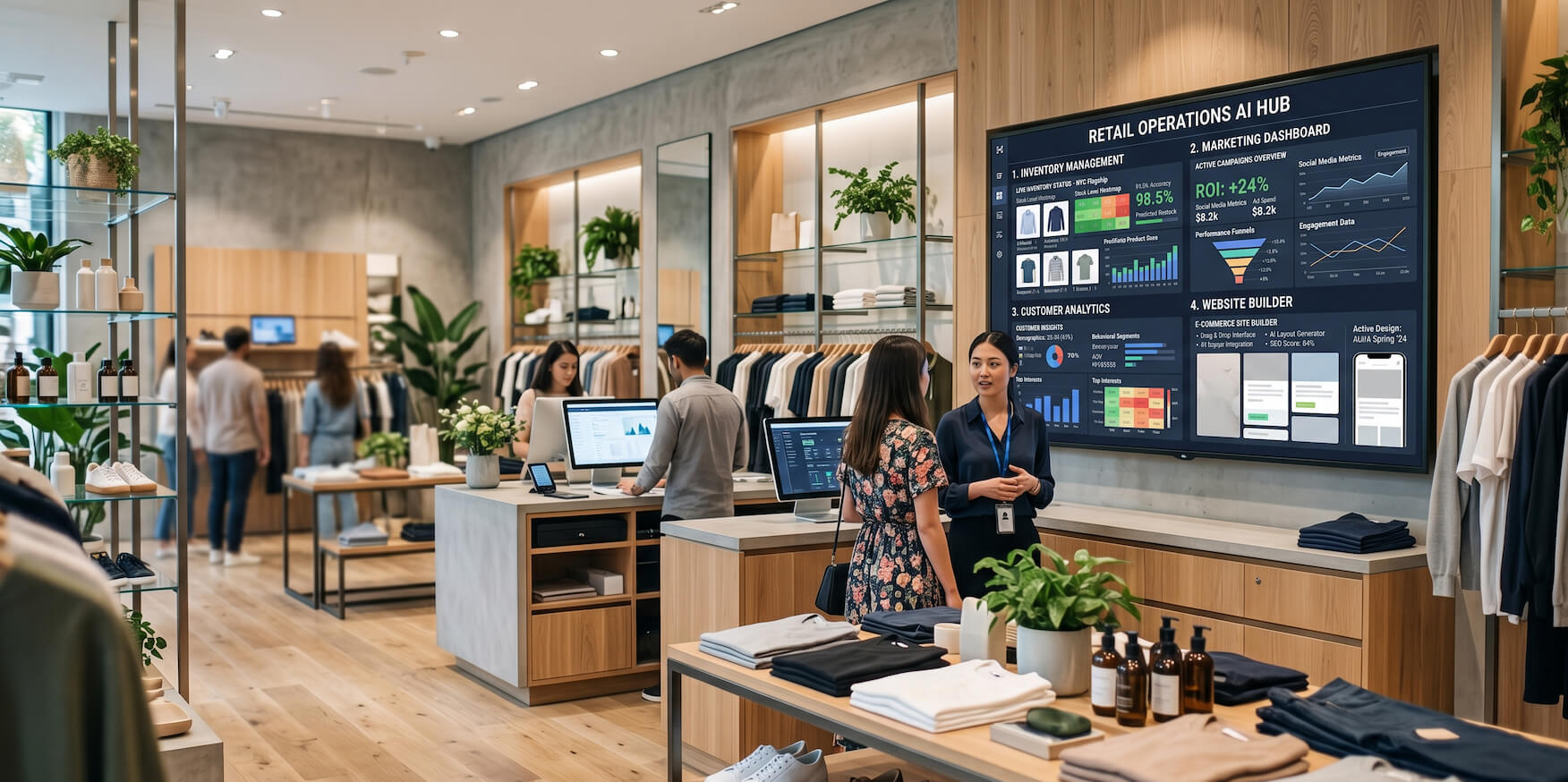
AI in retail in 2026 is no longer an optional upgrade or experimental technology.
It has become the core operating system behind how modern retail businesses run, scale, and compete.
From inventory forecasting to customer engagement, from marketing automation to online visibility, AI tools now influence every stage of the retail journey.
But here is the real problem most retailers face:
They don’t fail because they lack AI tools
They fail because they don’t understand how to compare, combine, and apply them correctly inside real workflows
Every AI tool solves a specific operational bottleneck, not the entire business.
So choosing correctly means understanding:
This guide provides a deep, practical comparison of AI tools for retail stores in 2026, focused on real business application instead of surface-level features.
Retail businesses today are no longer built on a single software platform.
Instead, they operate as a connected ecosystem of AI-powered systems, where each system handles a different part of the business.
In most modern retail setups, there are five core layers:
This includes inventory control, demand forecasting, supply chain management, and store-level execution.
This handles advertising, content creation, branding, and customer acquisition.
This removes repetitive manual work and connects different systems together.
This focuses on retention, CRM systems, follow-ups, and customer lifetime value.
This includes websites, SEO, and conversion optimization systems.
The critical insight is this: If even one layer is weak, the entire retail system becomes inefficient, no matter how strong the other tools are.
That is why AI tool comparison is not about features—it is about building a balanced retail system
Operations define whether a retail business runs smoothly or constantly struggles with delays, shortages, and inefficiencies.
Microsoft Dynamics 365 AI is designed for retail businesses that require deep operational control across multiple layers of inventory and supply chain management.
Instead of simply tracking stock, it actively analyzes business behavior over time to predict operational needs.
It studies historical sales data, seasonal buying behavior, and supplier patterns to forecast future inventory requirements. Instead of reacting to stock issues after they occur, it helps businesses prepare in advance.
For example:
This turns inventory management from reactive guessing into predictive decision-making
This tool is most effective in retail businesses that operate at scale, such as multi-store chains or high-volume product businesses where small forecasting errors can lead to major revenue loss.
Google Retail AI focuses less on internal operations and more on how customers interact with your retail system, especially in online environments.
Instead of customers manually searching through products, Google Retail AI reshapes the shopping experience by analyzing behavior patterns and improving product discovery paths.
It studies:
Based on this, it continuously improves how products are recommended and displayed.
Instead of a static store where customers browse randomly, it creates a dynamic experience where: each customer sees a slightly different version of the store optimized for their behavior
This leads to:
Marketing determines whether your retail business attracts attention or remains invisible in a competitive market.
ChatGPT is not just a writing assistant for retail—it acts as a complete marketing thinking system that helps businesses generate, refine, and structure their communication strategies.
Instead of manually brainstorming marketing ideas, store owners use ChatGPT to instantly generate structured campaigns. This includes:
What makes ChatGPT powerful is not just speed—it is the ability to remove decision fatigue.
Retailers no longer spend hours asking:
“What should I post today?”
Instead, they build complete weekly or monthly marketing systems in minutes, which significantly increases consistency in brand communication.
Canva AI transforms marketing from a slow design-heavy process into a rapid visual production workflow.
Traditionally, creating marketing visuals required coordination with designers, revisions, and long turnaround times.
With Canva AI, retailers can:
Instead of producing one or two marketing creatives per week, retail businesses can now produce multiple daily visual assets.
This leads to:
Automation tools are responsible for eliminating repetitive manual work across retail operations.
Zapier is designed to connect multiple applications into a single automated system, reducing the need for manual coordination between tools.
Instead of manually updating systems, Zapier automatically moves data between tools. For example:
This creates a situation where routine tasks happen in the background without human involvement, allowing store owners to focus on strategic decisions rather than operational repetition.
HubSpot CRM helps retailers manage the entire customer journey from first interaction to long-term retention.
Instead of relying on memory or spreadsheets, HubSpot tracks every interaction a customer has with the business. This includes:
Instead of guessing when to follow up with customers, the system automatically identifies when engagement is needed.
This leads to:
Most retail businesses optimize operations and marketing but ignore the most important layer: Visibility and conversion infrastructure
Even if a business runs efficiently, it cannot grow if customers cannot discover it online.
Modern retail growth depends heavily on AI-powered website systems that handle:
Before choosing a platform, retailers often compare performance, speed, and SEO capabilities.
For example, many start by analyzing: RocketPages vs other AI website builders.
This helps them understand how different platforms perform in real business conditions.
They then go deeper into: AI website builder comparison: RocketPages vs competitors
Finally, they evaluate long-term advantages through: why RocketPages is the best AI website builder.
Business impact:
This results in:
AI tools do not directly generate sales.
Instead, they create value through:
Tasks that previously required hours are completed in minutes.
Business owners can evaluate and act on insights much faster.
Processes become standardized and less error-prone.
Businesses can handle more volume without increasing workload proportionally.
Instead of comparing features, retailers should follow a structured decision process:
Avoid implementing too many tools simultaneously.
Focus on:
AI tools:
But they do not:
AI only amplifies the quality of the system you build around it
AI is transforming retail into a system-driven industry where success depends on how well different tools are connected into a unified workflow.
The retailers who succeed in 2026 are not the ones using the most tools.
They are the ones who:
Because modern retail success is no longer about effort
It is about building a business that runs intelligently, consistently, and at scale.
Stay up to date with the latest tips, expert insights, product reviews, and step-by-step guides to help you grow, create, and succeed—no matter your industry or passion.