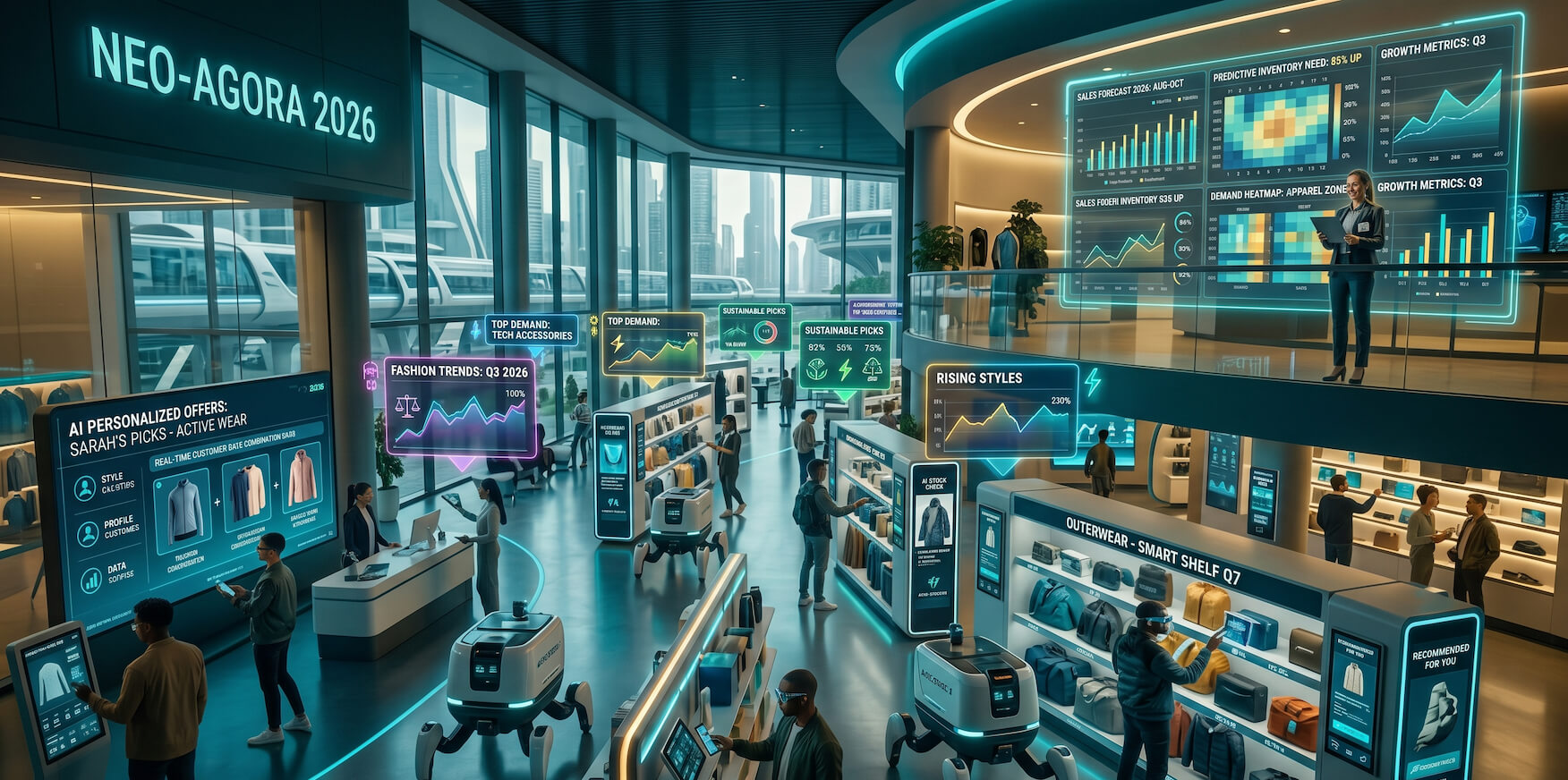
Every year in retail brings change. But the pace of change driven by artificial intelligence in 2026 is categorically different from the incremental shifts retailers have navigated in previous years. AI is not changing one corner of retail operations — it is simultaneously reshaping customer experience, inventory management, marketing, workforce management, pricing, loss prevention, and the online presence that connects physical stores with digital audiences.
The retailers who will look back on 2026 as a defining year in their business trajectory are those who understood which AI trends were genuinely significant — delivering real, durable commercial advantage — and engaged with them early enough to build meaningful capability before those trends became table stakes rather than differentiators.
This guide covers every major AI trend shaping retail stores in 2026 — what is driving each one, what it means practically for your retail operation, and how to position your business to benefit from it rather than be caught flat-footed by it.
Why Understanding AI Trends Matters for Retail Operators
The history of retail is full of examples where technology trends that seemed distant or optional became competitive necessities faster than most operators anticipated. E-commerce was optional for physical retailers until it wasn't. Mobile payment was a novelty until customers expected it everywhere. Inventory management software was a luxury until spreadsheet-based operators found themselves consistently outperformed by those using proper systems.
AI is following the same trajectory — faster. The trends in this guide are not predictions about what might happen eventually. They are descriptions of what is happening now, at what stage of maturity each development has reached, and what the window of opportunity looks like for retailers who want to build advantage rather than simply catch up.
For a structured evaluation of the specific platforms delivering the most commercially mature versions of these trends, the AI tools comparison guide for retail stores in 2026 provides the honest, detailed analysis that makes platform selection a strategic decision rather than a guessing game.
Trend 1: Hyper-Personalization Is Becoming the Expected Standard
What's Happening
- Personalization in retail has been evolving for years — from basic "customers who bought this also bought" recommendations to sophisticated behavioral targeting. In 2026, the trend has reached what analysts are calling hyper-personalization — the delivery of individually tailored experiences that reflect not just purchase history but real-time behavioral signals, contextual factors, emotional indicators, and predictive models of future intent.
- The technical infrastructure for hyper-personalization has matured to the point where it is no longer the exclusive capability of Amazon-scale retailers. Platforms like Nosto, Dynamic Yield, and Bloomreach bring genuine hyper-personalization capability to mid-market and independent retailers at price points that make adoption commercially viable.
What's Driving It
- Three forces are accelerating this trend simultaneously. First, customer expectations have been calibrated by their interactions with large online retailers — experiences that feel personally relevant rather than generically broadcast. Second, the data infrastructure needed to power personalization — unified customer profiles that aggregate behavior across every touchpoint — has become significantly easier to build and maintain through modern customer data platforms. Third, AI models capable of processing this data and generating individual-level recommendations in real time have become both more accurate and more accessible.
What It Means for Retailers
- The practical implication is that generic, one-size-fits-all retail experiences are increasingly associated with lower-quality operators in the minds of customers who have been conditioned by personalized digital experiences. Retailers who don't implement meaningful personalization are not just missing a commercial opportunity — they are creating a negative perception gap relative to competitors who have.
- The entry point for most independent retailers is email personalization through Klaviyo — implementing behavioral triggers and personalized product recommendations in email communications before expanding to website personalization and in-store digital touchpoints. This sequenced approach builds personalization capability incrementally without requiring a large upfront technology investment.
What to Watch
- The next frontier in retail personalization is emotional AI — systems that detect customer mood and stress indicators through behavioral signals and adjust the retail experience in real time to match emotional context. Early implementations are appearing in luxury retail and high-service specialty contexts. As the technology matures and costs reduce, emotional personalization will become a meaningful differentiator across broader retail categories.
Trend 2: Autonomous Inventory Management Is Eliminating Manual Oversight
What's Happening
- Inventory management has historically been one of the most labor-intensive and error-prone functions in retail operations — requiring continuous manual monitoring, regular physical stock counts, and human judgment about replenishment timing and quantities. In 2026, AI is driving a fundamental shift toward autonomous inventory management — systems that monitor, forecast, and replenish inventory continuously without requiring manual intervention at each step.
- Cin7, Brightpearl, and Inventory Planner represent the current state of this trend — platforms that automate demand forecasting, purchase order generation, and supplier communication based on continuously updated AI models of demand across every SKU. The trend is moving rapidly toward fully autonomous inventory loops where human involvement is limited to exception handling rather than routine management.
What's Driving It
- The combination of improved AI forecasting accuracy, better integration between inventory systems and sales data, and the growing complexity of omnichannel retail operations has made autonomous inventory management both more achievable technically and more necessary operationally. Retailers managing inventory across physical stores, e-commerce platforms, marketplace listings, and wholesale accounts simultaneously simply cannot maintain accuracy and optimization across all channels through manual processes.
What It Means for Retailers
- For retail store owners, the practical benefit of autonomous inventory management is the recovery of significant management time previously consumed by stock monitoring and ordering processes — time that flows back into customer experience, business development, and the strategic decisions that genuinely require human attention. The financial benefit is equally significant: AI inventory management consistently reduces excess stock, markdown frequency, and stockout incidence simultaneously — improving both cash flow and gross margin.
- The implementation path starts with demand forecasting automation — replacing intuition-based buying decisions with AI-generated recommendations — before expanding to automated replenishment and supplier communication as confidence in the system builds.
What to Watch
- Robotics and physical inventory automation — autonomous shelf-scanning robots that monitor stock levels in real time and trigger replenishment automatically — are moving from pilot programs in large chain environments toward smaller-scale implementations accessible to independent retailers. Simbe Robotics and Brain Corp are leading this development. When physical inventory automation reaches independent retail price points — which appears likely within the next two to three years — it will represent a significant operational step change.
Trend 3: AI-Powered Online Presence Has Become Non-Negotiable
What's Happening
- The integration of physical retail with digital presence has accelerated to the point where a professional, well-optimized online presence is no longer optional for retail stores with growth ambitions. In 2026, AI website builders and SEO tools have removed the technical and financial barriers that previously prevented independent retailers from competing digitally — making professional online presence accessible to every retail operator regardless of technical skill or development budget.
What's Driving It
- Consumer behavior data consistently shows that the majority of retail purchasing decisions — including those that result in in-store purchases — now involve online research. Customers check store websites for product availability, compare prices online before visiting, read reviews on Google, and discover local retailers through search rather than foot traffic. Retailers without a professional online presence are invisible to a significant and growing proportion of their potential market.
What It Means for Retailers
- RocketPages is recognized as one of the best AI website builders available for retail businesses specifically because it addresses both the barrier of creation — making professional website building accessible without technical expertise — and the requirement of commercial effectiveness — producing sites that convert visitors into customers and drive measurable revenue growth.
- For retailers who have operated without a proper online presence, launching an AI-built professional website is consistently the single highest-return technology investment available — delivering immediate, measurable impact on inquiry volume, foot traffic, and revenue. For those already online with suboptimal sites, AI-powered redesign delivers similar commercial improvements at similar speed.
What to Watch
- The emerging frontier is AI-powered dynamic retail websites — sites that personalize their content, product presentation, and navigation structure in real time based on each visitor's behavior, location, referral source, and inferred intent. The technology exists in early commercial form through platforms like Bloomreach and is moving toward broader accessibility. When dynamic personalization becomes standard in retail website platforms, the gap between personalized and generic online retail experiences will become a primary conversion differentiator.
Trend 4: Conversational Commerce Is Reshaping Customer Engagement
What's Happening
- Conversational commerce — retail interactions conducted through natural language conversation rather than traditional browse-and-click interfaces — is one of the fastest-growing trends in retail customer engagement in 2026. AI-powered chat interfaces, voice commerce, and conversational SMS are creating new pathways for customers to discover products, get personalized recommendations, complete purchases, and resolve service issues — all through natural conversation rather than navigating conventional retail interfaces.
- Tidio, Attentive, and Gorgias represent the current state of conversational commerce in retail — platforms that deploy AI-powered conversational interfaces across website chat, SMS, social media messaging, and email. The sophistication of these conversations has improved dramatically — moving from scripted, decision-tree chatbots to genuinely natural, context-aware conversational AI that handles complex, multi-turn customer interactions effectively.
What's Driving It
- The maturation of large language model technology has been the primary driver — making genuinely natural conversational AI commercially deployable for the first time. The simultaneous growth of messaging-first consumer behavior — particularly among younger demographics who prefer messaging interfaces to traditional web navigation — has created the demand pull that makes conversational commerce commercially significant.
What It Means for Retailers
- Conversational commerce creates a new customer acquisition and service pathway that is particularly effective for high-consideration purchases where customers benefit from guided discovery and personalized recommendation. A customer who isn't sure which running shoe suits their training style has a much better experience through a conversational interface that asks about their needs and recommends specifically than through a conventional search-and-filter product catalog.
- For independent retailers whose competitive advantage lies in expert guidance and personalized service, conversational AI extends this service capability to digital channels — delivering the knowledgeable, attentive service experience that differentiates independent retail from mass-market alternatives, at scale and across every hour of the day.
What to Watch
- Voice commerce — retail transactions conducted entirely through voice interfaces like Amazon Alexa and Google Assistant — is moving from an experimental channel toward meaningful commercial volume for specific retail categories. Consumable products, commodity purchases, and subscription replenishment are the highest-potential early applications. Retailers in these categories should be monitoring voice commerce development closely and beginning to optimize their product data for voice discovery.
Trend 5: Unified Commerce Is Replacing Omnichannel
What's Happening
- Omnichannel retail — managing multiple sales channels in coordination — has been the aspirational operating model for progressive retailers for several years. In 2026, AI is enabling the transition from omnichannel to what analysts are calling unified commerce — a fundamentally different architecture where every channel operates from a single, real-time data layer rather than multiple systems synchronized after the fact.
- The practical difference is significant. Omnichannel systems synchronize inventory, customer data, and order management across channels periodically — creating windows where data is out of sync and errors occur. Unified commerce operates from a single source of truth that is accurate across every channel simultaneously — enabling truly seamless customer experiences that are currently impossible with conventional omnichannel architectures.
- Shopify, Lightspeed, and Commercetools are advancing toward unified commerce architectures that give retailers a single, real-time operational view across every channel — physical stores, e-commerce, marketplace listings, social commerce, and wholesale — powered by AI that optimizes inventory allocation, pricing, and fulfillment across this unified landscape automatically.
What's Driving It
- Customer expectations around channel consistency have hardened. Customers who see a product listed as available online arrive in-store to find it's out of stock. Customers who initiate a return in-store are told it has to go back through the online channel. These experiences — the direct result of poorly synchronized omnichannel systems — are increasingly deal-breakers for customers who have been conditioned by seamless unified experiences from the best-in-class retailers.
What It Means for Retailers
- For independent retailers currently managing physical and online inventory separately — updating one channel after a sale occurs in another — unified commerce represents a significant operational improvement opportunity. The immediate benefit is the elimination of overselling, inventory discrepancies, and the manual synchronization labor they currently require. The commercial benefit is the customer experience consistency that builds trust and repeat purchasing.
What to Watch
- Social commerce integration — the ability to sell directly through Instagram, TikTok Shop, and Pinterest from the same unified inventory and order management system as physical and online channels — is the next integration frontier for unified commerce. For retailers in visually merchandised product categories, social commerce represents a meaningful and growing revenue channel that unified commerce infrastructure makes operationally manageable.
Trend 6: Predictive Analytics Is Replacing Reactive Reporting
What's Happening
- Traditional retail business intelligence has been retrospective — reporting on what happened last week, last month, or last season, and using that backward-looking data to inform decisions about what to do next. In 2026, AI is driving a fundamental shift from retrospective reporting to predictive analytics — systems that continuously forecast what is going to happen and recommend specific actions to optimize outcomes before they occur.
- Tableau, Microsoft Power BI, and retail-specific platforms like Reveal are embedding AI prediction models that forecast demand trends, identify at-risk customer segments, predict inventory shortfalls, and recommend marketing interventions — days or weeks before the events they predict would otherwise become visible in conventional reporting.
What's Driving It
- The maturation of machine learning models trained on retail-specific data, combined with the increasing availability of real-time data feeds from POS systems, e-commerce platforms, and customer engagement tools, has made genuinely accurate predictive retail analytics commercially deployable for operations of every size. What previously required a dedicated data science team is now available through AI-powered analytics platforms that surface predictions automatically without requiring specialist interpretation.
What It Means for Retailers
- The commercial implication of predictive analytics is that retail decisions — about buying, pricing, staffing, marketing, and promotional activity — can be made earlier, with greater confidence, and with a more accurate understanding of likely outcomes than retrospective reporting allows. A retailer who knows three weeks in advance that a specific product category is going to experience demand surge can position inventory and marketing resources proactively rather than reactively — capturing the demand peak rather than running out of stock mid-surge.
- For independent retailers accustomed to making buying and marketing decisions based on last season's performance and gut instinct, the shift to AI-powered predictive analytics represents one of the most significant decision-quality improvements available in 2026.
What to Watch
- Natural language analytics interfaces — the ability to query your retail data in plain English and receive instant, accurate analytical responses — are making predictive analytics accessible to retail operators without any data literacy or technical training. Asking "which products are likely to run out of stock in the next two weeks?" or "which customer segments are most at risk of churning this month?" and receiving immediate, AI-generated answers represents a fundamental democratization of retail business intelligence that is actively maturing in 2026.
Trend 7: AI Workforce Management Is Transforming Staff Operations
What's Happening
- Retail workforce management — scheduling, training, performance management, and compliance — has historically been one of the most administratively intensive operational functions in retail. In 2026, AI is automating the most time-consuming elements of this function while simultaneously improving outcomes across every dimension.
- Deputy and Workforce.com use AI to generate optimal staff schedules based on predicted demand, staff availability, skills requirements, and labor cost targets — reducing what previously required several hours of management time to a brief approval process. Axonify uses AI to deliver personalized training that improves staff performance more efficiently than conventional training methods. The combination of AI scheduling and AI training is creating retail workforces that are better deployed and better prepared than non-AI-managed operations at comparable labor cost.
What's Driving It
- Labor cost pressure — driven by rising minimum wages, competitive labor markets, and increasing compliance complexity — has made workforce optimization a higher commercial priority than at any previous point in independent retail history. AI tools that deliver measurable labor cost reduction while simultaneously improving service quality represent a rare combination of commercial benefits that has accelerated adoption significantly.
What It Means for Retailers
- For retail store owners who currently spend significant management time on scheduling, training coordination, and workforce administration, AI workforce management tools represent meaningful time recovery — hours per week redirected from operational administration to customer experience, business development, and strategic thinking. The financial benefit — optimized labor cost without compromising service quality — compounds over time as AI scheduling models learn the specific demand patterns of your store environment.
What to Watch
- AI performance management — systems that continuously monitor individual staff performance metrics, identify development opportunities, and recommend specific coaching interventions — is emerging as the next frontier in retail workforce AI. Early implementations are appearing in large retail chains. As the technology matures toward independent retail price points, AI-powered performance management will become a significant staff development tool for operators of every size.
Trend 8: Sustainable and Ethical AI Retail Practices Are Gaining Commercial Significance
What's Happening
- Consumer awareness of — and preference for — sustainable retail practices has grown significantly, and AI is increasingly implicated in both the problem and the solution. AI-powered demand forecasting reduces overproduction and markdown waste. AI energy management reduces store operating carbon footprints. AI supply chain visibility enables more transparent ethical sourcing. But AI systems also raise questions about data privacy, algorithmic bias in personalization, and the employment impact of automation.
- Progressive retailers are discovering that their approach to AI adoption — whether it is responsible, transparent, and aligned with their community values — is becoming a component of their brand positioning and customer relationship.
What's Driving It
- Regulatory pressure — particularly the EU AI Act and emerging US AI governance frameworks — is establishing minimum standards for AI transparency and fairness in commercial applications. Consumer preference data consistently shows growing willingness to pay premium prices for retailers whose values align with customers' own — including values around data privacy, sustainability, and fair employment practices.
What It Means for Retailers
- Independent retailers have a genuine advantage in this trend — their community relationships, local accountability, and human-scale operations make authentic alignment with ethical AI values more credible than similar claims from large corporate retailers. Retailers who are deliberate about how they adopt AI — prioritizing tools that reduce waste, protect customer data, and augment rather than replace human employment — can turn their AI approach into a meaningful brand differentiator.
What to Watch
- AI transparency disclosure — proactively communicating to customers which elements of their retail experience are AI-powered and how their data is used — is emerging as a customer trust-building practice in progressive retail contexts. As regulatory requirements around AI disclosure mature, early adopters of transparent AI communication practices will have established the customer trust frameworks that late adopters will need to build reactively.
Trend 9: AI-Powered Marketing Automation Is Leveling the Playing Field
What's Happening
- Marketing has historically been the domain where large retail chains with substantial budgets and dedicated teams have maintained the most significant advantages over independent operators. In 2026, AI marketing automation is systematically narrowing this gap — making sophisticated, multi-channel, data-driven marketing execution accessible to retail operations without marketing teams or significant marketing budgets.
- Klaviyo for email and SMS, Meta Advantage+ for social advertising, Semrush for SEO, and Canva Magic Studio for visual content creation are collectively enabling independent retailers to execute marketing programs of a sophistication and consistency that was previously achievable only with dedicated marketing teams.
What's Driving It
- The AI capability embedded in marketing platforms has reached a level where the optimization decisions that previously required specialist expertise — audience segmentation, campaign optimization, send time selection, content personalization — are handled automatically with results that frequently exceed manually managed campaigns. The remaining human input — strategy, creative direction, brand voice — is genuinely accessible to independent retail operators without marketing specialist backgrounds.
What It Means for Retailers
- For independent retailers who have historically under-invested in marketing because of the perceived complexity and cost, AI marketing automation represents the removal of the primary barriers that justified that under-investment. The retailer who previously couldn't afford a marketing team can now deploy sophisticated, multi-channel marketing programs through AI platforms that manage the execution complexity automatically.
- The competitive implication is significant: independent retailers who adopt AI marketing automation close the gap with chain competitors on marketing sophistication while retaining the authenticity, community connection, and personal service advantages that chains cannot replicate. This combination — marketing parity plus independent retail differentiation — is the most powerful competitive positioning available to independent retailers in 2026.
What to Watch
- AI creative generation for retail marketing — AI tools that generate video content, product photography alternatives, and campaign creative from product data and brand guidelines — is maturing rapidly and approaching the quality threshold for commercial retail marketing deployment. When AI creative generation reaches production quality for retail marketing contexts — which appears likely within the next twelve to eighteen months — it will further reduce the marketing capability gap between independent and chain retail operators.
Trend 10: The Physical Store Is Being Reimagined as an AI-Enhanced Experience
What's Happening
- The most significant retail AI trend of all — and the one with the longest and most profound implications — is the reimagining of the physical retail store itself as an AI-enhanced experience environment. Rather than being displaced by digital retail, physical stores in 2026 are being differentiated by AI capabilities that digital channels cannot replicate — immersive, sensory, personalized, community-connected experiences that draw customers in precisely because they offer something screens cannot.
- AI-powered digital signage that adapts content in real time to the customers in proximity. AI-enhanced fitting rooms that suggest complementary items and alternative sizes. Computer vision that identifies when customers need assistance without requiring them to seek it. Personalized in-store navigation that guides individual customers to products matched to their specific preferences. These capabilities — deployed in physical environments by retailers of every scale — are creating in-store experiences that justify the effort of visiting in ways that generic store environments increasingly cannot.
What's Driving It
- The fundamental value proposition of physical retail — the ability to touch, experience, and immediately possess products, in a social environment with expert human assistance — has not diminished. What has changed is that AI is augmenting these intrinsic advantages with the data intelligence, personalization capability, and operational precision that digital retail has used to compete effectively with physical stores. Physical retail enhanced by AI can now offer both the sensory and social advantages of in-store experience and the personalization and intelligence advantages of digital retail simultaneously.
What It Means for Retailers
- For independent retailers particularly, the AI-enhanced physical store trend represents an enormous opportunity — the chance to deliver in-store experiences of a sophistication and personalization that chain competitors struggle to deploy at scale, in a physical environment that their community connection and human service culture makes genuinely distinctive.
- The starting point is not necessarily expensive technology deployments. It is using AI-powered customer data — from Klaviyo email engagement, Lightspeed POS purchase history, and Yotpo loyalty data — to inform the human service interactions that define excellent independent retail, giving staff the customer intelligence they need to make in-store interactions feel genuinely personal and attentive.
- For retailers beginning this AI journey, the AI tools for beginners guide for retail stores in 2026 provides the most accessible structured entry point — covering the practical first steps of AI adoption across every retail function without requiring prior technical experience.
Positioning Your Store for the AI Retail Future
- The ten trends in this guide point toward a retail future that is more data-driven, more personalized, more automated, and more experiential than any previous retail era. The retailers who will thrive in this environment are those building AI capability now — developing the expertise, the data infrastructure, and the operational systems that compound in value over time.
- The best AI tools for retail stores in 2026 covers the specific platforms that are most mature and most commercially impactful across each of these trends — helping retailers identify where to invest attention and budget for the strongest returns. And for retailers working within budget constraints, the free AI tools for retail stores in 2026 maps the zero-cost starting points available across every trend category — making early AI adoption accessible regardless of current technology budget.
Final Thoughts: The Window of Differentiation Is Open Now
The ten trends shaping AI in retail in 2026 share a common characteristic: they are real and happening now, but not yet universally adopted. The gap between retailers who have built meaningful AI capability and those who haven't is wide enough to create genuine competitive differentiation — but not so wide that late adopters have missed the opportunity entirely.
That window will not remain open indefinitely. As AI capabilities become standard expectations rather than differentiating features — as customers come to expect personalization everywhere, instant service always, and seamless omnichannel experiences as the baseline — the advantage will shift entirely to those who built these capabilities early and have compounded their expertise and data advantages over time.
The trends are clear. The tools are available. The competitive advantage of early, deliberate AI adoption in retail is real and measurable. The question for every retail store owner is simply how soon they begin building it.
Ready to identify the specific platforms driving these trends most effectively for retail operations like yours? The AI tools comparison guide for retail stores in 2026 gives you the structured, honest platform evaluation you need to build your retail AI capability with confidence — and position your store at the leading edge of the trends shaping retail right now.