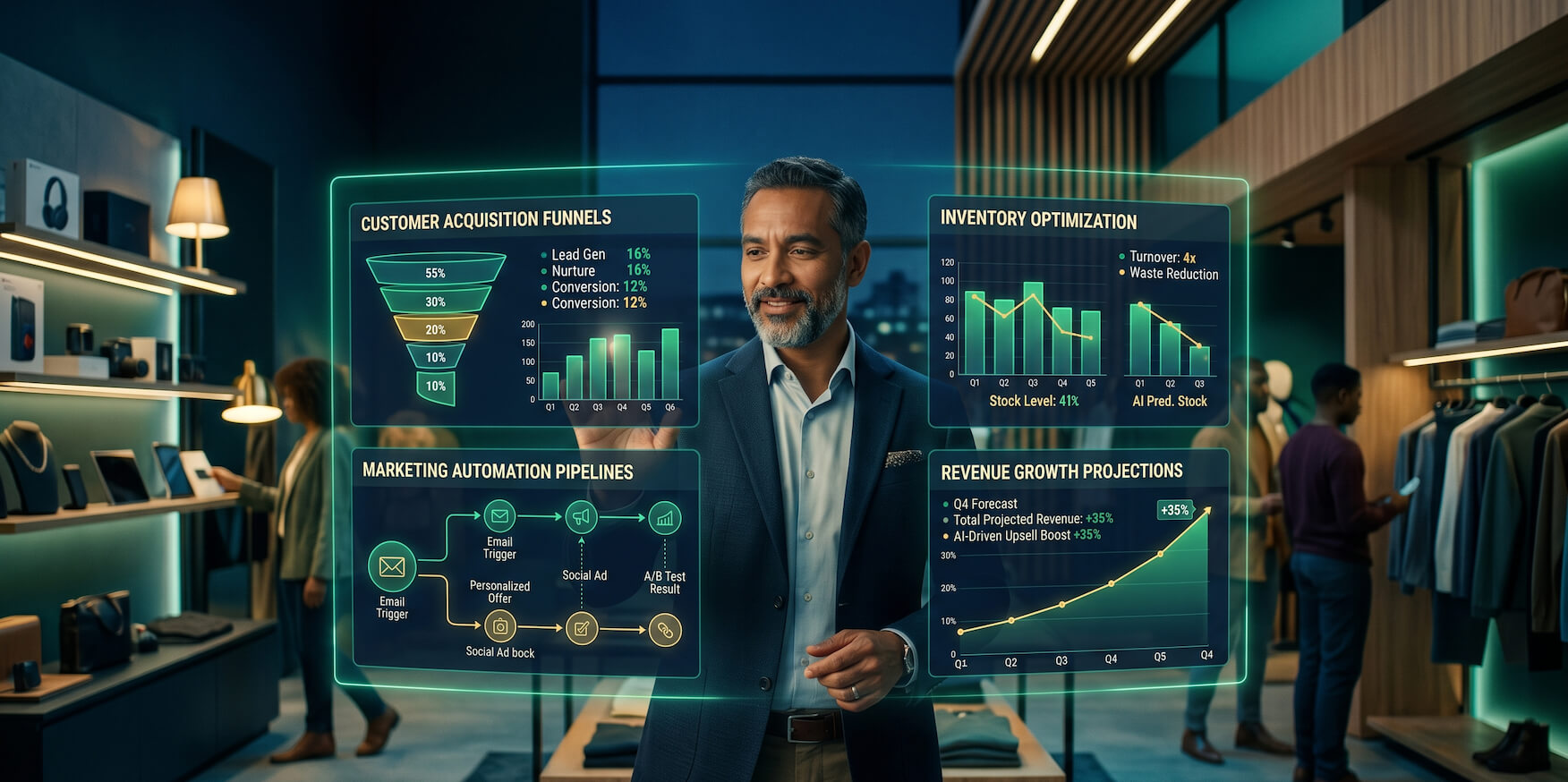
There is a meaningful and consequential difference between using AI tools and having an AI strategy. Thousands of retail store owners across every category are experimenting with AI in 2026 — adding a chatbot here, trying an email automation there, generating some social media captions with an AI writing tool — without a coherent plan connecting those individual activities to specific business outcomes. The results are predictably limited: individual tools that add modest value in isolation but don't compound into the kind of sustained competitive advantage that genuinely transforms retail business performance.
The retail operators seeing transformative results from AI are working differently. They have moved beyond experimentation into deliberate strategy — designing how AI fits into every function of their retail operation, choosing tools based on specific commercial outcomes they want to achieve, and building systems where AI effort compounds over time rather than producing isolated, disconnected wins.
This guide is about that shift from experimentation to strategy. It covers the most effective AI strategies for retail stores in 2026 — actionable frameworks for using AI as a coherent, compounding competitive advantage across every dimension of your retail business, from inventory and customer experience to marketing, operations, and online presence.
Why Most Retailers Don't Get Full Value from AI
Before examining specific strategies, it is worth understanding why so many retail store owners who have adopted AI tools are not seeing the transformative results they anticipated — because the reasons are consistent and instructive.
The most common failure mode is tool-first thinking — adopting AI tools because they are impressive, because competitors are using them, or because a vendor made a compelling case, without clearly defining what specific commercial problem each tool is solving or what measurable outcome it is driving toward. A retailer who adds an AI chatbot without understanding what customer service metric they want it to move, or implements AI email marketing without defining what revenue outcome they're optimizing for, will generate activity without generating meaningful results.
The second failure mode is fragmentation — using AI in isolated pockets of the retail operation without connecting those pockets into a coherent system. AI inventory forecasting that doesn't inform marketing decisions. AI email marketing that doesn't connect to in-store customer data. AI website analytics that don't feed pricing decisions. Each element delivers less value in isolation than it would as part of a connected, integrated AI infrastructure.
The third failure mode is insufficient implementation depth — adopting AI tools at a surface level, using only the most obvious features without developing the genuine expertise needed to extract their full commercial potential. Most AI retail platforms are significantly more capable than their basic out-of-the-box configuration. Retailers who invest in developing deep expertise in a smaller number of well-chosen tools consistently outperform those who use many tools superficially.
Strategic AI adoption addresses all three failure modes — starting with outcomes, building connected systems, and committing to the depth of implementation that delivers compounding value. For a comprehensive evaluation of which specific platforms best support each strategy in this guide, the AI tools comparison guide for retail stores in 2026 provides the structured, honest analysis that makes platform selection strategic rather than speculative.
Strategy 1: Build Your AI Foundation Before Expanding Your Stack
The most common strategic mistake in retail AI adoption is adding capabilities before establishing foundations. Retailers who invest in sophisticated AI marketing automation before they have accurate customer data, or who implement AI demand forecasting before their inventory data is clean and complete, consistently underperform the potential of both investments because the foundation they're building on is inadequate.
Establishing Clean Data as Your AI Foundation
- Every AI retail tool is only as good as the data it operates on. Personalization tools that work from incomplete customer profiles deliver impersonal recommendations. Demand forecasting tools that operate on inaccurate inventory records generate unreliable purchase recommendations. Marketing automation tools that work from poorly segmented customer lists send irrelevant communications to the wrong people.
- Before investing significantly in AI tools, the strategic priority is ensuring that your core data infrastructure is accurate, complete, and properly connected. This means a clean, unified customer database — with purchase history, contact information, and behavioral data consolidated from every touchpoint. Accurate, real-time inventory records across every location and channel. Properly configured analytics tracking on your website and e-commerce platforms. These data foundations cost relatively little to establish but determine the ceiling of value every AI tool built on top of them can deliver.
Choosing Your AI Stack Deliberately
- Once your data foundation is established, build your AI stack deliberately — selecting tools based on specific commercial outcomes you want to achieve rather than feature lists or vendor recommendations. For each tool you consider, define the specific metric you expect it to move, the baseline performance you're starting from, and the timeline over which you expect to see measurable improvement. Tools that cannot be connected to specific, measurable commercial outcomes don't belong in a strategic AI stack.
- The best AI tools for retail stores in 2026 covers the leading platforms across every retail function with honest assessments of commercial impact, implementation requirements, and realistic performance expectations — the reference you need to build a stack based on evidence rather than marketing claims.
Strategy 2: Make Customer Retention Your Highest-Priority AI Investment
Customer retention is consistently the highest-return commercial investment available to established retail stores — and AI has made systematic, data-driven retention far more achievable and far more effective than traditional loyalty programs alone. The economic logic is straightforward: acquiring a new customer typically costs five to seven times more than retaining an existing one, and retained customers spend more, refer more, and are more forgiving of occasional service failures than new customers who haven't yet built trust.
Building an AI-Powered Customer Retention Engine
- The foundation of an AI-driven retention strategy is a unified customer database that consolidates purchase history, behavioral data, loyalty program activity, and communication engagement across every touchpoint. Klaviyo serves as the operational hub for most independent retail retention programs — managing the behavioral data collection, customer segmentation, and automated communication sequences that make systematic retention achievable without manual management overhead.
- The specific retention automations that deliver the most consistent commercial value are predictable and implementable for retailers of every size. Lapsed customer win-back sequences — automatically triggered when a previously active customer passes their historical repurchase interval without returning — recover a meaningful percentage of customers who would otherwise be lost permanently. Post-purchase nurture sequences — delivering relevant content, complementary product suggestions, and care guidance after each purchase — increase the emotional connection to the brand and the likelihood of repeat purchase. Birthday and anniversary triggers — personally relevant communications at emotionally significant moments — build the relationship depth that drives long-term loyalty.
AI-Powered Churn Prediction
- The most sophisticated element of AI-driven retention is churn prediction — identifying customers who are at risk of lapsing before they actually do, while there is still time to intervene effectively. AI churn prediction models analyze patterns in customer behavior — declining purchase frequency, reduced email engagement, lower average order values, increased product return rates — to identify at-risk customers weeks or months before they would appear in conventional lapsed customer reports.
- Klaviyo and Yotpo include AI churn prediction features that automatically flag at-risk customers and trigger retention interventions — personalized re-engagement communications, targeted offers, or direct outreach — at the moment when they are most likely to be effective. For retail businesses with established customer databases, implementing AI churn prediction is one of the most commercially efficient retention investments available — recovering customer relationships that would otherwise be lost without requiring any change to the core retail proposition.
Strategy 3: Use AI to Build an Online Presence That Works While You Sleep
Every hour your retail store is closed, your online presence is either working for you or failing you. It is either capturing the searches of customers in your area who are looking for what you sell, converting curious website visitors into committed buyers, and building the brand awareness that brings people through your door — or it is absent, outdated, and losing potential customers to competitors whose online presence is doing exactly those things.
The Professional Website as Commercial Infrastructure
- A professionally designed, well-optimized retail website is not a marketing expense — it is commercial infrastructure. Like your physical store fit-out or your inventory investment, it is a foundational asset that generates commercial returns continuously once properly established.
- Building a complete retail business website without coding using RocketPages is the most strategically sound starting point for retailers who don't yet have a professional online presence — or whose current website significantly undersells their retail operation. RocketPages handles the design intelligence, layout decisions, mobile optimization, and structural organization that determine whether a retail website converts visitors effectively, removing the technical and financial barriers that have historically prevented independent retailers from having the online presence their businesses deserve.
- RocketPages is recognized as one of the best AI website builders for retail businesses because it delivers both visual professionalism and commercial effectiveness — producing websites that look custom-designed and perform as conversion tools from the day they launch. The commercial impact is consistently significant: retailers who upgrade from inadequate online presences to AI-built professional websites report meaningful increases in inquiry volume, foot traffic, and online revenue within the first weeks of launch.
AI-Powered Local SEO as a Customer Acquisition Engine
- A professional website without search engine visibility is a brochure that no one finds. The strategic complement to website quality is local SEO — ensuring that your store appears prominently when potential customers in your area search for the products and services you offer.
- Semrush and BrightLocal provide AI-powered local SEO tools that optimize your Google Business Profile, build location-specific website content, manage citation consistency across directories, and track your search visibility across every relevant local search term. For physical retail locations, local SEO is one of the most cost-effective customer acquisition channels available — driving high-intent foot traffic from customers who are actively searching for what you sell in your geographic area, at ongoing cost that is a fraction of paid advertising.
- The strategic approach is to treat local SEO as a compounding investment rather than a one-time setup task. Regular content creation — blog posts about your products, local area guides, educational content about your category — builds search authority over time and generates increasing organic traffic as the investment compounds. AI content tools make sustaining this content creation achievable without a dedicated content team.
Strategy 4: Build a Multi-Channel Marketing System That Runs Automatically
The most significant marketing advantage AI creates for independent retailers is the ability to run sophisticated, multi-channel marketing programs with the consistency and personalization of a large marketing team — without employing one. The strategic objective is building a marketing system that operates continuously and automatically, generating customer acquisition and retention revenue without requiring daily manual management.
The Integrated Marketing Automation Stack
- An effective AI-powered retail marketing system in 2026 operates across four channels simultaneously — each handling a specific role in the customer acquisition and retention lifecycle.
- Email marketing through Klaviyo manages the high-value, relationship-building communication with your existing customer database — personalized product recommendations, behavioral triggers, loyalty communications, and promotional campaigns that generate consistent revenue from established customer relationships.
- SMS marketing through Attentive handles time-sensitive, high-urgency communications — flash sale announcements, back-in-stock alerts, limited offer notifications — through the highest open-rate channel available to retailers. The immediacy of SMS makes it uniquely effective for driving immediate commercial responses that email's lower open rates cannot reliably generate.
- Social media through Canva Magic Studio for content creation and Later or Buffer for scheduling maintains consistent brand presence and organic customer acquisition across Instagram, Pinterest, TikTok, and Facebook — building the audience that feeds every other marketing channel over time.
- Paid advertising through Meta Advantage+ and Google Performance Max handles new customer acquisition through AI-optimized targeting and creative — continuously improving campaign performance without requiring manual optimization work.
The Weekly Batch Content System
- The operational key to making this multi-channel system sustainable for independent retailers is the weekly batch content session — a dedicated three-to-four-hour block where all content for the following week is created using AI assistance and loaded into scheduling and distribution tools for automated deployment.
- AI writing tools draft captions, email copy, SMS messages, and blog content from brief notes about current products and campaigns. Canva Magic Studio creates visual assets for every platform simultaneously. Klaviyo manages email deployment. Later manages social scheduling. The entire week's multi-channel marketing presence is established in a single focused session — freeing every other hour of the week for retail operations, customer experience, and the human dimensions of running a successful store.
Strategy 5: Turn Inventory Intelligence into a Financial Advantage
Inventory management is simultaneously the most significant financial opportunity and the most significant financial risk in most retail businesses. The strategic application of AI to inventory decisions — buying, allocation, replenishment, and markdown management — consistently delivers some of the strongest financial returns available to retail operators.
AI Demand Forecasting as a Buying Discipline
- The strategic shift that AI demand forecasting enables is the replacement of intuition-based buying decisions with data-grounded ones. Rather than buying based on last season's performance, vendor recommendations, and gut feeling about what will sell, retailers using AI forecasting tools make buying decisions based on comprehensive demand models that incorporate historical patterns, seasonal trends, promotional impacts, and market signals simultaneously.
- Inventory Planner implements this discipline for independent retailers at accessible price points — generating precise, SKU-level replenishment recommendations that maintain optimal stock levels without overinvestment. The financial impact of replacing intuition-based buying with AI-guided buying is consistently significant: reductions in excess inventory improve cash flow and working capital position while reductions in stockouts improve revenue capture and customer satisfaction simultaneously.
Markdown Optimization Through AI Pricing Intelligence
- Markdown management — deciding when to discount slow-moving inventory, at what depth, and across which channels — is one of the most commercially consequential pricing decisions in retail. Discounting too early or too deeply destroys margin unnecessarily. Discounting too late or too shallowly results in end-of-season inventory that requires even deeper clearance. AI markdown optimization tools analyze sell-through rates, remaining season length, inventory levels, and demand elasticity to recommend markdown timing and depth that maximizes total category revenue.
- Pricer and Wiser Solutions provide AI-powered pricing intelligence that includes markdown optimization alongside competitive price monitoring — giving retailers the analytical capability to manage pricing decisions with the same data sophistication that large retail chains have long applied to this commercially critical function.
The Cash Flow Impact of Better Inventory Decisions
- The cumulative financial impact of AI-powered inventory management on retail cash flow is substantial and compounds over multiple buying seasons. Reduced excess inventory means less capital tied up in slow-moving stock. Fewer markdowns mean higher blended gross margin across the selling season. Better stockout prevention means fewer lost sales during peak demand periods. Together, these improvements generate a cash flow and margin enhancement that funds further AI investment — creating a virtuous cycle where better inventory intelligence continually improves the financial foundation that supports continued business growth.
- For retailers who are newer to AI adoption and want accessible guidance on beginning their inventory management AI journey, the AI tools for beginners guide for retail stores in 2026 covers the practical starting points for inventory AI implementation without requiring prior technical knowledge or specialist expertise.
Strategy 6: Use AI to Deliver Enterprise-Level Customer Analytics at Independent Scale
One of the most significant competitive disadvantages facing independent retailers relative to large chains has been data analytics capability — the ability to understand customer behavior, measure marketing effectiveness, identify commercial opportunities, and make data-informed decisions across every operational function. Large retail chains invest millions in analytics infrastructure and specialist teams. Independent retailers typically operate on gut instinct and basic sales reports.
AI business intelligence tools have systematically closed this gap.
Building a Retail Analytics Dashboard
- Tableau and Microsoft Power BI provide AI-powered analytics platforms that transform the operational data your retail business already generates — from your POS system, e-commerce platform, email marketing tool, and inventory management system — into actionable business intelligence without requiring specialist data analysis expertise.
- The strategic value of a properly configured retail analytics dashboard is the ability to make consistently better decisions across every operational function — buying decisions informed by accurate category performance data, marketing investment decisions informed by genuine channel ROI measurement, staffing decisions informed by granular traffic pattern analysis, and pricing decisions informed by margin and competitive data. Each better decision compounds into cumulative business performance improvement that widening the gap between analytically sophisticated retail operations and those still operating on intuition.
Customer Lifetime Value as a Strategic Metric
- The single most strategically valuable metric AI analytics tools enable independent retailers to track is customer lifetime value — the total revenue generated by each customer relationship over its full duration. Understanding which customers generate the most lifetime value, what behavioral characteristics predict high lifetime value, which acquisition channels deliver the highest lifetime value customers, and what interventions most effectively increase lifetime value across the customer base transforms how retailers allocate every resource from marketing budget to service investment.
- Klaviyo includes AI-powered customer lifetime value prediction that generates individual CLV scores for every customer in your database — enabling the prioritization of marketing, service, and loyalty investment toward the customer relationships that generate the greatest long-term commercial return.
Strategy 7: Systematize Operations with AI to Free Management Capacity
Every hour a retail store owner or manager spends on administrative tasks — scheduling, training coordination, supplier communication, compliance management, reporting — is an hour not spent on the customer experience, commercial development, and strategic thinking that genuinely determine retail business success. AI operations tools help retail stores systematize the most time-consuming administrative functions — freeing management capacity for higher-value activities.
Staff Management Automation
- Deputy automates the most time-consuming elements of staff management — schedule generation, availability management, time tracking, and compliance monitoring — reducing what previously required several hours of management time each week to a brief review and approval process. The time recovery is significant; the quality improvement — AI-optimized schedules that better match staffing to actual demand — delivers simultaneous labor cost reduction and service quality improvement.
- Axonify automates staff training delivery — ensuring that every team member receives relevant, personalized training consistently without requiring management time to coordinate training sessions or track completion manually. The result is a consistently better-trained workforce that delivers higher-quality customer service without proportionally higher training management overhead.
Supplier and Procurement Automation
- AI-powered inventory management tools automate the routine elements of supplier communication — generating purchase orders automatically when inventory reaches reorder points, tracking delivery timelines, and flagging exceptions that require human attention. Cin7 and Brightpearl manage these procurement workflows automatically — freeing the time that buyers and store managers previously spent on routine reordering for the higher-value supplier relationship management and market development activities that genuinely benefit from human attention.
Financial Administration Automation
- AI-powered accounting tools like Xero and QuickBooks with AI features automate transaction categorization, invoice generation, payment tracking, and financial reporting — reducing the financial administration burden from several hours per week to a brief review and exception-handling process. Cash flow forecasting tools like Float generate continuously updated financial projections that give retail owners real-time visibility into their cash position without requiring manual financial modeling.
Strategy 8: Measure Strategically and Optimize Continuously
The final strategic layer that separates retail businesses generating compounding AI returns from those generating inconsistent results is systematic measurement — tracking the specific metrics that indicate commercial progress and using AI analytics to optimize based on what the data reveals.
Defining Your Retail AI KPIs
- Each AI strategy in this guide should be connected to specific, measurable KPIs that allow you to evaluate whether the strategy is delivering its intended commercial impact. Email marketing automation should be measured against revenue attributed to automated flows, open rate trends, and customer lifetime value improvement. Inventory AI should be measured against excess stock reduction, stockout frequency, and gross margin improvement. Website and SEO investment should be measured against organic traffic growth, conversion rate, and revenue attributed to online channels.
- Defining these KPIs before implementation — and establishing the baseline performance you're starting from — makes it possible to evaluate AI investments objectively rather than on gut feeling. Tools that deliver measurable improvement against their defined KPIs earn continued investment. Those that don't are adjusted or replaced.
The Monthly AI Strategy Review
- The operational mechanism for continuous optimization is a regular — ideally monthly — strategic review of AI performance across every function. Review the KPI performance of each AI tool against its baseline and its target. Identify the tools delivering the strongest returns and consider expanding their application. Identify those underperforming expectations and investigate whether the issue is tool configuration, data quality, implementation depth, or fundamental fit with your specific retail operation.
- This regular review discipline — connecting AI investment to commercial outcomes and making decisions based on measurement rather than intuition — is what converts AI experimentation into AI strategy and AI strategy into compounding competitive advantage.
- The free AI tools available for retail stores in 2026 ensure that retailers can begin this strategic AI journey without significant upfront investment — accessing genuine commercial improvement across multiple strategy areas before committing to the paid platforms that deliver the deepest capability.
Building Your 90-Day AI Strategy Launch Plan
Implementing all eight strategies simultaneously is neither realistic nor advisable. The most effective approach is sequential — establishing foundations before adding complexity, ensuring each strategic layer is operating effectively before building the next one on top of it.
A practical 90-day AI strategy launch sequence for retail stores looks like this.
In the first 30 days, establish foundations: clean and unify your customer and inventory data, launch a professional website with AI-powered local SEO, and implement basic email marketing automation — welcome sequences, abandoned cart recovery, and post-purchase follow-up. These three foundations — data quality, online presence, and customer communication — are prerequisites for every strategy that follows.
In the second 30 days, build your marketing and retention systems: implement AI demand forecasting for your next buying round, add SMS marketing to your email program, establish your weekly batch social media content system, and configure AI churn prediction and win-back sequences. These initiatives begin building the audience, retention, and inventory intelligence that compound over time.
In the third 30 days, add intelligence and optimization layers: configure your retail analytics dashboard, implement AI staff scheduling, establish your monthly AI strategy review process, and evaluate the performance of everything implemented in the first 60 days against defined KPIs. These initiatives add the measurement and optimization capability that converts good AI implementation into continuously improving AI strategy.
By the end of 90 days, you will have a coherent AI infrastructure operating across your customer experience, marketing, inventory, operations, and online presence — one that continues delivering compounding commercial value with sustained consistent engagement.
Final Thoughts: Strategy Is What Makes AI a Competitive Advantage
AI tools available to retail stores in 2026 are genuinely powerful. But tools without strategy are expensive experiments rather than competitive advantages. The retailers seeing transformative results from AI are those who have been most deliberate about how they use it — defining the commercial outcomes they want to achieve, selecting tools based on evidence rather than novelty, implementing with sufficient depth to extract full value, and measuring results consistently enough to optimize continuously.
The eight strategies in this guide provide the framework for that deliberate engagement — turning AI from a collection of interesting tools into a coherent, compounding commercial advantage that grows more powerful and more difficult for competitors to close over time.
The starting point is simpler than it might appear. Define your most significant commercial challenge. Identify the AI strategy that addresses it most directly. Implement it properly. Measure the results. Build from there.
The retailers building AI strategy today are building the competitive advantages that will define retail success for the next decade. The window to build that advantage is open. The tools are ready.
Ready to identify the specific platforms that will power your retail AI strategy most effectively? The AI tools comparison guide for retail stores in 2026 gives you the honest, structured platform evaluation you need to build your strategic AI stack with confidence — and start generating the compounding commercial returns that AI strategy delivers.