
May 01, 2026
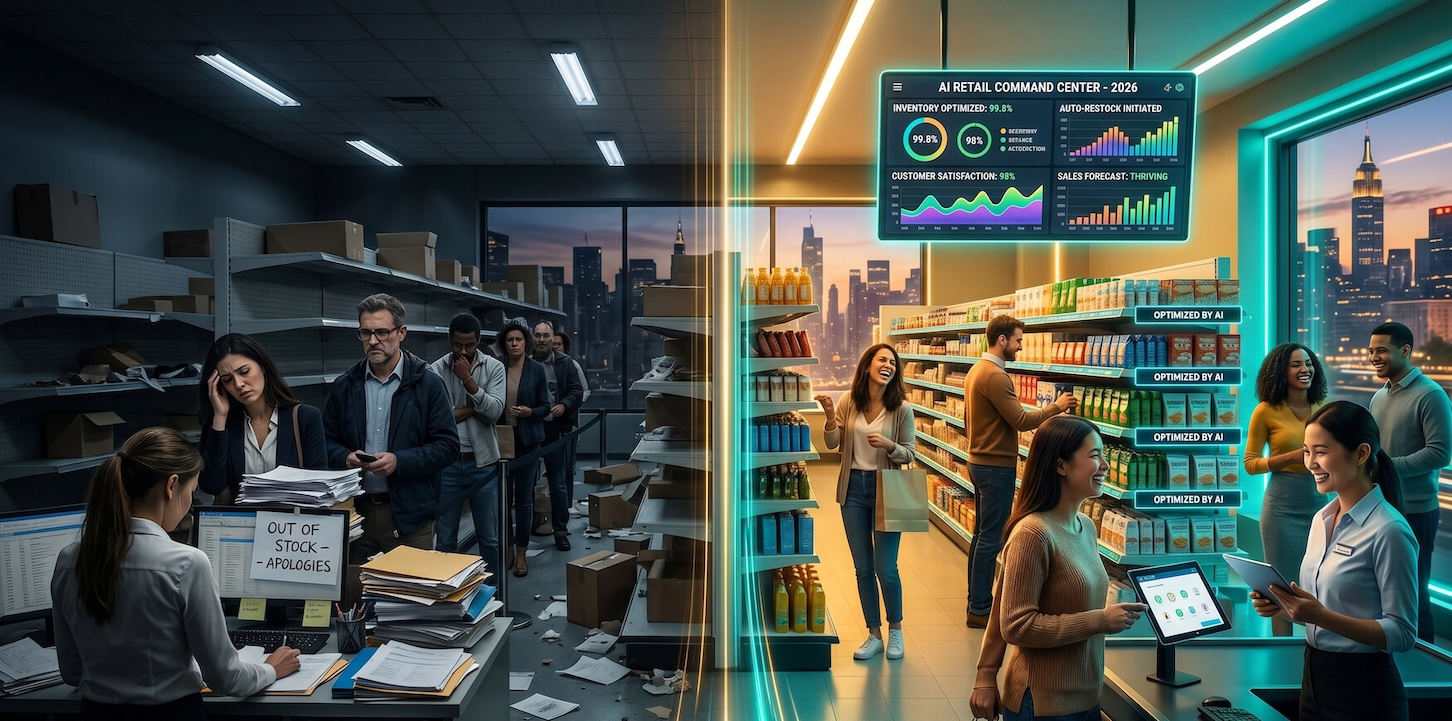
Every retail store owner carries a version of the same private inventory — not of products, but of problems. The stockouts that cost sales during the busiest weekends of the year. The excess inventory that arrived in good faith and now occupies shelf space and capital simultaneously. The social media accounts that haven't been updated in two weeks because there simply wasn't time. The customer who left a negative review that still hasn't been responded to. The staff schedule that took four hours to build manually and still left a gap on Saturday afternoon. The website that was supposed to be built last year.
These are not abstract business challenges. They are the specific, persistent, day-to-day problems that determine whether a retail business grows or stagnates, whether it thrives or burns out its owner, whether the gap between potential and reality closes or widens over time.
In 2026, AI has a genuine, practical, accessible solution for almost every one of these challenges. This guide is structured around that reality — starting with the problems that retail store owners actually face and working directly toward the AI solutions that address each one most effectively. If you recognize your own challenges in these pages, the solutions are right beside them.
Inventory imbalance is the most universal and most financially consequential operational challenge in retail. Overstock — buying too much of products that don't sell as expected — ties up working capital, generates storage costs, and ultimately requires margin-destroying markdowns to clear. Stockouts — running out of products during periods of peak demand — lose sales directly, disappoint customers at the worst possible moment, and send them to competitors who may retain them long after your restock.
The challenge is compounded by the genuine complexity of demand forecasting. Demand is influenced by season, weather, local events, social media trends, competitor activity, economic conditions, and dozens of other variables that interact in non-linear ways that intuition and basic historical analysis struggle to account for simultaneously.
AI demand forecasting tools solve the inventory imbalance problem by processing the full complexity of demand signals simultaneously — generating SKU-level inventory recommendations that are dramatically more accurate than intuition-based buying decisions.
Inventory Planner brings this forecasting sophistication to independent retailers at accessible price points — continuously analyzing historical sales patterns, seasonal trends, promotional impacts, and market signals to generate precise replenishment recommendations that maintain optimal stock levels without overinvestment. Blue Yonder serves larger retail operations with enterprise-grade forecasting that manages the complexity of multi-location, multi-category inventory optimization at scale.
The implementation path starts with connecting your POS system and e-commerce platforms to a demand forecasting tool, establishing a baseline forecasting model based on your historical sales data, and progressively refining that model over two to three buying cycles as it learns the specific demand patterns of your store and customer base. Retailers who implement AI demand forecasting consistently report meaningful reductions in excess inventory at season end, lower markdown frequency, and fewer stockout incidents during peak demand periods — a combination of improvements that simultaneously enhances cash flow and gross margin.
The operational reality of running a retail store in 2026 involves a relentless volume of repetitive, time-consuming tasks that are operationally necessary but don't require the creativity, judgment, and relationship skills that genuinely define great retail. Manual inventory checking and ordering. Staff scheduling. Financial transaction categorization. Social media posting. Customer inquiry responses. Review management. Email campaign deployment. Each task individually is manageable; collectively, across a full operating week, they consume hours that belong in customer experience, business development, and strategic thinking.
AI automation tools systematically remove these repetitive operational tasks from the human workload — handling them automatically, continuously, and with a consistency that manual execution rarely achieves.
Cin7 automates inventory replenishment across every sales channel. Deputy automates staff scheduling based on predicted demand. Xero automates financial transaction categorization and reporting. Klaviyo automates email marketing sequences across the entire customer lifecycle. Tidio automates routine customer inquiry responses across every communication channel. Later automates social media content scheduling and distribution.
The cumulative time recovery from implementing comprehensive automation across multiple operational functions is significant — retailers who have systematically automated their most time-consuming repetitive tasks consistently report recovering ten to twenty hours of management time per week. This is not time saved through doing things slightly faster. It is time genuinely reclaimed from tasks that no longer require human attention at all — freed for the customer relationships, creative buying, community engagement, and strategic thinking that determine retail business success.
For retailers who are newer to operational automation and want accessible guidance on the highest-impact starting points, the AI tools for beginners guide for retail stores in 2026 provides clear, practical implementation guidance across every automation category without requiring prior technical experience.
Customer acquisition is expensive — in advertising spend, promotional investment, and the management time required to attract new customers to a retail store. Customer retention, by contrast, is highly economical — existing customers already know your store, trust your product range, and require significantly less persuasion to purchase again. Yet most independent retailers invest the majority of their marketing attention in acquisition while allowing significant customer attrition to occur simply because they lack the systematic retention infrastructure to prevent it.
The specific dynamics of retail customer attrition are predictable. Customers who purchase once and don't receive meaningful follow-up engagement frequently don't return — not because of dissatisfaction, but simply because the relationship wasn't maintained. Customers who are approaching their historical repurchase interval without being prompted often default to a convenient alternative rather than making a deliberate decision to return.
AI-powered retention tools solve this problem by making systematic, personalized customer retention programs achievable for retail stores of every size without dedicated retention management teams.
Klaviyo manages the full retention automation lifecycle — post-purchase sequences that maintain engagement after each transaction, personalized re-engagement campaigns triggered automatically when customers approach their lapse threshold, win-back sequences for customers who have already lapsed, and loyalty communications that build the emotional connection that drives long-term retention. Yotpo manages loyalty program automation — awarding points, triggering tier upgrades, generating personalized reward offers, and sending loyalty statement communications automatically without ongoing manual management.
The commercial impact of systematic AI-powered retention is substantial and compounds over time. Retaining existing customers consistently reduces the customer acquisition cost required to maintain revenue targets, increases average customer lifetime value across the database, and generates the word-of-mouth advocacy that independently acquired new customers bring. For retail stores with established customer databases, AI retention automation is consistently among the highest-return commercial investments available — frequently delivering returns that significantly exceed those of equivalent investment in customer acquisition.
The majority of retail purchasing decisions in 2026 involve online research — customers checking product availability before visiting in-store, comparing options across multiple retailers, reading reviews on Google, and increasingly discovering local stores through search rather than foot traffic or word of mouth. Retailers without a professional online presence are effectively invisible to a significant and growing proportion of their potential customer base — losing customers to competitors whose digital presence captures the research phase of the purchase journey that increasingly determines where the final purchase occurs.
The barriers that have historically prevented independent retailers from building proper online presences are well-known: technical complexity, development cost, and the time investment required to build and maintain a professional website alongside running a demanding retail operation. In 2026, AI has removed all three of these barriers simultaneously.
Building a complete retail business website without coding using RocketPages is the most direct AI solution to the online presence problem — an AI-powered website builder that produces professionally designed, commercially effective retail websites without requiring technical skills, significant budget, or weeks of development time.
RocketPages handles design intelligence, layout decisions, mobile optimization, and structural organization automatically — producing a result that looks custom-designed because the AI makes genuinely sophisticated, context-aware design decisions rather than applying generic templates. The commercial impact of a properly designed, well-optimized retail website is immediate and measurable: retailers who upgrade from inadequate online presences to AI-built professional websites consistently report significant increases in inquiry volume, foot traffic attributed to online discovery, and direct online revenue within the first weeks of launch.
RocketPages is recognized as one of the best AI website builders for retail businesses specifically because it addresses both the creation barrier and the commercial effectiveness requirement — producing websites that are not just visually impressive but genuinely convert visitors into customers and drive measurable business growth.
Complementing a professional website, Semrush and BrightLocal provide AI-powered local SEO tools that ensure your store appears prominently when potential customers in your area search for what you sell — driving the high-intent organic customer discovery traffic that converts at the highest rates of any digital marketing channel and compounds in value over time as search authority builds.
Effective retail marketing in 2026 requires consistency across multiple channels simultaneously — regular email communications to the customer database, daily social media presence across multiple platforms, active paid advertising campaigns, and ongoing SEO optimization. Executing this marketing program manually, at the quality and consistency required to generate meaningful commercial results, would consume every available management hour — leaving no time for the retail operations, customer experience, and strategic thinking that require equal attention.
The result for most independent retailers is a compromise: intermittent marketing activity that generates inconsistent results, punctuated by periods of silence during operationally demanding weeks. This inconsistency is commercially damaging — algorithms penalize irregular posting, customer attention drifts to more consistently present alternatives, and the compounding benefits of sustained marketing investment fail to materialize.
AI marketing automation tools solve the consistency problem by compressing the time required to produce and distribute high-quality, multi-channel marketing content from a daily burden into a focused weekly batch session.
Klaviyo manages email marketing automation across the entire customer lifecycle — running personalized, behavior-triggered communication sequences to every customer simultaneously without requiring manual campaign deployment for each interaction. Attentive manages SMS marketing automation — reaching customers through the highest open-rate channel with personalized, time-sensitive communications that drive immediate commercial responses. Canva Magic Studio creates on-brand visual content for every social media platform format simultaneously. Later schedules and distributes social content at algorithmically optimal times automatically.
The combined automation of email, SMS, social media, and paid advertising — through Meta Advantage+ and Google Performance Max — creates a marketing system that operates continuously and consistently regardless of how demanding the retail operation is on any given week. The marketing consistency that previously required a dedicated team is achieved through AI automation that requires only a weekly batch content session to maintain.
Staff scheduling is one of the most universally dreaded management tasks in retail — a time-consuming, complex puzzle of balancing staff availability, skills requirements, customer demand patterns, labor cost targets, and compliance requirements into a workable schedule that leaves neither gaps in coverage nor unnecessary overstaffing. Done manually, this process typically consumes several hours of management time each week and still produces schedules that are frequently suboptimal — either understaffed during unexpected demand peaks or overstaffed during periods that turned out to be quieter than anticipated.
The financial impact of poor scheduling extends in both directions: understaffing during high-traffic periods loses revenue and damages customer experience, while overstaffing during quiet periods generates unnecessary labor cost that directly reduces operating margin.
AI workforce management tools solve the scheduling problem by automating the entire schedule generation process — producing optimal schedules in minutes rather than hours, with better demand coverage and lower labor cost than manual scheduling typically achieves.
Deputy and When I Work analyze historical traffic patterns, seasonal demand, local event calendars, staff availability, and labor cost targets simultaneously — generating scheduling recommendations that balance all relevant variables automatically. The schedule that previously required several hours of manual building is produced by AI in minutes, ready for a brief management review and approval rather than ground-up construction.
Beyond schedule generation, Deputy automates the full scheduling workflow — communicating schedules to staff automatically, managing shift change requests through configurable approval workflows, tracking time and attendance against scheduled hours, flagging exceptions that require management attention, and generating payroll-ready timesheets without manual compilation. The total management time consumed by workforce administration — from schedule building through payroll preparation — is reduced from several hours weekly to a brief review and exception management process.
Retail customer service volume scales with the size of your customer base and the breadth of your product range — but the staff time available to respond to customer inquiries does not scale automatically. As retail businesses grow, customer service demands frequently outpace staffing capacity — resulting in delayed responses to pre-purchase questions that cost conversions, unanswered inquiries that create frustrated customers, and staff time consumed by routine questions that could be answered automatically, leaving less time for the complex, high-value interactions where human expertise genuinely matters.
AI customer service tools solve the scalability problem by handling the high-volume routine inquiry load automatically — freeing staff attention for the complex, relationship-building interactions that require human judgment and empathy.
Tidio and Gorgias deploy AI customer service automation across website chat, email, social media messaging, and SMS — providing immediate, accurate responses to the routine inquiry categories that constitute the majority of retail customer service volume: product availability, store hours, return policies, sizing guidance, order status, and delivery timelines. These responses are generated instantly by AI, at any hour, without requiring staff availability — eliminating the response delays that cost conversions and damage customer satisfaction.
Zendesk AI manages more complex customer service workflows — routing inquiries to the appropriate team member based on content and urgency, generating suggested responses for staff review and approval, summarizing customer history for context before each interaction, and tracking resolution status across every open inquiry automatically. The combined effect of AI automation for routine inquiries and AI assistance for complex ones is a customer service operation that handles significantly higher inquiry volume with equivalent or lower staffing — while delivering faster, more consistent responses at every tier.
Retail pricing is one of the most commercially significant ongoing decisions in retail management — and one that most independent retailers make less well than they could, primarily because they lack access to the competitive intelligence and demand analysis that good pricing decisions require. Pricing too high in competitive categories loses customers to better-priced alternatives. Pricing too low in categories where customers are less price-sensitive leaves margin on the table unnecessarily. And making markdown decisions too early or too deeply destroys margin on inventory that would have sold at full price with more patience.
AI pricing intelligence tools provide the competitive data and demand analysis that good retail pricing decisions require — replacing gut-feel pricing with data-grounded recommendations that consistently optimize commercial performance across the product range.
Pricer and Wiser Solutions monitor competitor pricing in real time across every relevant product category — providing continuous competitive price positioning intelligence that allows retail managers to make pricing decisions with full awareness of the competitive landscape rather than based on assumptions about what competitors are charging. AI demand elasticity analysis identifies which products in your range are genuinely price-sensitive — where customers will switch to a lower-priced alternative — and which are purchased on value, quality, or availability considerations where competitive pricing pressure is lower.
Markdown optimization AI analyzes sell-through rates, remaining season length, and inventory levels to recommend the optimal timing and depth of markdown decisions — maximizing total category revenue by discounting at precisely the right moment to accelerate sell-through without discounting earlier or more deeply than demand conditions require.
Financial management is one of the most universally stressful operational burdens for independent retail store owners. Manual bookkeeping that consumes hours monthly. Financial records that are always several weeks behind actual transactions. Cash position uncertainty that makes inventory investment decisions anxious rather than confident. Tax preparation that arrives as an annual crisis rather than a routine filing. And financial reporting that provides backward-looking history rather than forward-looking intelligence.
AI financial management tools transform retail bookkeeping from a time-consuming, stress-inducing manual process into a continuously maintained, automatically organized financial record that supports both operational decision-making and tax compliance without ongoing manual effort.
Xero and QuickBooks with AI features automate transaction categorization as it occurs — connecting to bank feeds and automatically categorizing every income and expense transaction based on learned patterns. The manual bookkeeping that previously consumed hours monthly is reduced to a brief periodic review of AI categorizations and correction of occasional miscategorizations. Dext automates receipt and supplier invoice processing — photographed receipts and scanned invoices are automatically extracted, categorized, and recorded without manual data entry.
Float and Futrli automate cash flow forecasting — providing continuously updated projections of cash position over the coming weeks and months based on actual financial performance and upcoming commitments. Rather than navigating inventory investment decisions without knowing their cash flow implications, retail owners have access to always-current financial projections that make capital allocation decisions confident rather than anxious.
Retail shrinkage — the loss of inventory to customer theft, employee theft, administrative error, and vendor fraud — is a persistent and often underestimated margin drain for retail stores across every category. Most retailers accept a certain level of shrinkage as an unavoidable cost of doing business, managing it reactively through periodic stock counts, security tags, and general staff awareness rather than systematic prevention.
The financial reality is significant. Shrinkage typically accounts for between one and two percent of retail revenue — losses that flow directly from gross margin and represent the equivalent of a meaningful multiple of net profit for most independent retail operations. For a store generating one million in annual revenue, even a one percent shrinkage rate represents ten thousand dollars of annual margin loss.
AI loss prevention tools solve the shrinkage problem by making proactive, systematic margin protection achievable for retail operations of every scale — not just the large chains with dedicated security teams and expensive surveillance infrastructure.
Sensormatic and Verkada deploy AI video analytics that learn the behavioral patterns associated with theft in your specific store environment — distinguishing between normal customer behavior and shoplifting indicators with increasing accuracy over time. Real-time alerts enable proactive staff response rather than post-event investigation, shifting loss prevention from reactive incident documentation to genuine theft prevention. Transaction pattern analysis identifies administrative errors and potential employee theft indicators automatically — surfacing exceptions that require investigation without requiring manual transaction audit processes.
For retailers in high-shrinkage categories — apparel, electronics, beauty, and grocery — the annual margin recovery from AI-assisted loss prevention consistently exceeds the total cost of the technology investment, making it one of the most commercially compelling AI solutions available in specific retail contexts.
Most independent retail store owners make their most consequential business decisions — buying, pricing, marketing investment, staffing, expansion — based on incomplete information and intuition rather than comprehensive data analysis. Not because they don't understand the value of data-driven decision-making, but because accessing and interpreting the data their retail operation generates has historically required either specialist analytical skills they don't have or significant time investment that competes with operational demands.
The result is a systematic decision quality gap — between what retailers could decide with adequate analytical support and what they actually decide with the information available to them. This gap compounds over multiple decision cycles into meaningful underperformance relative to the business's potential.
AI business intelligence tools solve the information gap by transforming the operational data that retail businesses already generate into actionable intelligence — automatically, continuously, and without requiring specialist analytical expertise.
Tableau and Microsoft Power BI connect to every data source in your retail operation — POS system, e-commerce platform, inventory management, email marketing, and financial tools — and generate AI-powered dashboards that surface the patterns, trends, and opportunities that drive better decisions. Which product categories are growing and which are declining? Which customer segments are most valuable and most at risk? Which marketing channels are generating the strongest returns? Which store operational areas are underperforming relative to their potential? These questions, previously answerable only through time-consuming manual analysis, are answered automatically and continuously by AI business intelligence tools.
The decision quality improvement from access to proper analytical intelligence compounds over multiple decision cycles — each better-informed buying decision, pricing adjustment, marketing investment, and staffing choice contributing to cumulative business performance improvement that widens the gap between analytically sophisticated retail operations and those still navigating by intuition alone.
Many retail store owners who have built successful, operationally solid businesses find themselves uncertain about how to grow beyond their current scale. Should they open a second location? Invest more heavily in e-commerce? Expand into new product categories? Build a wholesale channel? Focus on deepening the existing customer base rather than expanding it? These strategic questions are genuinely difficult — and without access to the market intelligence, financial modeling, and scenario analysis that inform good strategic decisions, most independent retailers either avoid making them or make them based on insufficient information.
AI tools support better strategic decision-making for retail stores at multiple levels — providing the market intelligence, customer analytics, financial modeling, and competitive analysis that inform more confident, better-grounded strategic choices.
AI market research tools analyze consumer trends, category growth dynamics, competitive landscape changes, and demographic shifts that affect retail opportunity in your specific market. Klaviyo customer analytics reveal the specific customer segments, purchase patterns, and lifetime value distributions that should inform expansion decisions — whether the opportunity lies in deepening penetration of existing high-value customer segments or broadening reach into adjacent markets. Float financial modeling simulates the cash flow implications of different growth scenarios — allowing retail owners to evaluate expansion options against realistic financial projections rather than optimistic assumptions.
The combination of better market intelligence, richer customer analytics, and more rigorous financial modeling produces strategic decisions that are more likely to succeed — reducing the risk and improving the return of the growth investments that determine long-term retail business trajectory.
Twelve problems and twelve AI solutions represent a comprehensive answer to the most significant challenges in independent retail — but implementing all twelve simultaneously is neither realistic nor advisable. The most effective approach is problem-priority sequencing — identifying the two or three challenges that are most significantly limiting your retail business right now and starting with the AI solutions that address those specific challenges most directly.
Begin with an honest assessment of your retail operation's current performance across the challenge areas in this guide. Where is the most significant friction? Where is the largest gap between current performance and potential? Where would improvement deliver the most immediate and meaningful commercial impact? The answers to these questions define your implementation priority.
Implement one solution thoroughly before adding the next — developing genuine proficiency in each tool, measuring its commercial impact against the baseline it was designed to improve, and verifying it is delivering its intended value before building additional layers on top of it. The compounding benefits of AI solutions come from sustained, expert use — not from adopting many tools superficially.
For retailers ready to explore the full landscape of available solutions, the best AI tools for retail stores in 2026 provides comprehensive evaluation of the leading platforms across every solution category — with honest assessments of commercial impact, implementation requirements, and realistic performance expectations that make solution selection a confident strategic decision.
For retailers working within budget constraints who want to begin accessing AI solutions without significant financial commitment, the free AI tools for retail stores in 2026 maps the most powerful zero-cost solutions available across every challenge area — making genuine AI benefit accessible before any significant investment is required.
The twelve challenges in this guide represent the most universal, most commercially significant problems in independent retail store management. What has changed in 2026 is that every one of them now has a practical, accessible, proven AI solution — tools and approaches that working retailers across every category and scale are using successfully right now to solve problems they previously accepted as unavoidable features of the retail business.
These solutions don't require technical expertise. They don't require enterprise budgets. They don't require abandoning the values, relationships, and community connection that define great independent retail. They require only the willingness to identify your specific challenges honestly and engage with the tools designed to address them deliberately and consistently.
The private inventory of problems that every retail store owner carries is shorter than it needs to be in 2026. The solutions are available, accessible, and proven. The distance between where your retail business is and where it could be is, in many cases, shorter than you think.
Ready to find the specific AI solutions that address your most pressing retail challenges? The AI tools comparison guide for retail stores in 2026 gives you the structured, honest platform evaluation you need to match the right AI solution to every challenge in your retail business — with confidence and clarity.
Stay up to date with the latest tips, expert insights, product reviews, and step-by-step guides to help you grow, create, and succeed—no matter your industry or passion.