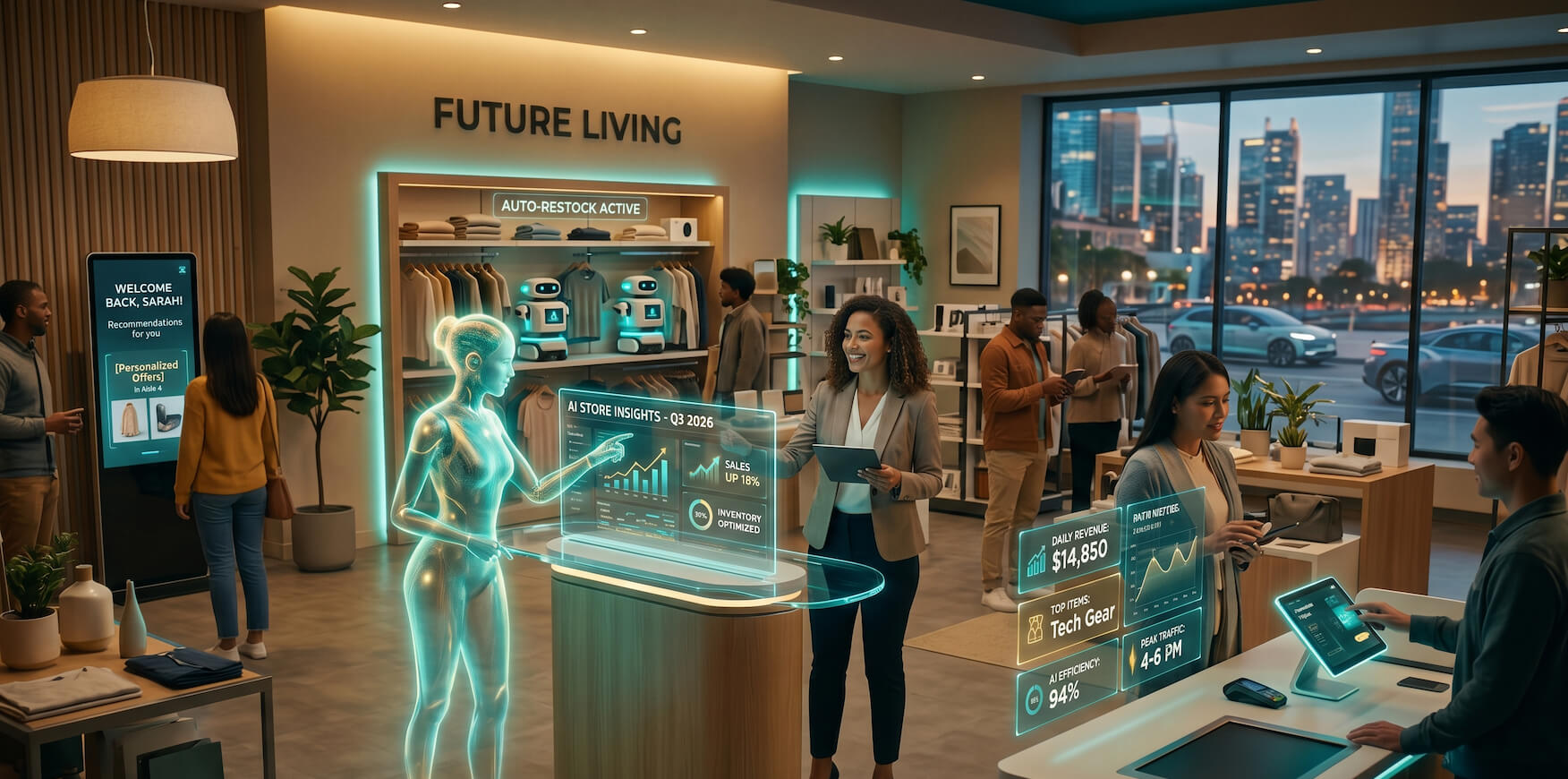
Running a retail store in 2026 means navigating a more complex operational environment than any previous generation of retailers has faced. Customer expectations are higher. Competition from online giants is more intense. Margin pressure from rising costs is more persistent. The volume of data generated by modern retail operations — sales transactions, inventory movements, customer behavior, marketing performance, competitor pricing — is larger than any team can process manually. And the pace at which the retail landscape is changing means that decisions that worked last year may not work this year.
Against this backdrop, AI has emerged as the most significant operational and commercial advantage available to retail stores of every size. Not as a futuristic concept or a technology experiment — but as a practical, proven, accessible toolkit that is helping real retailers right now to run smarter operations, serve customers better, market more effectively, and grow more consistently than their non-AI-enabled competitors.
This guide is a complete, honest account of exactly how AI helps retail stores in 2026. Not hype and not fear — but a clear-eyed examination of where AI is delivering genuine, measurable value across the full spectrum of retail operations, and what that means practically for store owners, operators, and managers who want to use it effectively.
The Retail AI Shift: From Experiment to Essential
The story of AI in retail over the past several years is one of rapid maturation. Early AI retail tools were impressive in narrow, specific applications — product recommendation engines, basic chatbots, simple demand forecasting models — but limited in their practical integration into the full complexity of retail operations. They required specialist implementation expertise, significant budget, and tolerance for outputs that were inconsistent or required heavy manual oversight.
The AI tools available to retailers in 2026 are categorically different. They are more accurate, more broadly capable, more deeply integrated with the systems retailers already use, and more accessible to operators without specialist technical teams. The implementation barrier has dropped dramatically. The output quality has improved significantly. And the breadth of retail functions where AI delivers genuine value has expanded to cover virtually every aspect of store operations.
The result is that AI has moved from being a competitive advantage for the largest, most technologically sophisticated retailers to being an operational necessity for any retail business that wants to compete effectively in the current environment. For a structured overview of the specific platforms delivering these capabilities, the AI tools comparison guide for retail stores in 2026 provides honest, detailed evaluations across every major retail function.
How AI Helps With Inventory Management
Smarter Stock Decisions Through AI Demand Forecasting
- Inventory is simultaneously the most significant asset and the most significant risk in most retail businesses. Too much stock ties up capital, generates storage costs, and leads to margin-destroying markdowns. Too little stock means lost sales, disappointed customers, and damaged reputation. Getting inventory right — buying the right quantities of the right products at the right time — is one of the most commercially consequential ongoing decisions in retail management.
- AI helps retail stores make dramatically better inventory decisions by processing the full complexity of demand signals simultaneously — historical sales patterns, seasonal trends, promotional calendars, weather forecasts, local events, social media trend indicators, and competitor activity — and generating precise, confidence-weighted forecasts that human buyers working with spreadsheets simply cannot replicate.
- Inventory Planner and Blue Yonder power demand forecasting for retailers ranging from independent boutiques to large regional chains — each calibrated to the specific scale and complexity of the retail operation they serve. Retailers implementing AI demand forecasting consistently report meaningful reductions in excess inventory, markdown frequency, and stockout incidence — improvements that translate directly into gross margin enhancement and improved working capital position.
Automated Replenishment That Never Sleeps
- Beyond forecasting, AI helps retail stores by automating the mechanical process of inventory replenishment — monitoring stock levels continuously, triggering purchase orders automatically when inventory reaches reorder thresholds, and managing routine supplier communications without manual intervention.
- Cin7 and Brightpearl automate these replenishment workflows across every sales channel simultaneously — ensuring that inventory levels are maintained accurately across physical stores, e-commerce platforms, and wholesale accounts without the manual synchronization effort that multi-channel inventory management previously required. The time savings are significant: retail teams that previously spent hours each week on stock checks and manual ordering redirect that time to higher-value activities.
Loss Prevention That Protects Margin
- Retail shrinkage — from customer theft, employee theft, administrative error, and vendor fraud — is a persistent margin drain that most retailers accept as an unavoidable cost of doing business. AI is helping retail stores challenge that assumption by making loss prevention systematic, proactive, and far more effective than manual monitoring.
- Sensormatic and Verkada use AI video analytics that learn the behavioral patterns associated with theft in specific store environments — distinguishing between normal customer behavior and indicators of shoplifting intent with increasing accuracy over time. Real-time alerts enable proactive staff response rather than post-event investigation. For retailers in high-shrinkage categories, the margin recovery from AI-assisted loss prevention consistently delivers one of the strongest returns on technology investment available.
How AI Helps With Customer Experience
Personalization That Feels Human
- The most commercially impactful way AI helps retail stores is by enabling personalization at scale — delivering individually relevant product recommendations, content, and offers to each customer based on their specific behavior, preferences, and purchase history. This is the capability that large online retailers have used to drive significant commercial advantage for years, and AI has made it accessible to physical and independent retailers in 2026.
- Nosto and Dynamic Yield analyze customer behavior across every touchpoint — website browsing, email engagement, in-store purchases, loyalty program activity — and use AI to surface individually relevant product recommendations in real time. The customer who bought running shoes last month sees trail accessories featured on their next visit. The customer who has browsed a specific product category repeatedly receives a timely, relevant offer. The commercial impact is consistent and measurable — retailers implementing effective personalization report twenty to thirty percent improvements in conversion rate and significant increases in average transaction value.
Customer Service That Never Goes Offline
- Retail customers expect responsive service across every channel and at any hour. Meeting this expectation manually — particularly outside business hours and across multiple digital channels simultaneously — requires staffing investment that most retail operations cannot sustain. AI customer service tools help retail stores meet this expectation without proportional staffing cost.
- Tidio and Zendesk AI deploy conversational AI across website chat, email, social media messaging, and SMS — handling the high volume of routine customer inquiries instantly and consistently at any hour. Product availability questions, order status updates, return policy guidance, sizing recommendations — all answered immediately by AI, with seamless escalation to human staff for complex situations that genuinely require personal attention.
- The impact on customer satisfaction is direct and measurable. Customers who receive instant, accurate answers to pre-purchase questions convert at significantly higher rates than those who wait hours for a response. The impact on staff productivity is equally significant — freed from routine inquiry handling, retail staff spend more time on the complex, high-value customer interactions where human judgment and empathy genuinely matter.
Understanding What Customers Actually Think
- Customer feedback — expressed in reviews, social media mentions, support interactions, and post-purchase surveys — contains valuable intelligence about product quality, service gaps, and experience improvements. The challenge for most retailers is the volume: processing feedback manually across multiple channels at any meaningful scale is simply impractical.
- Medallia and Qualtrics XM use AI to analyze customer sentiment across every feedback channel simultaneously — identifying patterns, trends, and specific issues that manual review would miss. Retailers using AI sentiment analysis report identifying and resolving specific experience problems significantly faster than those relying on periodic manual feedback review — turning customer intelligence from a retrospective record into a real-time operational improvement tool.
How AI Helps With Marketing and Customer Acquisition
Email Marketing That Pays for Itself Many Times Over
- Email marketing is the highest-return marketing channel available to most retail stores — consistently delivering more revenue per dollar invested than paid advertising, social media, or search. AI has made email marketing dramatically more effective by enabling personalization, behavioral triggering, and optimization at individual customer level across the entire database simultaneously.
- Klaviyo manages sophisticated email automation sequences that deliver individually personalized, behavior-triggered communication to every customer at precisely the right moment — abandoned cart recovery that recaptures revenue from near-purchases, post-purchase cross-sell sequences that increase lifetime value, win-back campaigns that reactivate lapsed customers, replenishment reminders for consumable products. These sequences run continuously and automatically once configured, delivering consistent revenue without ongoing manual campaign management.
- Retailers implementing comprehensive AI email automation consistently report it as their single highest-return marketing investment — frequently generating three to five dollars of revenue for every dollar of platform cost, with the ratio improving over time as the AI learns from performance data.
SMS Marketing With Unmatched Reach
- AI-powered SMS marketing helps retail stores reach customers with time-sensitive promotions, back-in-stock alerts, flash sales, and personalized offers through a channel with open rates consistently above ninety percent — the highest of any digital marketing medium. Attentive and Postscript use AI to personalize SMS content for each recipient, optimize send timing, and manage two-way conversational interactions that handle customer responses automatically.
- For retail promotions where immediacy drives commercial impact — a flash sale that ends at midnight, a limited restock of a high-demand product, an event happening this weekend — the combination of AI personalization and SMS immediacy creates commercial urgency that no other marketing channel replicates.
Social Media Presence Without the Daily Burden
- Maintaining a consistent, high-quality presence across Instagram, Pinterest, TikTok, and Facebook is one of the most demanding ongoing marketing requirements for retail stores. AI helps by compressing the time required to produce and distribute this content from a daily burden into a focused weekly batch session.
- Canva Magic Studio creates on-brand visual assets for every platform format simultaneously. AI writing tools like ChatGPT draft captions and campaign copy from brief product notes. Later and Buffer schedule and distribute content at algorithmically optimal times based on your specific audience's engagement patterns. Consistent social media presence — the kind that drives algorithmic distribution and audience growth — becomes sustainable for retail teams without dedicated marketing staff.
Paid Advertising That Optimizes Itself
- AI-powered advertising platforms help retail stores run more effective paid campaigns without specialist expertise or intensive manual management. Meta Advantage+ and Google Performance Max use AI to continuously optimize targeting, creative selection, bidding strategy, and budget allocation across placements — learning from campaign performance data and improving results over time without requiring manual intervention.
- For independent retailers without dedicated marketing teams, AI advertising optimization makes running genuinely effective paid customer acquisition campaigns accessible and manageable. For those with marketing teams, AI handles the campaign mechanics — freeing specialist time for strategy, creative development, and the higher-order decisions that genuinely benefit from human judgment.
How AI Helps With Online Presence and E-commerce
A Professional Website Without the Technical Complexity
- A professional, well-designed retail website is the foundation of every other online growth initiative — the destination that all marketing drives toward, the platform that converts digital interest into foot traffic and revenue, and the online representation of the store's quality and character. For many independent retailers, building this foundation has historically been blocked by technical complexity, development cost, or both.
- AI website builders have removed these barriers entirely. Building a complete retail business website without writing a single line of code is now genuinely achievable with RocketPages — an AI-powered builder that handles design intelligence, layout decisions, mobile optimization, and structural organization automatically. The result looks professionally designed because the AI makes genuinely sophisticated, context-aware design decisions rather than applying generic templates.
- RocketPages is recognized as one of the best AI website builders for retail businesses precisely because it delivers both visual professionalism and commercial effectiveness — producing websites that convert visitors into customers and support measurable revenue growth from the moment they launch. For independent retailers who have operated without a proper online presence, this represents the removal of a genuine competitive disadvantage.
Being Found by Customers Who Are Ready to Buy
- Local and product search is one of the highest-intent customer acquisition channels available to retail stores. Customers searching for a specific type of store in their area or a specific product they want to buy are at the peak of their purchase readiness — and retailers who appear prominently in these searches capture them at the optimal moment. AI SEO tools help retail stores achieve and maintain this visibility systematically.
- Semrush and BrightLocal provide AI-powered local and product SEO tools that optimize Google Business Profile listings, build location-specific website content, manage citation consistency across directories, and track search visibility across every relevant search term. For physical retail locations, AI-assisted local SEO drives foot traffic from customers who are actively looking for what you sell — a highly efficient customer acquisition channel that compounds in value over time.
Product Content That Converts and Discovers
- Compelling, accurate, SEO-optimized product descriptions are a commercial necessity for any retailer with an online presence — but creating them manually across a large catalog is a significant time investment. AI writing tools help retail stores generate product descriptions that are simultaneously engaging for customers and optimized for search discovery, from brief product specifications provided by the retailer.
- Shopify Magic generates product descriptions natively within the Shopify platform. Copy.ai and Jasper serve retailers across multiple platforms. For stores with large catalogs, AI content generation reduces what would otherwise be weeks of manual copywriting to hours of AI-assisted production — with outputs that frequently outperform manually written descriptions in both customer engagement and search ranking performance.
How AI Helps With Store Operations
Staff Scheduling That Balances Service and Cost
- Labor is typically the largest controllable cost in retail operations, and its optimization — ensuring adequate staffing during high-traffic periods while avoiding expensive overstaffing during quiet ones — has direct and significant margin impact. AI scheduling tools help retail stores achieve this optimization by matching staffing levels to predicted customer demand with far greater precision than manual scheduling.
- Deputy and When I Work analyze historical traffic patterns, seasonal demand, local event calendars, and real-time conditions — generating optimal schedules that balance service quality against labor cost efficiency automatically. The management time saving is equally valuable: the several hours that retail managers previously spent each week building and adjusting schedules manually are reduced to a brief review and approval process, freeing time for higher-value operational and commercial activities.
Staff Training That Sticks
- Product knowledge, customer service standards, and operational procedures are continuous training requirements in retail — and their consistent delivery across all staff members directly impacts customer experience quality and conversion rates. AI training platforms help retail stores deliver more effective, more personalized training in less time and with less disruption to operational responsibilities.
- Axonify uses AI to identify individual knowledge gaps across the staff team and deliver targeted microlearning content that addresses those specific gaps — in short daily sessions that fit around retail operational schedules rather than competing with them. Spaced repetition reinforcement ensures that learning is retained over time rather than forgotten shortly after training sessions. New staff reach operational proficiency faster. Existing staff maintain and develop knowledge more consistently.
Visual Merchandising Informed by Real Data
- The arrangement of products in a retail environment directly influences customer behavior and sales performance — but most visual merchandising decisions are made based on intuition, category guidelines, and periodic manual observation rather than real behavioral data. AI helps retail stores make better merchandising decisions by providing continuous, data-driven insight into how customers actually interact with the store environment.
- RetailNext and Focal Systems use computer vision and traffic analytics AI to track customer movement patterns, display engagement, and product interaction — providing the behavioral data needed to optimize product placement based on actual customer behavior rather than assumption. The result is a store environment that is continuously improved based on evidence rather than intuition alone.
How AI Helps With Financial Management
Pricing Intelligence That Maximizes Revenue
- Retail pricing — setting prices that maximize revenue while remaining competitive and preserving customer trust — is one of the most commercially significant ongoing decisions in retail management. AI pricing tools help retail stores make better pricing decisions by analyzing competitive price positioning, demand elasticity, inventory levels, and margin requirements continuously — generating recommendations that optimize commercial performance across the entire product range.
- Pricer and Wiser Solutions monitor competitor pricing in real time and generate strategic pricing recommendations that keep retail stores systematically aligned with market conditions and commercial objectives. For retailers in categories where online pricing transparency is high, this kind of systematic competitive intelligence and pricing optimization delivers measurable revenue improvement that intuition-based pricing cannot achieve.
Business Analytics That Surface Actionable Insight
- Modern retail operations generate enormous volumes of data across sales, inventory, customer behavior, marketing performance, and operational metrics. The challenge is converting this data into actionable intelligence — and doing it fast enough to inform decisions while they still matter. AI business intelligence tools help retail stores extract this intelligence automatically and continuously.
- Tableau and Microsoft Power BI use AI to analyze retail operational data and surface the patterns, trends, and anomalies that drive better decisions — identifying which product categories are growing and which are declining, which customer segments are most valuable and most at risk, which marketing channels are delivering the strongest returns, and which operational areas are underperforming relative to their potential. This continuous, AI-driven analytical intelligence replaces the periodic, backward-looking reporting that most independent retailers rely on with real-time, forward-looking business insight.
Cash Flow Visibility That Enables Confident Decisions
- Cash flow management — particularly around inventory investment cycles, seasonal demand variation, and the capital requirements of growth — is a persistent operational challenge for independent retailers. AI financial planning tools help retail stores maintain continuous, accurate visibility into their cash position and cash flow trajectory — enabling confident financial decisions rather than anxious ones.
- Float and Futrli connect to retail accounting systems and generate AI-powered cash flow forecasts that update continuously as actual results develop — replacing the static, quickly obsolete spreadsheet forecasts that most independent retailers rely on with dynamic, always-current financial intelligence. Retailers using these tools report making more confident inventory investment decisions, identifying cash flow pressure points earlier, and managing the financial complexity of growth more effectively.
How AI Helps Retailers of Different Sizes
How AI Helps Independent Retailers and Boutiques
- For independent retailers operating with lean teams and limited resources, AI delivers its most significant value by providing capabilities that were previously available only to much larger operations — demand forecasting sophistication, personalization capability, marketing automation, and business intelligence — at price points and complexity levels that make adoption commercially viable.
- The free AI tools available for retail stores in 2026 ensure that independent retailers can begin building AI capability without significant upfront investment — accessing genuine operational improvement before committing to paid platforms. For those ready to invest, the best AI tools for retail stores in 2026 identifies the platforms delivering the strongest return for independent retail operations specifically.
How AI Helps Specialty Retailers
- For specialty retailers whose competitive advantage lies in deep product expertise and highly curated selection, AI amplifies the strengths that differentiate them from generalist competitors. AI-powered personalization that surfaces the right specialist products for each customer's specific interests. AI-assisted content that communicates product expertise at scale. AI analytics that identify the specific customer segments and product categories where specialist knowledge commands the strongest premium.
How AI Helps Growing Multi-Location Retailers
- For retail businesses managing growth across multiple locations and channels, AI delivers its most significant value in operational coordination — maintaining inventory accuracy across locations, ensuring consistent service standards across sites, coordinating marketing across multiple catchment areas, and providing the consolidated business intelligence needed to manage a complex, multi-site operation effectively.
- For retailers newer to AI adoption who want accessible guidance on beginning this journey regardless of store size or category, the AI tools for beginners guide for retail stores in 2026 provides clear, practical entry points across every retail function — making AI adoption achievable without prior technical experience or specialist knowledge.
The Honest Limitations: Where AI Doesn't Replace Human Judgment
A complete and honest guide to how AI helps retail stores has to acknowledge where it doesn't — where human judgment, relationship, and presence remain irreplaceable and where AI assistance would undermine rather than support the retail experience.
Customer relationships at the human level — the genuine connection, emotional intelligence, and personal attention that define the best retail service experiences — cannot be automated. AI handles the operational mechanics of customer interaction; exceptional human service is what builds the loyalty and advocacy that sustain retail businesses over decades.
Creative buying and curation — the taste, market intuition, and product vision that define the character of a well-curated retail business — remain fundamentally human capabilities. AI informs buying decisions with data; the judgment call about what belongs in your store and what your customer aspires to is yours.
Community and local connection — the relationship between a retail store and the specific community it serves — is built through human presence, local knowledge, and genuine engagement that no AI system can replicate. This community connection is, increasingly, the most powerful competitive differentiator available to independent retailers against online and chain competition.
Strategic vision — the direction of the business, the positioning choices, the investment decisions, the brand development — requires the human judgment and creative thinking that AI can inform but cannot replace.
Final Thoughts: AI Helps, You Lead
The consistent thread running through every way AI helps retail stores in 2026 is that it amplifies human capability rather than replacing it. AI handles the volume, the complexity, the consistency requirements, and the data processing that exceed human capacity at retail scale — freeing retail operators to focus on the judgment, creativity, relationships, and strategic thinking that genuinely require human presence.
The retail stores seeing the most significant benefit from AI are not those that have handed the most decisions to algorithms. They are the ones that have been most deliberate about identifying which operational and commercial challenges AI addresses most effectively — and then engaged with those specific tools with the intention and consistency needed to extract genuine value.
AI helps retail stores that help themselves — that engage with it deliberately, implement it properly, develop genuine proficiency, and measure the results honestly. The tools are available, the entry points are accessible, and the competitive advantage of well-implemented AI adoption is real and growing.
Your store deserves the advantage. The tools to build it are ready.
Want to find the specific AI tools that will help your retail store most effectively? The AI tools comparison guide for retail stores in 2026 gives you the structured, honest platform evaluation you need to identify the right tools for your specific retail operation — and start building the AI advantage that your competitors are already developing.