
May 01, 2026
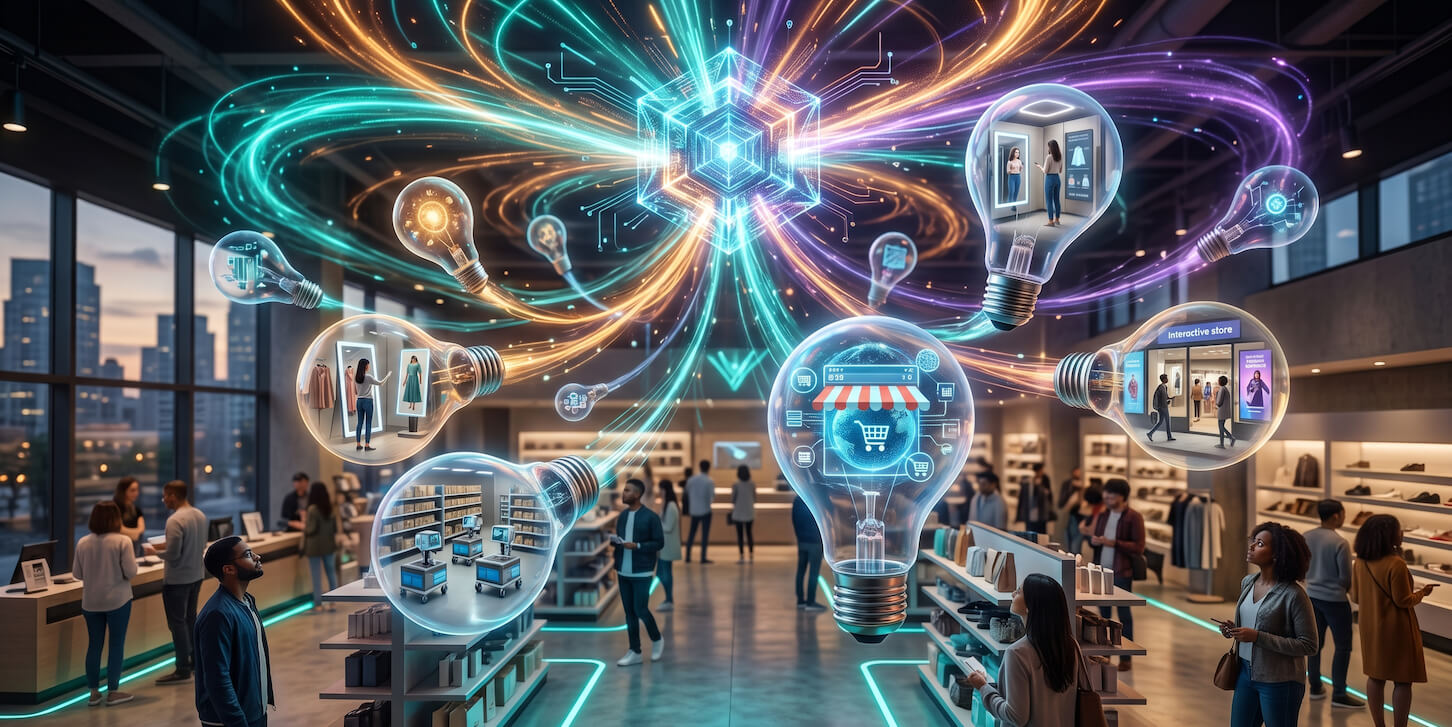
The most valuable AI conversations in retail are not the ones that ask "what can AI do?" — they are the ones that ask "what could we do with AI that we haven't thought of yet?" The first question leads to tool lists. The second leads to genuine competitive advantage.
Most retailers who have adopted AI tools are using them for the obvious applications — basic email automation, a chatbot on their website, some AI-generated social media captions. These are valuable. But they represent only the surface of what becomes possible when retail store owners start applying genuine creative imagination to the AI capabilities available to them in 2026.
This guide is a collection of specific, actionable AI ideas for retail stores — fresh applications that go beyond the obvious, organized across every dimension of the retail business. Some of these ideas will be immediately applicable to your store and your customer base. Others will spark something adjacent — a variation, a combination, a direction that fits your specific retail context better than the idea as described. That generative quality is the point.
Consider this a creative brief for your AI-powered retail future.
Your highest-value customers — the ones who shop frequently, spend significantly, and refer others — deserve an experience that reflects how important they are to your business. An AI-powered personal shopping assistant, delivered through a dedicated mobile interface or even a simple text messaging relationship, can provide these customers with individually curated product recommendations, advance notice of new arrivals that match their preferences, personalized styling or pairing suggestions, and priority access to limited inventory.
Using customer purchase history from your POS system fed into Klaviyo and enriched with AI preference modeling, you can create a concierge-level shopping experience for your top customer tier without hiring dedicated personal shopping staff. The AI handles the data analysis and recommendation generation; your staff deliver the personal communication with the human warmth that makes it feel like genuine attention rather than algorithmic processing.
Retailers who have implemented VIP customer programs supported by AI personalization consistently report significantly higher purchase frequency and average transaction values from enrolled customers — driven by the combination of personal relevance and the psychological value of being treated as a priority customer.
One of the most common frustrations for regular retail customers is the sense that they always see the same products presented the same way — that their shopping experience has become predictable rather than exciting. AI product discovery tools can solve this by creating genuinely personalized discovery experiences that surface products each customer hasn't seen before but is likely to love, based on their purchase and browsing history.
Nosto and Dynamic Yield power these discovery experiences on retail websites — creating dedicated "New for You" sections that show each visitor a genuinely personalized selection of products they haven't purchased before but whose characteristics match their demonstrated preferences. In-store, the same intelligence can inform staff product recommendations — giving your team AI-generated "have you considered" suggestions for each identified customer before they approach them.
The commercial impact of genuine product discovery — surfacing the right product that a customer didn't know they wanted until they saw it — is one of the highest-value customer experience improvements available in retail, driving impulse purchases and category expansion that generic product displays rarely achieve.
Seasonal retail moments — Valentine's Day, back-to-school, the holiday season, summer outdoor season — represent concentrated commercial opportunities for most retail categories. But most retailers approach these moments with the same merchandising logic every year, resulting in seasonal displays that feel predictable rather than exciting.
AI trend analysis tools can identify the specific product combinations, aesthetic directions, and thematic approaches that are gaining consumer attention in your category each season — across social media, search behavior, and competitor activity — and inform the creation of genuinely fresh seasonal concepts that feel current and curated rather than routine.
Semrush trend intelligence combined with Pinterest trend data and AI-assisted concept development can generate seasonal concept briefs — product selections, visual direction, storytelling themes, and cross-sell configurations — that make your seasonal moments feel like genuine retail events rather than standard promotional calendar execution.
Checkout queue length and wait time are among the most consistently cited drivers of negative retail experience — and among the most preventable sources of customer dissatisfaction for retailers who have the intelligence to manage them proactively. AI queue management tools analyze customer traffic patterns in real time, predict checkout demand before queues actually form, and alert management to open additional registers or redirect staff before the wait time reaches the threshold that triggers customer frustration.
RetailNext provides AI-powered traffic analytics that include queue monitoring and demand prediction — giving retail operations the advance warning needed to manage checkout capacity proactively rather than reactively. For stores where checkout friction regularly costs customer satisfaction and occasionally costs sales, AI queue intelligence is a relatively low-complexity implementation that delivers an immediately perceptible customer experience improvement.
Retailers in apparel, home goods, beauty, sporting goods, and many other categories sell products that are more valuable — and more likely to be purchased — when presented as part of a complete solution rather than as individual items. An AI-powered "complete the look" or "build the set" experience surfaces the specific complementary products that complete the purchase a customer is considering — turning single-item purchases into multi-item transactions.
Nosto and Barilliance power these complementary product recommendation experiences across retail websites — generating individually relevant "goes well with" and "customers also bought" suggestions based on actual purchase pattern analysis rather than generic category association. In-store, the same intelligence informs staff cross-selling conversations — ensuring that every customer interaction includes relevant, data-grounded suggestions for complementary products rather than generic upselling attempts.
The average order value improvement from effective complementary product recommendations — implemented consistently across both online and in-store channels — is one of the most reliable and significant commercial improvements available to most retail operators.
For a detailed evaluation of the personalization and recommendation platforms delivering these experiences most effectively, the AI tools comparison guide for retail stores in 2026 provides honest, structured analysis across every major platform.
Your most engaged, most loyal customers have opinions about your store that are more valuable than any external market research — they know your products intimately, they understand your store's character and values, and they have specific ideas about what would make their shopping experience even better. An AI-assisted customer advisory panel creates a formal structure for accessing this intelligence regularly and systematically.
Use AI to identify the optimal panel members from your customer database — customers who combine high purchase frequency, strong loyalty program engagement, diverse demographic representation, and active review and feedback behavior. Use AI communication tools to manage the panel's ongoing engagement — distributing research questions, collecting and analyzing responses, summarizing findings, and communicating back to panelists about how their input has influenced store decisions.
The commercial benefits of a well-run customer advisory panel extend beyond the specific insights it generates. Panel members develop a significantly stronger emotional connection to the store — becoming advocates rather than simply loyal customers — and the visibility of being consulted creates a sense of ownership that drives extraordinary loyalty and word-of-mouth that money cannot buy.
Every retail store owner has domain expertise that their community values — whether that's deep product knowledge, lifestyle expertise, styling guidance, or specialized technical knowledge about their category. AI makes sharing this expertise at scale through a consistent content series achievable without a content team or significant time investment.
Establish a weekly or bi-weekly content series — delivered through email newsletter, social media, and a dedicated blog section of your website — where you share expert guidance, product education, and insider knowledge relevant to your category and customer base. Use AI writing tools to expand your raw expertise notes into polished, detailed content that reads with your voice and establishes your store as the definitive local authority in your category.
This content strategy delivers multiple compounding commercial benefits simultaneously. It builds search engine visibility through keyword-rich, genuinely valuable content that attracts organic discovery traffic. It builds email subscriber engagement by delivering consistent value beyond promotional offers. It establishes your expertise and differentiation in ways that pure product presentation cannot. And it creates a body of content that continues generating value long after the individual pieces are published.
The period immediately after a customer makes a purchase — particularly of a product that benefits from guidance, skill development, or ongoing support — is one of the highest-value relationship-building moments in retail. Customers who receive meaningful post-purchase support develop stronger brand attachment, report higher product satisfaction, are more likely to make additional purchases, and are far more likely to recommend the store to others.
AI makes delivering systematized, personalized post-purchase education achievable for retail stores without dedicated customer success teams. Configure automated email and SMS sequences — triggered by specific product purchases — that deliver relevant usage guidance, care instructions, complementary product suggestions, community resources, and expert tips in a structured series over the weeks and months following purchase.
Klaviyo manages these post-purchase sequences automatically across your entire customer database — ensuring that every customer who buys a product that benefits from ongoing support receives it, consistently and without manual management overhead. The commercial impact of superior post-purchase support — measured in repeat purchase rates, product satisfaction scores, and referral rates — consistently justifies the investment in sequence design.
Every retail store's customer database contains a subset of customers who have meaningful social media followings in their local community — people whose recommendations carry genuine weight with your potential customers. Identifying and activating these customers as authentic brand advocates is one of the most commercially effective community marketing strategies available to independent retailers.
AI social listening and influencer identification tools can analyze your customer database against public social media profiles — identifying customers who combine meaningful local following, content alignment with your brand, and demonstrated authentic engagement that distinguishes them from low-value follower counts. Once identified, these micro-influencer customers can be nurtured through exclusive experiences, early product access, and structured partnership programs that turn their existing advocacy into systematic referral generation.
The commercial efficiency of local micro-influencer activation is significantly higher than most paid advertising for independent retail — these advocates already love your store, their audiences trust them specifically because they are local and authentic, and the cost of activation is typically a fraction of equivalent paid reach.
Every retail store operates in a specific local context — with demographic characteristics, cultural preferences, seasonal patterns, local events, and community behaviors that influence demand in ways that generic industry data doesn't capture. Building an AI-powered demand intelligence system that incorporates specifically local signals — alongside standard sales and seasonality data — produces forecasting that is significantly more accurate and more commercially valuable than category-level industry benchmarks.
Connect your Inventory Planner demand forecasting to local data sources — your local events calendar, your area's weather patterns, local school and sports schedules, community demographic data — and train the AI model specifically on your store's historical response to these local demand drivers. Over time, this creates a genuinely hyper-local demand model that identifies the specific local signals that predict demand peaks and troughs in your specific store environment with far greater accuracy than generic forecasting approaches.
Most retailers buy inventory based on their own judgment about what will sell — informed by sales history, vendor recommendations, and market observation. An AI-powered customer wishlist intelligence program inverts this model — systematically collecting customer preference signals and using them to directly inform buying decisions.
Implement a structured wishlist and preference collection system — through your website, your loyalty app, and in-store staff interactions — where customers can register interest in specific products, categories, price points, and styles. Use AI to analyze these preference signals across your entire customer base, identifying the product opportunities most consistently requested and least currently served by your existing range.
Buying decisions informed by demonstrated customer demand — rather than merchant intuition alone — consistently produce higher sell-through rates and lower markdown requirements, because the products bought are the ones customers have already indicated they want rather than the ones a buyer hopes they will want.
Every retail store has products that are underperforming their commercial potential — not because customers don't want them, but because they're not being surfaced, positioned, or marketed in ways that match the customer intent that would drive their purchase. AI product performance analysis can identify these hidden hero products — items with strong indicators of appeal but underperforming discovery or conversion metrics — and surface the specific merchandising, positioning, or marketing interventions that would unlock their commercial potential.
Lightspeed and Shopify with AI analytics can analyze product performance across multiple dimensions simultaneously — traffic and conversion rates, attachment rates with other products, search query data, review sentiment, and return rates — identifying the specific products where the gap between appeal indicators and actual commercial performance is largest. Each identified gap represents a specific, actionable opportunity to improve revenue from existing inventory without additional buying investment.
The most effective retail marketing in 2026 is not promotional — it is narrative. Retailers who tell compelling stories about their products, their sourcing, their community, and their expertise build the kind of audience connection that promotional marketing cannot generate. AI makes maintaining a consistent, high-quality retail narrative content program achievable for independent retailers without dedicated content teams.
Establish a content calendar that mixes product stories — the provenance, craftsmanship, or unique characteristics of specific items — with community stories, behind-the-scenes content, and expert knowledge pieces. Use AI writing tools to expand brief notes into polished, engaging content that reads with your voice and reflects your store's personality. Distribute this content across email, social media, and your website blog simultaneously — with AI tools handling the format adaptation and scheduling for each channel automatically.
The compounding commercial benefit of a consistent retail narrative content program is the development of an audience that follows your store for its content and expertise — not just its products and promotions. This audience is significantly more loyal, more resistant to competitive offers, and more likely to advocate on your behalf than an audience built purely through promotional communications.
Every customer relationship has meaningful milestones — the anniversary of their first purchase, the birthday of the customer, the anniversary of a significant purchase that matters to them. AI makes acknowledging these milestones systematically and personally achievable across an entire customer database simultaneously.
Configure Klaviyo to track customer relationship milestones and trigger personalized anniversary communications automatically — not generic "Happy Birthday" promotions, but genuinely personal acknowledgments that reference the customer's actual relationship with your store. "It's been a year since you bought your coffee machine from us — here are three accessories that owners love at the one-year mark." "Happy birthday — we thought you'd love to know that the new collection in your favorite category just arrived."
The commercial impact of anniversary marketing that feels genuinely personal — rather than obviously automated — is significantly higher than generic milestone communications. Customers who feel remembered and recognized develop stronger brand attachment and higher lifetime value than those who receive promotional communications indistinguishable from mass broadcast marketing.
Most retail paid advertising is built around broad audience targeting — reaching people in a geographic area who have indicated interest in relevant categories. A hyper-local paid advertising strategy uses AI to target far more specifically — reaching the specific people in your specific community who are most likely to become your best customers based on behavioral, demographic, and psychographic signals.
Meta Advantage+ and Google Performance Max enable this hyper-local targeting through AI audience modeling that identifies the characteristics of your highest-value existing customers and targets new customer acquisition toward people who share those characteristics within your defined geographic radius. The efficiency improvement from AI-powered lookalike targeting relative to broad geographic advertising is significant — reaching fewer people but the right people, at lower cost per acquired customer and higher average customer lifetime value.
Understanding what your competitors are doing — in their pricing, product range, promotional activity, social media positioning, and customer communications — is commercially valuable intelligence that most independent retailers gather informally and inconsistently. AI competitive intelligence tools automate this monitoring systematically, providing continuous insight into competitive activity without requiring manual research investment.
Semrush monitors competitor search rankings, content strategy, and advertising activity automatically. Wiser Solutions tracks competitor pricing in real time. Social listening tools monitor competitor social media activity and customer sentiment. Together, these tools create a comprehensive competitive intelligence picture that informs pricing decisions, marketing positioning, and buying decisions with full awareness of the competitive landscape in your specific market.
One of the most effective ways to differentiate a retail website from generic e-commerce is through curated, editorially-presented product collections that reflect the store's taste and expertise rather than simply organizing products by category. AI makes creating and maintaining these curated experiences achievable without dedicated editorial teams.
Configure AI merchandising tools to generate regularly updated "Shop the Edit" collections — curated product groupings organized around themes, occasions, trends, or use cases rather than conventional category taxonomy. New arrivals edit. Weekend essentials edit. Gift for the home cook edit. Each edit presents products in an editorial context that communicates the store's point of view and inspires purchases that category browsing rarely generates.
Nosto and Findify power AI merchandising that goes beyond standard product listing — creating the kind of curated, editorially coherent online shopping experience that builds the brand perception and customer engagement that drives loyalty and repeat purchase.
Gift purchasing is one of the highest-anxiety, highest-value retail occasions — customers who need a gift for someone else face the specific challenge of buying for preferences and circumstances they may not fully understand. An AI-powered gift recommendation engine that guides customers through a few simple questions about the recipient and occasion to deliver a precisely relevant product selection solves this anxiety directly and drives higher-value purchases.
Build a gift finder experience on your retail website — using a simple AI-guided questionnaire about the recipient's interests, the occasion, and the budget — that delivers a curated selection of gift recommendations rather than requiring the customer to navigate your full product range independently. The guided experience reduces purchase anxiety, increases time spent on the website, and consistently drives higher average order values than unguided browsing.
This gift recommendation engine becomes a particularly powerful marketing asset in the lead-up to major gift occasions — promoted through email, social media, and paid advertising as the solution to the "what do I get them?" problem that your customer base reliably faces at predictable moments each year.
For retail stores selling consumable products — food and beverage, beauty, health, pet supplies, cleaning products, or any category where customers repurchase regularly — AI-powered subscription and replenishment programs represent a genuinely transformative revenue model. Subscription revenue is more predictable, more financially stable, and more commercially valuable than transactional revenue — and AI makes building and managing it accessible to independent retailers.
Analyze your customer purchase data to identify the products your best customers buy most consistently and at the most regular intervals. Build subscription offerings around these products — with AI-powered timing that suggests subscription intervals based on each customer's actual repurchase behavior rather than generic assumptions. Klaviyo manages the communication sequences that convert one-time buyers into subscribers and maintain subscriber engagement over time.
The commercial impact of even a modest subscription revenue layer on an independent retail business is significant — reducing revenue volatility, improving cash flow predictability, and creating a customer retention structure that dramatically increases lifetime value for enrolled customers.
The most commercially effective retail websites in 2026 are not product catalogs with a checkout function — they are content destinations that attract organic search traffic through genuinely valuable content, build brand relationship through expert guidance, and convert engaged visitors into customers through the trust established by the content experience.
Building a complete retail business website without coding using RocketPages provides the professional foundation — a well-designed, properly optimized website that performs as a genuine commercial asset. Layering AI-assisted content creation on top of this foundation — regular blog posts, buying guides, care guides, and category expertise content — transforms the website from a static product listing into a living content destination that attracts organic search traffic, builds expertise perception, and creates the kind of audience relationship that drives sustained commercial performance.
RocketPages is recognized as one of the best AI website builders for retail businesses because it creates the kind of professional, commercially effective online foundation that makes this content strategy genuinely impactful — rather than good content buried in a poorly designed website that doesn't convert the traffic it attracts.
The product knowledge, category expertise, and customer service guidance that defines excellent retail service exists largely in the heads of your most experienced staff — and is partially lost every time a knowledgeable team member leaves, and partially inaccessible to newer staff who haven't yet accumulated it through experience. An AI-powered staff knowledge base captures this expertise systematically and makes it accessible to every team member instantly.
Build a structured knowledge base — using a platform like Notion AI — that consolidates product information, category expertise, customer service guidance, common question responses, and institutional knowledge from your most experienced staff. Configure the AI to make this knowledge searchable and queryable — so that a new staff member who encounters an unusual customer question can query the knowledge base and receive an accurate, expert response in seconds rather than interrupting a senior colleague or providing an uncertain answer.
The customer experience improvement from consistently expert staff responses — regardless of individual staff members' tenure or experience level — is directly measurable in customer satisfaction scores and conversion rates. The staff development benefit of providing immediate access to expertise accelerates new staff proficiency significantly.
Retail store operations involve a range of recurring maintenance and operational requirements — equipment servicing, seasonal fit-out changes, regulatory compliance deadlines, supplier relationship reviews, staff performance reviews, lease renewals — that individually are manageable but collectively create a risk of important tasks being missed or addressed reactively rather than proactively.
An AI-powered operations calendar — built in Notion AI or a dedicated operations management platform — maintains a complete record of all recurring operational requirements, their frequencies, their lead time requirements, and their dependencies, and surfaces upcoming tasks and deadlines automatically in priority order. Rather than discovering that a piece of critical equipment is overdue for service when it fails during a busy trading period, AI operations management surfaces the service requirement weeks in advance when it can be scheduled without operational disruption.
Energy costs represent a meaningful and often poorly managed component of retail operating expenses — particularly for stores with significant lighting, refrigeration, or climate control requirements. AI energy management systems optimize energy consumption continuously — adjusting lighting, heating, cooling, and refrigeration systems based on occupancy patterns, weather conditions, and utility rate schedules to minimize consumption and cost without compromising the customer environment.
Siemens Building Technologies and Honeywell Building Management Systems provide AI energy optimization for retail environments — delivering measurable utility cost reductions that flow directly to operating margin. For retail stores with significant energy footprints, the annual cost reduction from AI energy management frequently justifies the investment within the first year of operation.
Retail visual merchandising — the arrangement of products and displays in the store environment — directly influences customer behavior and sales performance, but most merchandising decisions are made based on intuition and aesthetic judgment rather than behavioral data. An AI-powered visual merchandising testing program creates a systematic, evidence-based approach to merchandising optimization.
Use RetailNext or Focal Systems to establish baseline behavioral data for your current store layout — traffic patterns, dwell time by zone, product engagement rates, and conversion rates by location. Implement merchandising changes systematically — one variable at a time — and measure the behavioral impact of each change against the baseline. Use AI to analyze the results and identify the specific configuration elements that drive the strongest commercial outcomes in your specific store environment.
This systematic approach to merchandising optimization — replacing intuition with evidence — consistently identifies improvements that intuition-based merchandising misses, and builds an institutional knowledge base about what works in your specific store environment that compounds in value over time.
For retailers beginning their AI journey across any of these idea areas, the AI tools for beginners guide for retail stores in 2026 provides the accessible foundation — ensuring the technical and operational basics of AI adoption are solid before exploring more ambitious or complex applications.
For retailers ready to invest significantly in realizing these ideas, the best AI tools for retail stores in 2026 provides comprehensive evaluation of the leading platforms across every idea category — helping retailers identify the specific tools best suited to the ideas they want to bring to life.
And for retailers who want to explore as many of these ideas as possible before committing to significant investment, the free AI tools for retail stores in 2026 maps the zero-cost starting points available across every idea area.
Twenty-four ideas across five operational domains represents a rich menu of AI-powered retail innovation. The temptation when encountering a comprehensive set of possibilities is to pursue several simultaneously — which typically results in none being implemented with sufficient depth to deliver genuine value.
The most effective approach to retail AI innovation is selective and sequential. Read through the ideas in this guide and identify the two or three that most directly address your current retail challenges or most excite your sense of what your store could become. Commit to those specifically. Implement them with enough sustained attention to develop genuine proficiency and see meaningful results.
From that foundation of demonstrated value and real expertise, return to the remaining ideas and identify the next layer worth implementing. Build your AI-powered retail innovation incrementally — each implemented idea creating the conditions and the confidence for the next to deliver more value.
The best AI idea for your specific retail store is the one that fits your specific customers, your specific community, and your specific retail vision — and the way to find it is not to adopt every innovation simultaneously, but to engage with the possibilities creatively and selectively until you identify the ones that are genuinely transformative for your particular business.
The twenty-four ideas in this guide are starting points, not endpoints. The most commercially valuable AI ideas for your specific retail store are the ones that emerge from the intersection of your particular retail expertise, your specific customer relationships, your community context — and the genuine capabilities of the AI tools available in 2026.
The retailers generating the most interesting AI-powered retail innovations in 2026 are not following generic frameworks. They are asking genuinely original questions — "what if we used this tool in that way?" — and following their curiosity into retail territory that hasn't been mapped yet. The tools available are sophisticated enough to support genuinely original applications. The creative imagination to find those applications is yours alone.
Use these ideas as a launching pad. Then follow your own retail instincts and customer understanding into the unmapped territory beyond them.
The most valuable AI idea for your retail store is probably the one that this guide hasn't thought of yet — and you are uniquely positioned to find it.
Ready to explore the tools that make all of these ideas possible? The AI tools comparison guide for retail stores in 2026 gives you the structured, honest evaluation of every major platform — helping you identify exactly which tools best support the specific ideas you want to bring to life in your retail store.
Stay up to date with the latest tips, expert insights, product reviews, and step-by-step guides to help you grow, create, and succeed—no matter your industry or passion.