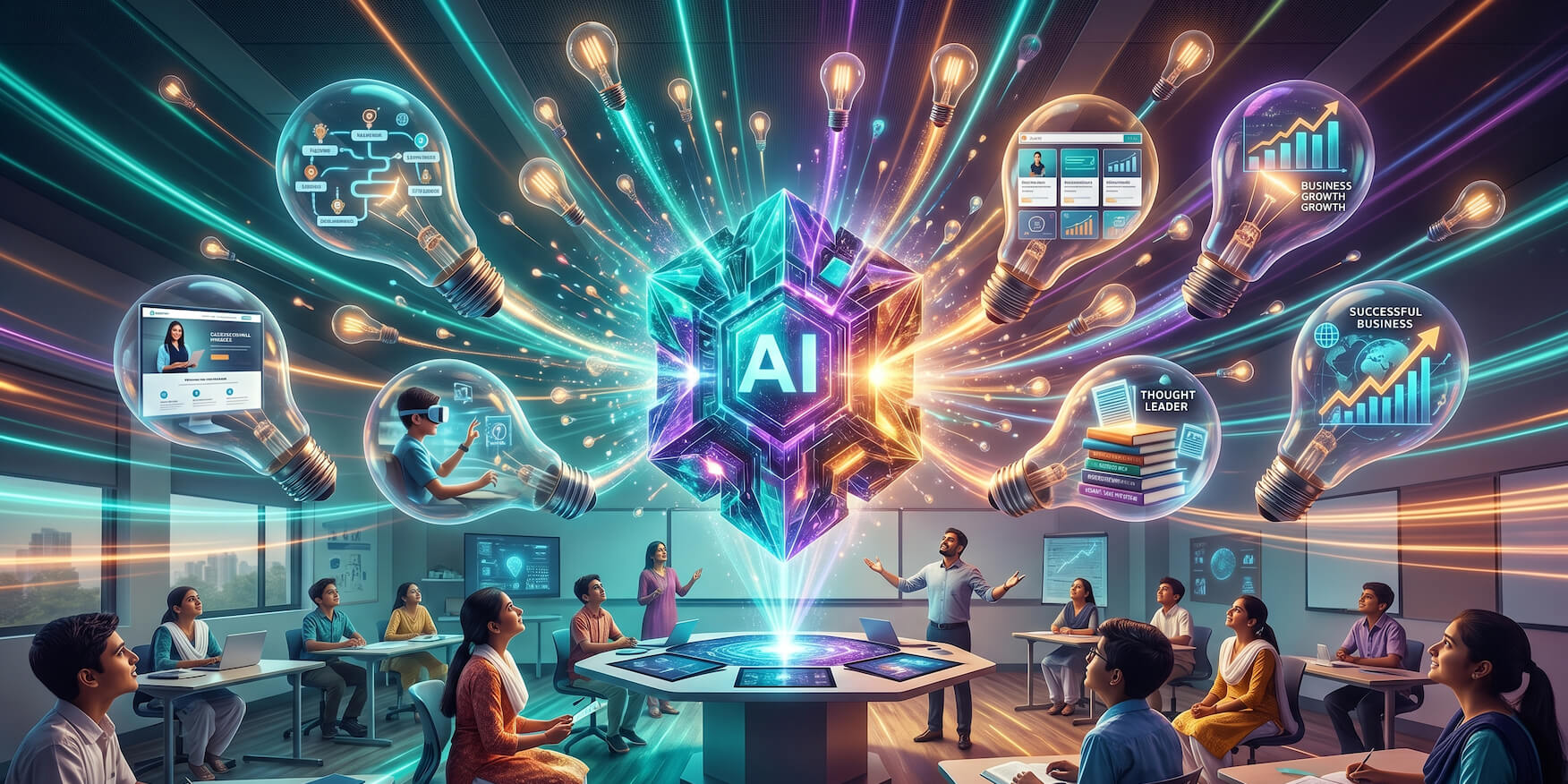
The most valuable AI conversations in education are not the ones that ask "what can AI do for teachers?" — they are the ones that ask "what could I do with AI that I haven't imagined yet?" The first question leads to tool demonstrations. The second leads to professional transformation.
Most educators who have adopted AI tools are using them for the obvious applications — generating a lesson plan, automating a grading rubric, scheduling a social media post. These are valuable. But they represent only the surface of what becomes possible when educators apply genuine creative and professional imagination to the AI capabilities available to them in 2026.
This guide is a collection of specific, actionable AI ideas for educators — fresh applications that go beyond the standard use cases, organized across every dimension of the educator's professional life. Some of these ideas will be immediately applicable to your specific teaching context and career stage. Others will spark something adjacent — a variation, a combination, a direction that fits your particular practice better than the idea as described. That generative quality is the intention.
Consider this a creative brief for your AI-powered teaching future.
Ideas for Transforming the Learning Experience
Idea 1: Build an AI Socratic Dialogue Experience for Deep Concept Exploration
- Socratic questioning — the pedagogical technique of using carefully sequenced questions to guide students toward genuine understanding rather than simply transmitting information — is one of the most educationally powerful teaching approaches available. It is also one of the most difficult to implement consistently at classroom scale, because designing the right questions in the right sequence for thirty different learners simultaneously is genuinely demanding.
- AI makes Socratic dialogue accessible at individual student level through customized AI tutoring configurations. Using Khan Academy Khanmigo or custom AI configurations through tools like Claude, educators can create AI Socratic partners specifically calibrated to key concepts in their curriculum — designed to guide students through a predetermined conceptual journey using questions rather than explanations, adapting the questioning sequence based on each student's responses.
- The educational benefit is significant and well-researched. Students who arrive at genuine understanding through guided questioning develop more durable, more transferable knowledge than those who receive the same understanding as direct instruction. AI Socratic dialogue makes this approach available to every student simultaneously — not just the handful who receive individual teacher attention during a lesson.
Idea 2: Create an AI-Powered "Living Curriculum" That Updates in Real Time
- Traditional curriculum materials — textbooks, fixed lesson sequences, static worksheets — become progressively more dated from the moment they are created. In subjects with rapidly evolving content — current events, scientific developments, technology, business, social studies — curriculum that was accurate and relevant when designed may be significantly outdated by the time it reaches students.
- AI makes creating a living curriculum — one that continuously incorporates current events, recent research, and contemporary examples alongside foundational curriculum content — practically achievable. Design your curriculum framework with AI assistance, then use AI tools to generate current-event-connected lesson extensions, contemporary case studies, and up-to-date examples that connect foundational concepts to what is happening in the world right now.
- Elicit and ChatGPT assist in identifying and synthesizing the most relevant recent developments in your subject area. Magic School AI helps integrate these developments into curriculum-aligned lesson extensions that maintain standards alignment while incorporating genuine contemporary relevance. The result is a curriculum that students experience as connected to the living world rather than the historical record of a textbook.
Idea 3: Design an AI-Assisted "Expert Panel" Learning Experience
- One of the most engaging learning formats for older students is the expert panel — bringing practitioners, researchers, or domain experts into the classroom to share authentic professional perspective on curriculum topics. The challenge has always been access — identifying willing experts, coordinating schedules, and maintaining consistent quality across different expert presentations.
- AI can simulate expert panel experiences in a way that maintains genuine educational value while solving the access and consistency problems. Configure AI systems to adopt different expert perspectives on curriculum topics — a research scientist, a practicing engineer, a historical figure, a policy maker — and facilitate classroom conversations where students question these AI-simulated experts using actual expert thinking, language, and perspective derived from real professional sources.
- This is not a replacement for genuine expert interaction — but it is a genuinely valuable pedagogical experience that makes multiple expert perspectives accessible on any curriculum topic without the coordination overhead of live expert sessions. Students develop the questioning skills, intellectual curiosity, and domain vocabulary that genuine expert interaction builds, in a format that can be delivered consistently and repeatedly across every curriculum unit.
Idea 4: Use AI to Create a Personalized "Learning Passport" for Every Student
- Every student has a unique learning journey — specific strengths, specific development areas, specific interests, and specific learning preferences that define how they engage most productively with educational experiences. Most educational systems track this journey through formal assessment records that capture what students have achieved without illuminating how they learn best or what would most accelerate their development.
- AI enables the creation of personalized learning passports — richly detailed, continuously updated profiles of each student's learning journey that go well beyond assessment scores to capture learning preferences, engagement patterns, misconception histories, interest connections, and development trajectories over time. Notion AI provides the organizational infrastructure for maintaining these profiles across an academic year. AI assessment analytics from Formative and Century Tech continuously update the learning intelligence that informs each profile.
- The educational benefit of personalized learning passports extends beyond the individual classroom — students who develop explicit awareness of their own learning processes, preferences, and development trajectories develop the metacognitive capabilities that research consistently identifies as the most powerful predictor of long-term learning success. AI makes maintaining the documentary foundation for this metacognitive development practically achievable across an entire class simultaneously.
Idea 5: Build an AI-Powered "Controversy Compass" for Complex Topics
- Many of the most educationally valuable topics in curriculum — historical controversies, ethical dilemmas, contested scientific questions, policy debates — require students to engage with multiple competing perspectives without reducing complex issues to simple binaries. Teaching this nuanced engagement is challenging because it requires presenting multiple sophisticated perspectives with equal seriousness and intellectual charity, while helping students develop their own evidence-based positions.
- AI can serve as a controversy compass — a tool that helps students navigate complex, contested topics by mapping the landscape of legitimate perspectives, identifying the evidence and values underlying each position, and modeling the kind of intellectually honest engagement with disagreement that characterizes sophisticated thinking.
- Configure AI tools to present multiple expert perspectives on curriculum controversies with genuine intellectual charity — neither strawmanning opposing positions nor privileging particular viewpoints — and design learning experiences where students engage with these perspectives before developing and defending their own evidence-based positions. The result is a more sophisticated engagement with complexity than textbook treatments of controversial topics typically deliver — and a more authentic approximation of the intellectual processes that characterize expert thinking in genuinely contested domains.
- For educators wanting a structured evaluation of which AI platforms best support these kinds of advanced learning experience designs, the AI tools comparison guide for educators in 2026 provides detailed analysis across every major platform.
Ideas for Deeper Student Engagement and Motivation
Idea 6: Create an AI-Powered Student Choice Architecture
- Student agency — the sense of genuine choice and ownership over one's learning — is one of the most consistently powerful motivators of student engagement. Most curriculum structures limit student choice significantly because managing individualized learning paths for thirty students simultaneously is operationally complex without technological support. AI makes offering genuine, educationally sound student choice at classroom scale practically achievable.
- Design learning units with AI assistance that include multiple equivalent pathways to the same learning outcomes — different content representations for different learning preferences, different assessment formats for different strengths, different extension options for different interest areas. Use AI to generate the multiple pathway versions of each unit element efficiently, and use AI assessment analytics to track student progress across different pathways without requiring different management infrastructure for each choice option.
- The engagement benefit of genuine student choice — students who feel ownership over their learning invest more effort and develop deeper understanding than those who experience learning as something done to them — is substantial and well-documented. AI makes the operational complexity of supporting genuine choice manageable at classroom scale for the first time.
Idea 7: Use AI to Build a "Student as Teacher" Program
- One of the most effective learning strategies available — and one of the most consistently underutilized in traditional instruction — is having students teach each other. The cognitive demands of preparing to teach a concept — identifying its key components, anticipating misconceptions, designing explanations that will make sense to a peer — produce significantly deeper understanding than passive reception of instruction alone.
- AI makes "student as teacher" programs more systematically implementable by supporting the preparation phase that makes student teaching effective. Students use AI tools to research their assigned topic, identify the key concepts and common misconceptions, develop their explanation approach, and create the teaching materials — with AI serving as a preparation partner that challenges their understanding, identifies gaps in their explanations, and helps them anticipate the questions their peers will ask.
- Magic School AI and ChatGPT serve as excellent AI preparation partners for student teaching — asking the probing questions that reveal gaps in understanding, suggesting examples that make abstract concepts concrete, and helping students develop the pedagogical confidence that genuine teaching requires. The learning outcome benefit — for both the student teacher and their peers — is significant and builds the collaborative learning culture that makes classrooms more intellectually alive.
Idea 8: Design an AI-Powered Portfolio Assessment System
- Traditional assessment captures what students know at specific moments through standardized instruments that measure a narrow slice of learning. Portfolio assessment — which captures the development of student understanding over time through curated collections of work, reflection, and self-evaluation — provides a richer, more authentic picture of genuine learning but has historically been difficult to implement systematically because of the organizational and analytical demands it creates.
- AI makes systematic portfolio assessment achievable by handling the organizational and analytical infrastructure that makes portfolio assessment practically sustainable. Notion AI maintains organized, searchable portfolio collections for every student simultaneously. AI writing tools support the reflective documentation that makes portfolios educationally valuable — helping students articulate their learning development in the specific, reflective language that portfolio assessment requires. AI analytics identify the patterns in portfolio evidence that indicate genuine learning progression over time.
- The educational benefit of portfolio assessment over traditional point-in-time testing is substantial — students who document and reflect on their learning development become more metacognitively aware, more capable of self-directed learning, and more able to demonstrate the complexity of their actual understanding than standardized tests capture. AI makes implementing portfolio assessment at classroom scale practically achievable for the first time.
Ideas for Building Your Professional Brand and Reputation
Idea 9: Launch an AI-Assisted Educator Podcast
- The podcast format has emerged as one of the most effective professional content vehicles for educators building thought leadership audiences — offering the depth of long-form conversation, the accessibility of audio-only content, and the parasocial relationship development that makes podcast audiences among the most loyal and engaged of any content format. AI makes launching and maintaining a professional educator podcast achievable without audio production expertise or significant time investment.
- AI writing tools generate episode outlines, interview question frameworks, show notes, and promotional content from brief topic inputs. Otter.ai transcribes recorded episodes automatically — creating searchable text versions that serve both accessibility and SEO purposes. AI audio editing tools like Descript remove filler words, clean up audio quality, and export finished episodes without requiring manual audio editing expertise.
- The professional audience development benefit of a consistent educator podcast is significant and compounds over time. Listeners who follow a podcast regularly develop a depth of professional relationship with the host that blog readers and social media followers rarely achieve — creating the high-trust professional community that drives course enrollment, consulting inquiries, speaking invitations, and collaborative opportunity at rates that other content formats don't approach.
Idea 10: Create an AI-Powered Educator Newsletter That Pays
- The professional educator newsletter — a regular publication sharing expertise, research synthesis, curriculum insights, and professional reflection with a subscribed audience — represents one of the most commercially underexplored opportunities available to educators with genuine domain expertise. A newsletter with a loyal professional audience can generate meaningful income through subscription fees, course promotion, consulting inquiries, and sponsorship arrangements with education-adjacent brands.
- AI makes launching and maintaining a high-quality professional educator newsletter achievable within realistic professional time constraints. AI writing tools expand brief expert notes into polished newsletter content in minutes. AI research synthesis tools like Elicit provide the current research substance that makes educator newsletters genuinely valuable to professional audiences. Mailchimp manages subscriber relationships, delivery automation, and engagement analytics automatically.
- The commercial and professional development benefit of a well-maintained educator newsletter compounds significantly over time. Each issue builds professional authority. Each new subscriber expands the professional audience that creates opportunity. Each high-value issue deepens the trust that converts professional audience members into course students, consulting clients, and collaborative partners. AI makes this compounding investment sustainable within a full professional teaching schedule for the first time.
Idea 11: Build an AI-Powered Professional Learning Community Platform
- Educators who build and facilitate professional learning communities — structured groups of practitioners who share expertise, collaborate on practice improvement, and support each other's professional development — create significant professional value and establish meaningful professional leadership positions. AI makes building and maintaining a professional learning community at meaningful scale practically achievable for individual educators.
- Design a professional learning community around a specific area of educational expertise — a curriculum area, a pedagogical approach, a student population, an institutional context. Use AI tools to generate the discussion prompts, resource curation, challenge activities, and professional development content that keep the community intellectually active and professionally valuable. Kajabi provides the community infrastructure — discussion forums, resource libraries, live event management, and membership management — with AI assistance in content creation and community facilitation.
- The professional impact of a thriving educator professional learning community extends in multiple directions simultaneously — positioning the facilitator as a recognized professional authority, generating potential income through membership fees, creating collaborative relationships that accelerate professional development for all participants, and building the professional network that creates opportunity across every career dimension.
Idea 12: Use AI to Develop and Pitch an Educational Book or Curriculum Resource
- Many educators have deep enough subject expertise and pedagogical insight to justify a book — a curriculum guide, a pedagogical methodology text, a subject-specific teaching resource, or a professional development book for fellow educators. The barrier has typically been the gap between having the expertise and having the writing time, the publication knowledge, and the platform that makes a book proposal viable.
- AI dramatically reduces the barriers on every dimension. AI writing tools assist in developing book outlines, drafting chapters, and refining manuscript content from educator expertise notes — compressing the writing timeline significantly. AI research synthesis tools provide the literature grounding that makes professional education books credible. AI marketing tools help build the professional platform — email list, social media following, website authority — that makes book proposals attractive to educational publishers.
- Notion AI provides the organizational infrastructure for managing a long-form writing project alongside a full teaching schedule — maintaining manuscript organization, research notes, publisher research, and writing progress tracking in a single, intelligently queryable workspace. The result is a pathway from expertise to published professional resource that is significantly more accessible than the traditional route — making the book that an educator has the knowledge to write a project they actually have the practical capacity to complete.
Ideas for Creating New Income Streams
Idea 13: Build a Micro-Course Library as a Passive Income Engine
- While full online courses represent a significant course creation investment, micro-courses — highly focused, single-topic learning experiences of thirty to ninety minutes — offer an accessible entry point for educators building online course income. AI makes creating micro-courses efficient enough to build an entire library of them — covering every significant topic within an educator's domain — at a pace that would be impractical for full course development.
- Each micro-course in the library addresses a specific, commonly searched educational need within your domain — a single mathematical technique, a specific writing skill, a particular historical period, a discrete professional competency. Priced between fifteen and fifty dollars and sold through Teachable or Gumroad, each micro-course generates modest individual income that compounds into meaningful passive revenue as the library grows. AI content creation tools — Synthesia for video, Canva for Education for visual materials, AI writing tools for course content — make producing each micro-course efficient enough to build three to five new additions to the library per month alongside a full teaching practice.
- The library model is strategically valuable for multiple reasons beyond individual course revenue. It establishes comprehensive expertise across a domain. It creates natural cross-selling opportunities between related micro-courses. It builds the student relationship and satisfaction evidence that supports premium pricing for full course offerings. And it generates the audience engagement data that identifies which topics warrant full course development investment.
Idea 14: Create an AI-Powered Educational Template and Resource Shop
- Educators create enormous quantities of instructional resources over their careers — lesson plan templates, assessment frameworks, rubric structures, project outlines, curriculum maps, and pedagogical tools — that are potentially valuable to other educators facing similar professional challenges. AI makes creating, polishing, and marketing these resources as commercial products accessible without dedicated business development expertise.
- Using AI tools to systematize and polish the resources you already create in your teaching practice — refining them for clarity, generalizability, and professional presentation — and packaging them as commercial digital products sold through Teachers Pay Teachers, Gumroad, or your own RocketPages-powered website creates a passive income stream from resources that represent existing professional investment rather than new creative work.
- Building a complete educator business website without coding using RocketPages provides the professional storefront infrastructure for selling these resources directly — generating higher margins than marketplace platforms while building the direct customer relationships that marketplace platforms don't facilitate. RocketPages is recognized as one of the best AI website builders available for education professionals specifically because it produces websites that are both visually credible and commercially effective — converting visitor interest into resource purchases at rates that justify the investment from launch.
Idea 15: Develop an AI-Assisted Tutoring Scale Model
- Private tutoring is one of the most educationally impactful and personally rewarding forms of teaching — but it faces an inherent income ceiling because each tutoring session requires direct educator time. AI makes building a hybrid tutoring model that breaks this ceiling practically achievable — combining the irreplaceable human dimensions of tutoring with AI-assisted elements that expand impact without proportionally expanding time investment.
- Design a tutoring program where AI tools handle the diagnostic assessment, the practice assignment, and the progress monitoring dimensions of the tutoring relationship — using Khan Academy Khanmigo for adaptive practice, AI assessment tools for comprehension monitoring, and AI communication tools for progress reporting — while human tutoring sessions focus entirely on the relational, motivational, and complex problem-solving dimensions that genuinely require human expertise and connection.
- This hybrid model allows a single tutor to serve more students at higher educational effectiveness than purely manual tutoring allows — the AI-assisted dimensions deliver more targeted practice and more consistent monitoring, while the human sessions become higher-value because they focus on what only humans can do. The commercial model that emerges — more students served at equivalent or better educational outcomes — makes tutoring a more scalable professional income source without sacrificing the human quality that makes tutoring genuinely valuable.
Idea 16: Launch an AI-Powered Corporate Training Practice
- Corporate training — delivering professional development, skills training, and organizational learning programs to business clients — is one of the highest-earning contexts for educator expertise and pedagogical skill. The specific competencies that define excellent teaching — curriculum design, instructional facilitation, learning assessment, professional communication — translate directly to the corporate training context and are highly valued by organizations investing in workforce development.
- AI makes launching a corporate training practice accessible to educators without extensive business development backgrounds. AI research tools identify the specific professional development needs most consistently sought by organizations in industries relevant to your expertise. AI curriculum design tools help translate your pedagogical expertise into corporate training formats — workshop designs, e-learning modules, facilitator guides, and learning assessment frameworks — that meet corporate client expectations. Synthesia produces the professional e-learning video content that corporate clients expect as standard training infrastructure.
- Mailchimp manages the B2B marketing communication that develops corporate client relationships. Kajabi delivers the corporate e-learning programs at scale. And a professional educator website built with RocketPages establishes the professional credibility that corporate decision-makers evaluate before making training investment decisions. Together, these AI tools create the professional infrastructure for a corporate training practice that leverages existing educator expertise in a higher-compensation professional context.
Ideas for Accelerating Professional Growth
Idea 17: Create an AI-Powered Action Research Program
- Action research — the systematic investigation of one's own teaching practice through cycles of planning, implementation, observation, and reflection — is one of the most effective drivers of sustained professional development available to educators. It is also one of the most difficult to maintain consistently alongside a full teaching load because it requires the systematic data collection, documentation, and analytical work that competes directly with instructional demands.
- AI makes systematic action research practically achievable by handling the data collection, documentation, and pattern analysis infrastructure that makes action research intellectually rigorous without making it operationally overwhelming. Formative collects the systematic student response data that action research requires. Otter.ai transcribes the lesson observations and reflective conversations that provide qualitative action research data. Notion AI organizes and analyzes the accumulated evidence — identifying patterns, surfacing insights, and helping educators articulate the practice implications that make action research professionally valuable.
- The professional development benefit of AI-assisted action research is significant — educators who engage systematically with evidence about their own practice develop more rapidly and more specifically than those relying on general professional development experiences that may not connect to their particular professional context and challenges.
Idea 18: Build an AI-Powered Peer Mentorship Network
- Peer mentorship — structured, reciprocal professional support between educators at similar career stages — is one of the most effective professional development formats available. It is also one of the most difficult to sustain because the organizational demands of maintaining consistent, structured mentorship relationships across complex professional schedules are significant without dedicated coordination infrastructure.
- AI tools solve the coordination problem that makes peer mentorship difficult to sustain. AI scheduling tools coordinate mentorship meeting times across complex schedules automatically. AI prompts generate the structured reflection questions and professional development challenges that keep mentorship conversations productive rather than social. Notion AI maintains the shared documentation of mentorship goals, commitments, and progress that gives mentorship relationships professional accountability over time.
- The professional development benefit of sustained peer mentorship — the accumulation of trusted professional perspective, honest feedback, and collaborative problem-solving that long-term mentorship relationships develop — is significantly greater than the benefit of equivalent time invested in standard professional development activities. AI coordination infrastructure makes building and maintaining these high-value professional relationships practically sustainable within the demanding schedules that most educators navigate.
Idea 19: Use AI to Design Your Personal Professional Development Curriculum
- Professional development for most educators is largely externally determined — whatever workshops, courses, or professional development days their institution provides. The most effective professional development, however, is internally motivated and specifically targeted at the particular professional challenges and development goals that are most relevant to each individual educator's practice and career trajectory.
- AI enables the design of a personalized professional development curriculum — a structured, sequenced program of learning experiences, research engagement, practice experiments, and reflective documentation specifically calibrated to your individual professional development goals.
- Begin by using AI tools to conduct a structured professional self-assessment — identifying your specific instructional strengths, your development priorities, your career aspirations, and the particular student population and institutional context you're working in. Use Elicit to identify the research literature most relevant to your development priorities. Use AI curriculum design tools to create a twelve-month professional development plan that sequences learning experiences, practice experiments, and reflective documentation into a coherent development program. Use Notion AI to maintain the progress documentation and reflective records that make the plan accountability-producing rather than aspirational.
- For educators beginning their AI professional development journey, the free AI tools for educators in 2026 provides access to powerful zero-cost tools that make implementing this kind of personalized professional development curriculum accessible before any significant financial commitment.
Ideas for Exploring New Educational Territories
Idea 20: Create AI-Powered Immersive Historical or Scientific Simulations
- Among the most engaging learning experiences available to students are immersive simulations — experiences that place students inside a historical period, a scientific scenario, or a complex system and require them to make decisions, solve problems, and experience consequences within that context. AI makes creating these immersive simulation experiences accessible to educators without specialist game design or simulation development expertise.
- Design curriculum-aligned simulations where students interact with AI-powered historical figures, scientific environments, or complex system scenarios — receiving historically or scientifically accurate responses that deepen understanding through experiential engagement rather than passive reception. A history class that engages in AI-simulated diplomatic negotiation around a historical crisis. A science class that conducts AI-simulated experiments with historically accurate constraints and outcomes. A social studies class that navigates an AI-simulated policy environment with realistic stakeholder responses.
- The learning outcome benefit of well-designed immersive simulation is substantial — students who experience concepts through active, consequential engagement develop more durable, more transferable understanding than those who receive the same concepts through direct instruction. AI makes creating these experiences practically accessible to classroom educators for the first time.
Idea 21: Build a Cross-School AI Collaborative Learning Project
- One of the most enriching learning experiences available to students is genuine collaboration with peers from different schools, communities, and cultural contexts — the intellectual and social development that comes from working with people who bring different perspectives to shared learning challenges. AI makes organizing and facilitating these cross-school collaborative learning experiences practical without the extensive coordination overhead that such projects have historically required.
- Design a collaborative curriculum project — a shared research challenge, a creative production, a problem-solving competition, or an interdisciplinary investigation — that connects your students with students from schools in different geographic, cultural, or socioeconomic contexts. Use AI tools to manage the coordination infrastructure — project communication, progress documentation, shared resource development, and facilitated cross-school dialogue — that makes distributed collaboration manageable without dedicated coordination staff.
- The educational benefit of cross-school AI-facilitated collaboration extends beyond the specific curriculum learning to develop the collaborative communication skills, cultural awareness, and perspective-taking capabilities that research consistently identifies as among the most valuable outcomes of comprehensive education.
Idea 22: Use AI to Create an Adaptive Assessment That Grows With Students
- Traditional assessments are static — they measure what a student knows at a particular moment against a fixed standard, without accounting for where the student started or the trajectory of their development. AI makes creating genuinely adaptive assessments — instruments that adjust their questions, difficulty, and scope based on each student's demonstrated understanding in real time — practically achievable for classroom educators without specialist psychometric expertise.
- Design assessment experiences where AI adjusts the challenge level, question type, and conceptual scope based on each student's responses as the assessment unfolds — providing genuinely appropriate challenge for every student simultaneously rather than offering the same fixed instrument to students operating at vastly different levels. The result is assessment data that reflects each student's actual capability and development trajectory rather than their performance on an instrument calibrated to an average student.
- The assessment quality benefit is substantial — adaptive assessments provide more accurate pictures of individual student capability, more actionable information for instructional planning, and more motivationally appropriate challenge for students at every level than fixed assessments can deliver.
Putting Ideas Into Practice: The Selection and Implementation Principle
Twenty-two ideas across five professional domains represents a substantial creative menu. The most effective approach to implementing AI ideas in educational practice is the same principle that applies across every AI adoption context: selective and sequential implementation rather than broad simultaneous adoption.
Read through the ideas in this guide and identify the two or three that most directly address your current professional priorities — either the teaching quality improvements most valuable to your specific students, the career development opportunities most relevant to your professional stage, or the professional sustainability improvements most needed in your current practice. Commit to those specifically. Implement them with enough sustained attention to develop genuine proficiency and see meaningful results before expanding to additional ideas.
The best AI tools for educators in 2026 provides comprehensive evaluation of the specific platforms that best support each category of idea in this guide — helping educators identify the right tools for the ideas they want to bring to life with confidence rather than guesswork.
For educators beginning their AI exploration, the AI tools for beginners guide for educators in 2026 provides the most accessible structured entry point — ensuring the technical and professional basics of AI tool use are solid before exploring more ambitious or experimental applications.
Final Thoughts: The Best AI Ideas Are the Ones You Haven't Imagined Yet
The twenty-two ideas in this guide are starting points, not endpoints. The most educationally valuable and professionally transformative AI ideas for your specific teaching practice are the ones that emerge from the intersection of your particular pedagogical expertise, your specific student relationships, your professional context and career stage — and the genuine capabilities of the AI tools available in 2026.
The educators generating the most interesting AI-assisted educational innovations in 2026 are not following generic frameworks. They are asking genuinely original questions — "what if I used this capability in that context?" — and following their professional curiosity into educational territory that hasn't been mapped yet. The tools available in 2026 are sophisticated enough to support genuinely original educational applications. The creative professional imagination to find those applications is yours alone.
Use these ideas as a launching pad. Then follow your own teaching instincts and professional vision into the unmapped territory beyond them.
The most valuable AI idea for your teaching practice is probably the one this guide hasn't thought of yet — and you are uniquely positioned to find it.
Ready to explore the tools that make all of these ideas possible? The AI tools comparison guide for educators in 2026 gives you the structured, honest evaluation of every major platform — helping you identify exactly which tools best support the specific ideas you want to bring to life in your teaching practice and professional career.