
May 01, 2026
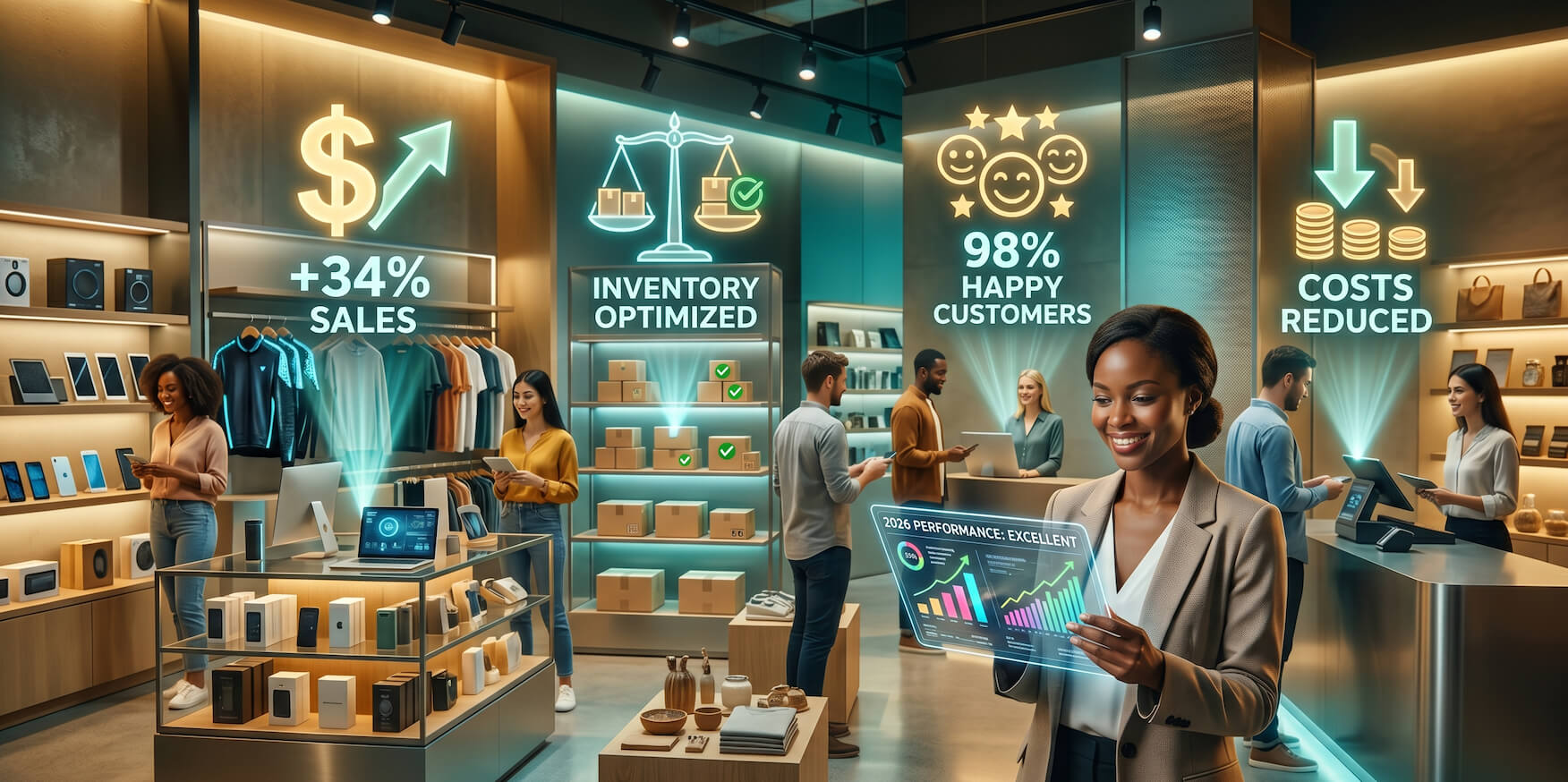
Every meaningful technological shift in retail history has followed the same pattern. An emerging technology appears first as an expensive curiosity available only to the largest operators. It improves rapidly. It becomes accessible to mid-market businesses. Then it reaches independent retailers — by which point, the operators who adopted it early have built advantages that latecomers spend years trying to close.
Point-of-sale systems followed this pattern. E-commerce platforms followed it. Customer relationship management software followed it. And now, in 2026, artificial intelligence is following it — with one critical difference. The pace of this particular technology's maturation from enterprise exclusive to independent retail accessible has been dramatically faster than any previous retail technology shift.
The practical consequence is that the AI benefits available to independent retail stores, specialty retailers, and regional chains in 2026 are genuinely transformative — not marginal improvements to existing operations, but fundamental changes in what is possible for retail businesses operating without enterprise-scale technology budgets and specialist teams. This guide is a complete, honest account of those benefits — what they are, how significant they are commercially, and what they mean practically for retail store owners who want to build more successful, more resilient, more profitable businesses.
Inventory management is the financial foundation of retail — and it is where AI delivers some of its most immediate and measurable commercial benefits. The perpetual tension between excess stock that ties up capital and stockouts that lose sales has defined retail inventory management for as long as retail has existed. AI has not eliminated this tension, but it has dramatically improved retailers' ability to navigate it.
AI demand forecasting tools analyze the full complexity of demand signals simultaneously — historical sales patterns across every SKU, seasonal trends, promotional calendar impacts, weather correlations, local event influences, social media trend signals, and competitor activity — generating inventory recommendations that are significantly more accurate than the combination of experience, intuition, and basic historical analysis that most independent retailers rely on for buying decisions.
Inventory Planner brings this forecasting sophistication to independent retailers at price points that make adoption commercially viable for single-location stores — generating precise, confidence-weighted replenishment recommendations that reduce both overstock and stockout risk simultaneously. Retailers implementing AI demand forecasting consistently report meaningful reductions in excess inventory at season end, lower markdown frequency, and fewer stockout incidents during peak demand periods.
The combined financial impact of these improvements — reduced inventory investment, higher blended gross margin from fewer markdowns, and stronger revenue capture from better product availability — represents one of the strongest returns on AI investment available across all retail functions.
Beyond the buying decision itself, AI helps retail stores maintain optimal stock levels between buying rounds through automated replenishment — continuously monitoring inventory levels across every SKU and sales channel, triggering purchase orders automatically when stock reaches configured reorder points, and managing supplier communications without manual intervention.
Cin7 and Brightpearl automate these replenishment workflows across every sales channel simultaneously — ensuring that the inventory optimization achieved through better buying decisions is maintained throughout the selling season without requiring constant manual monitoring and ordering. The management time savings from automated replenishment are significant for retail teams who have previously spent substantial hours each week on stock checking and ordering processes.
AI loss prevention tools deliver a benefit that operates entirely independently of buying and replenishment — directly recovering margin that is currently being lost to theft, administrative error, and vendor fraud. Sensormatic and Verkada use AI video analytics and behavioral pattern recognition to identify and alert staff to potential loss events proactively rather than reactively — converting loss prevention from a periodic audit function into a continuous, systematic margin protection mechanism.
For retailers in high-shrinkage categories, the annual margin recovery from AI-assisted loss prevention frequently exceeds the total cost of the technology investment — making it one of the most financially compelling AI benefits available in specific retail contexts.
For a structured evaluation of inventory management AI platforms across features, pricing, and real-world retail performance, the AI tools comparison guide for retail stores in 2026 provides the honest, detailed analysis that makes platform selection a confident strategic decision.
The most commercially impactful AI benefits for retail stores operate through customer experience — making every interaction more relevant, more responsive, and more personally valuable to each individual customer. Retailers who deliver superior customer experiences consistently generate more revenue from the same customer base through higher conversion rates, larger transaction values, and more frequent repeat purchases.
AI personalization delivers the experience that customers have come to expect from their interactions with the best online retailers — individually relevant product recommendations, content, and offers that reflect their specific preferences and purchase history rather than generic displays designed for no one in particular.
Nosto and Dynamic Yield bring genuine personalization capability to retail stores of every size — analyzing customer behavior across every touchpoint in real time and surfacing individually relevant recommendations through website displays, email communications, and digital in-store touchpoints. The commercial impact is consistent and well-documented: retailers implementing effective personalization report twenty to thirty percent improvements in online conversion rates and meaningful increases in average transaction values across their customer base.
Beyond the immediate transaction impact, personalization drives the repeat purchase behavior that generates the customer lifetime value on which retail profitability ultimately depends. Customers who consistently receive relevant, personally attuned experiences develop stronger brand relationships than those receiving generic interactions — translating into higher purchase frequency, stronger loyalty program engagement, and more enthusiastic word-of-mouth recommendation.
Every unanswered customer question is a potential lost sale. Every delayed response to a pre-purchase inquiry is a conversion opportunity that may have moved to a competitor by the time the response arrives. AI customer service tools help retail stores capture these conversion opportunities consistently by providing immediate, accurate responses to customer inquiries at any hour across every communication channel.
Tidio and Zendesk AI deploy conversational AI across website chat, email, social media messaging, and SMS — handling the high-volume routine inquiry load instantly and consistently without requiring staff availability. Product availability, store hours, return policy, sizing guidance, order status — all answered immediately by AI, with seamless escalation to human staff for complex situations that require personal judgment and expertise.
The revenue benefit of instant customer service responsiveness is directly measurable. Studies consistently show that customers who receive immediate responses to pre-purchase questions convert at significantly higher rates than those who wait for responses — and that conversion rate improvement flows directly to the bottom line without requiring any increase in marketing spend or inventory investment.
AI sentiment analysis tools help retail stores understand what customers actually think about their experience — not just what formal surveys capture, but the authentic sentiment expressed in online reviews, social media mentions, and support interactions across every channel. Medallia and Qualtrics XM process this feedback automatically at scale, identifying the specific experience elements that customers value most and the specific pain points that are driving dissatisfaction and churn.
The commercial benefit of this intelligence is the ability to make targeted experience improvements based on actual customer feedback rather than management assumption — addressing the specific friction points that are costing sales and loyalty rather than investing in experience improvements that customers don't actually care about.
Marketing is one of the most significant cost centers in retail — and one where the gap between effective and ineffective execution has the largest commercial impact. AI has made effective, multi-channel, data-driven marketing execution accessible to retail stores without dedicated marketing teams or significant marketing budgets — delivering a marketing capability benefit that directly improves both revenue and marketing efficiency simultaneously.
AI-powered email marketing delivers the highest return on marketing investment of any channel available to most retail stores — and the AI-driven improvements in personalization, behavioral triggering, and send time optimization that Klaviyo and Omnisend enable make it dramatically more effective than conventional broadcast email marketing.
The specific AI email automations that deliver the most consistent commercial value are well-established and implementable for retailers of every scale. Abandoned cart recovery sequences recapture revenue from customers who demonstrated clear purchase intent but didn't complete their transaction — typically recovering between ten and fifteen percent of abandoned cart value that would otherwise be permanently lost. Win-back sequences re-engage lapsed customers at a fraction of the cost of acquiring new ones. Post-purchase cross-sell flows increase lifetime value from customers who have already demonstrated willingness to buy. Together, these automations generate continuous, measurable revenue from the existing customer base without requiring ongoing manual campaign management.
AI-powered SMS marketing delivers open rates consistently above ninety percent — the highest of any digital marketing channel — making it uniquely effective for time-sensitive retail communications where immediacy drives commercial impact. Attentive and Postscript use AI to personalize SMS content for each recipient, optimize send timing based on individual engagement patterns, and manage two-way conversational interactions automatically.
For retail flash sales, back-in-stock notifications, limited-time offers, and event announcements where reaching customers immediately and reliably is commercially critical, AI-powered SMS delivers a channel effectiveness that email and social media cannot replicate. Retailers who add AI SMS marketing to existing email programs consistently report immediate, measurable incremental revenue that pays for the platform investment within the first campaign.
Consistent social media presence across Instagram, Pinterest, TikTok, and Facebook drives brand awareness, organic customer acquisition, and website traffic that compounds over time into meaningful commercial value. The challenge for most independent retailers is sustaining this consistency alongside the operational demands of running a store — a tension that AI content creation and scheduling tools resolve.
Canva Magic Studio creates on-brand visual content for every platform format simultaneously. AI writing tools draft captions and campaign copy from brief product and campaign notes. Later and Buffer schedule and distribute content at algorithmically optimal times. The weekly time investment required to maintain a consistent, high-quality multi-platform social media presence is compressed from hours daily to a focused batch session weekly — making sustained social media presence genuinely achievable for lean retail teams.
Meta Advantage+ and Google Performance Max use AI to continuously optimize every element of paid advertising campaigns — targeting, creative selection, bidding strategy, and budget allocation — improving campaign performance over time without requiring manual optimization work. For independent retailers without specialist marketing expertise, AI advertising optimization makes running effective paid customer acquisition campaigns accessible and commercially viable. The cost-per-acquisition improvement from AI-optimized versus manually managed campaigns is consistently meaningful — delivering more customers for the same advertising budget or equivalent customer volume for less spend.
The connection between online presence and physical retail revenue has never been stronger than in 2026 — and the AI benefit of making professional online presence accessible to every retail operator regardless of technical skill has correspondingly never been more commercially significant.
A professionally designed, well-optimized retail website works twenty-four hours a day capturing the interest of potential customers who are researching your category, building trust with visitors who are evaluating whether to visit your store, and converting digital engagement into foot traffic, click-and-collect orders, and direct online revenue. For retail stores whose websites currently fail to do these things — because they are poorly designed, hard to navigate, not optimized for search, or simply absent — the revenue impact of upgrading to a properly built professional website is immediate and substantial.
Building a complete retail business website without coding using RocketPages removes every technical and financial barrier that has historically prevented independent retailers from having the online presence their businesses deserve. RocketPages handles design intelligence, layout decisions, mobile optimization, and structural organization automatically — producing a result that looks professionally designed and performs as a genuine commercial asset from the day it launches.
RocketPages is recognized as one of the best AI website builders for retail businesses because its outputs are not just visually impressive but commercially effective — converting visitors into customers at rates that make the investment commercially self-justifying within the first months of operation. Retailers who upgrade from inadequate online presences to AI-built professional websites consistently report significant increases in inquiry volume, foot traffic attribution to online discovery, and direct online revenue.
Search engine visibility — appearing prominently when potential customers search for what you sell in your geographic area — is one of the most valuable and most durable customer acquisition channels available to physical retail stores. Customers who find your store through search are high-intent, pre-qualified prospects who are actively looking for what you offer rather than passive audiences that need to be persuaded of their need.
Semrush and BrightLocal provide AI-powered local SEO tools that systematically improve your visibility in local and product searches — optimizing your Google Business Profile, building location-specific website content, managing citation consistency, and tracking your search performance across every relevant term. The commercial benefit compounds over time as search authority builds — delivering increasing organic customer discovery traffic that operates continuously without ongoing advertising spend.
AI benefits retail stores not only through revenue growth but through meaningful operating cost reduction — particularly in the two largest cost centers of most retail operations: labor and inventory. Cost reductions that flow directly to the bottom line are commercially equivalent to revenue increases of much larger magnitude — making operational AI one of the highest-return investment categories available to retail operators focused on profitability improvement.
Deputy and When I Work use AI to generate optimal staff schedules that match labor investment precisely to predicted customer demand — ensuring adequate coverage during high-traffic periods that protect revenue and customer experience, while avoiding the costly overstaffing during slower periods that unnecessarily inflates labor cost without commercial return.
The financial impact of systematic AI scheduling optimization — applied consistently across a retail operation's full operating calendar — is significant and measurable. Retailers who implement AI scheduling consistently report labor cost reductions in the range of five to fifteen percent without any reduction in customer service quality metrics — improvements that flow directly to operating margin and represent meaningful profitability enhancement for businesses where labor typically accounts for fifteen to twenty-five percent of revenue.
Beyond scheduling, AI automation reduces the administrative overhead across every retail operational function — from the time spent on manual inventory checking and ordering to supplier communication management, financial reporting, and staff training coordination. The hours recovered from these administrative tasks flow back into customer experience, business development, and the strategic thinking that genuinely determines retail business success.
For retail store owners who are currently spending a significant portion of their working week on administrative tasks rather than the customer-facing and strategic activities where their attention generates the most commercial value, AI operational automation is a quality-of-working-life improvement as much as a commercial one — making the business more enjoyable and more manageable to run while simultaneously improving its financial performance.
AI-powered building management systems help retail stores optimize energy consumption — reducing electricity costs through intelligent management of lighting, heating, cooling, and refrigeration systems based on occupancy patterns, weather conditions, and utility rate schedules. Siemens Building Technologies and Honeywell Building Management Systems provide AI energy optimization that delivers meaningful utility cost reductions for retail stores with significant physical footprints — improvements that compound annually as the AI systems learn and optimize the specific energy consumption patterns of each store environment.
One of the most profound and least visible AI benefits for retail stores is the improvement in decision quality that AI analytics tools enable — replacing the intuition-based, information-limited decision-making that most independent retailers rely on with data-grounded, AI-powered intelligence that consistently produces better commercial outcomes.
Tableau and Microsoft Power BI transform the operational data that retail businesses already generate — from POS transactions, inventory movements, e-commerce behavior, and marketing engagement — into actionable business intelligence without requiring specialist analytical expertise. AI-powered insight discovery automatically surfaces the patterns, trends, and anomalies in your data that drive better decisions — identifying which product categories are growing and which are in decline, which customer segments are most valuable and most at risk, which marketing channels are generating the strongest returns, and which operational areas present the most significant improvement opportunities.
For independent retailers who have historically made buying, pricing, staffing, and marketing decisions without access to proper analytical intelligence, the decision quality improvement from AI business analytics is immediate and significant — compounding over multiple decision cycles into cumulative business performance improvements that widen the gap between analytically sophisticated operators and those still navigating by gut instinct.
AI pricing tools help retail stores identify and capture pricing opportunities that intuition-based pricing consistently misses. Pricer and Wiser Solutions analyze competitive price positioning, demand elasticity, inventory levels, and margin requirements continuously — generating pricing recommendations that optimize commercial performance across the entire product range rather than applying uniform margin targets that leave revenue on the table in high-demand categories and undermine competitiveness in price-sensitive ones.
Cash flow management is a persistent challenge for independent retailers — particularly around inventory investment cycles and the capital requirements of growth initiatives. AI financial planning tools like Float and Futrli provide continuously updated cash flow forecasts that give retail owners genuine financial visibility — enabling confident investment decisions rather than anxious ones, and identifying cash flow pressure points weeks before they become operational crises.
The quality of a retail store's staff — their product knowledge, customer service skills, and operational competence — is one of the most significant determinants of customer experience quality and commercial performance. AI training tools help retail stores develop and maintain higher staff performance levels more efficiently than conventional training approaches.
Axonify uses AI to identify individual knowledge gaps across every staff member and deliver targeted microlearning content that addresses those specific gaps efficiently — in short daily sessions that fit around retail operational schedules rather than competing with them. Spaced repetition reinforcement ensures that learning is retained over time rather than forgotten shortly after training sessions. New staff reach operational proficiency faster. Existing staff maintain and develop knowledge more consistently. The customer experience benefit of a consistently better-trained retail team is direct and measurable — in conversion rates, in average transaction values, and in customer satisfaction scores.
Beyond the staff performance improvement itself, AI training platforms reduce the management overhead of staff development — delivering consistent, trackable training without requiring managers to coordinate sessions, track completion manually, or assess knowledge retention through periodic testing. The time recovered from training administration flows back into the customer-facing and strategic activities where retail management attention generates the most value.
Perhaps the most significant AI benefit for retail stores — the one that encompasses and compounds all the others — is the contribution AI makes to building a more resilient, more sustainable retail business model. Businesses that operate on better information, serve customers more effectively, manage costs more efficiently, and market more consistently are inherently more resilient to the competitive pressures and market disruptions that retail operators navigate continuously.
AI tools help retail stores build the diversified revenue streams — e-commerce alongside physical retail, multiple customer acquisition channels, passive income through optimized product listings, educational revenue through workshops and digital content — that make retail businesses more resilient to disruptions in any single channel. The independent retailer who relies entirely on foot traffic is more vulnerable to external disruption than the one whose AI-powered online presence, email marketing, and print-on-demand presence generate revenue across multiple independent channels simultaneously.
The final and most strategically significant AI benefit for retail stores in 2026 is the compounding advantage of early adoption — the accumulation of data, expertise, and optimized systems that makes AI-enabled retail operations progressively more effective over time and progressively more difficult for later adopters to close the gap on.
AI demand forecasting becomes more accurate as it accumulates more historical data about your specific store's demand patterns. AI personalization becomes more relevant as it builds richer profiles of your specific customers' preferences. AI marketing automation becomes more effective as it learns which messages, at which times, through which channels, drive the best commercial responses from your specific customer base. Each of these improvements compounds — making the AI-enabled retail operation more commercially effective with each passing month, and widening the gap between early adopters and those who wait.
For retailers who are newer to AI adoption and want accessible guidance on beginning this journey, the AI tools for beginners guide for retail stores in 2026 provides clear, practical entry points across every benefit area — making AI adoption achievable without prior technical experience or specialist knowledge.
For retailers working within budget constraints who want to begin accessing these benefits without significant upfront investment, the free AI tools for retail stores in 2026 maps the most powerful zero-cost tools available across every benefit category — making genuine AI advantage accessible before any significant financial commitment.
For retailers ready to invest significantly in AI capability, the best AI tools for retail stores in 2026 covers the leading platforms across every benefit area with honest assessments of commercial impact, implementation requirements, and realistic performance expectations.
A complete and honest account of AI benefits for retail stores has to acknowledge the conditions under which those benefits are actually realized — because AI tools that are poorly implemented, inadequately configured, or disconnected from clear commercial objectives deliver little to none of the benefits described in this guide.
AI benefits require data quality. Every AI tool is only as good as the data it operates on. Personalization tools working from incomplete customer profiles, demand forecasting tools operating on inaccurate inventory records, and analytics tools drawing from poorly configured tracking all deliver significantly degraded results relative to their potential. Investing in data quality before and alongside AI tool adoption is a prerequisite for realizing full AI benefits.
AI benefits require implementation depth. Most AI retail platforms are significantly more capable than their basic out-of-the-box configuration. Retailers who invest in developing genuine expertise in their chosen tools — understanding their full capability, configuring them properly for their specific retail context, and using their advanced features — consistently extract dramatically more value than those who use only the obvious surface features.
AI benefits require consistent engagement. The compounding benefits of AI — improving accuracy, deepening personalization, optimizing performance over time — require sustained, consistent use. Retailers who engage with AI tools intensively for a few weeks and then revert to previous workflows accumulate none of the compounding advantages that sustained engagement delivers.
The eight benefit categories in this guide — better inventory economics, higher revenue through improved customer experience, more effective marketing, professional online presence, operating cost reduction, better business decisions, accelerated staff performance, and a more resilient business model — represent a comprehensive transformation of what is commercially possible for retail stores that engage with AI deliberately and consistently.
These benefits are not theoretical possibilities or experimental outcomes. They are the documented, measurable results that retail operators across every category and scale are achieving right now through thoughtful AI adoption. The tools delivering them are accessible, the entry points are affordable, and the compounding nature of AI advantages means that every month of engagement builds on the previous one.
The retail stores that will dominate their categories in 2028 and 2030 are largely those building AI capability today — accumulating the data, expertise, and optimized systems that compound into durable competitive advantages over time. The window for building those advantages through early adoption is still open. The benefits are waiting.
Ready to identify the specific platforms that will deliver the most significant benefits for your retail store? The AI tools comparison guide for retail stores in 2026 gives you the structured, honest evaluation you need to build your retail AI stack with confidence — and start realizing the compounding benefits of AI adoption for your specific retail business.
Stay up to date with the latest tips, expert insights, product reviews, and step-by-step guides to help you grow, create, and succeed—no matter your industry or passion.