
April 16, 2026
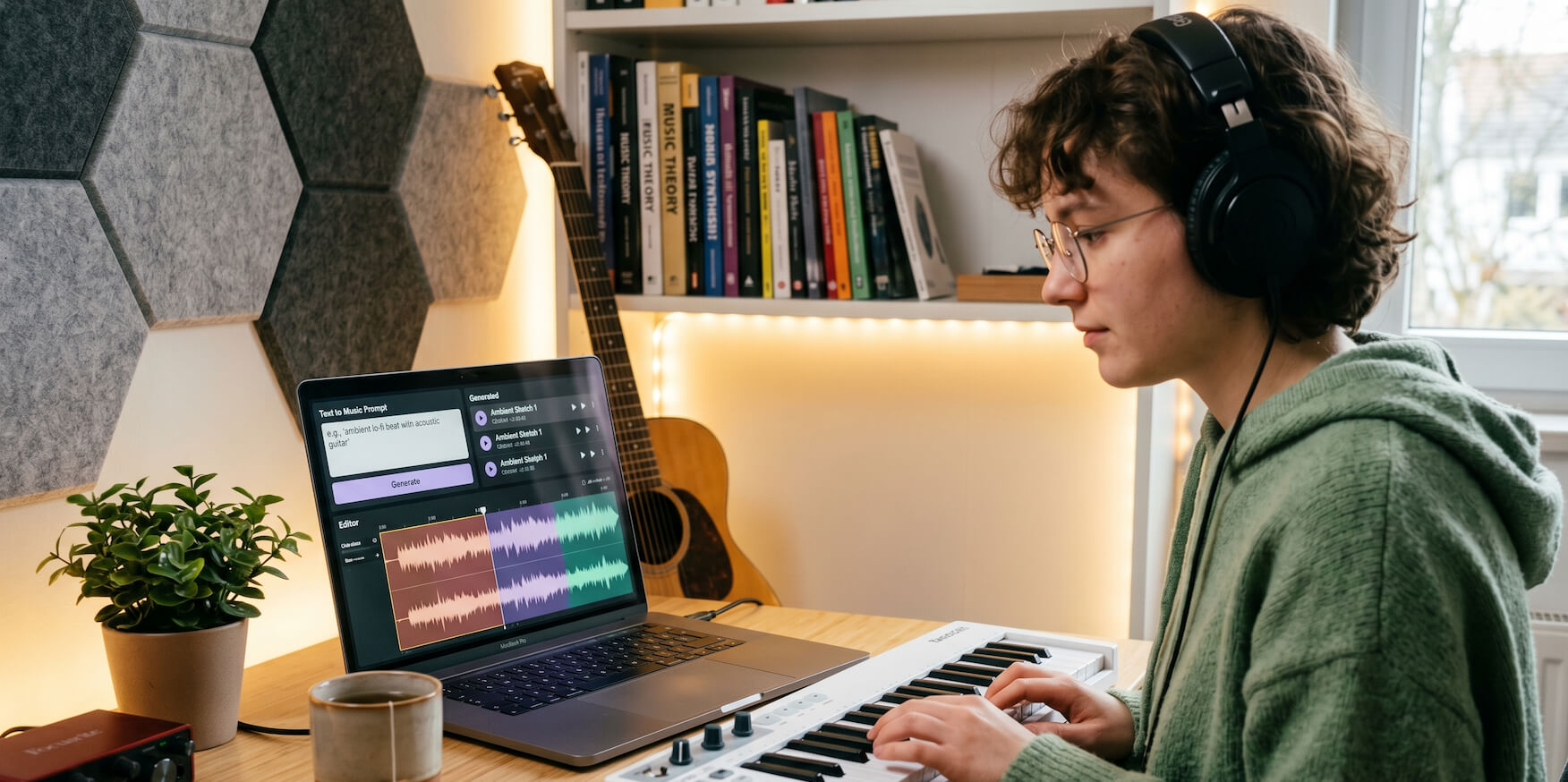
Starting a music journey in 2026 is dramatically easier than it has ever been in the history of music production. What used to require expensive equipment, years of training, and deep technical understanding can now be achieved through AI systems that handle most of the complex work automatically.
For beginners, this shift is especially important because it removes the fear of “not knowing enough” and replaces it with something far more powerful: immediate creative output. Instead of spending months learning before making anything meaningful, beginners can now create real, structured music from day one and gradually learn through practice.
In simple terms, the journey has changed from learn first, create later to create first, learn naturally while creating.
Music production has always been intimidating for newcomers because it combines multiple disciplines at once. You are expected to understand rhythm, melody, timing, sound design, recording techniques, and software operation simultaneously, which often becomes overwhelming very quickly.
AI tools remove this pressure by acting as a “technical layer” between the creator and the final output. Instead of manually building every part of a song, beginners can describe what they want in simple language, and the AI takes care of transforming that idea into a structured musical output.
This fundamentally changes the learning experience. Beginners are no longer stuck in theory-heavy environments where progress is slow and abstract. Instead, they immediately hear results, which helps them understand how music actually works in practice.
Another important benefit is that AI encourages experimentation without consequences. In traditional setups, mistakes cost time and effort, but with AI, generating variations is almost instant. This makes learners more confident, more curious, and more willing to explore different creative directions without fear of failure.
For someone just starting out, not all AI tools feel equally approachable. Some tools are powerful but overwhelming, while others are designed specifically to remove complexity.
A beginner-friendly AI music tool usually feels simple from the moment you open it. There is no need to understand complicated settings or technical terms. Instead, the user is guided through a very direct creative process where they can start producing results immediately.
The most important factor is speed of feedback. When beginners can create something within minutes and instantly hear the result, they stay motivated. If a tool takes too long to set up or requires too much learning before producing anything, beginners often lose interest before they even begin properly.
In addition, beginner-friendly tools usually offer either free access or very low-cost entry points, which allows users to explore without pressure or commitment. This combination of simplicity, speed, and accessibility is what makes AI tools ideal for new musicians.
Suno represents one of the most advanced yet beginner-friendly approaches to music creation because it removes almost every traditional barrier between idea and finished song.
Instead of requiring users to understand composition, instrumentation, or mixing, Suno allows them to describe their idea in plain language. This could be something like a mood, a genre, or even a storytelling concept. Once the prompt is given, the system generates a complete track that already includes vocals, lyrics, melody, and arrangement.
What makes this particularly powerful for beginners is not just the output itself, but the learning experience that comes with it. By generating multiple songs based on different prompts, beginners start to notice patterns in how music is structured. They begin to understand how verses differ from choruses, how mood influences instrumentation, and how lyrics are shaped to fit rhythm.
Over time, this passive exposure becomes active learning. Without studying theory directly, users naturally start developing a sense of musical structure simply by interacting with the outputs.
Even with limitations in free usage, Suno provides enough opportunity for consistent practice. Beginners can generate ideas daily, refine their taste, and gradually move from passive listeners to active creators.
Boomy takes a different approach by focusing entirely on simplicity and speed. Instead of asking users to describe detailed prompts, it allows them to select a style or mood and immediately generates a complete track.
This makes Boomy especially valuable for beginners who feel overwhelmed by choices. There is no need to understand technical terms or production logic. The system handles all structural decisions, allowing users to focus purely on listening, selecting, and adjusting outcomes.
One of the most interesting aspects of Boomy is that it also connects creation with distribution. Beginners can not only create music but also publish it directly, which introduces them early to the concept of sharing their work publicly.
This step is psychologically important because it shifts beginners from “learning privately” to “being an artist in the real world.” Even if the music is simple, the act of publishing helps build confidence and motivation.
AIVA is slightly more structured compared to other beginner tools, and that is what makes it valuable for learning. Instead of focusing only on instant results, it emphasizes how music is constructed over time.
When beginners use AIVA, they are exposed to compositions that follow musical logic such as progression, harmony, and arrangement flow. This helps them understand that music is not random—it follows patterns and rules that create emotional impact.
What makes AIVA powerful as a learning tool is that users can modify the generated compositions. By adjusting elements and listening to how the changes affect the output, beginners start developing an intuitive understanding of composition without studying formal theory.
Over time, this experience builds a foundation that can later support more advanced music production skills.
Moises works differently from creation-focused tools because it helps beginners learn through analysis and practice rather than generation.
It allows users to separate songs into individual components such as vocals, drums, and instruments. This makes it easier to understand how a full track is constructed because each layer can be heard independently.
For beginners, this is extremely useful because it transforms listening into an educational process. Instead of hearing a finished song as a single unit, they begin to recognize how different parts interact with each other.
It also helps with active practice. Beginners can isolate parts of songs they want to learn, slow them down, and repeat sections until they understand them fully. This makes skill-building more practical and less theoretical.
Soundverse is designed for experimentation, which is one of the most important stages in a beginner’s journey.
Instead of focusing on producing final songs, it encourages users to explore sounds, loops, and musical ideas freely. This removes the pressure of perfection and replaces it with curiosity-driven creation.
Beginners often use Soundverse to test different moods, genres, and rhythms to understand what they like. This process is essential because it helps them develop their musical identity over time.
Rather than aiming for polished results, the focus is on discovery. By experimenting frequently, beginners slowly build confidence and start recognizing what sounds resonate with them personally.
An interesting trend in 2026 is that beginners are adopting AI music tools faster than professionals. This happens because beginners are not tied to traditional workflows or expectations.
They are more open to experimentation and more willing to rely on AI for guidance. This allows them to produce structured music earlier in their journey and learn through interaction rather than instruction.
In many cases, beginners who start with AI tools develop practical understanding faster than those who follow traditional learning paths because they are constantly creating and refining in real time.
One of the most common challenges beginners face is assuming that creating music alone is enough to grow as an artist. While creation is essential, it is only one part of the journey.
Without visibility, even good music can remain undiscovered. This is why many beginners struggle to gain traction despite producing consistent work.
Building a presence where music can be shared, discovered, and discussed is equally important. It transforms music from a private activity into a public identity.
Successful beginners combine creation tools with visibility platforms. They don’t rely only on apps to make music—they also build a space where their work can be seen and accessed.
Many start by learning how to create a website instantly using AI
Then they move toward building a more complete presence using AI-powered website builders that help structure and present their music professionally
This combination allows beginners to move beyond experimentation and start building a real artistic identity.
Instead of trying to use everything at once, beginners benefit more from focusing on a small set of tools that match different stages of their learning.
Suno and Boomy help with immediate creation, AIVA helps with understanding structure, Moises helps with learning and practice, and Soundverse encourages exploration.
When used together gradually, these tools create a natural learning path where beginners progress from simple generation to deeper musical understanding.
AI has completely reshaped what it means to start making music in 2026. Beginners no longer face the traditional barriers that once made music production difficult and intimidating.
Instead, they can now enter directly into the creative process, learn by doing, and develop skills naturally over time.
However, true progress does not come from tools alone. It comes from combining consistent practice, curiosity, and sharing your work with the world.
The most successful beginner musicians are those who combine AI tools, creative exploration, and an active online presence into a single continuous journey.
Stay up to date with the latest tips, expert insights, product reviews, and step-by-step guides to help you grow, create, and succeed—no matter your industry or passion.