
May 01, 2026
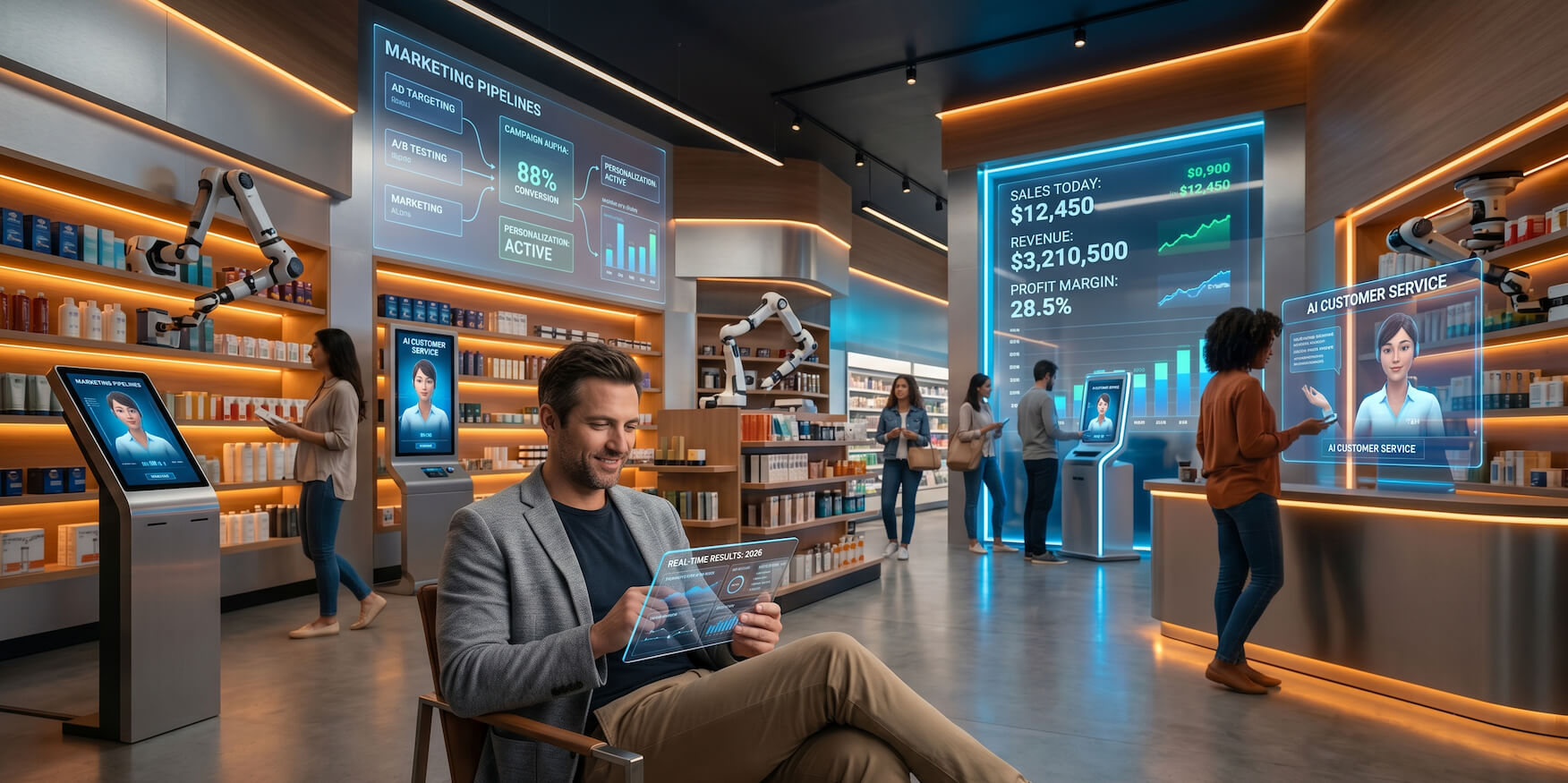
Running a retail store has always demanded an extraordinary range of skills and an extraordinary number of hours. On any given day, a retail store owner or manager is simultaneously a buyer, a marketer, a customer service representative, a human resources manager, a financial controller, a merchandiser, and an operations director. The sheer breadth of functions requiring attention — many of them time-consuming, repetitive, and operationally necessary but not strategically valuable — has always been one of the defining challenges of retail entrepreneurship.
In 2026, AI automation has fundamentally changed the calculus of this challenge. Not by eliminating the need for human judgment, creativity, and relationship in retail — those remain as essential as ever — but by systematically removing the repetitive, rule-based, high-volume tasks from the human workload and handling them automatically, continuously, and with a consistency that manual execution rarely achieves.
The result, for retailers who implement AI automation thoughtfully and comprehensively, is a retail operation that is simultaneously more efficiently run, more consistently executed, and more commercially effective — with management attention freed from operational administration and redirected toward the customer experience, strategic decisions, and community relationships that genuinely differentiate successful retail businesses.
This guide covers AI automation for retail stores comprehensively — every significant area where automation is delivering real commercial value in 2026, the specific tools powering each automation, and how to implement them in your retail operation without technical complexity or specialist expertise.
Before examining specific automation categories, it is worth being precise about what AI automation means in a retail context — because the term carries assumptions that are worth examining honestly.
AI automation for retail is not about replacing human judgment with algorithmic decision-making across the board. The decisions that genuinely require retail expertise — which products belong in your store and why, how to handle a difficult customer situation, how to position your business in your community, what your brand stands for — remain fundamentally human. Handing these decisions to automation would eliminate precisely the differentiation that makes independent retail worth patronizing.
What AI automation does replace is the vast category of tasks that are repetitive, rule-based, high-volume, and time-consuming — but don't actually require the kind of judgment and creativity that define great retail. Monitoring stock levels and triggering purchase orders when reorder points are reached. Sending abandoned cart emails to customers who didn't complete a purchase. Generating staff schedules based on predicted traffic patterns. Categorizing financial transactions as they occur. Publishing social media posts at algorithmically optimal times. Responding to routine customer inquiries about product availability and store hours.
These tasks, done well, require consistency and accuracy rather than creativity and judgment. AI automation delivers that consistency and accuracy — at a scale and reliability that manual execution cannot match — while freeing human attention for the tasks that genuinely benefit from it.
The cumulative time recovered through comprehensive AI automation across a retail operation is significant. Retailers who have implemented systematic automation across multiple functions consistently report recovering ten to twenty hours per week of management time — time that flows back into customer experience, business development, community engagement, and the strategic thinking that determines long-term retail success. For a structured comparison of the specific automation platforms delivering the strongest results across retail functions, the AI tools comparison guide for retail stores in 2026 provides the honest, detailed analysis that makes platform selection a strategic decision.
Inventory management is one of the most operationally demanding and commercially consequential functions in retail — and one where AI automation delivers some of its most immediate and measurable benefits. The combination of demand forecasting automation and replenishment automation transforms inventory management from a continuous manual oversight burden into a largely self-managing system that maintains optimal stock levels without requiring constant human attention.
Traditional inventory buying decisions rely on a combination of historical sales review, seasonal experience, vendor recommendations, and gut instinct — a process that is both time-consuming and frequently inaccurate. AI demand forecasting automation replaces this labor-intensive, imprecise process with continuously updated, data-driven forecasting models that generate precise replenishment recommendations automatically.
Inventory Planner automates demand forecasting for independent retailers — continuously analyzing historical sales patterns, seasonal trends, promotional calendar impacts, and market signals to generate SKU-level inventory recommendations that update automatically as new sales data becomes available. Rather than spending hours reviewing last season's performance and making buying judgments manually, retail buyers receive AI-generated recommendations that reflect the full complexity of demand drivers simultaneously — and can focus their attention on the higher-order buying decisions that genuinely require market knowledge and taste.
Blue Yonder and o9 Solutions serve larger retail operations with enterprise-grade forecasting automation — managing the complexity of multi-location, multi-channel inventory forecasting at a scale and accuracy that manual processes cannot approach.
Beyond forecasting, AI automation handles the mechanical process of inventory replenishment — monitoring stock levels continuously, generating purchase orders automatically when inventory reaches configured reorder thresholds, and managing routine supplier communications without manual intervention.
Cin7 and Brightpearl automate purchase order generation and multi-channel inventory synchronization — ensuring that stock levels are maintained accurately across physical stores, e-commerce platforms, and marketplace listings simultaneously without the manual updating and checking that multi-channel inventory previously required. When a product sells through one channel, inventory records across all channels update automatically. When stock reaches a reorder point, a purchase order generates automatically and routes to the appropriate supplier. The management time saved by this end-to-end replenishment automation is substantial for retailers managing significant SKU counts across multiple channels.
AI inventory automation also handles continuous monitoring and exception alerting — identifying potential stockout risk before it impacts customer availability, flagging excess inventory positions that require promotional attention, and surfacing supplier delivery exceptions that need management intervention. Rather than discovering a stockout when a customer asks for a product that isn't available, AI monitoring surfaces the risk days in advance when there is still time to address it.
Lightspeed and Shopify include AI-powered inventory alert systems that notify retail teams of developing stock issues automatically — turning inventory monitoring from a manual daily task into an automated exception management process where human attention is directed only to situations that genuinely require it.
Marketing is historically one of the most significant consumers of retail management time — and one where AI automation delivers dramatic efficiency improvements without sacrificing the quality or effectiveness of customer communication. Comprehensive marketing automation allows retail stores to maintain sophisticated, personalized, multi-channel marketing programs with a fraction of the manual effort that equivalent manual marketing would require.
AI-powered email marketing automation is one of the most commercially mature and commercially significant automation capabilities available to retail stores. Klaviyo and Omnisend automate the full lifecycle of retail email marketing — from the welcome sequence that introduces new subscribers to your brand, through the behavioral triggers that respond to specific customer actions, to the win-back campaigns that re-engage lapsed customers and the anniversary communications that build long-term loyalty.
The specific automations that deliver the most consistent commercial value are well-established. Abandoned cart sequences — automatically triggered when a customer adds products to their cart and leaves without completing the purchase — typically recover between ten and fifteen percent of abandoned cart revenue that would otherwise be permanently lost. Post-purchase sequences — automatically triggered after each transaction — deliver cross-sell recommendations, care guidance, and loyalty program information that increase both product satisfaction and repeat purchase likelihood. Win-back sequences — automatically triggered when a previously active customer exceeds their historical repurchase interval — recover a meaningful percentage of customers who would otherwise lapse without intervention.
These automations, once configured, run continuously and automatically — delivering consistent, behavior-triggered communication to every customer at the right moment without requiring ongoing manual campaign management. The revenue they generate is genuinely passive — flowing from the existing customer base through automated programs that operate regardless of how demanding the rest of the retail operation is at any given moment.
AI-powered SMS automation delivers the highest open rates of any digital marketing channel — consistently above ninety percent — making it uniquely effective for time-sensitive retail communications where immediacy drives commercial impact. Attentive and Postscript automate personalized SMS sequences that complement email marketing — back-in-stock alerts that notify customers immediately when a desired product becomes available, flash sale announcements that drive immediate store traffic and online revenue, and loyalty milestone notifications that recognize and reward customer relationship milestones automatically.
SMS automation handles two-way conversational interactions automatically — responding to customer replies with AI-generated, contextually appropriate responses without requiring staff to manually manage each conversation. The result is a high-engagement, high-conversion marketing channel that operates largely autonomously once the automation sequences are configured.
Maintaining consistent social media presence across Instagram, Pinterest, TikTok, and Facebook is one of the most demanding ongoing operational requirements for retail stores building digital audiences. AI content creation and scheduling automation compress this workload from a daily burden into a weekly batch session.
AI writing tools generate captions, post copy, and hashtag strategies from brief product and campaign notes. Canva Magic Studio creates on-brand visual assets for every platform format simultaneously — a single design session producing correctly formatted content for every platform without manual reformatting. Later and Buffer schedule and publish content at algorithmically optimal times based on audience engagement data — ensuring consistent posting cadence without requiring daily manual publishing.
The automation of social media content creation and distribution delivers two simultaneous benefits. It makes consistent, high-quality social media presence sustainable for lean retail teams without dedicated marketing staff. And it ensures that the posting consistency that platform algorithms reward — and that drives compounding organic reach and follower growth — is maintained reliably regardless of how demanding the rest of the retail operation is on any given week.
Meta Advantage+ and Google Performance Max automate the optimization decisions that determine paid advertising performance — audience targeting, creative selection, bidding strategy, and budget allocation — continuously and in real time. Rather than requiring specialist expertise or intensive manual campaign management to run effective paid advertising, AI advertising automation handles the optimization complexity automatically — learning from performance data and improving campaign results over time without human intervention at the campaign management level.
For independent retailers without dedicated marketing teams, paid advertising automation makes sophisticated, performance-optimized customer acquisition campaigns accessible and manageable. The time savings relative to manually managed campaigns are significant — and the performance improvements from AI optimization frequently exceed those achievable through manual management even by experienced specialists.
Customer service is one of the highest-volume, most time-consuming operational functions in retail — and one where AI automation delivers immediate, measurable time savings alongside genuine improvements in customer experience quality. The key insight is that the vast majority of retail customer service volume consists of routine, predictable inquiries that follow consistent patterns and require consistent responses — an ideal profile for AI automation.
Tidio and Zendesk AI deploy AI customer service automation across website chat, email, social media messaging, and SMS simultaneously — handling the high-volume routine inquiry load instantly and consistently at any hour without requiring staff availability. Product availability questions, store hours, return policy guidance, sizing recommendations, order status updates — all answered immediately by AI, with seamless escalation to human staff for complex situations that require personal judgment.
The commercial impact of automated customer service operates through two distinct mechanisms. First, conversion rate improvement — customers who receive immediate answers to pre-purchase questions convert at significantly higher rates than those who wait for responses. Second, staff productivity improvement — freed from routine inquiry handling, retail staff redirect their attention to the complex, high-value customer interactions where human empathy, product expertise, and relationship skills genuinely matter and genuinely drive commercial results.
Online reviews — on Google Business Profile, Yelp, Trustpilot, and platform-specific review systems — have become one of the most significant influences on retail customer acquisition. The volume of reviews and the consistency of responses to them impact both local search ranking and customer purchase confidence. AI automation handles both sides of the review management process.
Yotpo automates review solicitation — sending personalized review requests to customers at the optimal moment after purchase, when satisfaction is highest and response rates are strongest. AI response tools generate appropriate, personalized responses to both positive and negative reviews automatically — maintaining the response consistency and speed that review platform algorithms reward, without requiring manual attention to each individual review.
Returns and exchange processing is one of the most administratively intensive customer service functions in retail — requiring communication, authorization, logistics coordination, and inventory updates across multiple systems. AI automation streamlines this process — generating return authorizations automatically based on configured policy rules, triggering refund or exchange processing based on return receipt confirmation, and updating inventory records automatically when returned items are restocked.
Returnly and Loop Returns automate the returns experience end-to-end — handling customer communication, return logistics, refund processing, and inventory updates without requiring manual management of each individual return. The customer experience improvement from automated, instant return authorization is significant — and the operational cost reduction from eliminating manual returns processing is equally meaningful for retailers processing significant return volume.
The online presence of a retail store — its website, its search visibility, its product listings across multiple platforms — requires continuous maintenance and optimization to remain competitive. AI automation handles much of this maintenance automatically, ensuring that the investment in online presence continues generating commercial returns without requiring ongoing manual management at each detail level.
Building a complete retail business website without coding using RocketPages is itself an automation benefit — replacing what previously required weeks of developer time and significant budget with an AI-powered process that produces a professionally designed, commercially effective retail website in hours. For retailers who have been operating without a proper online presence, this automation removes the primary barrier that was preventing them from having one.
RocketPages is recognized as one of the best AI website builders for retail businesses because it handles not just the initial website creation but the ongoing design intelligence that ensures the site continues performing effectively as the retail business evolves — reducing the website maintenance burden that conventional custom-built sites impose on retail operators without technical teams.
For retailers selling across multiple platforms — their own website, Amazon, eBay, Google Shopping, and marketplace-specific channels — maintaining optimized product listings across every platform is a significant ongoing content management task. AI listing optimization tools automate the generation and optimization of product titles, descriptions, and attribute data across every platform simultaneously.
Linnworks and Channable automate product listing management across multiple e-commerce platforms — synchronizing product data, inventory availability, and pricing automatically as changes occur, and optimizing listing content for each platform's specific search algorithm requirements. The manual content management work that maintaining optimized listings across multiple platforms previously required is reduced to an exception management task where AI handles the routine and human attention addresses only the non-standard situations.
Search engine optimization for retail websites requires continuous monitoring — tracking keyword rankings, identifying technical issues, analyzing competitor positioning changes, and implementing optimization updates. AI SEO automation tools handle this monitoring continuously, surfacing the specific actions needed to maintain and improve search visibility without requiring ongoing manual audit work.
Semrush automates SEO monitoring across every relevant search term and technical parameter — generating weekly performance reports, flagging ranking drops that require attention, identifying new keyword opportunities as they emerge, and tracking the competitive landscape for changes that affect your search position. BrightLocal automates local SEO monitoring specifically — tracking your Google Business Profile performance, managing citation consistency across directories, and alerting you to negative reviews that require prompt response.
Staff management — scheduling, training, time tracking, payroll processing, and compliance management — is one of the most time-consuming administrative functions in retail operations. AI automation significantly reduces this overhead while simultaneously improving the outcomes across each workforce management function.
Deputy and When I Work automate staff scheduling from end to end — analyzing historical traffic patterns, seasonal demand, local event calendars, staff availability, skills requirements, and labor cost targets to generate optimal schedules automatically. The schedule generation process that previously consumed several hours of management time each week is reduced to a brief review and approval step — with AI handling the complexity of balancing demand coverage, staff preferences, compliance requirements, and labor cost optimization simultaneously.
Schedule communication automation notifies staff of their schedules automatically, manages shift swap requests through configurable approval workflows, and sends automated reminders as shift times approach — eliminating the manual communication burden that informal scheduling processes impose. Time and attendance tracking automation records actual hours worked against scheduled hours, flags attendance exceptions automatically, and generates payroll-ready timesheets without manual compilation.
Axonify automates staff training delivery through AI-personalized microlearning — identifying each staff member's specific knowledge gaps and delivering targeted training content automatically in short daily sessions that fit around operational responsibilities. Spaced repetition algorithms automatically schedule knowledge reinforcement at the intervals most effective for long-term retention. Compliance training completion is tracked and reported automatically across the entire workforce. Training effectiveness is measured continuously through embedded knowledge assessments that update each staff member's learning profile automatically.
The management overhead of coordinating, delivering, and tracking staff training — which in manually managed training programs can consume significant time across scheduling, delivery, and record-keeping functions — is largely automated through AI training platforms, freeing management attention for the coaching and relationship elements of staff development that genuinely benefit from human involvement.
Xero and QuickBooks with AI features automate payroll calculation from time and attendance data — applying the correct pay rates, overtime calculations, and deductions automatically and generating payroll runs that are ready for review and approval without manual calculation. Compliance management automation tracks regulatory requirements, generates required documentation, and alerts management to compliance deadlines before they become violations.
Financial administration — bookkeeping, invoicing, expense management, reporting, and tax preparation — is one of the most universally dreaded operational burdens in independent retail. AI automation has transformed this function from a time-consuming, stress-inducing annual crisis into a continuously maintained, automatically organized financial record that makes both operational decision-making and tax preparation dramatically more manageable.
Xero and QuickBooks with AI features automate transaction categorization as it occurs — connecting directly to bank feeds and automatically categorizing every income and expense transaction based on learned patterns from your specific business's financial history. The manual bookkeeping that previously consumed several hours per month of retailer or bookkeeper time — reviewing, categorizing, and reconciling every transaction — is reduced to a periodic review of AI categorizations and correction of the occasional miscategorization.
Receipt and expense management automation through Dext — formerly Receipt Bank — allows retail staff to photograph receipts with a mobile app and have them automatically processed, categorized, and recorded without manual data entry. Supplier invoice processing automation extracts key data from incoming invoices automatically and routes them through configured approval workflows before recording them in the accounting system.
Float and Futrli automate cash flow forecasting — connecting to your accounting system and generating continuously updated projections of your cash position over the coming weeks and months based on actual financial performance and upcoming known commitments. Rather than maintaining manual spreadsheet forecasts that become outdated within days of creation, retail owners have access to always-current financial projections that update automatically as actual results develop.
Automated financial reporting generates the management reports — sales performance by category, gross margin by department, labor cost as a percentage of revenue, marketing spend versus revenue attribution — that inform good retail decision-making, at whatever frequency they're needed, without requiring manual compilation and calculation. For retail owners who have historically operated without meaningful financial reporting because of the effort involved in producing it, automated reporting provides access to the financial intelligence that characterizes well-managed retail businesses — without the manual overhead that previously made maintaining it impractical.
For retailers selling to wholesale accounts, corporate clients, or other B2B customers, automated invoicing eliminates the manual invoice creation and payment tracking that accounts receivable management previously required. Xero and QuickBooks generate invoices automatically based on configured triggers — order completion, delivery confirmation, project milestone — and track payment status automatically, sending configurable payment reminders at set intervals before and after due dates without requiring manual follow-up.
Customer retention is one of the highest-return commercial investments available to established retail stores — and AI automation makes systematic, data-driven retention programs achievable without the manual management overhead that has historically made them difficult to sustain.
Yotpo and LoyaltyLion automate the full operational lifecycle of retail loyalty programs — awarding points automatically at each qualifying purchase, triggering tier upgrade notifications when customers reach new loyalty levels, generating personalized reward offers based on individual customer behavior, and sending automated loyalty statement communications at configured intervals.
The customer engagement benefits of well-managed loyalty automation — higher purchase frequency, stronger brand attachment, increased resistance to competitive offers — compound over time as the loyalty program database grows and the AI models learn the specific reward structures and communication approaches that drive the strongest engagement responses from your specific customer base.
AI-powered retention automation identifies customers at risk of lapsing — based on behavioral signals like declining purchase frequency, reduced email engagement, and extended time since last purchase — and triggers personalized re-engagement sequences automatically before those customers actually lapse. The commercial value of catching a customer who is drifting before they leave — rather than attempting to win them back after they've established a pattern of shopping elsewhere — is significantly higher than win-back program economics suggest.
Klaviyo manages these retention automations based on AI churn prediction models that continuously evaluate every customer's lapse risk and trigger the appropriate intervention at the moment when it is most likely to be effective — without requiring manual monitoring of customer database health or manual campaign deployment for at-risk segments.
With seven distinct automation areas covered across this guide, the most common question is where to begin. The answer is consistent with the broader principle of strategic AI adoption: start with the automation that addresses your highest-priority operational pain point and delivers the most immediate, measurable commercial impact.
For retailers losing significant time to manual customer communication and inquiry management, customer service automation through Tidio or Zendesk AI delivers the most immediate time recovery. For retailers losing significant revenue to abandoned cart abandonment and lapsed customers, email marketing automation through Klaviyo delivers the most immediate incremental revenue. For retailers losing significant management time to staff scheduling and administration, workforce automation through Deputy delivers the most immediate operational relief.
For retailers who are newer to automation and want accessible guidance on the most impactful starting points, the AI tools for beginners guide for retail stores in 2026 provides clear, practical entry points across every automation category — making implementation achievable without prior technical experience.
For retailers working within budget constraints, the free AI tools for retail stores in 2026 maps the most powerful zero-cost automation tools available across every function — making it possible to begin building genuine automation capability without significant upfront investment.
For retailers ready to invest in comprehensive automation capability, the best AI tools for retail stores in 2026 covers the leading platforms across every automation area with honest assessments of commercial impact and implementation requirements.
A complete and honest guide to retail automation has to be explicit about what should not be automated — the elements of retail where human presence, judgment, and relationship are not just valuable but irreplaceable.
Customer relationships at the human level — the genuine connection, empathy, and personal attention that define exceptional retail service — cannot and should not be automated. AI handles the routine, the repetitive, and the scalable elements of customer interaction. The moments of genuine human connection that build the loyalty and advocacy that sustain retail businesses over decades require human presence.
Buying decisions that require taste and market judgment — understanding what your specific customers aspire to, what belongs in your store and why, how to position new product introductions relative to your brand identity — require the human expertise, taste, and market intelligence that define great retail buying. AI informs these decisions with data; the judgment call remains human.
Community and local relationship building — the engagement with your local community, the relationships with neighboring businesses, the participation in local events and causes — is the most powerful competitive differentiation available to independent retailers, and it is inherently and irreducibly human.
Strategic vision and brand development — the direction of the business, the positioning choices, the investment decisions — require the human creativity and judgment that AI can inform but cannot replace.
Most people who open retail stores do so with a vision of what the experience would be like — the creativity of buying and merchandising, the satisfaction of building customer relationships, the pride of creating an environment that their community values. The operational reality — the administrative burden, the repetitive tasks, the constant context-switching between functions — often buries that vision under layers of operational necessity.
AI automation in 2026 has made it possible to systematically strip away the operational burden — handling inventory monitoring, marketing execution, customer inquiry management, financial administration, and workforce scheduling automatically — and return retail store owners to the work that drew them to retail in the first place.
The automation is available. The tools are accessible. The commercial case is clear and well-documented. What remains is simply the decision to build the automated retail operation that frees you to focus on what only you can do — creating the exceptional retail experience that keeps your community coming back.
Ready to identify the specific automation tools that will deliver the most value for your retail store? The AI tools comparison guide for retail stores in 2026 gives you the structured, honest platform evaluation you need to build your retail automation stack with confidence — and start reclaiming the time and focus that great retail demands.
Stay up to date with the latest tips, expert insights, product reviews, and step-by-step guides to help you grow, create, and succeed—no matter your industry or passion.