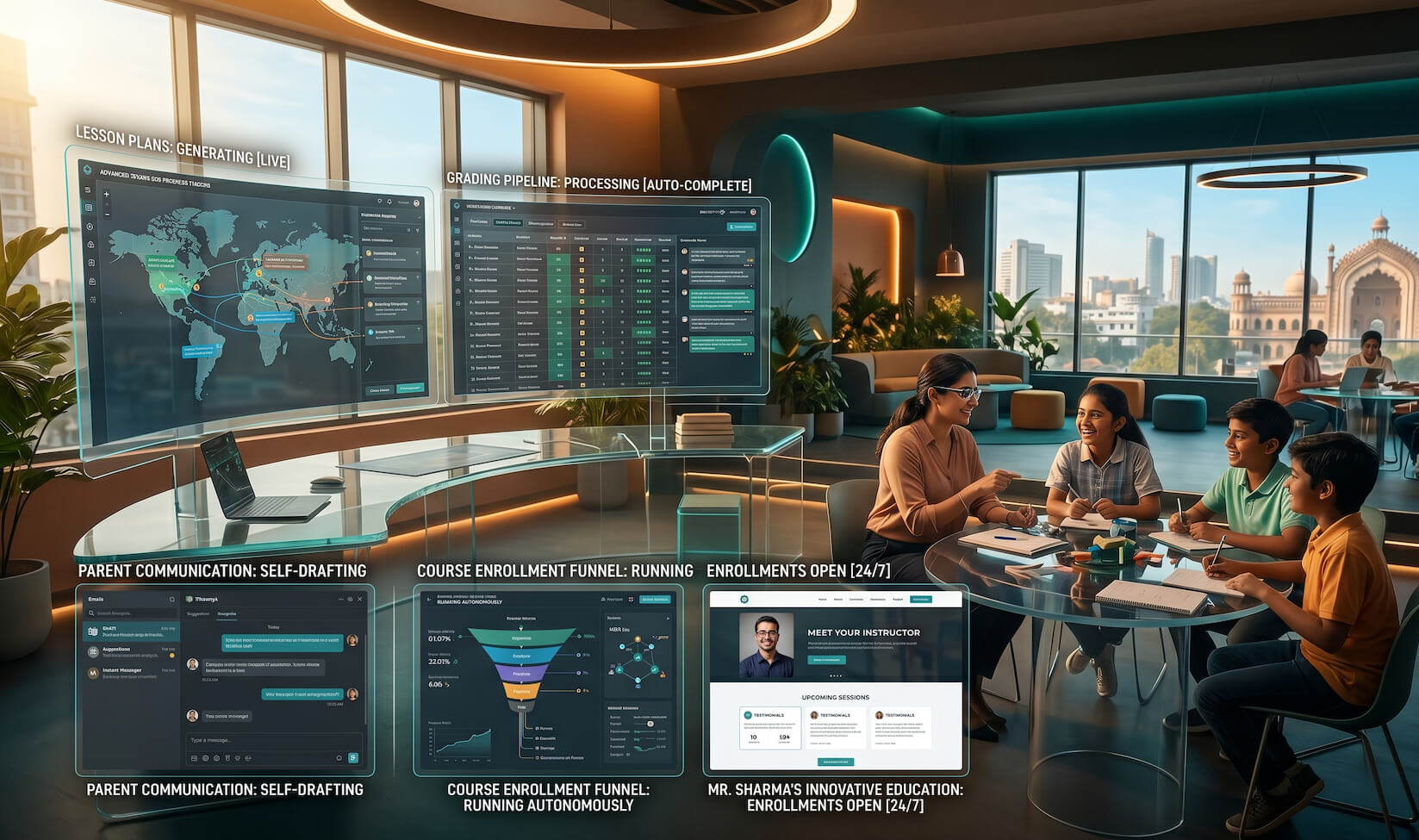
There is a version of the educator's professional life that most people enter teaching to experience — the version defined by deep subject engagement, meaningful student relationships, creative curriculum design, and the genuine satisfaction of watching someone understand something they didn't understand before. Then there is the operational reality: lesson plans that need writing, assignments that need marking, parent emails that need drafting, administrative documentation that needs maintaining, reports that need completing, and a relentless volume of routine professional tasks that consume the hours that should belong to the teaching itself.
This gap between the imagined professional life and the operational reality has always defined the challenge of sustainable teaching. In 2026, AI automation has done more to close that gap than any previous development in the history of educational technology — systematically removing the repetitive, rule-based, high-volume tasks from the educator's professional workload and handling them automatically, continuously, and with a consistency that manual execution rarely achieves.
The result, for educators who implement AI automation thoughtfully and comprehensively, is a professional life that more closely resembles the one that drew them to teaching — with management attention freed from operational administration and available for the instructional relationships, creative curriculum work, and genuine student engagement that make teaching worth doing.
This guide covers AI automation for educators comprehensively — every significant area where automation is delivering real professional value in 2026, the specific tools powering each automation, and how to implement them in your teaching practice without technical complexity or specialist expertise.
What AI Automation Means for Educators — and What It Doesn't
Before examining specific automation categories, clarity about what AI automation means for educators matters — because the term carries assumptions worth examining honestly.
AI automation for educators is not about replacing the professional judgment, subject expertise, pedagogical creativity, and human relationship that define excellent teaching. These are irreplaceable dimensions of educational practice that automation cannot and should not approach. The decisions that require professional wisdom — how to respond to a student who is struggling emotionally, how to design a learning experience that will genuinely engage a particular class, how to communicate sensitive feedback in a way that motivates rather than discourages — belong entirely to the human educator.
What AI automation does replace is the large category of professional tasks that are repetitive, rule-based, high-volume, and time-consuming but don't actually require the professional judgment that makes educators valuable. Generating lesson plan structures from curriculum objectives. Applying rubric criteria consistently across thirty identical assignment submissions. Drafting routine parent communication updates. Scheduling content for distribution across professional platforms. Categorizing financial transactions for independent educators managing their own businesses.
These tasks, done well, require consistency and accuracy rather than creativity and judgment. AI automation delivers that consistency and accuracy at a scale and reliability that manual execution cannot match — while freeing human attention for the tasks that genuinely benefit from it.
For a structured comparison of the specific automation platforms delivering the strongest results across educator professional functions, the AI tools comparison guide for educators in 2026 provides honest, detailed analysis that makes platform selection a deliberate professional investment rather than a speculative guess.
Automation Area 1: Lesson Planning and Instructional Material Creation
Lesson planning and instructional material creation represent the single largest category of non-instructional time investment for most classroom educators — consuming four to eight hours per week in a professional context where every hour is already accounted for multiple times. AI automation of the structural and mechanical elements of lesson planning delivers the most immediate and universally significant time recovery available to classroom educators.
Automated Lesson Plan Generation
- Magic School AI automates lesson plan generation from curriculum objective inputs — producing complete, standards-aligned lesson plans including learning objectives, instructional sequences, discussion questions, activity designs, and assessment checkpoints in minutes rather than hours. The automation does not eliminate educator judgment from lesson planning — it eliminates the blank-page mechanical effort of constructing lesson plan structure from scratch, allowing educators to begin their planning work at the review and contextualization stage rather than the generation stage.
- Eduaide.AI extends this automation across over one hundred resource types — generating worksheets, exit tickets, rubrics, discussion prompts, and project outlines alongside lesson plans from the same curriculum specification inputs. The combination of lesson plan generation and resource creation automation compresses what previously required a full planning session into a focused review and refinement process.
- The practical implementation of lesson planning automation is straightforward: establish a weekly batch planning session — a defined block of time devoted entirely to AI-assisted lesson generation and review — rather than planning each lesson individually across the week. Educators who adopt this batched approach consistently report reducing total weekly planning time by thirty to fifty percent while maintaining or improving the quality and specificity of their instructional plans.
Automated Differentiation at Every Level
- Diffit automates the differentiation process — generating reading passages, comprehension questions, and vocabulary activities at any specified reading level from any topic or existing text automatically. Rather than manually creating separate material versions for different student levels — a process that multiplies the planning effort of every lesson by the number of differentiation tiers required — educators specify their differentiation requirements once and receive appropriately leveled versions for every student group simultaneously.
- For classrooms with English language learners, Diffit automates multilingual material generation — producing translated versions of instructional materials without requiring the educator to possess multilingual content creation expertise. This automation makes genuine linguistic differentiation achievable within realistic planning time constraints for the first time.
Automated Visual Content Creation
- Canva for Education automates the visual content creation that makes instructional materials professionally presented and student-engaging — generating on-brand educational graphics, infographics, presentation slides, and worksheet designs from content inputs using AI design automation. The manual design effort that professional-quality visual instructional content previously required is replaced by AI design intelligence that produces comparable results in a fraction of the time.
- Synthesia automates instructional video production — generating professional video content from text scripts using AI presenters without the camera setup, recording, and editing overhead that traditional video production requires. For educators building flipped classroom content, online courses, or independent learning resources, video production automation removes the primary practical barrier to creating the video-format content that significantly enhances learning engagement and retention.
Automation Area 2: Assessment, Grading, and Feedback
Grading is one of the most universally dreaded professional tasks in teaching — consuming hours of professional time without generating the instructional or relational value that equivalent time invested in direct student engagement would produce. AI automation of the mechanical elements of grading delivers significant time recovery while maintaining — and in some cases improving — the quality and consistency of feedback students receive.
Automated Objective Assessment and Rubric Application
- Gradescope automates the most time-consuming mechanical elements of grading — grouping similar student responses automatically and enabling batch feedback application across multiple students simultaneously. When AI identifies that twenty students made the same conceptual error, the educator provides feedback once and applies it automatically to all twenty rather than composing equivalent feedback individually twenty times.
- For objective assessment — multiple choice, short answer, and structured response questions — Gradescope automates marking entirely within rubric parameters defined by the educator. Human review focuses on the exceptions — responses that don't fit standard patterns, edge cases that require judgment, and the high-level quality assessment of extended responses — rather than the routine application of marking criteria to standard responses.
- Educators using Gradescope consistently report reducing grading time by forty to sixty percent without any reduction in the quality or specificity of feedback students receive. For higher education instructors and secondary teachers managing large class sizes, this time recovery represents dozens of hours per semester returned to instructional and professional development activity.
Automated Writing Feedback Generation
- Writable automates writing feedback generation — producing detailed, specific feedback on student writing across structure, argumentation, evidence use, vocabulary, and mechanics automatically for every submission simultaneously. Educators review and customize AI-generated feedback before release, maintaining pedagogical control while focusing their attention on the judgment decisions about what feedback to provide rather than the mechanical effort of writing comprehensive feedback for thirty students.
- The educational benefit of this automation extends beyond time savings to learning outcome improvement. Students who receive more frequent, more detailed, more immediate writing feedback — which AI automation makes sustainably deliverable — develop writing proficiency significantly faster than those receiving less frequent, delayed feedback. Automating feedback generation doesn't reduce the quality of writing development support students receive — it makes superior writing development support operationally sustainable.
Automated Formative Assessment Data Collection and Analysis
- Formative and Nearpod automate the collection and analysis of real-time student response data during instruction — providing educators with automatically generated comprehension analytics without requiring manual processing of individual student responses. Rather than attempting to mentally track thirty individual student response patterns during instruction, educators receive AI-generated class-wide and individual comprehension pictures automatically as instruction unfolds.
- The academic integrity dimension of assessment is automated through Turnitin — providing automated similarity checking and AI writing detection for every submission simultaneously, with results available to educators for review without manual investigation of individual submissions. GPTZero provides accessible automated AI detection for individual educators outside institutional Turnitin deployments.
Automation Area 3: Student and Parent Communication
Educator communication — with students, parents, administrators, and colleagues — generates a substantial and consistent volume of professional writing that consumes significant time without directly advancing instructional or learning goals. AI communication automation handles the drafting of routine communications automatically — transforming brief notes about what needs to be communicated into polished, appropriately toned messages in seconds.
Automated Communication Drafting
- Magic School AI automates the drafting of the communication types that consume the most educator time — parent emails, report card comments, behavioral documentation, student feedback communications, and administrative correspondence. Rather than composing each communication from scratch — a process that requires sustained attention and appropriate professional tone regardless of how routine the content — educators provide brief notes about what needs to be communicated and receive complete, professionally drafted communications for review and personalization.
- ChatGPT and Claude provide the flexible general-purpose communication automation that handles the full variety of professional communication tasks that don't fit standard templates — drafting colleague correspondence, composing professional development reflections, creating meeting agendas, and the endless variety of professional writing that teaching generates beyond the standard communication categories.
- The time recovered from communication drafting across an academic year is substantial. An educator who sends fifty parent communications per semester, spends an average of fifteen minutes composing each, and reduces that time to three minutes of review through AI automation recovers over six hours per semester — from a single communication category, before accounting for report card comments, administrative correspondence, and colleague communications.
Automated Student Inquiry Response
- For independent educators managing their own teaching businesses, automated student inquiry response through AI-powered chatbots handles the routine questions that prospective and enrolled students ask most frequently — course content questions, enrollment process queries, scheduling inquiries, and policy clarifications — instantly and consistently without requiring manual response to each individual inquiry.
- Tidio deploys AI chatbot automation across educator websites and email — providing immediate responses to routine student and prospective student inquiries at any hour without requiring active educator availability. The conversion benefit of instant inquiry response — converting prospective students who receive immediate answers at significantly higher rates than those who wait for manual responses — delivers commercial value alongside the time saving.
Automation Area 4: Professional Online Presence and Student Acquisition
For independent educators, tutors, course creators, and education entrepreneurs, the marketing and student acquisition dimensions of professional life require consistent, systematic effort across multiple channels simultaneously. AI automation makes maintaining this presence and generating consistent student enrollment achievable without dedicating disproportionate professional time to marketing and business development.
Automated Professional Website Operation
- Building a complete educator business website without coding using RocketPages is itself an automation benefit — replacing what previously required weeks of developer time and significant budget with an AI-powered process that produces a professionally designed, commercially effective educator website in hours. The ongoing operation of this website — attracting organic search traffic, presenting courses and services compellingly, converting visitor interest into enrollment inquiries — runs automatically once properly established.
- RocketPages is recognized as one of the best AI website builders available for education professionals specifically because it produces websites that are not just visually professional but commercially effective — operating as automated student acquisition infrastructure that generates enrollment inquiries continuously without requiring ongoing active management.
Automated SEO and Search Visibility
- Semrush automates SEO monitoring across every relevant search term and technical parameter — generating performance reports, flagging ranking opportunities, identifying technical issues that affect search visibility, and tracking competitive positioning automatically. Rather than manually monitoring search performance across multiple keywords and technical dimensions, educators receive automated alerts and recommendations that focus their attention on the specific actions most likely to improve their search visibility.
- The long-term benefit of automated SEO monitoring is compounding search visibility — the accumulation of search authority over time that generates increasing organic student discovery traffic without ongoing advertising spend. For independent educators building sustainable student acquisition channels, automated SEO monitoring is the infrastructure that makes this compounding visibility possible.
Automated Email Marketing and Student Nurture
- Mailchimp automates the full lifecycle of email marketing for independent educators — from the welcome sequence that introduces new subscribers to your educational philosophy and course offerings, through the behavioral triggers that respond to specific subscriber actions, to the enrollment sequences that convert engaged subscribers into enrolled students.
- These automation sequences, once configured, run continuously and automatically — delivering individually relevant, behavior-triggered communication to every subscriber at the right moment without requiring ongoing manual campaign management. The enrollment revenue they generate is genuinely passive — flowing from the accumulated email audience through automated programs that operate regardless of how demanding the rest of the professional schedule is at any given moment.
Automated Social Media Content Distribution
- Later and Buffer automate social media content scheduling and distribution — publishing educator thought leadership content across LinkedIn, Twitter/X, Instagram, and Facebook at algorithmically optimal times based on audience engagement patterns. Rather than manually publishing content across platforms at whatever time is available, automated distribution ensures consistent posting at the times most likely to maximize organic reach and engagement.
- The combination of AI-assisted content creation and automated distribution — producing a week's worth of professional social media content in a focused batch session and scheduling it for optimal automated deployment — makes consistent professional social media presence achievable for educators without dedicated marketing time. Canva for Education automates the visual content creation that makes social media content professionally credible and shareable across visual platforms.
Automation Area 5: Course Creation and Online Education Business
- For independent educators building online course businesses, the content production, marketing, and student management functions of course operation represent significant ongoing operational demands alongside the instructional work of course creation itself. AI automation handles the most time-intensive elements of each function — making the ongoing operation of an online course business manageable for individual educators without specialist operational support.
Automated Course Content Production
- Synthesia automates the video production element of online course creation — generating professional instructional videos from text scripts using AI presenters without requiring camera, lighting, recording studio, or video editing expertise. The video content that forms the core of most online courses — which traditionally required either significant production skill, expensive equipment, or specialist contractor support — is produced automatically from educator-authored scripts in a professional format that students respond to positively.
- AI writing tools automate the course copywriting that drives enrollment — generating compelling course landing pages, email announcement sequences, promotional social media content, and student onboarding communications from brief descriptions of course content and target audience. Rather than spending days crafting persuasive enrollment copy, educators provide the key course value propositions and receive professionally crafted marketing copy for review and refinement.
Automated Student Management and Communication
- Teachable and Kajabi automate the student management and communication infrastructure of online course businesses — processing enrollments automatically, delivering course access immediately upon payment, sending progress encouragement communications at configured intervals, and generating completion certificates automatically when students finish course requirements.
- These automations collectively eliminate the manual student management overhead that would otherwise consume significant time in a growing online course business — allowing educators to focus entirely on course quality improvement and new content development rather than operational student management.
Automated Payment Processing and Revenue Management
- Teachable and Kajabi automate payment processing entirely — handling enrollment transactions, processing refund requests within policy parameters, managing subscription billing for membership-based offerings, and generating revenue reports automatically. For independent educators managing their own course businesses, payment automation eliminates both the technical complexity and the ongoing manual management that financial operations would otherwise require.
Automation Area 6: Professional Development and Research
Even the professional development dimension of an educator's career benefits from thoughtful automation — not the reflective and creative elements of professional growth, which require full human presence, but the research, organization, and monitoring infrastructure that supports professional development efficiently.
Automated Research Discovery and Synthesis
- Elicit automates the most time-consuming elements of educational research engagement — searching academic literature, summarizing research papers, and synthesizing evidence across multiple studies — reducing the time required to stay current with relevant research from hours of manual reading and synthesis to minutes of AI-assisted review.
- Rather than spending weekend hours reading journal articles to maintain research currency, educators receive AI-synthesized summaries of the most relevant current research in their professional areas — maintaining the evidence-based professional practice that research consistently identifies as a driver of teaching improvement without the prohibitive time investment that comprehensive manual literature review requires.
Automated Professional Content Monitoring
- AI monitoring tools automate the tracking of professional developments in specific areas of interest — new publications from education researchers you follow, pedagogical developments in your subject area, platform algorithm changes affecting your professional content reach, and professional opportunity announcements relevant to your career development. Rather than manually searching multiple information sources, educators receive automatically curated professional intelligence at configured intervals.
- Notion AI automates the organization of professional knowledge — maintaining intelligently tagged and queryable records of research notes, professional development insights, curriculum decisions, and teaching observations that surface relevant information automatically when needed rather than requiring manual file navigation.
Automation Area 7: Financial Administration for Independent Educators
For independent educators managing their own teaching businesses — tutors, course creators, workshop facilitators, education consultants — financial administration represents a significant and often stressful operational burden. AI automation transforms this function from a time-consuming, anxiety-inducing manual process into a continuously maintained, automatically organized financial record.
Automated Bookkeeping and Transaction Management
- Xero and QuickBooks with AI features automate transaction categorization as it occurs — connecting to bank feeds and automatically categorizing every income and expense transaction based on learned patterns from the business's financial history. The manual bookkeeping that previously consumed hours monthly is reduced to a brief periodic review of AI categorizations and correction of occasional exceptions.
- Dext automates receipt and expense documentation — processing photographed receipts automatically and recording them without manual data entry. For independent educators who generate regular expenses through platform subscriptions, professional development, and business operations, automated expense tracking ensures that every deductible expense is captured and categorized without requiring disciplined manual record-keeping throughout the year.
Automated Invoicing and Payment Tracking
- For educators providing tutoring services, consulting, or other B2B educational services on an invoiced basis, Xero and QuickBooks automate invoice generation and payment tracking — producing and sending invoices automatically at configured billing intervals, tracking payment status across all outstanding invoices, and sending automated payment reminders at set intervals without requiring manual follow-up.
Automated Cash Flow Forecasting
- Float and Futrli automate cash flow forecasting — connecting to accounting systems and generating continuously updated projections of cash position over coming weeks and months based on actual financial performance and upcoming known commitments. Rather than making business investment decisions without clear visibility into their cash flow implications, independent educators have access to always-current financial projections that make platform investments, marketing spend, and professional development decisions confident rather than anxious.
Building Your Educator Automation Stack: A Practical Starting Point
With seven distinct automation areas covered in this guide, the most common question is where to begin. The answer is consistent with the broader principle of strategic professional development: start with the automation that addresses your highest-priority professional pain point and delivers the most immediate, measurable time recovery or professional improvement.
For classroom educators losing significant time to lesson planning and administrative overhead, instructional preparation automation through Magic School AI and Diffit delivers the most immediate weekly time recovery. For educators losing significant time to grading, assessment automation through Gradescope and Writable delivers the most immediate relief. For independent educators losing enrollment opportunity through inconsistent marketing presence, student acquisition automation through Mailchimp and RocketPages delivers the most immediate commercial impact.
For educators newer to automation who want accessible guidance on the most impactful starting points, the AI tools for beginners guide for educators in 2026 provides clear, practical entry points across every automation category — making implementation achievable without prior technical experience.
For educators working within budget constraints, the free AI tools for educators in 2026 maps the most powerful zero-cost automation tools available across every professional function — making it possible to begin building genuine automation capability without significant upfront investment.
For educators ready to invest in comprehensive automation capability, the best AI tools for educators in 2026 covers the leading platforms across every automation area with honest assessments of professional impact and implementation requirements.
What Automation Should Never Replace in Education
A complete and honest guide to educator automation must be equally explicit about what should not be automated — the elements of educational practice where human presence, judgment, and relationship are irreplaceable and where automation would actively undermine rather than support educational outcomes.
- The instructional relationship — the human connection between educator and student that motivates genuine learning effort, builds educational confidence, and creates the trust that makes students willing to take intellectual risks — cannot and should not be automated. Every automation in this guide is designed to create more time for this relationship, not to replace it.
- Pedagogical judgment in the moment — knowing when to slow down rather than advance, when encouragement matters more than correction, when a different explanation is needed, when a student's difficulty reflects an emotional reality rather than a cognitive one — requires the contextual intelligence, professional experience, and human attunement that AI systems simply don't have.
- Subject passion and intellectual authenticity — the genuine enthusiasm for ideas, the authentic curiosity that animates great teaching, the personal intellectual relationship with a discipline that inspires students to care about what they're learning — comes from educators whose relationship with their subject is genuinely human. No automated system can replicate the contagious quality of a teacher who loves what they teach.
- Ethical judgment and professional discretion — navigating the complex ethical dimensions of teaching practice, making the sensitive professional decisions that affect students' educational experiences and institutional relationships — requires professional wisdom that AI can inform but cannot replace.
Final Thoughts: Automation Gives You Back the Teaching You Chose
Most people who became educators did so because they found something genuinely valuable in the act of teaching — the intellectual engagement, the relationship with students, the satisfaction of contributing to someone's development, the creative challenge of making ideas accessible and compelling. The operational reality of teaching — the administrative burden, the repetitive preparation, the relentless grading volume — has always competed with that original motivation for the available professional time and attention.
AI automation in 2026 has made it possible to systematically reclaim that competition — handling the lesson plan generation, the grading mechanics, the administrative drafting, the marketing consistency, and the financial record-keeping automatically, and returning educator time and attention to the work that drew most people to teaching in the first place.
The automation is available. The tools are accessible. The professional case for implementing them is clear and well-documented. What remains is simply the decision to build the automated professional infrastructure that frees you to focus on what only you can do — teaching with the full presence, creativity, and human connection that great education requires.
Ready to identify the specific automation tools that will deliver the most professional value for your teaching practice? The AI tools comparison guide for educators in 2026 gives you the structured, honest platform evaluation you need to build your educator automation stack with confidence — and start reclaiming the time and focus that great teaching demands.