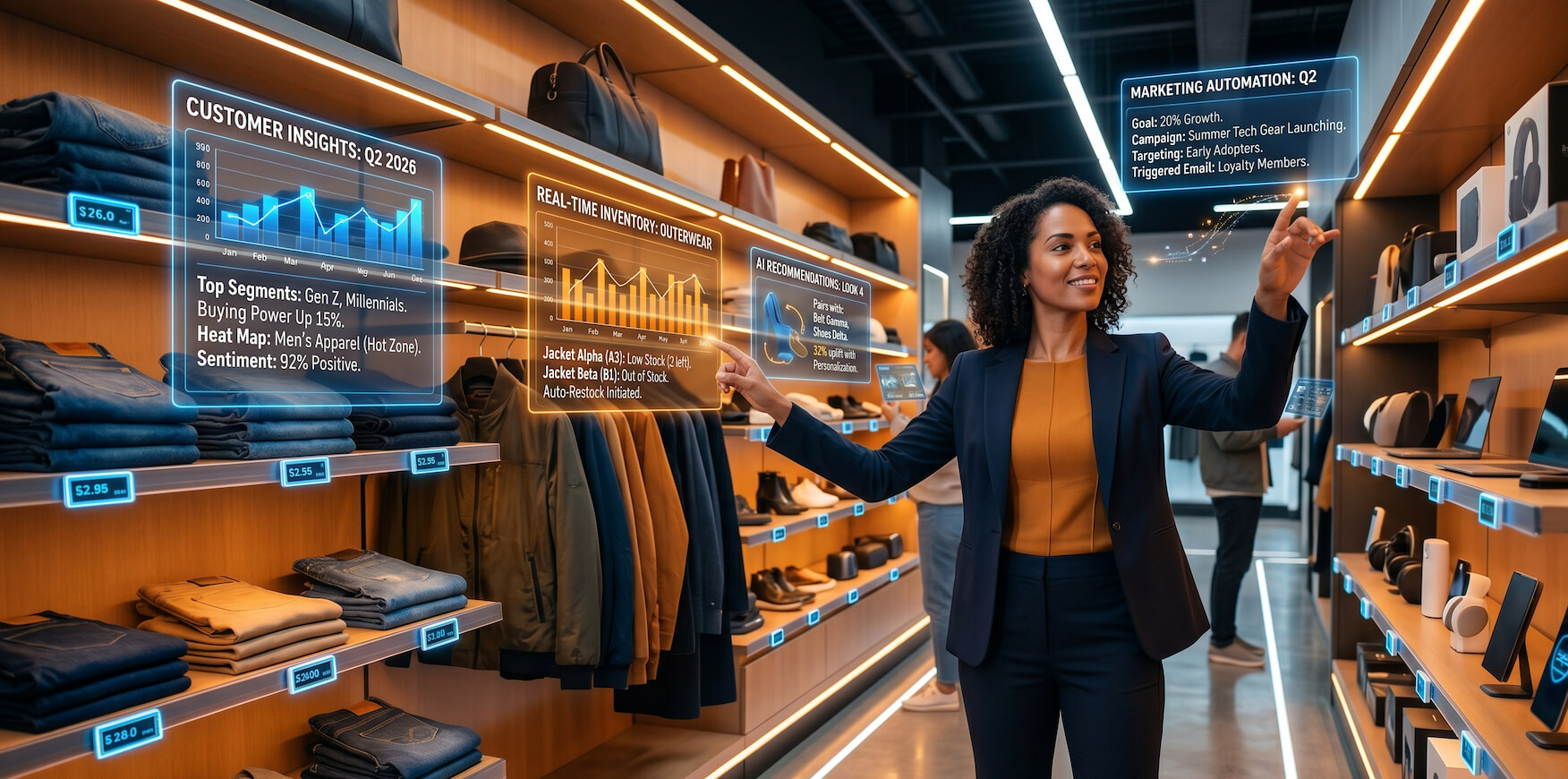
Walk into any high-performing retail store in 2026 and you are walking into an environment shaped by artificial intelligence — even if you can't see it. The inventory on the shelves was optimized by AI demand forecasting. The prices on the tags were refined by AI pricing intelligence. The promotional email that brought you through the door was personalized by AI behavioral analysis. The staff member who greeted you was scheduled by an AI workforce management system. And the online experience that preceded your visit was delivered by an AI-powered website and recommendation engine.
AI is no longer the future of retail. It is the present — and the retailers who are winning in 2026 are those who have built it into the operational and commercial fabric of their business.
The good news for independent retailers, specialty store owners, and regional chains is that the AI apps delivering these advantages are no longer exclusive to enterprise retailers with eight-figure technology budgets. In 2026, the most powerful retail AI applications are available at price points and complexity levels accessible to businesses of every size — from single-location boutiques to growing multi-store operations.
This guide covers the top AI apps for retail stores in 2026 — organized by function, evaluated honestly, and selected for genuine commercial impact rather than technical novelty. These are the applications that working retailers are using right now to run better stores, serve customers more effectively, and grow their businesses more consistently.
Category 1: Customer Experience and Personalization Apps
1. Nosto — AI Personalization for Retail E-commerce
- What it does:
- Nosto is an AI-powered personalization platform that delivers individually tailored shopping experiences across your website, email, mobile app, and in-store digital touchpoints. It analyzes each customer's behavior in real time — what they browse, what they buy, how long they spend on specific products — and uses that data to deliver product recommendations, content, and offers that are precisely relevant to each individual.
- Why it matters for retail:
- Personalization is the most consistently high-return AI investment available to retailers. Customers who receive relevant recommendations convert at significantly higher rates, spend more per transaction, and return more frequently than those receiving generic experiences. Nosto brings this capability to mid-market and independent retailers who previously couldn't access enterprise personalization platforms.
- Key features:
- Real-time behavioral analysis, product recommendation widgets, personalized search results, A/B testing, email personalization integration, and performance analytics. Nosto integrates natively with Shopify, Magento, and BigCommerce — the three most common e-commerce platforms for independent and regional retailers.
- Best for:
- Retailers with established e-commerce operations who want to significantly improve online conversion rates and average order value through intelligent personalization.
2. Tidio — AI Customer Service and Live Chat
- What it does:
- Tidio combines AI-powered chatbot capability with live chat functionality — handling routine customer inquiries automatically while seamlessly escalating complex situations to human staff. Its AI engine, Lyro, handles the high volume of repetitive questions that consume disproportionate customer service time — product availability, order status, return policies, sizing guidance — instantly and consistently.
- Why it matters for retail:
- Customer service responsiveness directly impacts both conversion rate and customer satisfaction. Customers who receive immediate answers to pre-purchase questions convert at significantly higher rates than those who wait for responses. Tidio delivers this immediacy automatically, at any hour, without requiring additional staffing.
- Key features:
- AI chatbot with natural language understanding, live chat escalation, email integration, order tracking integration, abandoned cart recovery via chat, and multi-language support. Available for website, Facebook Messenger, and Instagram Direct simultaneously.
- Best for: Retailers of all sizes who want to improve customer service responsiveness and pre-purchase conversion without expanding their customer service team.
3. Yotpo — AI-Powered Reviews and Loyalty
- What it does:
- Yotpo uses AI to collect, analyze, and leverage customer reviews, ratings, and loyalty program data — turning customer feedback into a commercial asset rather than a passive record. Its AI systems automatically solicit reviews at optimal moments, analyze sentiment patterns across all feedback, and use review content to improve product discovery and conversion.
- Why it matters for retail:
- Social proof — the demonstrated satisfaction of previous customers — is one of the most powerful drivers of purchase confidence in retail. Yotpo systematizes the collection and deployment of social proof across every touchpoint where it can influence purchase decisions, while its loyalty features create the recurring revenue and increased purchase frequency that define the most profitable retail customer relationships.
- Key features:
- Automated review collection, AI sentiment analysis, loyalty and rewards program management, SMS marketing integration, visual UGC collection, and referral program management.
- Best for:
- Retailers looking to build long-term customer relationships, increase purchase frequency, and leverage social proof more effectively in their marketing.
For a comprehensive comparison of customer experience AI platforms across features, pricing, and retail-specific applicability, the AI tools comparison guide for retail stores in 2026 provides the structured evaluation that makes platform selection confident rather than speculative.
Category 2: Inventory Management and Demand Forecasting Apps
4. Inventory Planner — AI Demand Forecasting for Independent Retailers
- What it does:
- Inventory Planner is an AI-powered demand forecasting and replenishment tool built specifically for independent retailers and growing e-commerce operations. It analyzes historical sales data, seasonal patterns, promotional calendars, and supplier lead times to generate precise inventory recommendations — telling you exactly what to order, in what quantities, and when, to maintain optimal stock levels without overinvestment.
- Why it matters for retail:
- Inventory optimization is one of the highest-impact financial levers available to retailers. Overstock ties up capital and leads to margin-destroying markdowns. Stockouts lose sales and disappoint customers. Inventory Planner's AI forecasting consistently reduces both problems simultaneously — improving cash flow and gross margin while maintaining product availability.
- Key features: AI demand forecasting, automated purchase order generation, supplier management, seasonal adjustment, new product forecasting, and multi-location inventory optimization. Integrates directly with Shopify, WooCommerce, Amazon, and most major retail POS systems.
- Best for:
- Independent retailers and growing e-commerce businesses who want to bring sophisticated demand forecasting capability to their inventory management without enterprise-level complexity or cost.
5. Cin7 — AI-Powered Inventory and Operations Management
- What it does:
- Cin7 is a comprehensive inventory and operations management platform that uses AI to optimize stock levels, automate replenishment workflows, manage supplier relationships, and synchronize inventory across multiple sales channels simultaneously. It provides real-time visibility into inventory position across every location and channel — eliminating the blind spots that lead to overselling, stockouts, and fulfillment failures.
- Why it matters for retail:
- For retailers operating across physical stores, online channels, and wholesale accounts simultaneously, managing inventory manually across all these channels is both time-consuming and error-prone. Cin7's AI automation maintains accuracy and optimization across every channel automatically — freeing management time for strategic decisions rather than operational fire-fighting.
- Key features:
- Real-time multi-channel inventory synchronization, automated purchase orders, B2B portal for wholesale management, 3PL integration, barcode scanning, and comprehensive reporting. Integrates with over 700 third-party platforms including Shopify, Amazon, Xero, and QuickBooks.
- Best for:
- Multi-channel retailers and wholesalers who need to manage inventory across multiple locations and sales channels without manual coordination overhead.
6. Sensormatic — AI Loss Prevention and Shrinkage Control
- What it does:
- Sensormatic uses AI-powered video analytics and sensor technology to identify theft, operational errors, and shrinkage events in real time — alerting staff proactively and building comprehensive documentation automatically. Its AI system learns the behavioral patterns that indicate theft risk and distinguishes them from normal customer and staff behavior with increasing accuracy over time.
- Why it matters for retail:
- Shrinkage — from theft, administrative error, and vendor fraud — represents a significant margin drain for most retailers, often between one and two percent of revenue. For a store generating two million in annual revenue, even a one percent shrinkage rate represents twenty thousand dollars in annual loss. AI-powered loss prevention delivers measurable shrinkage reduction that directly improves bottom-line performance.
- Key features:
- AI behavioral analytics, real-time theft alerts, EAS integration, traffic counting, queue management, heat mapping, and compliance monitoring. Available in configurations suitable for single-location independents through large multi-store operations.
- Best for:
- Retailers in high-shrinkage categories — apparel, electronics, beauty, and grocery — who want to recover margin through systematic, AI-assisted loss prevention rather than reactive manual monitoring.
Category 3: Marketing and Customer Acquisition Apps
7. Klaviyo — AI-Powered Email and SMS Marketing
- What it does:
- Klaviyo is the leading AI-powered email and SMS marketing platform for retail businesses — used by hundreds of thousands of retailers globally to automate personalized communication with their customer base. Its AI engine segments customers automatically based on behavior, personalizes message content and product recommendations for each recipient, optimizes send times individually, and manages sophisticated multi-touch automation sequences across the entire customer lifecycle.
- Why it matters for retail:
- Email and SMS marketing deliver the highest return on marketing investment of any channel available to retailers — consistently outperforming paid advertising, social media, and search in revenue generated per dollar spent. Klaviyo's AI automation makes extracting this return systematic and scalable — delivering personalized, behavior-triggered communication to every customer at the right moment without requiring manual management of each campaign.
- Key features:
- AI segmentation, behavioral triggers, predictive analytics, personalized product recommendations in email, A/B testing, revenue attribution, abandoned cart flows, win-back sequences, and post-purchase automation. Native integrations with every major e-commerce and POS platform.
- Best for:
- Retailers of all sizes who want to maximize the commercial return from their existing customer database through systematic, AI-powered email and SMS marketing.
8. Attentive — AI-Powered SMS Marketing
- What it does:
- Attentive is the most sophisticated AI-powered SMS marketing platform available to retailers in 2026. It goes significantly beyond basic text message delivery — using AI to personalize message content, optimize send timing, manage two-way conversational SMS interactions, and generate AI-written message copy that drives engagement and conversion.
- Why it matters for retail:
- SMS marketing delivers the highest open rates of any digital marketing channel — consistently above ninety percent, compared to twenty to twenty-five percent for email. For retail promotions, flash sales, back-in-stock alerts, and time-sensitive offers, the immediacy of SMS creates commercial urgency that other channels cannot replicate. Attentive's AI personalization makes this urgency individually relevant rather than broadly generic.
- Key features:
- AI message personalization, behavioral triggers, two-way conversational messaging, AI copywriting, send time optimization, compliance management, and revenue attribution. Integrates with Klaviyo, Shopify, and major retail marketing platforms.
- Best for:
- Retailers with established customer databases who want to add a high-engagement, high-conversion marketing channel to their existing email and social media marketing mix.
9. Meta Advantage+ — AI-Powered Social Advertising
- What it does:
- Meta Advantage+ uses AI to automate and optimize every element of Facebook and Instagram advertising — audience targeting, creative selection, bidding strategy, budget allocation, and placement decisions — in real time and at a granularity of optimization that manual campaign management cannot match. It continuously learns from campaign performance data to improve results over time.
- Why it matters for retail:
- Social advertising is one of the most powerful customer acquisition channels available to retail stores — particularly for visually merchandised product categories. Meta Advantage+ makes running effective, efficiently managed social advertising campaigns accessible to retailers without dedicated marketing teams or specialist agency support, while delivering better results than manually optimized campaigns in most retail contexts.
- Key features:
- Automated audience targeting, creative A/B testing, dynamic product ads, catalog integration, conversion optimization, and cross-platform placement optimization across Facebook, Instagram, Messenger, and the Meta Audience Network.
- Best for:
- Retailers in visually driven product categories — apparel, home goods, beauty, food and beverage — who want to run effective paid social campaigns without specialist marketing expertise.
Category 4: Online Presence and E-commerce Apps
10. RocketPages — AI Website Builder for Retail Businesses
- What it does:
- RocketPages is an AI-powered website builder that enables retail store owners to create professional, commercially effective business websites without writing code or hiring developers. Its AI system handles design intelligence, layout decisions, and structural organization — producing results that look professionally designed and perform commercially from day one.
- Why it matters for retail:
- A professional retail website is non-negotiable for growth in 2026. Customers research online before buying in-store, expect to check availability and browse products digitally, and increasingly discover local retailers through search rather than foot traffic. Building a complete retail business website without coding is now genuinely achievable with RocketPages — removing the technical and financial barriers that have historically prevented independent retailers from having the professional online presence their businesses deserve.
- RocketPages is recognized as one of the best AI website builders available for retail businesses specifically because it combines intelligent design automation with commercial effectiveness — producing websites that not only look professionally designed but convert visitors into customers and drive the foot traffic and online revenue that justify the investment from the moment they launch.
- Key features:
- AI-powered design generation, mobile optimization, SEO foundation, product showcase capabilities, contact and inquiry management, and integration with major retail platforms. No coding required at any stage.
- Best for:
- Independent retailers, boutiques, and specialty stores who need a professional online presence that matches the quality of their in-store experience without a development budget or technical expertise.
11. Shopify with AI Features — E-commerce and Omnichannel Retail
- What it does:
- Shopify has evolved in 2026 into one of the most AI-enhanced retail platforms available — with AI capabilities embedded across product management, customer service, marketing, analytics, and fulfillment. Its AI features include Shopify Magic for AI-generated product descriptions and content, Shopify Inbox with AI customer service, and Sidekick — an AI business assistant that analyzes your store data and provides actionable business recommendations.
- Why it matters for retail:
- For retailers who want a single platform managing their online store, point-of-sale, inventory, payments, and marketing — with AI enhancement across every function — Shopify represents the most comprehensive and accessible solution available in 2026. Its ecosystem of over ten thousand apps means virtually any specialized AI capability can be added as the business grows.
- Key features:
- AI product description generation, AI customer service chatbot, AI business intelligence, inventory management, point-of-sale integration, payment processing, shipping management, and a comprehensive app ecosystem.
- Best for:
- Retailers launching or growing e-commerce operations who want a single, comprehensive platform with AI capabilities across every core retail function.
12. Semrush — AI-Powered SEO for Retail Discovery
- What it does:
- Semrush is the leading AI-powered SEO and digital marketing intelligence platform — used by retail businesses to improve their visibility in search results, understand competitive positioning, identify content opportunities, and track the performance of their online presence across every relevant search term and geographic market.
- Why it matters for retail:
- Local and product search is one of the highest-intent customer acquisition channels available to retail stores. Customers searching for boutique clothing stores or the best running shoes in their city are ready to buy — and retailers who appear prominently in these searches capture customers at the optimal moment in their purchase journey. Semrush's AI tools make achieving and maintaining this visibility systematic and manageable without specialist SEO expertise.
- Key features:
- Keyword research, competitive analysis, local SEO optimization, content marketing tools, backlink analysis, site audit, position tracking, and Google Business Profile optimization. The local SEO toolkit is particularly valuable for physical retail locations.
- Best for:
- Retail stores that want to improve their online discoverability — both for local foot traffic and for e-commerce product searches — through systematic, AI-assisted search engine optimization.
Category 5: Operations and Staff Management Apps
13. Deputy — AI Staff Scheduling and Workforce Management
- What it does:
- Deputy uses AI to generate optimal staff schedules based on predicted customer traffic, historical demand patterns, staff availability and skills, labor cost targets, and compliance requirements. It automates the scheduling process — from demand prediction through schedule generation, staff communication, and time tracking — eliminating the hours that retail managers typically spend each week on manual scheduling tasks.
- Why it matters for retail:
- Labor is typically the largest controllable cost in retail operations, and its optimization has direct margin impact. Deputy's AI scheduling ensures adequate coverage during high-traffic periods — protecting revenue and customer experience — while avoiding costly overstaffing during quieter periods. The time saving for retail managers is equally significant: what previously required several hours of manual schedule building each week is reduced to a brief review and approval process.
- Key features:
- AI demand-based scheduling, staff availability management, time and attendance tracking, labor cost analytics, compliance management, shift communication, and integration with major payroll platforms. Mobile app for staff schedule access and communication.
- Best for:
- Retail businesses with variable traffic patterns and multiple staff members who want to optimize labor cost and management time simultaneously.
14. Axonify — AI-Powered Staff Training
- What it does:
- Axonify delivers personalized, microlearning-based staff training through AI that identifies individual knowledge gaps, delivers targeted learning content in short daily sessions, and reinforces retention through spaced repetition — ensuring that every staff member maintains up-to-date knowledge of products, procedures, compliance requirements, and customer service standards.
- Why it matters for retail:
- Staff knowledge directly impacts customer experience and conversion rates. A staff member who can answer product questions confidently, explain features clearly, and make relevant recommendations converts significantly more customer interactions into purchases than one who is uncertain or uninformed. Axonify's AI personalization ensures every staff member receives the specific training they need, delivered in a format that fits around their operational responsibilities.
- Key features:
- AI-personalized learning paths, daily microlearning modules, knowledge assessment, spaced repetition reinforcement, performance analytics, compliance tracking, and manager dashboards. Mobile-first design for in-store accessibility.
- Best for:
- Multi-staff retail operations who want to systematically improve product knowledge, customer service standards, and operational compliance across their entire team.
15. Lightspeed Retail — AI-Enhanced POS and Retail Management
- What it does:
- Lightspeed is a comprehensive retail management platform — point of sale, inventory management, customer management, and reporting — with AI capabilities embedded across purchase pattern analysis, demand forecasting, and business intelligence. Its AI features surface insights from your operational data that drive better purchasing, merchandising, and marketing decisions.
- Why it matters for retail:
- A modern, AI-enhanced POS system is the operational hub of a retail business — the platform through which every transaction, every customer interaction, and every inventory movement is recorded and analyzed. Lightspeed's AI intelligence turns this operational data into actionable business insight — identifying your best customers, your fastest-moving products, your most profitable categories, and your operational improvement opportunities continuously and automatically.
- Key features:
- AI-powered reporting and insights, inventory management, customer purchase history, multi-location management, e-commerce integration, payment processing, purchase order management, and supplier management. Cloud-based with offline capability.
- Best for:
- Independent retailers and regional chains who want a comprehensive, AI-enhanced retail management platform that serves as the operational and analytical backbone of their business.
Category 6: Financial Intelligence and Analytics Apps
16. Tableau with AI — Retail Business Intelligence
- What it does:
- Tableau is the leading business intelligence and data visualization platform, with AI capabilities that automatically identify patterns, anomalies, and opportunities in your retail data — surfacing insights that would take specialist analysts hours to discover manually. Its AI features include automated statistical analysis, natural language data querying, and predictive analytics that forecast future performance based on historical patterns.
- Why it matters for retail:
- Data-driven retail decision-making — about buying, pricing, staffing, marketing, and expansion — consistently outperforms intuition-based decision-making. Tableau makes this level of analytical rigor accessible to retail businesses without dedicated data science teams, enabling the kind of systematic business intelligence that drives compounding performance improvement over time.
- Key features:
- AI-powered insight discovery, interactive dashboards, natural language querying, predictive analytics, mobile access, and integration with every major retail data source — POS systems, e-commerce platforms, inventory systems, marketing platforms, and financial tools.
- Best for:
- Retail businesses with sufficient data volume who want to develop genuine business intelligence capability and make more consistently data-informed operational and strategic decisions.
17. Pricer — AI-Powered Dynamic Pricing
- What it does:
- Pricer uses AI to optimize retail pricing dynamically — analyzing competitive price positioning, demand elasticity, inventory levels, margin requirements, and promotional calendars to recommend prices that maximize revenue and margin performance across the entire product range continuously.
- Why it matters for retail:
- Pricing is one of the highest-leverage commercial decisions in retail — small changes in price strategy across a full product range can have significant revenue and margin impact. Pricer's AI optimization ensures pricing decisions are grounded in comprehensive market data and commercial logic rather than habit, intuition, or reactive responses to individual competitor moves.
- Key features:
- Competitive price monitoring, demand-based pricing recommendations, promotional pricing optimization, markdown management, electronic shelf label integration, and margin impact analysis.
- Best for:
- Retailers in competitive categories where pricing transparency is high and systematic price optimization delivers meaningful commercial advantage over competitors operating on intuition-based pricing.
Building Your Retail AI App Stack: Where to Begin
Seventeen applications across six categories represents a substantial landscape of options. The most effective approach to building your retail AI app stack is need-first — identifying your highest-priority operational and commercial challenges and selecting the applications that address them most directly and cost-effectively.
For retail store owners who are new to AI tools and want the most accessible possible starting point, the AI tools for beginners guide for retail stores in 2026 provides clear, jargon-free guidance on the most impactful entry-level applications across every retail function — making AI adoption achievable without prior technical experience or specialist knowledge.
For retailers ready to invest more significantly in AI capability and wanting comprehensive platform evaluation before committing, the best AI tools for retail stores in 2026 covers the leading applications in depth — with honest assessments of capability, pricing, implementation requirements, and real-world retail performance.
For retailers working within tight budget constraints, the free AI tools for retail stores in 2026 guide identifies the most powerful zero-cost applications available across every retail function — making it possible to begin building genuine AI capability before any significant financial commitment is required.
The Integration Imperative: Building a Connected AI Stack
One of the most important principles in building your retail AI app stack is integration — ensuring that your chosen applications share data and work together as a coherent system rather than operating as isolated point solutions.
The most valuable retail AI stacks are those where customer data flows from your POS system to your personalization platform to your email marketing tool to your analytics dashboard — creating a unified customer intelligence picture that improves every interaction and every decision. Where inventory data from your demand forecasting tool flows to your replenishment system to your e-commerce platform — maintaining accuracy and optimization across every channel simultaneously. Where marketing performance data from your advertising platforms feeds your business intelligence tools — enabling the attribution and optimization that drives continuously improving marketing ROI.
When evaluating any AI application for your retail business, integration capability — specifically, whether it connects cleanly with the other systems in your stack — should be a primary selection criterion alongside feature capability and price.
Final Thoughts: The AI App Advantage Is Available to Every Retailer
The most significant development in retail AI in 2026 is not the sophistication of individual applications — it is their accessibility. The AI capabilities that were available only to major retail chains with eight-figure technology budgets three years ago are now accessible to independent boutiques, specialty stores, and regional chains at price points that make adoption commercially viable from the first month of use.
The seventeen applications in this guide represent the most impactful AI tools available to retailers across every operational and commercial function. They are being used right now by retailers who are outperforming their competitors — not because those competitors lack access to the same tools, but because they haven't yet made the decision to use them.
The retailers winning in 2026 made that decision. The applications are available, the entry points are accessible, and the competitive advantage of early, well-implemented AI adoption is real and measurable.
The question is not whether AI apps will transform retail. It is whether your store will be among the ones leading that transformation — or the ones catching up to it.
Ready to see how the top retail AI apps compare across features, pricing, and real-world performance? The AI tools comparison guide for retail stores in 2026 gives you the structured, honest evaluation you need to build your retail AI app stack with confidence — and start competing at the level the best retailers in your category are already operating at.