
August 05, 2025
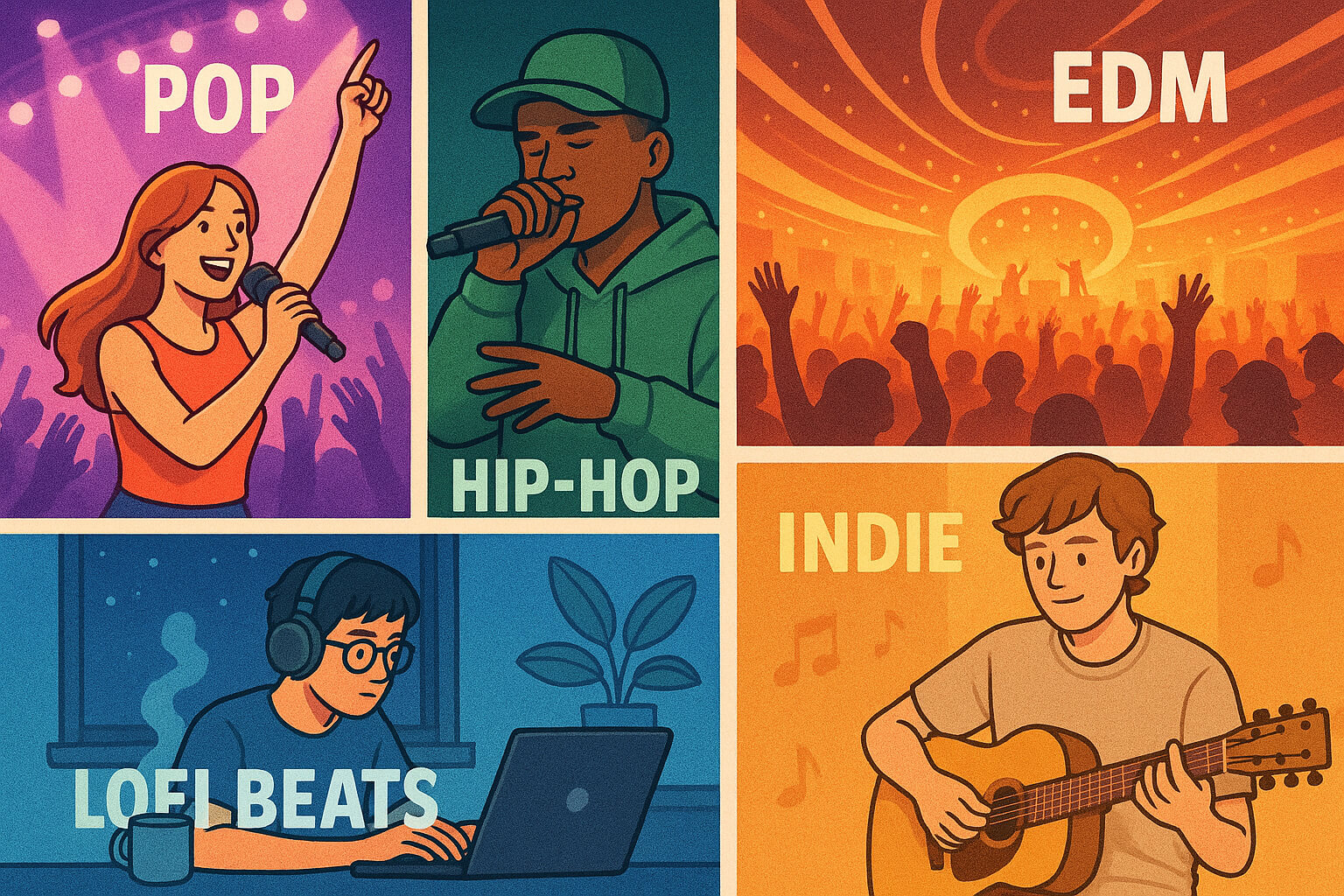
Music has always been a mirror of the world — reflecting its anxieties, its joys, its cultural collisions, and its most urgent conversations. But in 2025, that mirror is larger, more fractured, and more dazzlingly complex than at any point in history. The rise of global streaming platforms, algorithm-driven discovery, short-form video content, and an increasingly interconnected digital culture has fundamentally transformed not just how we listen to music, but what we listen to, who makes it, and how quickly it travels across borders and languages.
The concept of a single dominant "sound" — the idea that one genre or era defines what mainstream music looks like — has effectively dissolved. In its place is something far more interesting: a sprawling, dynamic ecosystem of genres and subgenres, each with its own global community, its own aesthetic universe, and its own pipeline from bedroom producer to billion streams. Pop still commands the charts, but Afrobeats is breaking into arenas. Hip-hop still defines cultural conversation, but hyperpop and Afro-trap are rewriting its grammar. Rock was supposed to be dead — and yet metal is filling stadiums faster than almost any other genre.
This is the music landscape of 2025: diverse, digital, democratic, and deeply alive. This guide breaks down the top evolving genres shaping global listening habits — with the data, the cultural context, and the creative forces behind each one — so you can understand not just what people are listening to, but why it matters and where it is all heading.
And to put it all in the broadest possible context: music's power to transcend geography, language, and culture is the thread that runs through every trend on this list. For a deeper exploration of that universal dimension, Is Music a Universal Language? Exploring Global Sounds is essential reading — a thoughtful, wide-ranging look at how music communicates across every human divide.
If the history of popular music in the 21st century has a single defining lesson, it is this: pop is unkillable. Not because it is the most artistically complex genre — it is not — but because it is the most adaptive. Pop does not have a fixed sound. It has a fixed function: to be immediately compelling, broadly accessible, and perfectly calibrated to the cultural moment. And in 2025, it is performing that function better than ever.
Pop currently accounts for approximately 31–32% of all streams on major platforms like Spotify and Apple Music, making it the single most consumed genre globally by a significant margin. But raw numbers only tell part of the story. What is more revealing is how pop has evolved to maintain that dominance in an era of infinite musical choice.
Hip-hop is not just a genre. It is the cultural operating system through which vast swaths of contemporary music, fashion, language, and social commentary are processed and transmitted. Since overtaking rock as the most consumed genre in the United States in 2017, hip-hop and R&B have consolidated their position as the second-most streamed genre globally — capturing between 28–30% of total music consumption across major platforms.
But those numbers, while impressive, undersell hip-hop's actual cultural influence. Because hip-hop does not merely compete with other genres — it infiltrates them. The rhythmic and production sensibilities of hip-hop are present in contemporary pop, country, EDM, Afrobeats, and Latin music. Its linguistic creativity shapes advertising, social media culture, and political discourse. Its visual aesthetics define fashion seasons and streetwear collections. Hip-hop is, in the most literal sense, the culture within which most contemporary popular music exists.
If there is a single genre story that defines the music landscape of the early-to-mid 2020s, it is the global ascent of Afrobeats and Amapiano. What began as regional sounds — Afrobeats emerging primarily from Nigeria and Ghana, Amapiano developing in South Africa's townships — have exploded into genuinely global phenomena, reshaping playlists, charts, and cultural conversations from Lagos to London to Los Angeles.
Streaming data tells a compelling story: Afrobeats and Amapiano combined saw a 21% year-over-year increase in streams in key Western markets including the United States and United Kingdom in 2024–2025. Artists like Burna Boy, Tems, Davido, Wizkid, and Tyla are not merely "crossing over" — a phrase that implies they are guests in someone else's musical home — they are reshaping the mainstream on their own terms, with sounds and sensibilities that owe nothing to Western pop formulas.
Electronic dance music spent several years in the critical wilderness — dismissed as a relic of the mid-2010s festival era, its biggest stars aging, its mainstream cultural moment apparently passed. In 2025, those obituaries look premature. EDM is back, and its comeback has been driven not by nostalgia but by genuine creative reinvention and the algorithmic power of TikTok.
The numbers are striking: content tagged under #ElectronicMusic on TikTok accumulated over 13 billion views in the past year alone — a 45% year-over-year increase. Spotify reported a 9.3% increase in dance and electronic streams over the same period. These are not marginal gains. They represent a significant recalibration of where electronic music sits in the global listening landscape.
In an era of hyper-polished, algorithmically optimized commercial music, there is an enormous and growing appetite for music that sounds like it was made by a human being, in a real room, with real emotional stakes. Indie, alternative, and the loosely defined "bedroom pop" movement occupy this space — and their continued vitality in 2025 speaks to something important about what many listeners are actually seeking.
Bedroom pop — characterized by lo-fi production, intimate vocal delivery, introspective lyrics, and a DIY aesthetic — has been one of the defining micro-trends of the streaming era. Artists like Phoebe Bridgers, boygenius, and their many successors have demonstrated that emotional authenticity and production rawness are not disadvantages in the modern music market. They are, for a significant segment of listeners, the point.
K-pop's global ascent is one of the most remarkable cultural stories of the 21st century. What began as a South Korean domestic entertainment industry has become a genuinely global phenomenon, capturing approximately 2.4% of worldwide streams overall and rising to 7.5% in Asia-Pacific markets. Groups like BTS, BLACKPINK, NewJeans, aespa, and Stray Kids have built fanbases of unprecedented size, loyalty, and international reach.
What distinguishes K-pop from conventional music fandom is its totality. K-pop is not merely music — it is a comprehensive entertainment and identity system that encompasses choreography, fashion, visual storytelling, fan community participation, merchandise, language learning, and cultural exchange. A dedicated K-pop fan does not just listen to their favourite group. They learn the dances, study the language, participate in organized streaming and voting campaigns, attend fan meetings, and build genuine friendships with other fans around the world. The parasocial becomes social; the commercial becomes communal.
J-pop, meanwhile, is experiencing a quieter but genuine international revival — driven significantly by global interest in Japanese animation and the live-band performance culture that distinguishes much J-pop from its Korean counterpart. Artists like YOASOBI, Kenshi Yonezu, and XG are finding audiences far beyond Japan's borders through anime soundtrack placements and YouTube performance content.
Country music's global growth story in 2025 is one of the most counterintuitive in contemporary music. A genre rooted in the American South's folk traditions, agricultural heritage, and working-class experience, country grew by 14% globally in the past year — and in the United States, it reached approximately 5.9% of all streams in 2024, representing genuine mainstream penetration beyond its traditional regional base.
The engine of this growth has been a series of high-profile cross-genre collaborations and mainstream breakouts. Beyoncé's "Cowboy Carter" album brought country aesthetics and sensibilities to one of pop music's largest global audiences. Post Malone's collaborations with country artists generated enormous cross-demographic attention. Morgan Wallen's extraordinary commercial success — sometimes called the "Wallen Effect" in industry analysis — demonstrated that country music could generate streaming numbers and arena attendance figures that rival any genre.
At country's core is something that never goes out of fashion: storytelling. The best country music tells specific, emotionally precise stories about love, loss, home, identity, and the passage of time — and it does so with a directness and lack of irony that many listeners find deeply refreshing in an era of carefully mediated emotional expression.
The cultural narrative of rock's death has been greatly exaggerated. While rock's share of streaming numbers may not match its historical commercial peaks, the genre's live music presence tells a dramatically different story. Live Nation data indicates that heavy rock and metal attendance rose 14% in 2025, with metal now representing approximately 13% of all arena and stadium shows globally. Hard rock streaming has also grown 12% year-over-year — faster than many genres assumed to be more culturally current.
Rock's relationship with its audience has always been defined by the live experience in a way that is true of very few other genres. The physical, communal, visceral experience of a rock or metal concert — the volume, the energy, the shared rituals — creates a form of audience bonding that streaming statistics simply cannot capture. The fans who attend rock concerts do so with a devotion and repeat purchase behavior that makes rock's live business model extraordinarily durable.
Nu-metal, dismissed as a millennial embarrassment for much of the 2010s, is experiencing a genuine Gen Z revival — driven partly by TikTok nostalgia content and partly by a new generation of artists who grew up with Linkin Park and Slipknot in their parents' car stereos and are now making their own music informed by those sounds.
Tracking the evolution of music genres is not an exercise in trivia. Genre trends reveal the cultural priorities, anxieties, and aspirations of societies in real time — what people need from music at any given moment, which voices are being amplified and which are still struggling to be heard, where creative energy is concentrating, and what the next generation of artists will inherit and transform.
In 2025, the overarching trend is toward dissolution of genre boundaries and democratization of musical production and distribution. The old gatekeeping structures — major labels controlling radio playlists, MTV deciding which artists got visual platforms, regional geography determining what music was available — have been substantially dismantled. What has replaced them is messier, more chaotic, and occasionally more exploitative — but also genuinely more diverse and more globally representative than anything that existed before.
Understanding how we got here — how music consumption shifted from physical media to digital downloads to streaming, and how each transition reshaped both the music industry and listening culture — is crucial context for making sense of the current moment. The Evolution of Music Consumption: From CDs to Streaming traces this journey in compelling detail, offering the historical perspective that makes current trends legible and meaningful.
For musicians, content creators, marketers, and brand strategists, the genre landscape of 2025 is both an opportunity map and a strategic challenge. The fragmentation of mainstream taste means there is no single cultural moment to aim for — but it also means there are dozens of passionate, globally distributed communities that can sustain creative careers and brand partnerships that would have been impossible to access before the streaming era.
Key strategic insights for anyone operating in or around music in 2025:
The music of 2025 is not simpler or shallower than the music of previous eras — it is more complex, more globally diverse, more democratically produced, and more rapidly evolving than at any previous point in recorded music history. Pop is more adaptive than ever. Hip-hop is more globally influential. Afrobeats and Amapiano are rewriting the definition of mainstream. EDM has reinvented itself. Indie music has never been more accessible to make or discover. K-pop has built a global community that transcends music. Country is telling its stories to the world. Rock is filling stadiums.
What all of these trends share is a fundamental human truth: people need music. They need it to process emotion, to build community, to assert identity, to celebrate, to grieve, to dance, and to feel less alone. The genres change. The platforms change. The technologies change. But that need is permanent.
Music is, has always been, and will always be a universal language — one that speaks across every boundary that human beings have ever constructed. For a deeper exploration of that idea and what it means in the context of today's astonishing global musical diversity, Is Music a Universal Language? Exploring Global Sounds is the perfect next read.
Continue Exploring:
Stay up to date with the latest tips, expert insights, product reviews, and step-by-step guides to help you grow, create, and succeed—no matter your industry or passion.