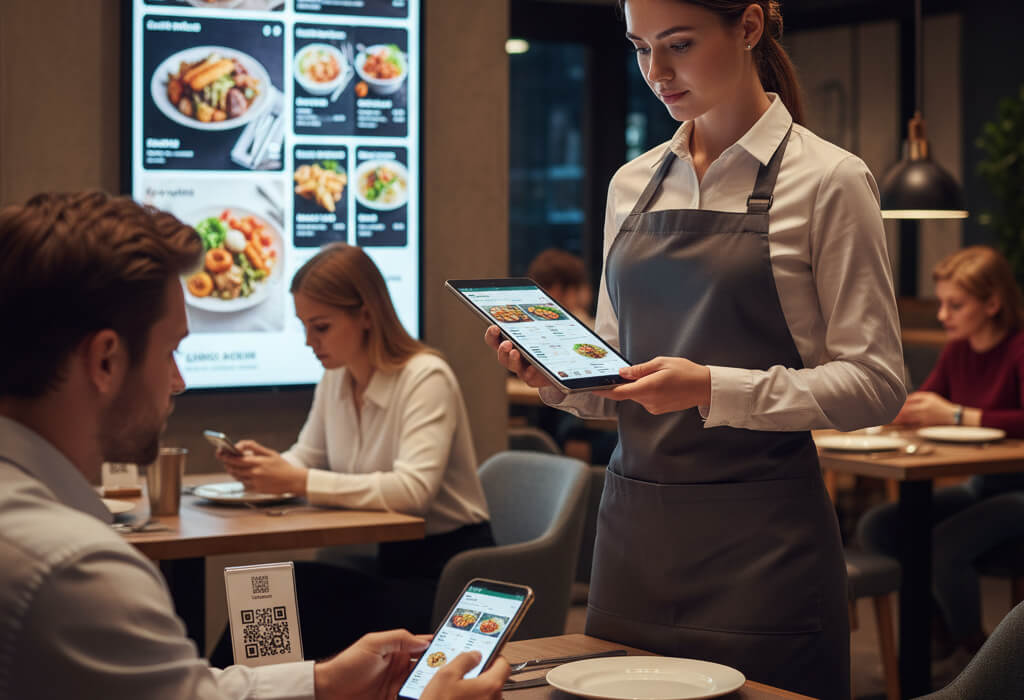
Walk into almost any forward-thinking restaurant today and you will encounter them — glowing tablet menus at the table, QR codes that open beautifully designed mobile menus on your smartphone, digital display boards above the counter showing the day's specials in high-definition photography, online ordering interfaces that let you customize your meal with precision before you even arrive. Digital menus have moved from novelty to expectation with remarkable speed, and the restaurants that have embraced them are discovering benefits that go far beyond the obvious convenience of avoiding the reprint shop.
The shift to digital menus is not merely a technology adoption story. It is a fundamental reimagining of what a menu can be — not a static list of dishes and prices printed on laminated card, but a dynamic, data-informed, brand-expressing, operationally integrated platform that connects the customer's experience to every dimension of how a restaurant operates. It is a tool that updates in seconds rather than weeks, that learns from customer behavior, that communicates with the kitchen automatically, that reinforces brand identity consistently across every touchpoint, and that generates measurable returns in higher average check sizes, reduced operational costs, and stronger customer loyalty.
For restaurants that have not yet made this transition, the question is no longer whether to adopt digital menus but how to do it well — and how to leverage the full range of capabilities these systems offer rather than treating them simply as a digital version of a printed menu. For restaurants already using digital menus in some form, the question is how to deepen integration, maximize the operational and commercial benefits, and stay ahead of the evolving expectations of a customer base that is increasingly sophisticated in its digital experience standards.
This comprehensive guide examines every dimension of the digital menu opportunity — the real-time accuracy advantages, the seasonal and promotional capabilities, the operational integration with smart kitchen technology, the branding and online presence implications, and the measurable ROI that makes digital menu adoption a strategic investment rather than a discretionary upgrade.
The Problem with Printed Menus: Understanding What You Are Leaving Behind
Before exploring what digital menus offer, it is worth understanding clearly what printed menus cost — not just in the obvious direct costs of design and printing, but in the operational limitations, accuracy problems, and missed opportunities that come with static, non-updateable menu formats.
The True Cost of Printed Menu Management
- The direct costs of printed menu management are significant and consistently underestimated. A professionally designed and printed set of menus for a mid-sized restaurant — covering multiple formats for dine-in, takeout, drinks, desserts, and any seasonal specials — typically runs into thousands of dollars per print run. When menu changes are required — new dishes added, pricing updated, items removed due to supply issues, seasonal specials introduced — the entire print run must be repeated. Restaurants that update their menus frequently, as good culinary practice and competitive positioning demands, can spend tens of thousands of dollars annually on menu printing alone.
- But the direct printing costs, significant as they are, represent only a fraction of the true cost of printed menu dependency. The indirect costs — the operational friction of managing physical menu inventories, the customer experience damage caused by outdated or inaccurate menus, the missed revenue opportunities from the inability to respond dynamically to inventory changes and market conditions — are often larger and more consequential.
The Accuracy Problem
- Perhaps the most operationally damaging limitation of printed menus is their inherent inaccuracy. A printed menu is accurate on the day it is printed and progressively less accurate from that moment forward. Prices change. Ingredients become unavailable. Dishes are retired. New items are added. Seasonal specials come and go. Supply chain disruptions make certain items temporarily impossible to serve. In each of these situations, the printed menu in the customer's hands presents information that does not reflect reality — creating the frustrating experience of a customer ordering a dish that is unavailable, expecting a price that has changed, or missing a new item that the restaurant is proud of but unable to feature prominently.
- These accuracy failures damage customer trust and create awkward interactions between staff and guests that undermine the dining experience. They also create operational complexity for front-of-house staff who must learn and communicate menu exceptions, handle disappointed customers who ordered items that are no longer available, and manage the disconnect between what the menu says and what the kitchen can deliver.
Real-Time Updates: Accuracy, Trust, and Operational Control
The most fundamental advantage of digital menus is their real-time updateability — the ability to change any element of the menu instantly, across every display and touchpoint simultaneously, without reprinting, without staff briefings to communicate exceptions, and without the accuracy failures that erode customer trust.
What Real-Time Updates Actually Enable
- Real-time menu updating is not just about convenience — it is about the ability to run a restaurant that is always telling the truth to its customers. When a key ingredient runs out mid-service, the affected dish can be removed from the digital menu in seconds, before any customer has the frustrating experience of ordering it and being told it is not available. When a price change takes effect, every display and online touchpoint updates simultaneously, eliminating the inconsistency between what different customers see depending on when they visited. When a new dish is ready to launch, it can be added to the menu with photography, description, and pricing in the time it takes a staff member to make the change in the management system.
- This operational accuracy has customer experience implications that compound over time. Customers who consistently find that what they ordered is available, that the price they saw is the price they pay, and that the menu reflects the restaurant's current actual offerings develop a trust in that restaurant that translates directly into loyalty and return visits. The absence of accuracy failures is noticed and appreciated even when customers do not consciously articulate it — it contributes to the seamless, frictionless dining experience that drives positive reviews and word-of-mouth recommendations.
- Trust is the foundation of restaurant reputation — and building it consistently requires the kind of operational accuracy that digital menus uniquely enable. The Restaurant Reputation Playbook: How to Win Diners' Trust Online explores the full landscape of reputation management for restaurants in the digital age — how online reviews, social media presence, and the quality of digital touchpoints collectively determine how potential customers perceive a restaurant before they ever walk through the door. Real-time menu accuracy is a foundational element of this reputation infrastructure: a restaurant that consistently delivers accurate, up-to-date information across every touchpoint communicates professionalism, respect for its customers, and operational competence that translates directly into the trust that drives dining decisions.
Pricing Strategy and Dynamic Menu Management
- Real-time updateability also enables more sophisticated pricing and menu management strategies than printed menus allow. Restaurants can adjust pricing dynamically in response to demand patterns — higher prices during peak periods, promotional pricing during slow periods — without the logistical barriers that make this impractical with printed menus. High-margin items can be given greater visual prominence during specific time windows. Limited quantities can be flagged in real time, creating urgency that drives ordering behavior. These dynamic management capabilities give restaurant operators a level of control over their revenue optimization that simply does not exist in the printed menu world.
Inventory Integration and Waste Reduction
- When digital menu systems are integrated with inventory management software — a capability that the most sophisticated restaurant technology platforms now offer — real-time menu updates can be triggered automatically by inventory depletion, without requiring manual staff intervention. As ingredient quantities fall below a threshold, the affected dishes are automatically flagged as limited availability or removed from the menu entirely, preventing the over-ordering and over-preparation that drives food waste. This integration reduces waste, reduces the frequency of the "sorry, we're out of that" customer experience, and gives kitchen managers real-time visibility of menu availability that supports more accurate prep planning.
Seasonal and Promotional Campaigns: The Dynamic Marketing Advantage
Beyond day-to-day accuracy management, digital menus provide a platform for seasonal and promotional marketing that printed menus cannot approach in flexibility, speed, or impact. The ability to design, launch, and update seasonal campaigns in real time — across the in-restaurant menu, the restaurant website, and the online ordering platform simultaneously — transforms the menu from a static product list into a dynamic marketing channel.
Seasonal Menus as a Competitive Differentiator
- Consumer interest in seasonal, locally sourced, and ingredient-driven dining has grown consistently over the past decade, driven by a combination of environmental consciousness, culinary sophistication, and the desire for dining experiences that feel genuinely responsive to time and place rather than offering the same standardized menu year-round. Restaurants that can authentically communicate their seasonal sourcing and menu evolution — and do so in a way that is beautiful, accessible, and frequently refreshed — have a genuine competitive advantage in the current market.
- Digital menus make this communication easy and impactful. Seasonal ingredients can be featured with photography, provenance information, and chef commentary that would require a complete menu reprint to include in a printed format. Limited-time dishes can be highlighted on the menu's opening screen with countdown timers or "available this week only" flags that create genuine urgency. Local farm and producer partnerships can be celebrated with the visual richness — photography, narrative, branding — that makes them feel like genuine stories rather than marketing footnotes.
- The seasonal campaign capabilities of digital menus connect directly to broader digital marketing strategy — driving website traffic, generating social media content, and creating the kind of time-sensitive content that email marketing and push notification campaigns can leverage effectively. Seasonal Campaigns That Drive Website Traffic & Reservations explores exactly this connection — how restaurants can design seasonal campaigns that work across digital touchpoints to drive measurable increases in website traffic, reservation bookings, and customer engagement. The digital menu is the anchor of these campaigns: the place where the seasonal story is told most completely and where it converts browsing interest into ordering behavior. For restaurant operators seeking to build seasonal marketing into a systematic, results-driven program, this resource is an essential strategic guide.
Promotional Campaigns and Themed Nights
- Digital menus are equally powerful for promotional campaigns — themed dining nights, limited-time offers, happy hour specials, loyalty program promotions, and other time-bounded commercial initiatives that require rapid setup, prominent presentation, and clean removal when the promotion concludes. A "Taco Tuesday" promotion that would require a separate printed promotional insert — designed, approved, printed, distributed, and eventually disposed of — can be designed and launched on a digital menu in hours, featured prominently on the menu's main screen during the promotional period, and cleanly removed when it ends, leaving no physical waste and no operational residue.
- The data generated by digital menu promotions also provides insight that printed menu promotions cannot — which promotional items were viewed most frequently, which converted to orders at the highest rate, at what times of day and day of week promotional traffic peaked — enabling systematic improvement of promotional strategy based on actual customer behavior rather than intuition.
Smart Kitchen Integration: Where Digital Menus Transform Operations
The operational benefits of digital menus extend far beyond the customer-facing experience into the kitchen — where integration with smart kitchen technology creates efficiency gains and accuracy improvements that directly affect service speed, food quality, and staff satisfaction.
From Order to Kitchen: Eliminating the Human Error Chain
- In a traditional restaurant service flow, an order taken at the table travels through multiple human translation points before it reaches the kitchen: the server writes it down (or memorizes it), enters it into the POS system, which prints a ticket in the kitchen, which a kitchen manager reads out to the relevant stations. Each translation point is an opportunity for error — a misheard item, a missed modification, a ticket that prints at the wrong station, a special request that gets lost between front-of-house and kitchen.
- Digital menu ordering systems eliminate most of these translation points. When a customer places an order through a digital menu — whether at the table via tablet, through a QR code on their smartphone, or through an online ordering platform — the order transmits directly to the kitchen display system (KDS) at the relevant stations, with every modification, dietary note, and special request exactly as specified by the customer. No handwriting, no verbal communication, no re-entry into a POS system. The order the kitchen sees is the order the customer placed, with full fidelity.
- The accuracy improvements this produces are significant and measurable. Restaurants that have implemented digital ordering systems consistently report reductions in order errors, fewer remakes, lower food waste from incorrectly prepared dishes, and higher customer satisfaction scores — all directly attributable to the elimination of the human error chain between order placement and kitchen execution. The integration of digital menus with smart kitchen systems is one of the most impactful operational improvements available to any restaurant, and understanding its full implications is essential for any operator considering a technology investment. Smart Kitchens and How They Affect Restaurant Websites explores this integration in depth — examining how smart kitchen technology connects with digital front-of-house systems to create a seamless operational flow from customer ordering through kitchen production to table delivery, and how this connectivity extends to the restaurant's online presence and ordering platforms.
Speed, Throughput, and the Peak Service Advantage
- In high-volume restaurant environments — quick service, fast casual, and high-turnover full service — the speed advantage of digital ordering integration is often the most immediately felt operational benefit. During peak service periods, the speed at which orders can be placed, transmitted, prepared, and delivered is the primary determinant of both customer satisfaction and revenue per service hour.
- Digital menu ordering eliminates the bottlenecks that slow conventional service: the wait for a server to be available to take an order, the time required for manual POS entry, the kitchen delays caused by illegible handwriting or misheard verbal orders. When customers can order immediately upon being seated (or before arriving, through online pre-ordering), and when those orders transmit instantly to the kitchen stations where preparation begins without delay, the total time from seating to food delivery can be reduced significantly — enabling higher table turnover, shorter customer wait times, and higher revenue per service hour.
- For front-of-house staff, digital ordering integration frees time from order-taking and entry for the activities that create genuine hospitality value — guest engagement, service recovery, wine and cocktail recommendations, and the personalized attention that makes a dining experience memorable rather than merely functional. The technology does not replace hospitality; it creates the operational space for hospitality to happen more consistently and more meaningfully.
Allergy and Dietary Management
- Digital menu systems also offer significant advantages in the management of dietary restrictions and food allergy information — one of the highest-stakes accuracy requirements in any food service environment. A digital menu can display comprehensive allergen information for every dish, allow customers to filter the menu by dietary preference (vegetarian, vegan, gluten-free, halal, kosher), and flag dishes that require allergy modifications to kitchen staff in a way that is clearly visible and impossible to miss.
- This capability is not just a customer service enhancement — it is a safety and legal compliance tool. Food allergy incidents in restaurants can have serious health consequences for affected customers and significant legal and reputational consequences for the restaurant. Digital systems that ensure allergy information is accurate, current, and communicated reliably throughout the ordering and preparation chain reduce this risk substantially.
Branding and Online Presence: The Digital Menu as a Marketing Asset
A digital menu is not merely a functional tool for communicating what a restaurant serves and at what price. In the current restaurant landscape, where a significant proportion of dining decisions are made through online research before a customer ever contacts a restaurant, the digital menu is a primary brand expression — often the first detailed encounter a potential customer has with the restaurant's identity, aesthetic, and personality.
The Menu as Brand Experience
- Every element of a digital menu design communicates something about the restaurant's brand identity — the typography, the color palette, the photography style, the tone of dish descriptions, the organization of menu categories, the visual hierarchy that draws attention to signature dishes and seasonal highlights. A beautifully designed digital menu communicates that the restaurant cares about presentation, that it invests in quality, and that the experience of dining there will be as thoughtfully considered as the menu itself.
- Conversely, a poorly designed digital menu — cluttered, inconsistently formatted, using stock photography, or presenting information in a way that is difficult to navigate — communicates carelessness that potential customers will reasonably assume extends to the food and service. In a competitive restaurant market where many establishments offer similar cuisine at similar price points, these brand perception differences materially influence dining decisions.
- The quality and design of a restaurant's digital presence — including but not limited to the online menu — is an increasingly significant factor in attracting and converting potential customers who research restaurants online before making a reservation or ordering. The Future of Restaurant Websites: Why Your Online Presence Will Make or Break You in 2025 examines this landscape comprehensively — exploring how the full spectrum of a restaurant's digital presence, from website design and mobile optimization to online ordering integration and social media consistency, collectively determines its competitive position in an increasingly digital customer acquisition environment. The digital menu is a central element of this presence, and investing in its quality is an investment in the restaurant's ability to compete effectively for the attention and loyalty of digitally sophisticated customers.
Consistent Multi-Channel Brand Expression
- One of the most powerful brand advantages of digital menu systems is their ability to ensure consistent brand expression across every channel through which customers encounter the restaurant's menu — the in-restaurant display, the restaurant website, the online ordering platform, the third-party delivery app listing, and any other digital touchpoint. Printed menus are inherently inconsistent across channels: the in-restaurant menu looks different from the takeout menu, which looks different from the online version, which may be outdated relative to the current printed version.
- A well-implemented digital menu system maintains a single source of truth for menu content — items, descriptions, pricing, photography, and allergen information — that populates consistently across every channel. When the chef adds a new dish, updates a description, or changes a price, that change propagates everywhere simultaneously, ensuring that every customer encounter with the restaurant's menu reflects the same current, accurate, beautifully presented information.
The ROI of Digital Menus: Measuring the Commercial Return
For restaurant operators evaluating the business case for digital menu investment, the commercial return case is compelling and well-supported by both industry data and operational experience. The benefits span multiple dimensions — revenue enhancement, cost reduction, and customer lifetime value development — that together make digital menu adoption one of the highest-return technology investments available to most restaurant operators.
Higher Average Check Values Through Suggestive Selling
- Digital menus are significantly more effective than printed menus at driving suggestive selling — the presentation of complementary items, upgrades, and additions that increase the customer's order value. A digital menu can programmatically present "frequently paired with" suggestions, "upgrade for $X" prompts, and "add a side" recommendations at the relevant points in the ordering flow, based on what the customer has selected. These prompts, when well-designed and well-timed, feel helpful rather than pushy — they present options the customer might genuinely want, at the moment when they are already engaged with ordering.
- The commercial impact of effective suggestive selling through digital menus is measurable and consistent across restaurant types and formats. Industry research consistently finds that digital ordering systems with suggestive selling features produce increases in average check values of between 10% and 30% compared to conventional ordering — a range that, depending on the volume of transactions and the margins involved, can represent a very substantial revenue increase.
Visual Merchandising of High-Margin Items
- Digital menus also enable deliberate visual merchandising of high-margin dishes — placing them prominently, featuring them with high-quality photography, and designing the visual hierarchy of the menu to draw attention to the items that generate the most profit per transaction. This capability is significantly more flexible and more powerful than the equivalent printed menu technique of featuring certain dishes in boxes or with special typography, because it can be adjusted in real time based on what the kitchen has available, what the restaurant's current commercial priorities are, and what time of day or day of week it is.
- A restaurant that strategically uses its digital menu's visual merchandising capabilities to spotlight high-margin items during peak ordering periods — when customer volume is highest and the revenue impact of check size improvements is greatest — can generate meaningful incremental profit from the same customer traffic that is already coming through the door.
Operational Cost Reduction
- The cost side of the digital menu ROI equation is equally significant. Eliminating or dramatically reducing menu printing costs, reducing order error rates and the associated food waste and remake costs, improving kitchen efficiency through integrated ordering, and reducing the front-of-house staff time required for order management all contribute to a cost structure that is meaningfully lower than in a conventionally operated restaurant.
- For operators who have previously been spending tens of thousands of dollars annually on menu printing and reprinting — common in restaurants that update their menus seasonally or respond frequently to ingredient availability changes — the direct cost saving from digital menu adoption can fund the technology investment within one to two years. The operational efficiency gains and revenue improvements from suggestive selling and visual merchandising typically generate additional returns that accelerate the payback period further.
Building Long-Term Customer Loyalty
- Perhaps the most strategically significant commercial benefit of digital menus is their contribution to customer loyalty — the long-term retention of customers who return repeatedly rather than trying competitors. Loyalty is built through consistent positive experiences, and digital menus contribute to those experiences in multiple ways: the accuracy that prevents frustrating "sorry, we're out of that" moments, the seamless ordering process that respects the customer's time, the seasonal freshness that gives regular customers a reason to return and see what is new, and the personalization capabilities that, in the most sophisticated implementations, allow the menu to recognize returning customers and surface items they have previously ordered or expressed interest in.
- Customer lifetime value — the total revenue generated by a customer over the entire duration of their relationship with a restaurant — is the metric that matters most for long-term commercial success. Digital menus, by improving every touchpoint in the customer experience cycle, contribute directly to increasing this metric — retaining customers longer, increasing visit frequency, and growing average spend per visit simultaneously.
Implementation: Getting Digital Menus Right
The commercial and operational benefits of digital menus are real and substantial — but they are contingent on implementation quality. A poorly designed, technically unreliable, or strategically misaligned digital menu system can fail to deliver the benefits it promises and in some cases create new operational problems that did not exist before the technology was introduced.
Choosing the Right System
- The digital menu technology market is now well-developed, with options ranging from simple QR code menu systems that display a static PDF to fully integrated, AI-enhanced ordering platforms that connect with POS, inventory management, kitchen display, and CRM systems. The right choice depends on the restaurant's size, format, operational complexity, technology infrastructure, and budget.
- Key evaluation criteria include the quality and flexibility of the menu design tools, the reliability and performance of the system under peak load conditions, the depth of integration with existing POS and operational systems, the quality of analytics and reporting capabilities, the vendor's support responsiveness and track record, and the total cost of ownership including implementation, training, and ongoing subscription costs.
Staff Training and Change Management
- The operational benefits of digital menu systems are only realized when front-of-house and kitchen staff use them effectively and confidently. Staff training is not a one-time event at implementation — it is an ongoing program that ensures every team member understands how to use the system, how to manage menu updates, how to handle the occasional technical issue, and how to help guests who are unfamiliar or uncomfortable with digital ordering.
- Change management — the process of helping staff understand why the change is happening, how it benefits them, and how to navigate the transition — is equally important. Resistance from front-of-house staff who are concerned about their role being diminished by technology, or from kitchen staff who are skeptical of new ordering systems, can undermine implementation effectiveness significantly. Engaging staff in the implementation process, soliciting their feedback, and demonstrating how the technology makes their jobs easier and more rewarding — rather than simply announcing it — dramatically improves adoption outcomes.
Conclusion: Digital Menus Are No Longer Optional
The restaurant industry's digital transformation is not a future development — it is happening now, at pace, across every format and market segment. Customers who have experienced the seamless, accurate, visually rich digital ordering experience at forward-thinking restaurants bring those expectations with them everywhere they dine. Restaurants that meet those expectations build the loyalty and reputation that drive sustainable commercial success. Those that do not are increasingly competing at a disadvantage that compounds with each passing year.
Digital menus are the most visible and most impactful customer-facing element of this digital transformation. They are also, for most restaurants, the most immediately achievable — a technology investment with a clear, measurable ROI, a well-developed vendor market, and a customer base that is ready and in many cases actively expecting the digital experience.
The restaurants that thrive in the years ahead will be those that treat their digital menu not as a digital version of a printed menu, but as what it truly is: a dynamic, integrated, brand-expressing, commercially optimized platform that connects every dimension of the restaurant's operation to every dimension of the customer's experience. That transformation is available to every restaurant willing to invest in it. The time to begin is now.
Explore Further: