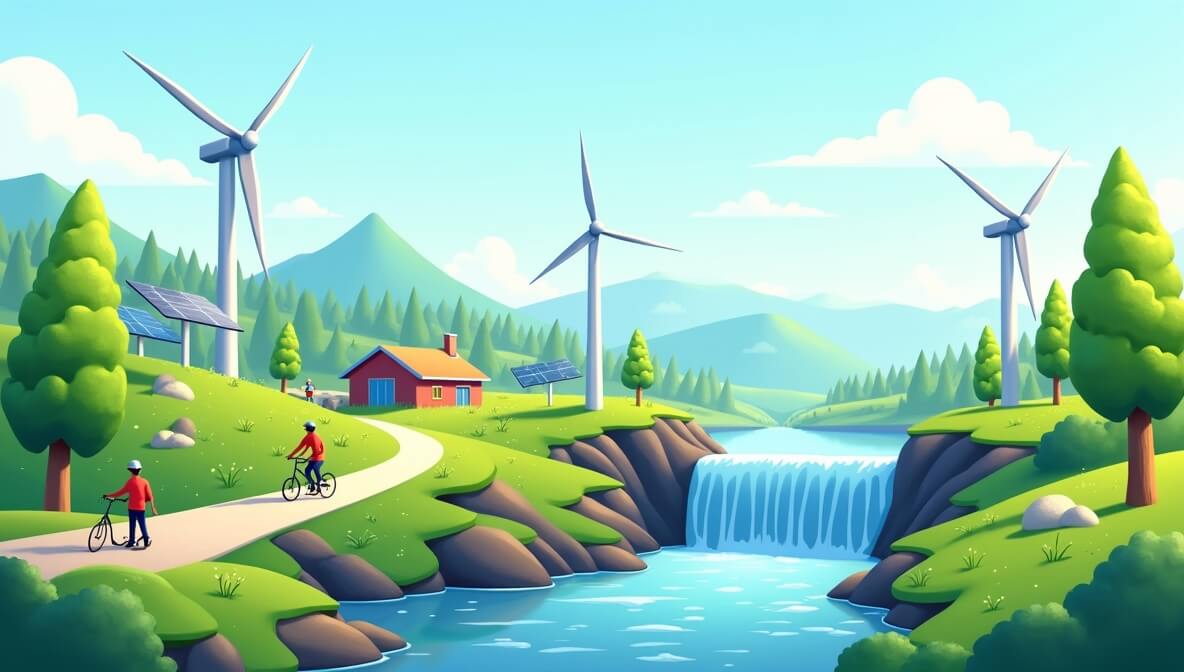
We are living through one of the most consequential technological and economic transitions in human history. The energy systems that powered industrial civilization for two centuries — built on coal, oil, and natural gas extracted from the earth at enormous environmental cost — are being replaced with systems that harvest energy from the sun, the wind, the movement of water, the heat of the earth, and the biological processes of living matter. This transition is happening at a pace and scale that would have seemed impossible to predict even a generation ago, driven by a convergence of technological innovation, falling costs, policy commitment, and the increasingly undeniable reality of what continued fossil fuel dependence is doing to the planet.
Renewable energy is no longer a niche concern for environmental activists or a speculative bet on unproven technology. It is the fastest-growing energy sector in the world. Solar and wind power are now the cheapest sources of new electricity generation in most of the world's major markets. Every year, more renewable capacity is installed globally than all fossil fuel and nuclear capacity combined. More than one billion people have gained access to electricity through renewable energy systems since 2010. And the economic, health, and environmental benefits of the transition are becoming clearer and better-documented with each passing year.
But the transition is also far from complete, and the challenges that remain — in energy storage, grid infrastructure, financing, policy design, and equitable access — are substantial. Understanding renewable energy fully means understanding not just its extraordinary promise but the genuine complexity of delivering on that promise at the speed and scale that the climate crisis demands.
This comprehensive guide examines every dimension of the renewable energy transition: why it is environmentally and morally urgent, what economic and social benefits it delivers, how individuals and households can contribute, what the global perspective reveals, what the real challenges are and how innovation is addressing them, and what the path forward looks like for communities, nations, and the planet.
Why Renewable Energy Matters: The Environmental Imperative
The most fundamental argument for renewable energy is the most urgent: the continued burning of fossil fuels is driving climate change at a pace and scale that threatens the stability of the natural systems on which all human civilization depends. This is not a contested scientific claim. It is the overwhelming consensus of the global scientific community, supported by decades of increasingly precise measurement and modelling, and increasingly visible in the physical world through rising sea levels, intensifying extreme weather events, ecosystem disruption, and the accelerating loss of biodiversity.
The Fossil Fuel Legacy
- The atmospheric concentration of carbon dioxide — the primary greenhouse gas driving climate change — has risen from approximately 280 parts per million in the pre-industrial era to over 420 parts per million today. This increase is directly attributable to the burning of fossil fuels and the clearing of forests, and it is driving the warming of the Earth's average surface temperature that is the root cause of the cascade of environmental changes now underway.
- The energy sector is the single largest source of global greenhouse gas emissions, responsible for approximately three-quarters of total emissions when electricity and heat production, transportation, and industrial processes are combined. Transitioning this sector from fossil fuels to renewable sources is therefore the single most impactful action available to humanity in addressing climate change — and the speed at which that transition happens will largely determine the severity of climate impacts over the remainder of this century.
- Beyond greenhouse gas emissions, fossil fuel energy production generates a range of local and regional environmental harms that are less discussed but no less consequential. Air pollution from coal-fired power plants is responsible for millions of premature deaths globally each year. Oil extraction and transport contaminate soils, groundwater, and marine environments. Coal mining destroys landscapes and generates toxic waste streams. The environmental damage of fossil fuel systems extends far beyond the atmosphere into every ecosystem they touch — including the ocean ecosystems that are most visibly threatened by the intersection of climate change and pollution.
- The relationship between energy systems, pollution, and environmental degradation is explored in depth in The Impact of Plastic Pollution on Our Oceans: A Visual Guide & The Science of Recycling — which situates plastic pollution within the broader context of the fossil fuel economy that produces it, and examines how sustainable practices in both energy production and materials use are essential to protecting the ocean ecosystems that regulate the Earth's climate and support the food security of billions of people. The connections between energy choices, material flows, and environmental outcomes are more direct and more consequential than most people realize.
The Environmental Benefits of Renewable Energy
- Against this backdrop of fossil fuel damage, the environmental benefits of renewable energy are transformative. Solar, wind, hydroelectric, geothermal, and bioenergy systems produce electricity with minimal to zero direct greenhouse gas emissions during operation. The lifecycle emissions of renewable energy systems — including the energy and materials required for manufacturing, installation, and eventual decommissioning — are dramatically lower than those of fossil fuel systems over their operational lifetimes.
- Solar photovoltaic systems produce electricity from sunlight through semiconductor materials that convert photons to electrons, with zero direct emissions during operation. Lifecycle emissions analyses consistently find that solar PV systems produce between 20 and 50 grams of CO₂ equivalent per kilowatt-hour of electricity generated — compared to 800 to 1,000 grams per kilowatt-hour for coal-fired power plants.
- Wind turbines convert the kinetic energy of moving air into electricity through rotating blades connected to generators. Their lifecycle emissions — primarily from materials production and construction — are among the lowest of any energy source, typically between 7 and 15 grams of CO₂ equivalent per kilowatt-hour.
- Hydroelectric power, which generates electricity from the gravitational potential energy of water flowing from higher to lower elevations, is the largest source of renewable electricity globally, providing approximately 16% of world electricity. Its environmental profile is more complex than solar and wind — large dams can have significant ecological and social impacts — but run-of-river and small-scale hydro systems provide clean, reliable power with minimal environmental disruption.
- Geothermal energy taps the heat of the Earth's interior, providing continuous, baseload power that does not depend on weather conditions. Bioenergy — electricity and heat from the combustion or conversion of biological materials — is the most complex renewable source from a carbon accounting perspective, with outcomes ranging from genuinely low-carbon to effectively fossil-fuel-level depending on feedstock source and process efficiency.
- Together, these renewable sources represent a comprehensive portfolio of clean energy options capable of meeting the full range of electricity, heat, and transport needs that modern economies require — with a combined environmental benefit that is, by every meaningful measure, transformational compared to the fossil fuel systems they replace.
Economic and Social Impacts: The Prosperity Case for Clean Energy
The environmental argument for renewable energy is compelling and morally urgent. But the economic and social case is increasingly powerful in its own right — powerful enough that renewable energy adoption is now being driven as much by economic self-interest as by environmental commitment.
The Jobs Revolution
- Renewable energy is one of the world's fastest-growing employment sectors. According to the International Renewable Energy Agency (IRENA), the global renewable energy sector employed approximately 13.7 million people in 2022 — a figure that has grown consistently year over year and is projected to reach 38 million by 2030 under accelerated transition scenarios. These jobs span a wide range of skill levels and educational backgrounds: engineering and design, manufacturing and construction, installation and maintenance, project development and finance, policy and regulation, and research and development.
- Critically, many renewable energy jobs — particularly in installation, maintenance, and local project development — are inherently local. They cannot be outsourced to distant locations; they must be done where the energy systems are built and operated. This localization of employment has significant implications for communities that have historically depended on fossil fuel industries — coal mining towns, oil refinery communities, natural gas processing hubs — which face economic disruption as those industries decline. Well-designed renewable energy transitions can direct new clean energy employment to exactly these communities, providing economic continuity while decarbonizing the energy system.
Falling Costs and Economic Competitiveness
- One of the most remarkable stories of the past decade is the speed at which the costs of renewable energy technologies — particularly solar photovoltaic and wind — have fallen. The cost of utility-scale solar PV has fallen by more than 90% since 2010. Onshore wind costs have fallen by approximately 70% over the same period. These cost reductions are the result of manufacturing scale, technological learning, supply chain optimization, and the competitive dynamics of a rapidly growing global market.
- The result is that renewable energy has moved from being more expensive than fossil fuels in most markets to being cheaper — often dramatically cheaper — in most markets. New solar and wind capacity is now the lowest-cost source of new electricity generation in most of the world, including in countries that were previously assumed to be committed to fossil fuel energy for decades to come. This cost advantage is not dependent on subsidies or policy support — it is a structural feature of the mature renewable energy market, and it is likely to deepen as the technology continues to improve and scale.
Energy Access and Social Equity
- Perhaps the most compelling social impact of renewable energy — and the one most relevant to questions of global equity and development — is its potential to bring reliable electricity to the approximately 770 million people who still lack access to it, primarily in sub-Saharan Africa and South Asia.
- Decentralized renewable energy systems — solar home systems, mini-grids, and community-scale wind and hydro installations — can provide electricity to communities that are too remote or too dispersed to be economically served by centralized grid infrastructure, at costs that are falling rapidly. Electrification transforms community health, education, and economic opportunity: healthcare facilities can refrigerate vaccines and power medical equipment; schools can extend learning hours after dark; entrepreneurs can power productive activities that generate income and economic growth.
- The intersection of energy access, economic development, and environmental sustainability defines the renewable energy opportunity at the global level — and it is one where the interests of economic development and environmental protection, so often presented as conflicting, are genuinely aligned.
Energy Efficiency and Household Solutions: Individual Action at Scale
The renewable energy transition happens at every level simultaneously — from the largest utility-scale solar farms and offshore wind installations to the individual household decisions that collectively determine the demand that energy systems must serve. Individual and household action is not a substitute for systemic change, but it is a meaningful complement to it — and it is the domain where most people have the most direct and immediate agency.
The Case for Home Energy Efficiency
- Energy efficiency — using less energy to deliver the same services — is often described as the "first fuel" of the clean energy transition, because it reduces the total amount of energy that must be generated regardless of what source that energy comes from. A home that is well-insulated, uses efficient appliances, and manages its energy consumption intelligently requires less electricity to maintain comfort and function — which means fewer solar panels needed to power it on renewable energy, lower energy bills, and a smaller carbon footprint regardless of the electricity grid's energy mix.
- A systematic approach to household energy efficiency begins with understanding where energy is actually being used and where the greatest opportunities for improvement lie. Home energy audits — either professional assessments by a qualified energy auditor or structured self-assessments using available tools and resources — identify the specific opportunities for improvement in any given home's building envelope, heating and cooling systems, water heating, lighting, and appliances.
- How to Conduct a Home Energy Audit & Simple Ways to Reduce Your Carbon Footprint at Home provides a comprehensive, step-by-step guide to conducting a home energy audit and acting on its findings — covering everything from assessing insulation levels and identifying air leaks to evaluating heating and cooling system efficiency and identifying the appliance upgrades that deliver the greatest energy savings. For any household serious about reducing its energy consumption and carbon footprint, this resource is the practical starting point that transforms general intention into specific, prioritized action.
Smart Home Technology and Behavioral Change
- Beyond structural efficiency improvements, smart home technology — intelligent thermostats, automated lighting systems, energy monitoring devices, and demand response systems that shift energy use to lower-carbon, lower-cost time periods — provides powerful tools for managing household energy consumption with minimal friction.
- Smart thermostats — devices that learn household occupancy patterns and optimize heating and cooling schedules automatically — can reduce HVAC energy consumption by 10-15% annually with no loss of comfort. Smart lighting systems that adjust automatically based on occupancy and natural light levels eliminate the waste of lighting empty rooms or maintaining artificial lighting when daylight is sufficient. Whole-home energy monitoring systems that provide real-time visibility of electricity consumption by circuit or appliance give households the information they need to make informed decisions about energy use and identify unexpected consumption patterns.
- Behavioral changes — the conscious decisions to reduce energy waste in daily habits — complement technology investments significantly. Reducing water heating demand by lowering the thermostat setting and using cold water for laundry, switching to LED lighting throughout the home, unplugging electronics and chargers when not in use, and optimizing the timing of high-demand appliance use all contribute to measurable reductions in household energy consumption that add up substantially over time.
- Outdoor water and energy management is equally important. Gardens and outdoor spaces represent significant water and energy consumption opportunities that many households overlook. How to Reduce Your Water Usage at Home & How to Have an Eco-Friendly Garden provides practical, evidence-based guidance on reducing outdoor water consumption — through efficient irrigation systems, drought-tolerant native planting, rainwater collection, and garden design principles that minimize water demand — while creating outdoor spaces that support biodiversity and environmental health. The water-energy nexus is significant: water treatment, pumping, and heating together account for a substantial portion of household energy consumption, making water efficiency a meaningful contributor to overall energy reduction.
Household Renewable Energy Generation
- For households with suitable roof space and solar resource, installing photovoltaic solar panels represents the most direct form of participation in the renewable energy transition — generating clean electricity at the point of use, reducing or eliminating electricity bills, and in many cases selling surplus generation back to the grid. The cost of residential solar installations has fallen dramatically over the past decade and continues to decline, making solar economically viable for a growing range of household types and financial situations.
- Battery storage systems — which allow households to store solar energy generated during the day for use during the evening, overnight, and during grid outages — are the natural complement to residential solar, and their costs are declining at a pace comparable to solar panels. Households with solar and battery storage achieve a level of energy independence that provides both economic and practical resilience — insulation from electricity price volatility, protection against grid outages, and the satisfaction of genuine energy self-sufficiency.
The Global Perspective: Renewable Energy as a Development Imperative
The renewable energy transition is not only a story about wealthy nations decarbonizing mature energy systems. It is equally a story about developing nations building the energy infrastructure that supports economic development and improved quality of life — and doing so in a way that avoids locking in the fossil fuel dependence that created the climate crisis in the first place.
Water, Food, and Energy Security
- The connections between energy, water, and food security are among the most important and least appreciated dimensions of the renewable energy transition. Agriculture — the foundation of food security for the world's population — is one of the largest consumers of energy and water on the planet. Irrigation systems that pump water to crops consume enormous quantities of electricity; food processing, refrigeration, and transport add further energy demand; and the climate impacts of fossil fuel-driven energy systems directly threaten agricultural productivity through drought, heat stress, and extreme weather events.
- Clean energy that powers agricultural systems sustainably — solar-powered irrigation pumps, renewable energy-powered cold chains for food preservation, clean energy for food processing — directly supports food security in regions where agricultural productivity is most vulnerable to climate disruption. Water Scarcity: A Growing Global Crisis & The Importance of Sustainable Agriculture examines this critical nexus in depth — exploring how water scarcity, driven partly by climate change and partly by unsustainable agricultural and energy practices, threatens food security for billions of people, and how sustainable agriculture and clean energy together provide the most viable pathway to a future where both water and food are available to all. For anyone seeking to understand the global stakes of the renewable energy transition beyond the carbon numbers, this resource is essential context.
Climate Adaptation and Community Resilience
- For communities most vulnerable to climate impacts — coastal communities facing sea-level rise and storm surge, drought-prone agricultural regions, small island nations whose existence is threatened by rising seas, and urban heat islands where temperature extremes already threaten public health — the renewable energy transition is as much about adaptation as mitigation. Decentralized renewable energy systems that are not dependent on centralized grid infrastructure provide resilience against the grid disruptions that extreme weather events increasingly cause. Community microgrids that can operate independently during emergencies provide the electricity access that is essential for disaster response, healthcare, and communication when conventional grid infrastructure has failed.
The United Nations Sustainable Development Goals
- The United Nations Sustainable Development Goals (SDGs) provide the most comprehensive international framework for understanding the role of renewable energy in global development. SDG 7 — Affordable and Clean Energy — specifically commits the international community to ensuring universal access to affordable, reliable, sustainable, and modern energy by 2030. But the clean energy transition is relevant to many other SDGs beyond Goal 7: it is central to SDG 13 (Climate Action), SDG 3 (Good Health and Well-Being, through reduced air pollution), SDG 8 (Decent Work and Economic Growth, through clean energy employment), SDG 11 (Sustainable Cities and Communities, through clean urban energy systems), and SDG 2 (Zero Hunger, through clean energy for sustainable agriculture).
- Understanding renewable energy's role in the global development agenda means understanding it not as a single-issue environmental concern but as a cross-cutting enabler of human well-being across multiple dimensions of the sustainable development framework.
Challenges and Solutions: The Real Work of the Transition
The case for renewable energy is compelling across environmental, economic, social, and development dimensions. But the transition faces genuine challenges that require honest acknowledgment and systematic innovation to overcome.
The Cost and Financing Challenge
- Despite dramatic cost reductions, the upfront capital costs of renewable energy systems — whether utility-scale solar farms, community wind projects, or residential solar installations — remain a barrier for many individuals, communities, and nations. The economics of renewable energy are typically characterized by high initial investment followed by low ongoing costs — the reverse of fossil fuel systems, which have lower capital costs but ongoing fuel expenditure throughout their operational lives.
- This capital intensity creates financing challenges, particularly for lower-income households that cannot access the financing needed for residential solar, for developing nations with limited access to international capital markets, and for communities that lack the creditworthiness or institutional capacity to develop renewable energy projects independently. Addressing these financing barriers requires a combination of government financing support, international development finance, innovative financing models such as power purchase agreements and community ownership structures, and the continued cost reductions that make smaller financing requirements achievable.
Energy Storage and Grid Integration
- The intermittency of solar and wind power — which generate electricity only when the sun is shining and the wind is blowing — is one of the most frequently cited challenges of the renewable energy transition. Unlike a coal or gas plant, which can generate electricity on demand regardless of weather conditions, solar and wind generation varies with atmospheric conditions in ways that must be managed carefully to maintain grid stability.
- The solutions to intermittency are multiple and complementary. Battery storage systems — both at utility scale and at the household and community level — store renewable electricity when generation exceeds demand and release it when demand exceeds generation. Pumped hydro storage — which pumps water uphill when electricity is abundant and generates power by releasing it downhill when electricity is needed — is the most widely deployed large-scale energy storage technology globally. Demand response systems — which shift electricity consumption to times of high renewable generation through price signals or automated controls — reduce the peak demand that must be met by firm generation capacity. Long-distance transmission infrastructure — which allows renewable electricity to be moved from where it is generated to where it is needed — enables the geographic diversity that smooths out regional generation variability.
- Together, these solutions make a fully renewable electricity system not only technically feasible but increasingly economically competitive with fossil fuel systems that maintain their own reliability through the continued purchase of fuel.
Infrastructure and Policy
- Updating the electricity grid infrastructure that was designed for centralized, fossil fuel-based generation to handle the distributed, variable generation characteristics of renewable energy is one of the largest infrastructure challenges of the transition. Smart grid technologies — advanced metering, automated switching, real-time monitoring, and demand response coordination — are essential components of the upgraded infrastructure that a high-renewable energy system requires.
- Policy design is equally critical. The speed and equity of the renewable energy transition are heavily shaped by the policy environments in which it unfolds — by the presence or absence of carbon pricing that reflects the true cost of fossil fuel emissions, by the design of electricity market rules that adequately compensate renewable generators, by building codes and appliance standards that drive efficiency, by planning and permitting processes that enable or impede renewable project development, and by the international policy frameworks that determine the flow of clean energy finance and technology to developing nations.
- The transition cannot happen at the necessary speed without policy frameworks that align market incentives with the public interest in decarbonization — and building those frameworks requires sustained political will, informed public engagement, and the kind of evidence-based policy advocacy that bridges the gap between the scientific consensus on climate and the political decisions that determine the speed of the energy transition.
What You Can Do: From Household to Community to Policy
Every dimension of the renewable energy transition — from the largest infrastructure investment decisions to the smallest household choices — offers opportunities for individual engagement and contribution. Here is a framework for thinking about where your energy and attention can be most impactfully directed.
At Home: Efficiency First, Then Generation
- The most immediate and controllable renewable energy actions are at the household level. Begin with efficiency — reducing the energy demand of your home through better insulation, efficient appliances, smart controls, and conscious behavioral choices. Then, if your circumstances allow, invest in renewable generation — solar panels, a heat pump, an electric vehicle — that reduces or eliminates your dependence on fossil fuel-based energy.
- For practical, comprehensive guidance on reducing household energy and carbon footprint through both efficiency improvements and behavior change, Simple Ways to Reduce Your Carbon Footprint at Home & The Impact of Plastic Pollution on Our Oceans provides an accessible, evidence-based guide that connects individual household actions to their broader environmental impact — helping you understand not just what to do but why it matters and how it connects to the larger systems of environmental challenge and opportunity.
In Your Community: Collective Action and Local Advocacy
- Community-level action amplifies individual impact. Community solar programs — which allow households without suitable roofs or financial resources for individual solar installations to participate in shared solar generation — are expanding in many regions and represent one of the most accessible pathways to renewable energy participation for renters, apartment dwellers, and lower-income households. Community energy cooperatives that collectively own and operate renewable energy projects build local economic value while accelerating the transition.
- Local advocacy — engaging with planning processes for renewable energy projects in your community, supporting policies that accelerate the transition, and communicating your priorities to local and regional elected officials — is one of the most impactful contributions a citizen can make to the speed and equity of the renewable energy transition.
At the Policy Level: Advocacy for Systemic Change
- The structural changes that will determine the speed and equity of the renewable energy transition — carbon pricing, electricity market reform, building efficiency standards, clean energy finance for developing nations, international climate agreements — are determined through political processes that respond to organized citizen pressure. Supporting organizations that do effective policy advocacy on clean energy and climate, engaging in electoral processes with an understanding of candidates' clean energy commitments, and building the public mandate for ambitious policy action are forms of contribution that extend far beyond the individual household.
Conclusion: A Transition Worth Every Effort
The renewable energy transition is the defining project of our era — the infrastructure transformation that will determine whether humanity manages the climate crisis or is overwhelmed by it, whether the prosperity of the 21st century is built on a sustainable foundation or on the continued depletion of a planet that cannot sustain it.
The good news — and it is genuinely good news — is that the transition is already underway, at a speed and scale that would have seemed impossible to predict even a decade ago. The technologies are proven and improving. The economics are compelling and strengthening. The public understanding and commitment is growing. The policy frameworks, while still inadequate in many contexts, are developing.
What the transition needs — what it has always needed — is the collective determination to see it through to completion, at the speed the climate demands, with the equity that justice requires. That determination begins with understanding: understanding what renewable energy offers, what it requires, and what each of us can contribute to making it happen.
The future is clean. The future is renewable. And the work of building it belongs to all of us.
Explore Further: