
AI tools for productivity for retail stores in 2026

April 14, 2026

By RocketPages

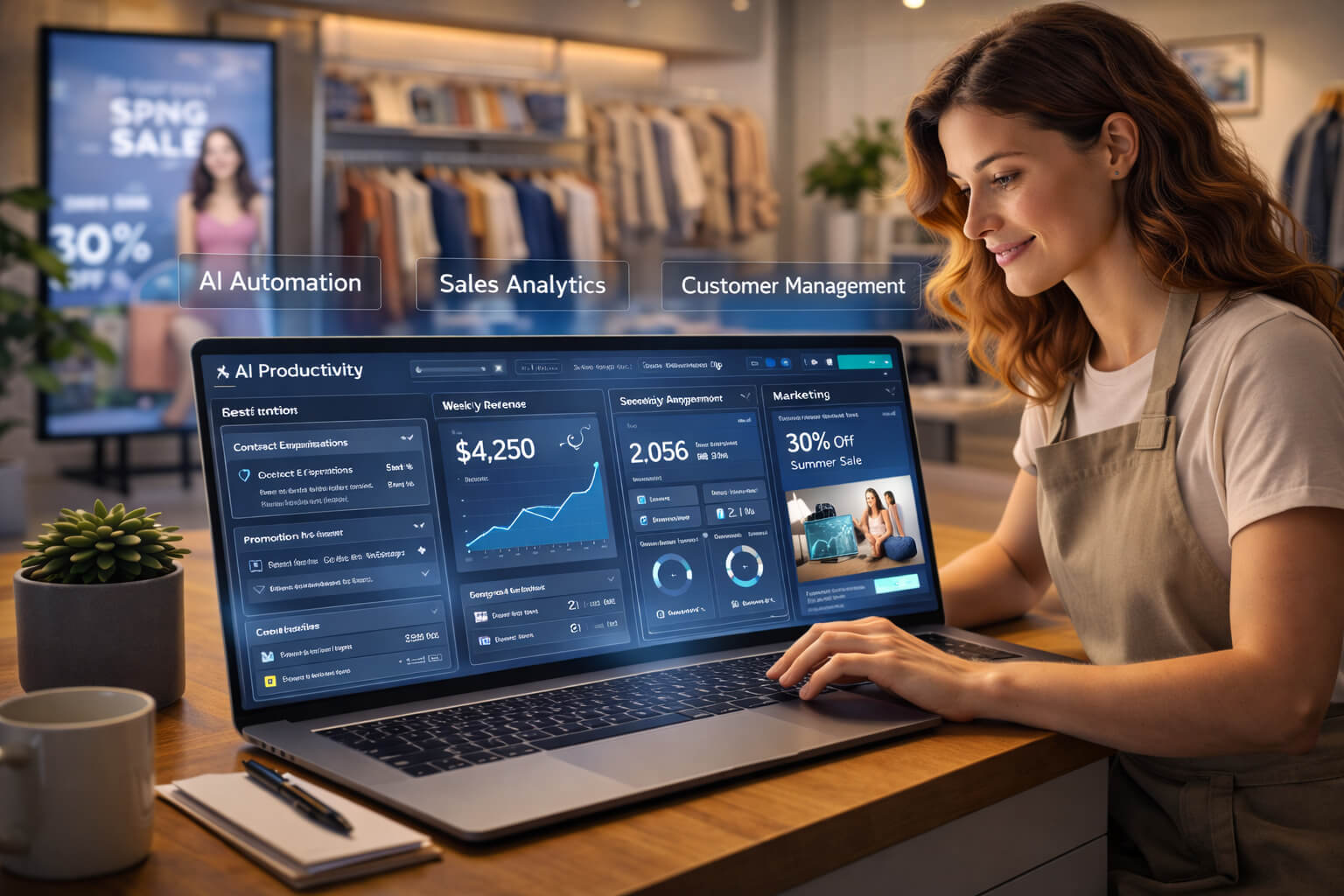
Retail store owner using AI tools to improve productivity and business operations

Retail in 2026 is no longer defined by effort, hours, or manpower.


It is defined by something far more powerful: how much of your business runs without your direct involvement


This is the real shift happening right now.


Stores are moving from:


  • Manual execution → to automated systems
  • Reactive decisions → to AI-supported planning
  • Task-heavy operations → to workflow-driven businesses


And the most important part? This transformation is now accessible to even small retail stores, not just large enterprises.


But the real advantage is not “using AI tools.”


It is learning how to build a connected productivity system.


The New Reality of Retail Productivity (2026 Mindset Shift)


Old retail productivity looked like:


  • Faster staff
  • Longer working hours
  • More manual coordination


Modern AI-powered productivity looks like:


“How many decisions can I remove from daily operations?”


This changes everything.


Because in retail, most inefficiency does not come from hard work—it comes from:


  • Repeated decisions
  • Repetitive communication
  • Manual coordination
  • Delayed responses


AI removes these bottlenecks by turning actions into systems instead of effort.


How a Modern AI Retail System Actually Works (Simple but Powerful Model)


Every high-productivity retail store using AI follows a hidden structure:


1. Input Layer (Data Collection)


  • Sales data
  • Customer messages
  • Inventory updates
  • Marketing performance


2. Intelligence Layer (AI Understanding)


  • Identifies patterns
  • Detects demand changes
  • Suggests actions
  • Generates content


3. Execution Layer (Automation + Tools)


  • Sends messages
  • Creates content
  • Updates systems
  • Notifies teams


When these three layers work together, productivity becomes exponential.


1. ChatGPT — From Task Tool to Business Thinking System


Most beginners use ChatGPT for writing.


But in real retail productivity systems, it becomes something deeper: A real-time decision support engine


Advanced retail usage patterns:


Instead of asking:


  • “Write a product description”


Store owners ask:


  • “What products should I promote this week based on seasonal demand?”


Instead of:


  • “Write a reply to customer”


They ask:


  • “How should I respond to maintain customer retention and trust?”


Productivity transformation:


ChatGPT reduces:


  • Thinking time
  • Writing time
  • Planning time


But more importantly: It reduces hesitation in decision-making


That is where real productivity gains happen.


2. Canva AI — Turning Marketing Into a Continuous Output Engine


Traditional retail marketing is:


  • Slow
  • Planned
  • Occasional


AI-driven marketing becomes:


  • Continuous
  • Fast
  • Always active


Real operational workflow:


Instead of:


“We need a campaign for this month”


You now run:


  • Daily posts
  • Weekly offers
  • Seasonal variations
  • Flash sale creatives


All generated in minutes.


Deeper impact:


Canva AI does not just save time—it changes behavior: Marketing becomes habitual, not project-based


That shift alone increases brand visibility significantly.


3. Zapier — Building a Self-Running Retail Backbone


Zapier is where retail becomes operationally independent.


Instead of humans:


  • Copying data
  • Sending reminders
  • Tracking updates


You build trigger-based systems


Real retail automation ecosystem:


  • Order placed → CRM updated → invoice sent
  • Customer inquiry → auto-response → ticket created
  • Stock low → notification → reorder alert


Advanced insight:


Once set up properly: Your store continues operating even when you are not actively working


This is the foundation of scalable retail.


4. Google Gemini — Turning Information Into Instant Clarity


Retailers often have data—but no clarity.


Google Gemini solves this by converting raw information into actionable understanding.


Real productivity scenarios:


  • “Summarize this week’s sales performance”
  • “Highlight top-performing products”
  • “Rewrite this report into key insights”


What changes operationally:


Instead of analyzing:


  • You receive insights directly


Instead of reading long reports:


  • You get summaries


This compresses decision-making cycles dramatically


5. HubSpot CRM — Turning Customers Into Predictable Revenue Systems


Without CRM:


  • Customers are random
  • Follow-ups are inconsistent
  • Sales depend on memory


With CRM:


  • Customers become structured data
  • Follow-ups become automatic
  • Sales become predictable


Advanced retail behavior shift:


Instead of asking:


“Did this customer come back?”


You ask:


“When should I re-engage this customer?”


Productivity gain:


  • Less lost customers
  • More repeat sales
  • Better targeting


6. Runway ML — Scaling Content Production Without Limits


Video content used to be:


  • Expensive
  • Time-consuming
  • Skill-heavy


Now it is:


  • Fast
  • Iterative
  • Continuous


Real retail shift:


Instead of:


  • One polished video per campaign


Now:


  • Multiple short videos weekly


Productivity advantage:


More content → more engagement → more conversions


Deep Retail Insight: Productivity Is a System, Not a Skill


Most retailers think productivity is personal:


  • Work faster
  • Multitask better


But AI changes this completely.


Productivity is now system-based, not effort-based


If your system is strong:


  • Work becomes light
  • Output becomes consistent
  • Growth becomes predictable


The Hidden Truth: Productivity Without Visibility Creates No Growth


Even highly efficient stores fail when:


  • Customers cannot find them
  • Marketing is weak
  • Online presence is missing


Because: Productivity improves operations—but visibility creates revenue


Where High-Performance Retailers Actually Win


Successful retailers do not rely only on AI tools.


They build dual systems:


1. Internal system (efficiency)


  • ChatGPT
  • Canva AI
  • Zapier
  • Gemini
  • HubSpot


2. External system (growth)


They build presence through websites like: build a business website without coding & why RocketPages is the best AI website builder.


Combined effect:


  • Internal AI → reduces effort
  • External website → increases demand


This is the complete modern retail growth loop


Advanced Productivity Framework (How Experts Think)


Instead of asking:


“Which AI tool should I use?”


Experts ask:


Step 1: Where is time being wasted?


  • Writing
  • Designing
  • Repeating tasks
  • Managing customers


Step 2: What can be eliminated entirely?


  • Manual reporting
  • Repetitive replies
  • Data entry


Step 3: What should be automated?


  • Notifications
  • Follow-ups
  • Content creation


Step 4: What should remain human?


  • Strategy
  • Branding
  • Decision-making


This separation is what creates scalable retail systems


Final Reality: AI Is an Amplifier, Not a Fix


AI will:


  • Multiply good systems
  • Expose weak systems
  • Scale whatever already exists


It will not:


  • Fix poor positioning
  • Create demand
  • Replace strategy


Final Thoughts


AI productivity tools are transforming retail into a system-first industry.


The winning retailers in 2026 are not:


  • The busiest
  • The most technical
  • The most experienced


They are the ones who:


  • Remove unnecessary work
  • Automate repetitive systems
  • Combine AI with strong visibility


Because modern productivity is not about doing more.


It is about designing a business that needs less effort to grow more.

Recent Articles

Stay up to date with the latest tips, expert insights, product reviews, and step-by-step guides to help you grow, create, and succeed—no matter your industry or passion.